




Abstract
Poverty and inequality represent major policy syndromes that are relevant in the achievement of most United Nations’ Sustainable Development Goals (SDGs) in sub-Saharan Africa (SSA), while economic growth is also essential for the achievement of attendant SDGs. This study extends existing literature by assessing the conditional influence of poverty, income inequality, and severity of poverty on economic growth. The focus is on 42 countries in SSA with data from 1980 to 2019. The Gini index is used to measure income inequality. Poverty is measured in terms of the poverty headcount ratio, while the severity of poverty is computed as the squared of the poverty gap index. The empirical evidence is based on quantile regressions to assess how income inequality and poverty dynamics affect economic growth throughout the conditional distribution of economic growth. Our main finding shows that the negative response of economic growth to poverty is a decreasing function of economic growth. In other words, the incidence of poverty in reducing economic growth decreases with increasing levels of economic growth. In two specifications, the effect of inequality is negative in bottom quantiles and positive in top quantiles of the conditional distribution of economic growth. Policy implications are discussed, especially as it pertains to (1) the relevance of poverty in mitigating economic growth in SSA contingent on initial levels of economic growth and (2) comparative incidences of poverty and inequality in affecting economic growth.
Introduction
The motivational elements of this study are premised on two fundamental factors in the extant policy and scholarly literature, notably, (1) the role of poverty in decreasing the much needed economic growth for Sustainable Development Goals (SDGs) and (2) the relevance of improving a debate in the extant literature on the growth, income, and poverty nexuses. 1 These two motivational elements are substantiated in the paragraphs that follow, in the same chronology in which they are highlighted.
First, economic growth is fundamental in the achievement of some SDGs, notably, the mitigation of the extreme poverty or SDG1. While income inequality and poverty are policy concerns in many regions of the world (Koengkan et al. 2022; Santiago et al. 2022), in the attendant literature, Ravallion (2013) has argued that the criticality of mitigating extreme poverty to a threshold of below 3 percent by 2030 is substantially contingent on countries in sub-Saharan Africa (SSA) experiencing the same economic growth levels of the 2000–2010 years, to 2030. Bicaba, Brixiova, and Ncube (2017) concluded that unless the concern of income inequality is addressed, the underlying extreme poverty target cannot be achieved by most countries in SSA by the year 2030. This study departs from the two perspectives in the literature by assessing the relevance of poverty, severity of poverty, and income inequality on economic growth in the SSA region.
Second, in the light of the above, this study contributes to the extant literature on nexuses between economic growth, income inequality, and poverty, which is critically engaged in section “Literature on Nexuses Between Poverty, Income Inequality and Economic Growth.” According to the attendant literature, despite the recent period of growth resurgence experienced by countries in the region, extreme poverty has been growing in SSA, not least because, inter alia, the fruits of economic prosperity are not evenly distributed across the population (Asongu and Kodila-Tedika 2017, 2018; Asongu and le Roux 2017, 2019; Asongu and Nting 2022; Chandy, Ledlie, and Penciakova 2013; Nwani and Osuji 2020; Ofori et al. 2021; Tchamyou 2020, 2021; Yoshida, Uematsu, and Sobrado 2014). In essence, as substantiated by Fosu (2010c, 2015), the response of poverty to economic growth is a decreasing function of inequality. The present research is premised as an extension of the underlying strand of literature on nexuses between economic growth, poverty, and income inequality within the specific remit of SSA. More specifically, this study extends conclusions from a previous strand of literature, notably, “The study finds that the responsiveness of poverty to income is a decreasing function of inequality” (Fosu 2010a:818); “The responsiveness of poverty to income is a decreasing function of inequality, and the inequality elasticity of poverty is actually larger than the income elasticity of poverty” (Fosu 2010b:1432); and “In general, high initial levels of inequality limit the effectiveness of growth in reducing poverty while growing inequality increases poverty directly for a given level of growth” (Fosu 2011:11). The corresponding research question this study aims to answer is the following: how does economic growth respond to poverty, income inequality, and the severity of poverty when existing levels of economic growth are taken in account in SSA? Our findings show that the negative response of economic growth to poverty is a decreasing function of economic growth. In other words, the incidence of poverty in reducing economic growth decreases with increasing levels of economic growth.
The closest study in the literature to this research is Asongu, Soumtang, and Edoh (2021b) which has examined how the dynamics of financial institutions (in terms of depth, efficiency, and access) influence poverty and its severity in 42 SSA countries for the period 1980–2019. Employing the quantile regressions approach, the findings show that financial institutions efficiency (depth) consistently mitigates poverty headcount (the severity of poverty), while financial institutions access decreases both the severity of poverty and poverty on a consistent basis, with the underlying decreasing tendency increasing with growing poverty levels in the top quantiles and throughout the severity of poverty’s conditional distribution. This study uses the same sample and periodicity as well as the empirical strategy in assessing how income inequality, poverty, and severity of poverty affect economic growth.
The rest of the study is organized in the following manner. The second section engages the extant literature, while the data and methodology are covered in the third section. The empirical results are discussed in the fourth section, while the fifth section concludes with implications and future research directions.
Literature on Nexuses Between Poverty, Income Inequality, and Economic Growth
Poverty and Economic Growth
In the extant literature on the nexus between poverty and economic growth, there is some consensus on the prospect that poverty is detrimental to long-run externalities of economic growth (Cerra, Lama, and Loayza 2021). López and Servén (2015) have focused on a panel of 85 countries for the period 1960–2000 to establish that a 10 percent increase in the rate of poverty decreases per capita economic prosperity by about 1 percent. In essence, when the rate of poverty increases, the rate of investment in nations characterized by low levels of financial development decreases. Evidence is also apparent that the negative incidence of poverty on economic prosperity is contingent on existing levels of poverty. Marrero and Servén (2018) have employed a panel of 158 countries for the period 1960–2010 to show that in countries in which poverty levels are below the median, economic growth is insignificantly affected by poverty. Conversely, in countries where existing levels of poverty are above the median, a 10 percent reduction in poverty headcount is linked to an increase in economic growth of about between 0.5 and 1.2 percent on an annual basis.
In another study, Ravallion (2012) focusing on 90 countries for the period 1991–2004, has established two distinctive features that are standing on the way toward convergence of the rates of poverty. This is against the backdrop of comparative evidence showing that despite the global tendency in poverty reduction, cross-country differences in poverty rates are not converging (Cerra et al. 2021). First, in accordance with López and Servén (2015), economic growth is reduced by poverty. Second, consistent with Cerra et al. (2021), when existing levels of poverty are high, the impact of economic growth in reducing poverty is dampened. Moreover, when the underlying two mechanisms are combined, poorest countries are not in an optimal position to reap from effective poverty reduction strategies.
Inequality and Economic Growth
Consistent with Cerra et al. (2021), the impact of income inequality on economic prosperity is contingent on economic sectors. To put this point in more perspective, Erman and te Kaat (2019) have assessed the incidence of income inequality on value-added growth in the industry for the period 1980–2012 in a panel of 86 countries consisting of 22 industries. The study established that the growth rate in industries that are capital and physical intensive is promoted by higher levels of income inequality, whereas such income inequality reduces the growth in industries in which there is an intensive employment of skilled labor. It follows that human capital stock that is lower is linked to income inequality and drives the corresponding negative incidence on economic growth. Galor and Moav (2004) at the country level have established theoretical predictions that are in line with the attendant findings.
Using the panel fixed-effects empirical strategy, Cingano (2014) shows that income inequality affects economic growth negatively in a panel of 30 OECD (Organisation for Economic Co-operation and Development) countries for the period 1970–2010. It is also found by Berg et al. (2018) that in a sample of developing and advanced countries, net inequality affects economic growth negatively. Moreover, moderation or redistribution through transfers and taxes affects economic growth insignificantly. According to Cerra et al. (2021), the panel evidence is also consistent on the position that the level of economic development substantially affects the income–growth nexus, especially when such economic growth dynamics are considered in the short-run versus long-run horizons. In another study, Brueckner and Lederman (2018) show that while income inequality could be favorable for growth that is transitional in poor countries, such income inequality becomes unfavorable to economic growth in countries in which average incomes are comparatively high.
As concerns the horizon of time, Halter, Oechslin, and Zweimüller (2014) show that income inequality is favorable to the performance of the economy in the short run. However, in the long run, the net incidence of the nexus becomes negative. According to the corresponding literature, the duration of spells of economic prosperity is mitigated by income inequality (see Berg and Ostry 2017; Berg, Ostry, and Zettelmeyer 2012), with a substantial proportion of the findings emanating from variations over time instead of cross-country variations. For example, it has been shown by Aiyar and Ebeke (2020) that the negative impact of income inequality on economic growth is substantially contingent on how intergenerational mobility plays out. In nations in which higher intergenerational mobility is apparent, the negative effect of income inequality on economic growth can be reversed easily, not least because the poor are provided with enhanced avenues by which to ameliorate their standards of living. Moreover, Kraay (2015), while considering the absence of robust findings on the nexus between economic growth and income inequality in panel studies, beyond reflecting concerns of specification, also provides insights into issues surrounding weak instruments and endogeneity.
Data and Methodology
Data
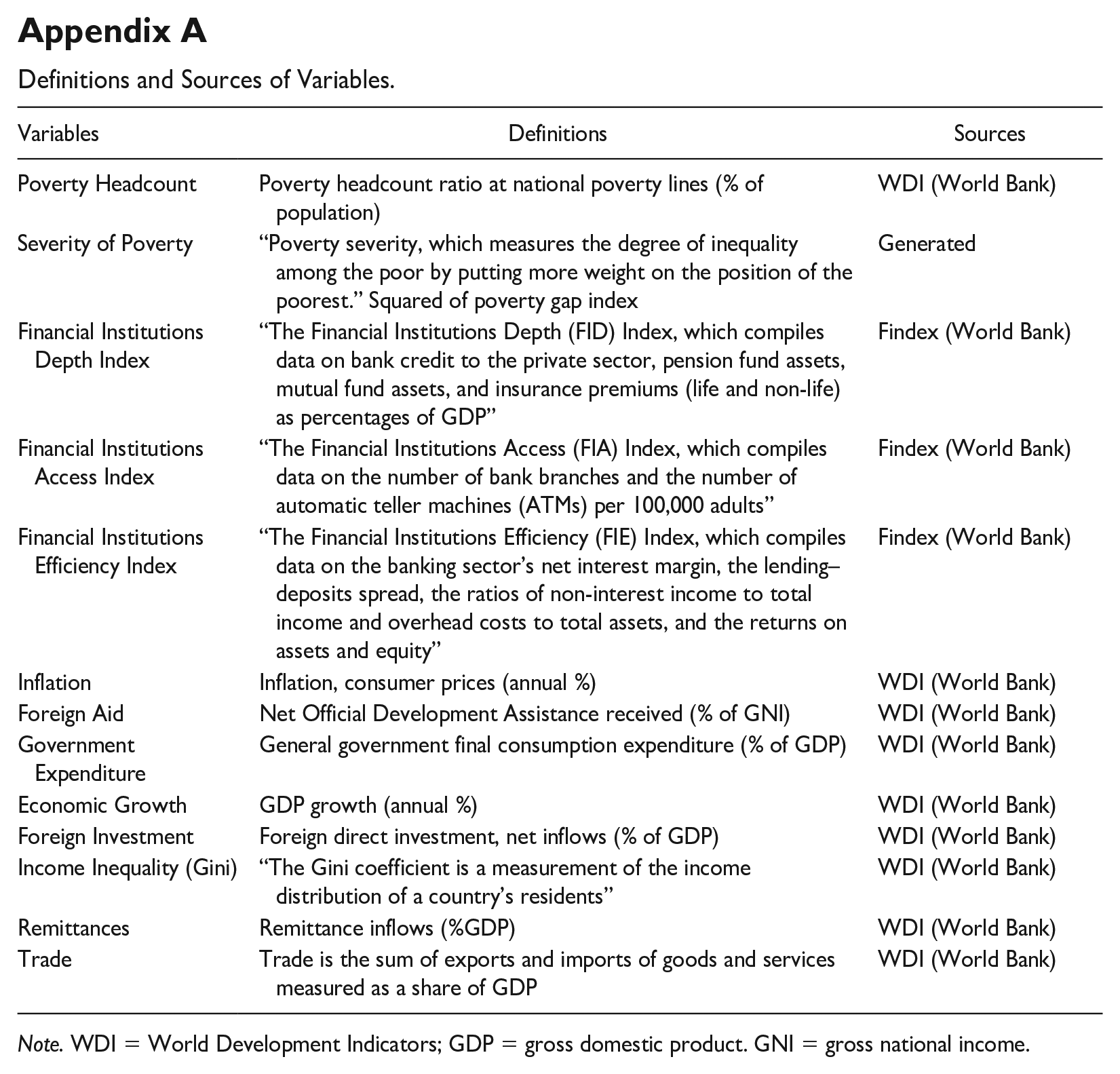
The study is based on 42 countries in SSA, and the data cover the period 1980–2019. The number of countries and corresponding periodicity are constrained by availability of data at the time of the study. 2 It is also important to note that an unbalanced panel data set is used given the fact that it is difficult to obtain the data on income inequality and poverty for all the countries included in the study. As shown in Appendix A, two main sources are the origin of the data, notably, (1) the Global Findex Database from the World Bank and (2) World Development Indicators (WDI) of the World Bank. Consistent with the motivation of the study, the outcome variable is economic prosperity proxied by gross domestic product (GDP) growth. Concerning the two independent variables of interest, income inequality is measured with the Gini index, in accordance with contemporary inclusive development literature (Tchamyou 2019; Tchamyou, Erreygers, and Cassimon 2019), while poverty is measured in accordance with the study in the literature closest to the present research (Asongu, Soumtang, and Edoh 2021b): (1) the poverty headcount ratio at national poverty lines (percentage of population) is used to proxy for poverty, and (2) the severity of poverty is generated as the squared of the poverty gap index.
The following control variables are also selected in view of accounting for variable omission bias, namely, financial institutions depth, financial institutions efficiency, financial institutions access, inflation, development assistance, government expenditure, foreign direct investment (FDI), remittances, and trade openness. The choice of these variables is consistent with contemporary economic growth literature on SSA (Nyasha, Odhiambo, and Asongu 2021; V. S. Tchamyou, Asongu, and Odhiambo 2019). Concerning the expected signs, with the exception of inflation that is anticipated to have a negative incidence on economic growth, the other determinants of economic growth are expected to have a positive influence on the economic prosperity outcome variable.
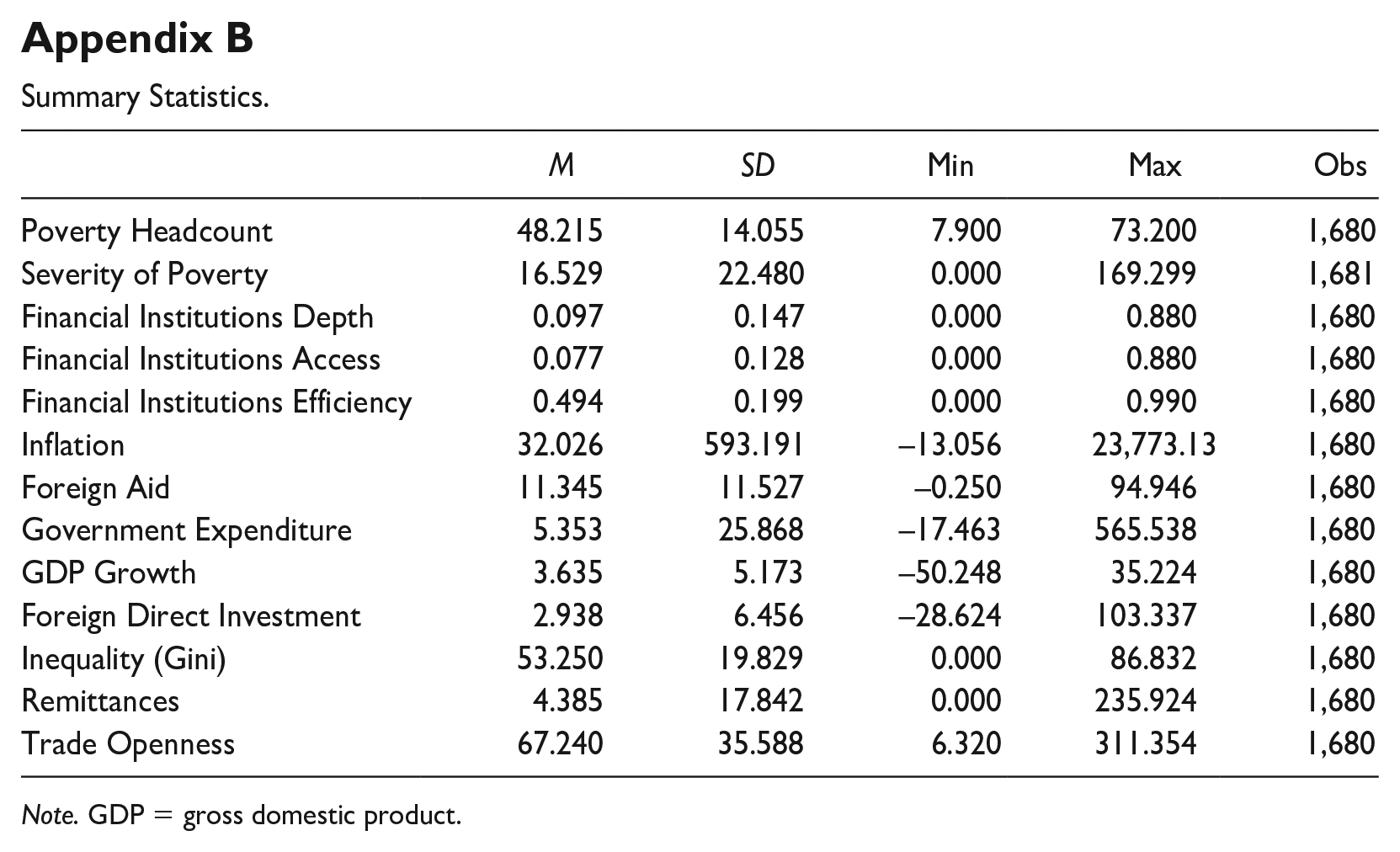
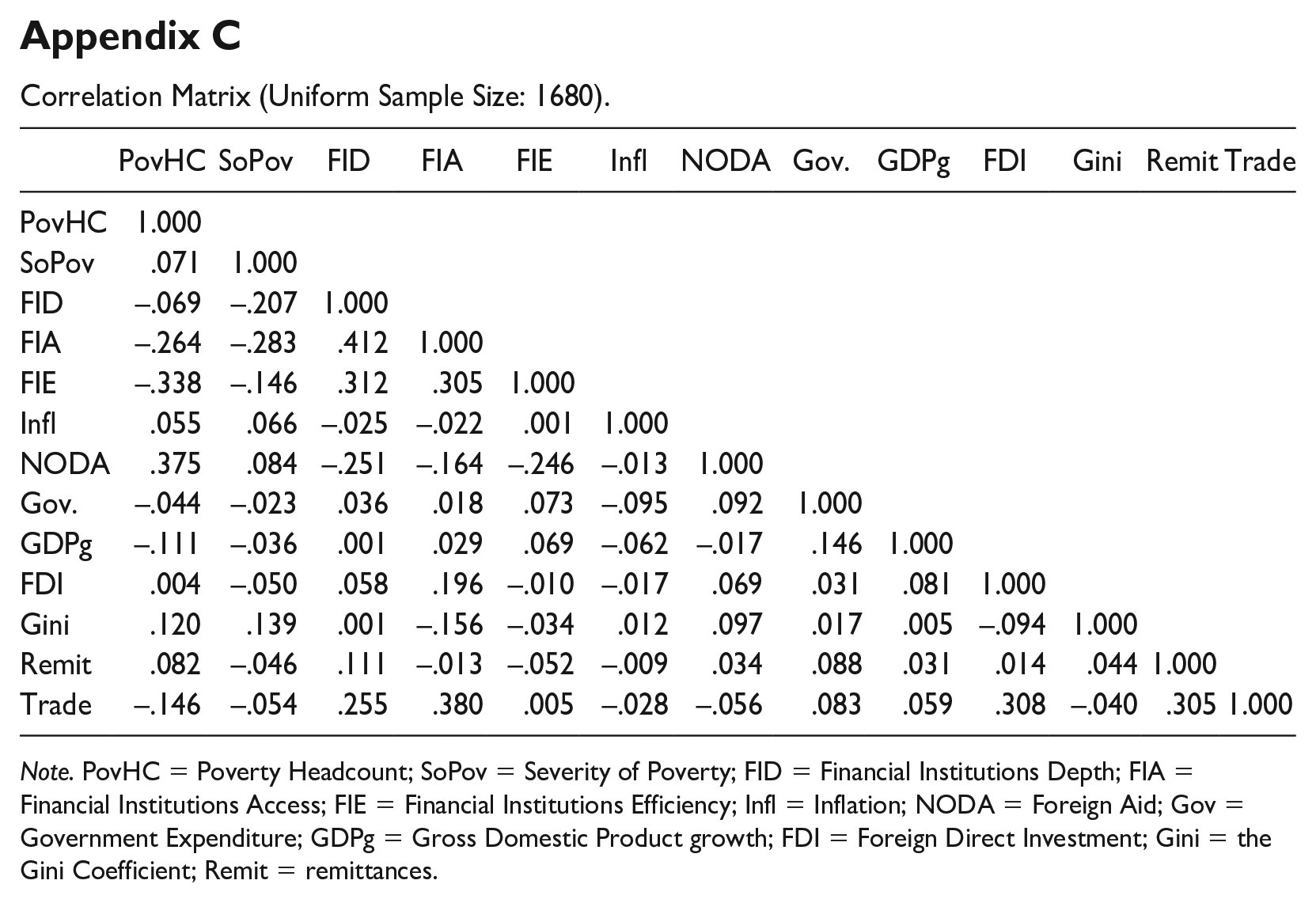
The definitions and sources of the variables are provided in Appendix A, while the corresponding summary statistics is disclosed in Appendix B. The correlation matrix that is provided in Appendix C helps the study to avoid concerns of multicollinearity that can affect the signs of estimated coefficients, in accordance with contemporary literature on the importance of addressing concerns surrounding multicollinearity to establish findings with less misplaced policy implications. In line with Asongu, Biekpe, and Cassimon (2020, 2021), a .600 threshold is used to assess the corresponding concerns of multicollinearity. In essence, corresponding specifications in section “Empirical Results” are not affected by any concern of multicollinearity because the correlations in the attendant specifications do not exceed the .600 threshold.
Methodology
Consistent with the elements of the motivation, the empirical strategy adopted in this study is the quantile regression (QR) methodology that is tailored to assess how income inequality, poverty, and the severity of poverty affect economic growth throughout the conditional distribution of economic growth. Accordingly, as established in the attendant QR-centric literature, such an estimation approach enables the articulation of the determinants with particular emphasis on low, intermediate, and high initial levels of the outcome variables (Billger and Goel 2009; S. A. Tchamyou and Asongu 2017). It is important to note that other estimation approaches such as fixed-effects regressions, ordinary least-squares (OLS), and generalized method of moments, inter alia, are based on mean values of the outcome variable and hence are inappropriate to address the objective of the study, not least, because the attendant objective can only be assessed by an empirical strategy that assesses the investigated nexuses throughout the conditional distribution of the outcome variable. One main limitation of the QR technique is that it can only be employed to obtain global effects, and hence, country-specific studies are still worthwhile for country-specific policy implications. This avoids recommendations based on a blanket approach.
It is important to emphasize that compared with the OLS that is premised on the assumption of error terms that are normally distributed, the QR technique does not assume that the error terms are normally distributed. Moreover, with the QR approach, parameters are examined throughout the conditional distribution of the dependent variables (Asongu 2017; Koenker and Bassett 1978; Koenker and Hallock 2001). In essence, the

where
In the light of the above, the conditional quantile of economic growth or

where for the respective
Empirical Results
The empirical results are disclosed in Tables 1 and 2 in this section. While Table 1 shows nexuses between economic growth, income inequality, and poverty, Table 2 reflects linkages between economic growth, income inequality, and the severity of poverty. It is apparent from the disclosed findings that the choice of the QR empirical strategy is valid, not least, because when the estimated coefficients of the OLS regressions are compared with estimates from the conditional distribution of economic growth, the estimates are distinct in terms of significance, signs, and magnitude of estimated coefficients.
Growth, Inequality, and Poverty Headcount.
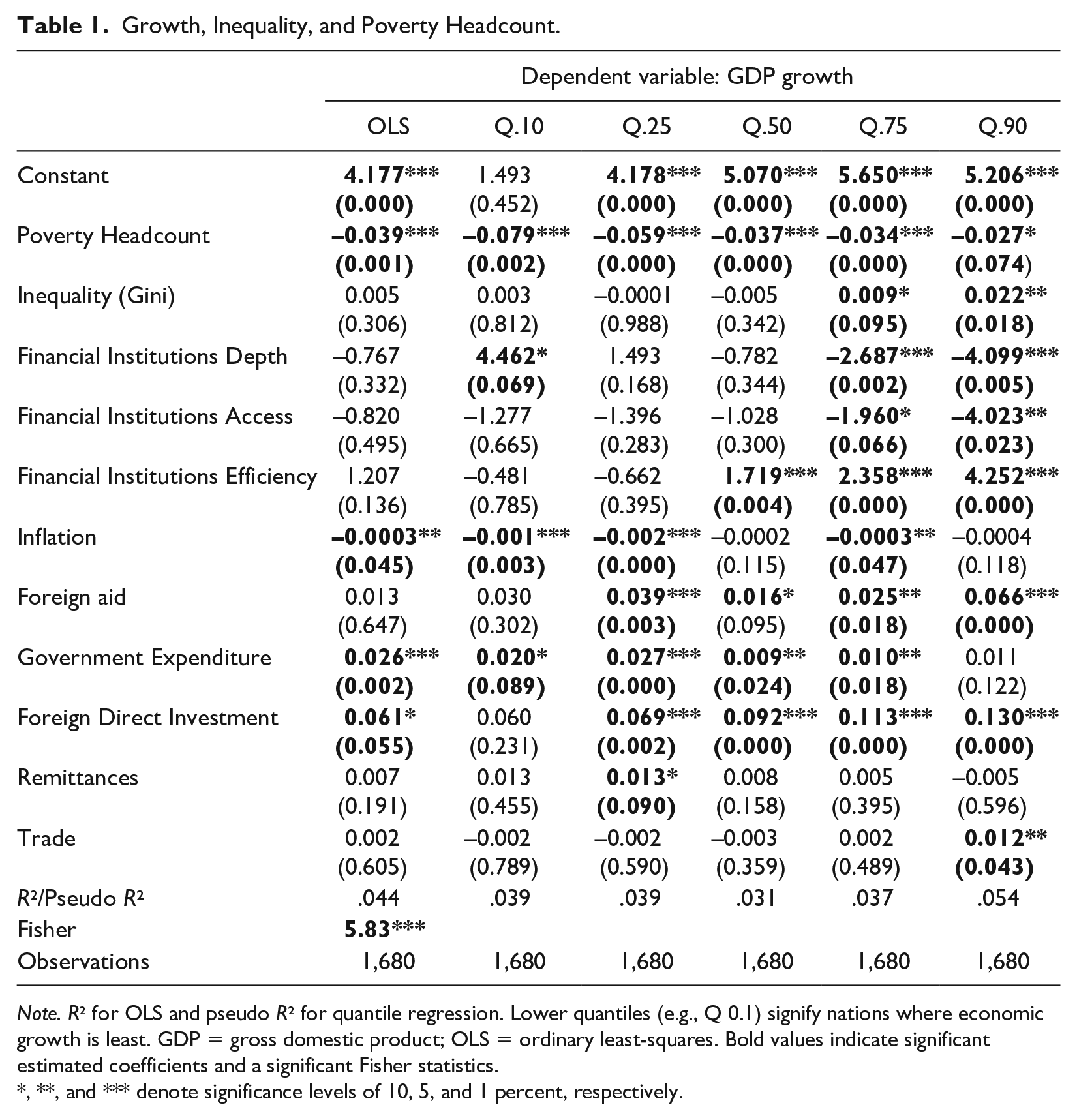
Note. R² for OLS and pseudo R² for quantile regression. Lower quantiles (e.g., Q 0.1) signify nations where economic growth is least. GDP = gross domestic product; OLS = ordinary least-squares. Bold values indicate significant estimated coefficients and a significant Fisher statistics.
, **, and *** denote significance levels of 10, 5, and 1 percent, respectively.
Growth, Inequality and Severity of Poverty.
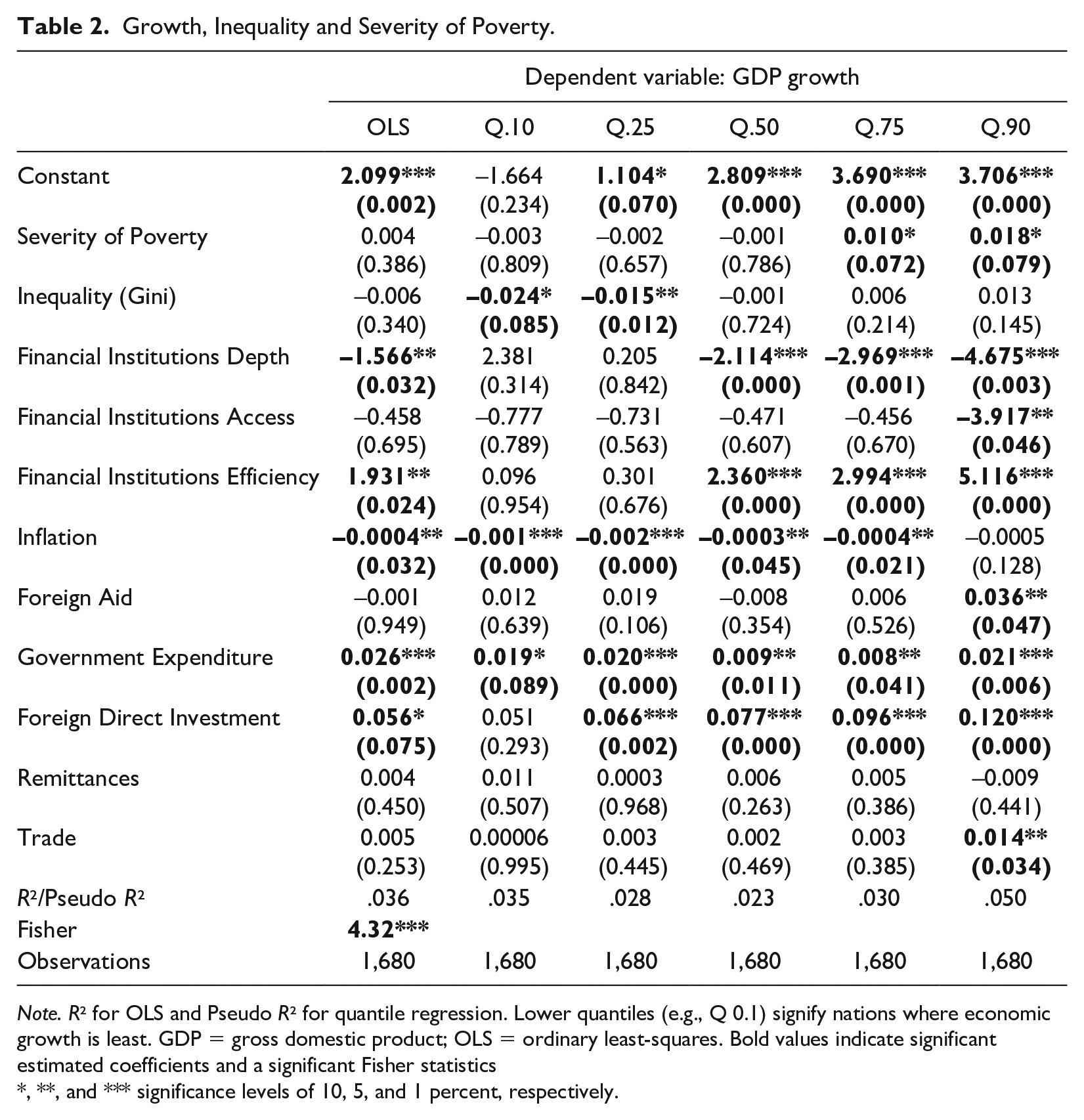
Note. R² for OLS and Pseudo R² for quantile regression. Lower quantiles (e.g., Q 0.1) signify nations where economic growth is least. GDP = gross domestic product; OLS = ordinary least-squares. Bold values indicate significant estimated coefficients and a significant Fisher statistics
, **, and *** significance levels of 10, 5, and 1 percent, respectively.
The following findings are established in Tables 1 and 2. (1) Poverty reduces economic growth, and the negative response of economic growth to poverty is a decreasing function of economic growth. In other words, the incidence of poverty in reducing economic growth decreases with increasing levels of economic growth. (2) Income inequality and the severity of poverty increase economic growth in the top quantiles of the economic growth distribution, while the incidence of income inequality is also negative in the bottom quantiles of the economic growth distribution.
In both tables, most of the significant control variables have anticipated signs. Accordingly, in accordance with the narrative in the data section, inflation has a negative effect, while for the most part the other control variables have a positive sign. Accordingly, trade openness and investment avenues are expected to increase economic prosperity, consistent with Nyasha et al. (2021). Moreover, high inflation decreases economic growth, inter alia, because investors have been documented not to invest and promote economic growth in economic environments characterized by high uncertainty and ambiguity which are translated by inflation (Kelsey and le Roux 2017, 2018). Remittances have also been documented to be a source of economic prosperity (Efobi et al. 2019), while government expenditure is designed to increase indicators and drivers of economic growth such as domestic investment and consumption (Onifade et al. 2020). By extension, at least in the short run, foreign aid is also designed to improve indicators and drivers of economic growth (Selaya and Thiele 2010). The incidence of financial development dynamics on economic growth remains mixed in the extant literature, as apparent in a meta-analysis on the finance–growth nexus (Asongu 2015).
It is important to articulate that consistent with the motivation of the study which is to assess nexuses throughout the conditional distribution of the outcome variable, only nexuses that are significant throughout the conditional distribution of the outcome variable constitute the main findings and by extension, engender policy implications. Hence, nexuses that are exclusively relevant to either bottom or top quantities do not constitute the main findings and by extension, are not relevant for policy implications.
Concerning the nexus of the findings with the corresponding literature discussed in section “Literature on Nexuses Between Poverty, Income Inequality and Economic Growth,” such linkages can be discussed in five main strands, notably, (1) the negative nexus of poverty, (2) the relative significance of the severity of poverty, (3) the comparative insignificance of income inequality, (4) the negative effect of income inequality, and (5) the positive incidence of income inequality on economic growth.
First, the fact that poverty reduces economic growth is consistent with a strand of literature, notably, López and Servén (2015) who showed that per capita economic growth is decreased by poverty. Second, in relation to the effect of severity of poverty, the insignificance of the severity of poverty estimates below the median of the economic growth distribution is broadly consistent with Marrero and Servén (2018) who demonstrated that the incidence poverty on economic growth is insignificant in countries where poverty levels are below the median. Moreover, the fact that at the top quantiles of the economic growth distribution the severity of poverty positively affects economic growth is also broadly consistent with Marrero and Servén (2018) who have shown that in countries in which existing levels of poverty are higher than the median, poverty increases economic growth.
Third, the insignificance of income inequality (i.e., in the bottom quantiles of Table 1 and top quantiles of Table 2) could also be explained from the perspective that the nexus cannot be exclusively direct and some channels could be considered as established by Erman and te Kaat (2019) and Aiyar and Ebeke (2020). The underlying insignificance may also be viewed in the light of the position of Kraay (2015) on concerns pertaining to instruments, endogeneity, and specifications. Fourth, the negative effect of income inequality in the bottom quantiles of Table 2 is consistent with Cingano (2014) within the remit of OECD countries and Berg et al. (2018) in a panel of advanced and developing countries. Fifth, the positive incidence of income inequality on economic growth in top quantiles of Table 1 is also in line with Brueckner and Lederman (2018) who have established that income inequality could be favorable for economic prosperity in transitional poor countries. Moreover, Halter et al. (2014) have established that the nexus between income inequality and economic growth is time-dynamic.
Concluding Implications and Future Research Directions
This study has extended existing literature by assessing the conditional influence of poverty, income inequality, and severity of poverty on economic growth. The focus is on 42 countries in SSA with data from 1980 to 2019. The Gini index is used to measure income inequality. Poverty is measured in terms of the poverty headcount ratio, while the severity of poverty is computed as the squared of the poverty gap index. The empirical evidence is based on quantile regressions to assess how income inequality and poverty dynamics affect economic growth throughout the conditional distribution of economic growth. Our main finding shows that the negative response of economic growth to poverty is a decreasing function of economic growth. In other words, the incidence of poverty in reducing economic growth decreases with increasing levels of economic growth. In two specifications, the effect of inequality is negative in bottom quantiles and positive in top quantiles of the conditional distribution of economic growth. Policy implications are discussed in what follows.
The first policy implication is that the relevance of poverty in mitigating economic growth in SSA is consistently contingent on initial levels of economic growth. It follows that blanket poverty–growth policies are unlikely to succeed unless they are tailored to reflect initial levels of economic growth. By extension, country-specific empirical analyses are also likely to engender more targeted policy implications in the light of the contingency of the poverty–growth nexus on initial levels of economic growth.
As a second policy implication, as well as the alleviation of poverty may depend on economic growth, economic growth also depends on the level of poverty. The latter which is established in this study is evidence of the position that fighting poverty is extremely important for driving economic growth and countries equally depend on economic growth for the alleviation of poverty.
The third policy implication is premised on the comparative relevance of poverty compared with income inequality in promoting economic growth. This implication does not negate the practical importance of maintaining income inequality levels in check for extreme poverty to be mitigated. It follows that this policy implication is exclusively relevant when in view of promoting economic growth, there is a choice between dealing with either poverty or income inequality. The empirical scrutiny in the study is suggestive that, compared with income inequality, more resources should be placed in addressing poverty in view of promoting economic growth. This policy implication is based on poverty nexuses that are more consistently significant throughout the conditional distribution of economic growth, compared with income inequality nexuses.
Future studies can improve the extant literature on nexuses between growth, income, and poverty by assessing how the underlying linkages affect SDGs, especially within the remit of considering countries and regions in which concerns surrounding such SDGs are most apparent. Moreover, it is worthwhile to engage the suggested future research directions while making distinctions between policy syndromes (i.e., poverty and income inequality) and positive signals (e.g., economic growth and SDG measurements) within an interactive regressions framework. As articulated in the methodology section, one main shortcoming of the quantile regression technique is that it can only be employed to obtain global effects, and hence, country-specific studies are still worthwhile for more targeted country-specific policy implications.
Footnotes
Appendix A
Definitions and Sources of Variables.
| Variables | Definitions | Sources |
|---|---|---|
| Poverty Headcount | Poverty headcount ratio at national poverty lines (% of population) | WDI (World Bank) |
| Severity of Poverty | “Poverty severity, which measures the degree of inequality among the poor by putting more weight on the position of the poorest.” Squared of poverty gap index | Generated |
| Financial Institutions Depth Index | “The Financial Institutions Depth (FID) Index, which compiles data on bank credit to the private sector, pension fund assets, mutual fund assets, and insurance premiums (life and non-life) as percentages of GDP” | Findex (World Bank) |
| Financial Institutions Access Index | “The Financial Institutions Access (FIA) Index, which compiles data on the number of bank branches and the number of automatic teller machines (ATMs) per 100,000 adults” | Findex (World Bank) |
| Financial Institutions Efficiency Index | “The Financial Institutions Efficiency (FIE) Index, which compiles data on the banking sector’s net interest margin, the lending–deposits spread, the ratios of non-interest income to total income and overhead costs to total assets, and the returns on assets and equity” | Findex (World Bank) |
| Inflation | Inflation, consumer prices (annual %) | WDI (World Bank) |
| Foreign Aid | Net Official Development Assistance received (% of GNI) | WDI (World Bank) |
| Government Expenditure | General government final consumption expenditure (% of GDP) | WDI (World Bank) |
| Economic Growth | GDP growth (annual %) | WDI (World Bank) |
| Foreign Investment | Foreign direct investment, net inflows (% of GDP) | WDI (World Bank) |
| Income Inequality (Gini) | “The Gini coefficient is a measurement of the income distribution of a country’s residents” | WDI (World Bank) |
| Remittances | Remittance inflows (%GDP) | WDI (World Bank) |
| Trade | Trade is the sum of exports and imports of goods and services measured as a share of GDP | WDI (World Bank) |
Note. WDI = World Development Indicators; GDP = gross domestic product. GNI = gross national income.
Appendix B
Summary Statistics.
| M | SD | Min | Max | Obs | |
|---|---|---|---|---|---|
| Poverty Headcount | 48.215 | 14.055 | 7.900 | 73.200 | 1,680 |
| Severity of Poverty | 16.529 | 22.480 | 0.000 | 169.299 | 1,681 |
| Financial Institutions Depth | 0.097 | 0.147 | 0.000 | 0.880 | 1,680 |
| Financial Institutions Access | 0.077 | 0.128 | 0.000 | 0.880 | 1,680 |
| Financial Institutions Efficiency | 0.494 | 0.199 | 0.000 | 0.990 | 1,680 |
| Inflation | 32.026 | 593.191 | –13.056 | 23,773.13 | 1,680 |
| Foreign Aid | 11.345 | 11.527 | –0.250 | 94.946 | 1,680 |
| Government Expenditure | 5.353 | 25.868 | –17.463 | 565.538 | 1,680 |
| GDP Growth | 3.635 | 5.173 | –50.248 | 35.224 | 1,680 |
| Foreign Direct Investment | 2.938 | 6.456 | –28.624 | 103.337 | 1,680 |
| Inequality (Gini) | 53.250 | 19.829 | 0.000 | 86.832 | 1,680 |
| Remittances | 4.385 | 17.842 | 0.000 | 235.924 | 1,680 |
| Trade Openness | 67.240 | 35.588 | 6.320 | 311.354 | 1,680 |
Note. GDP = gross domestic product.
Appendix C
Correlation Matrix (Uniform Sample Size: 1680).
| PovHC | SoPov | FID | FIA | FIE | Infl | NODA | Gov. | GDPg | FDI | Gini | Remit | Trade | |
|---|---|---|---|---|---|---|---|---|---|---|---|---|---|
| PovHC | 1.000 | ||||||||||||
| SoPov | .071 | 1.000 | |||||||||||
| FID | –.069 | –.207 | 1.000 | ||||||||||
| FIA | –.264 | –.283 | .412 | 1.000 | |||||||||
| FIE | –.338 | –.146 | .312 | .305 | 1.000 | ||||||||
| Infl | .055 | .066 | –.025 | –.022 | .001 | 1.000 | |||||||
| NODA | .375 | .084 | –.251 | –.164 | –.246 | –.013 | 1.000 | ||||||
| Gov. | –.044 | –.023 | .036 | .018 | .073 | –.095 | .092 | 1.000 | |||||
| GDPg | –.111 | –.036 | .001 | .029 | .069 | –.062 | –.017 | .146 | 1.000 | ||||
| FDI | .004 | –.050 | .058 | .196 | –.010 | –.017 | .069 | .031 | .081 | 1.000 | |||
| Gini | .120 | .139 | .001 | –.156 | –.034 | .012 | .097 | .017 | .005 | –.094 | 1.000 | ||
| Remit | .082 | –.046 | .111 | –.013 | –.052 | –.009 | .034 | .088 | .031 | .014 | .044 | 1.000 | |
| Trade | –.146 | –.054 | .255 | .380 | .005 | –.028 | –.056 | .083 | .059 | .308 | –.040 | .305 | 1.000 |
Note. PovHC = Poverty Headcount; SoPov = Severity of Poverty; FID = Financial Institutions Depth; FIA = Financial Institutions Access; FIE = Financial Institutions Efficiency; Infl = Inflation; NODA = Foreign Aid; Gov = Government Expenditure; GDPg = Gross Domestic Product growth; FDI = Foreign Direct Investment; Gini = the Gini Coefficient; Remit = remittances.
Acknowledgements
The authors are indebted to the editors and reviewers for constructive comments.
Declaration of Conflicting Interests
The author(s) declared no potential conflicts of interest with respect to the research, authorship, and/or publication of this article.
Funding
The author(s) received no financial support for the research, authorship, and/or publication of this article.
Ethical Approval
This article does not contain any studies with human participants or animals performed by the authors.

Data Availability
The data for this research are available upon request.