



Abstract
Calpurnia aurea is a yellow-flowered, multi-stemmed small tree or shrub that grows 3-4 meters tall and is widely distributed across Africa, from South Africa to Eritrea, and also found in southern India. This study aimed to document and synthesize the traditional medicinal uses, phytochemicals, and pharmacological properties of Calpurnia aurea. Relevant literature and information were collected from credible sources, including databases such as PubMed, ScienceDirect, Scopus, and Google Scholar. In Ethiopian traditional medicine, C. aurea is used to treat a wide range of health conditions, including wounds, giardiasis, malaria, diarrhea, rabies, diabetes, herpes zoster, external parasites, Tinea capitis, leishmaniasis, tapeworm infections, trachoma, ringworm, and hypertension. In addition to Ethiopia, South Africa and Nigeria have used this plant as a traditional treatment mostly for dermatological conditions. Quinolizidine alkaloids and flavonoids are the major phytochemicals that have been isolated from different parts of the plant. Both in vivo and in vitro studies have reported that C. aurea possesses a wide range of pharmacological activities, such as hepatoprotective, antibacterial, antidiarrheal, antidiabetic, antihypertensive, antitumor, wound-healing, antioxidant, anti-inflammatory, antifungal, acaricidal and anti-arthritic effects. Some of these activities are linked with ononin, maackiain, medicarpin, and virgiline-type quinolizidine alkaloids. Given the plant's notable chemical and pharmacological potential, further investigation of its remaining isolated compounds, particularly their bioactivities, structure-activity relationships, and safety profiles, could play a vital role in translating traditional medicinal knowledge into modern therapeutic discovery.
Introduction
The flowering plant family Leguminosae (Fabaceae) contains approximately 650 genera and nearly 20 000 species distributed throughout the world in many ecological settings, from deserts of high latitudes to seasonally dry or wet tropical forests of equatorial regions.1,2 The genus Calpurnia (Leguminosae) includes seven species that are widely distributed in Africa. C. aurea (Ait.)Benth. (Fabaceae) is one of the species from this genus that grows as a yellow-flowered, multi-stemmed, 3-4 m tall small tree or shrub. It is widely distributed in Africa, ranging from the Cape Province (now known as Eastern Cape, Western Cape, and Northern Cape provinces in South Africa) to Eritrea, and it also occurs in southern India.3,4 There are three subspecies of C. aurea, namely subsp. (ssp.) aurea (Figure 1), which occur in Ethiopia, Democratic Republic of the Congo, Zimbabwe, Angola, and West Africa, and ssp. Sylvatica and indica, which are found in Cape Province and India, respectively. 5 However, recently, ssp. Sylvatica is known to be the same as C. aurea subsp. aurea and has been considered synonymous. 6
The plant has gained attention due to its wide ethnobotanical use, its various pharmacological studies, and its richness in bioactive compounds. In Ethiopia and other African countries, the cultural and historical significance of C. aurea is underscored by its extensive use for medicinal and ethnoveterinary purposes. Medical conditions such as malaria, syphilis, leishmaniasis, diarrhea, hypertension, skin infections, and helminthiasis have been treated traditionally by using C. aurea in different communities.7–13 These traditional claims were validated through different pharmacological studies. These studies showed the plant has significant biological activities, including antimicrobial, antioxidant, antimalarial, anti-inflammatory, antidiabetic, and anticancer activities.4,14–20 The phytochemicals responsible for these activities were also identified, revealing that the plant contains several secondary metabolites, notably quinolizidine alkaloids, flavonoids, saponins, tannins, and terpenoids. Quinolizidine alkaloids are characterized by their bitterness and cytotoxicity; however, they also possess antimicrobial properties and serve as chemical defenses by deterring herbivores from feeding on plant leaves. 21
A previous review by Beressa, 2021 22 has offered a general overview of the plant's ethnomedicinal uses, phytochemistry, and pharmacology, largely within the Ethiopian context. However, it was focused primarily on leaves, while other plant parts (roots, seeds, bark) remain uncovered; it was also limited to qualitative phytochemical screening, with few detailed characterizations of individual compounds. The other review 23 highlights features of C. aurea, but it does not explore the molecular characterization of specific compounds or include comparative analyses of different extracts using standardized assays.
Against the above backdrop, the present narrative review aims to provide a comprehensive synthesis of existing knowledge on ethnobotany, ethnopharmacology, and phytochemistry of different parts of Calpurnia aurea from different countries. In addition to this, it also identifies knowledge gaps and recommends future research that can link traditional medicine with scientific validation.
Ethnobotanical Uses of Calpurnia aurea
Various ethnobotanical studies demonstrate the extensive use of C. aurea for traditional medicine throughout the eastern and southern African communities. The plant has different vernacular names across the countries, for example, the South African Zulu people named this plant “umkhiphampethu,” which means maggot-extractor, reflecting immemorial use of the plant to remove wound maggots. 13 In Ethiopia, it is known locally as “digitta” (Amharic) or “cheka” (Oromiffa). 22 Even though the plant has widespread traditional use, ethnobotanical knowledge of C. aurea remains unevenly recorded, with Ethiopia being the most widely studied for ethnomedicinal use, while other regions are comparatively underexplored (Table 1).
Traditional Uses of Calpurnia aurea.

UR, unreported.
The plant is used for the treatment and management of over 20 human and animal diseases (ailments) as well as pathogenic and parasitic infections. Some of the medical conditions that are treated and managed by C. aurea include hypertension, diabetes mellitus, wounds, hemorrhoids, diarrhea, malaria, abdominal (stomach) pain, bronchitis, ascaris, anthrax, rabies, Herpes zoster (chickenpox virus), and other conditions.7–12
Leaves, seeds, roots, and bark are plant parts used for these purposes, but leaves are the most frequently used plant part by the local community. Commonly, it can be prepared by squeezing, crushing, or pounding into juices, pastes, or powders, which are then applied topically for skin diseases, wounds, and ectoparasite infestations25,32,36 or taken orally for systemic illnesses such as stomachache, dysentery, and ascaris.25,33
According to the current review, Ethnobotanical use of C. aurea is different across African countries, in Ethiopian the plant is used for both systematic and dermatological aliments such as malaria, diarrhea hypertension, diabetes mellitus, ectoparasite infection and anthrax.11,25,30,32,36 Additionally, Ethiopians used it for treating veterinary conditions such as livestock lice and ticks35,36 as well as spiritual disorders. 24 Whereas in South Africa and Nigeria, it is mainly used to treat dermatological conditions, particularly lice infestations, caterpillar rashes, maggot-infested wounds and abscesses. 4 Despite these variations, the use of C. aurea for infectious and parasitic conditions is a unifying feature across regions, which may be supporting evidence for traditional antimicrobial and antiparasitic remedies. This shows C. aurea is not only a plant embedded by culture, but also with diverse uses in human, veterinary, and ritual medicine.
Phytochemicals of Calpurnia aurea
Except from the root, more than thirty phytochemicals have been isolated and identified from the leaves, seeds, steam, and bark of C. aurea, mainly from Ethiopian and South African C. aurea subsp. Aurea (Table 2). Although various preliminary phytochemical screening showed the presence of Alkaloids, flavonoids, tannins, terpenoids, saponins, and phenols in the C. aurea,4,14–16 the phytochemistry of C. aurea is highly dominated by quinolizidine alkaloids (both lupanine-type and virgiline-type) and flavonoids.19,38–41
Compounds Isolated from Calpurnia aurea.
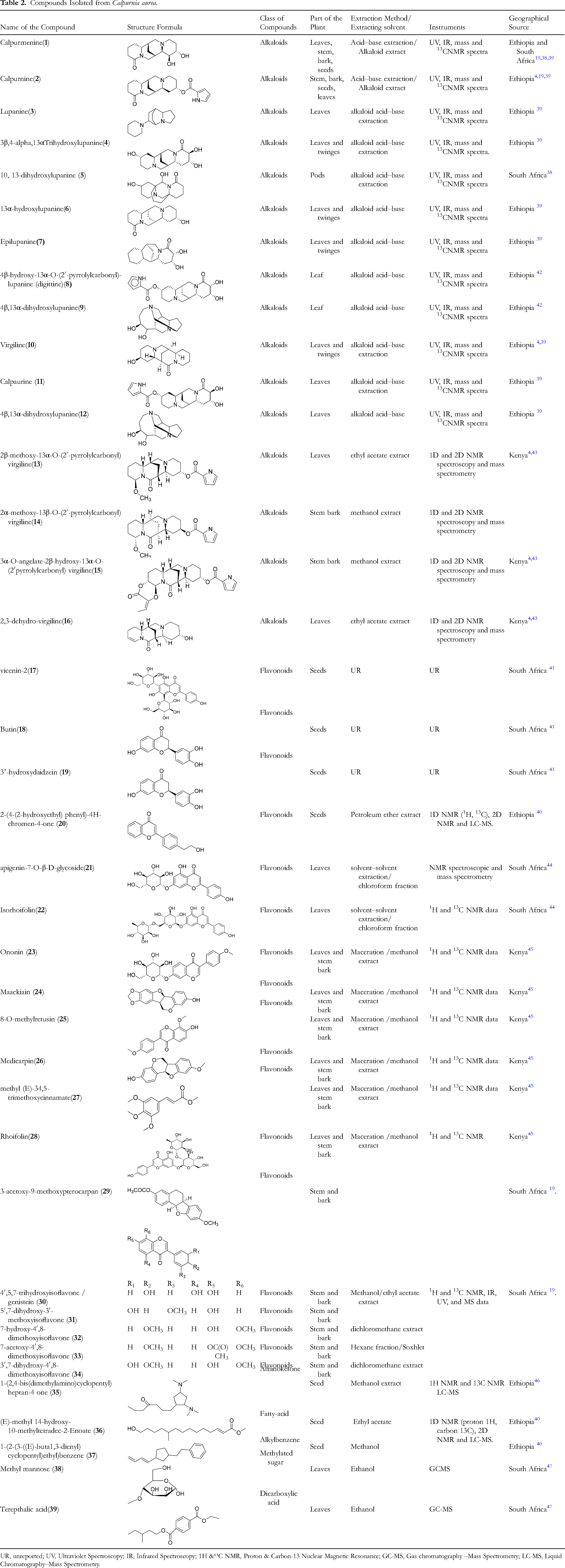
UR, unreported; UV, Ultraviolet Spectroscopy; IR, Infrared Spectroscopy; 1H &¹³C NMR, Proton & Carbon-13 Nuclear Magnetic Resonance; GC-MS, Gas chromatography –Mass Spectrometry; LC-MS, Liquid Chromatography–Mass Spectrometry.
The novel quinolizidine alkaloids, such as calpurnine and calpurmenine, were among the first isolated compounds from the leaf part of C. aurea. Then, subsequent investigations reported several more quinolizidine alkaloids, which are characteristic chemotaxonomic markers for the family, Fabaceae.19,39,42 Unusual virgiline-type alkaloids, including 2α-methoxy-13β-O-(2′-pyrrolylcarbonyl) virgiline, 3α-O-angelate-2β-hydroxy-13α-O-(2′-pyrrolylcarbonyl) virgiline, and 2,3-dehydro-virgiline were also identified and isolated from Kenyan C. aurea.21,43 As shown in Table 2, in addition to the quinolizidine alkaloids, the flavonoids such as vicenin-2 (6,8-di-β-D-glucopyranosyl-5,7,4'-trihydroxyflavone), butin (7,3’, 4'-trihydroxyflavanone), 3'-hydroxydaidzein (7,3’,4’ trihydroxyisoflavone), and pterocarpans were isolated from the seeds, stem, and bark of C. aurea.19,41
Beyond secondary metabolites, proteinaceous agglutinins (lectins) were isolated from seeds of C. aurea. These agglutinins are known to specifically cause hemagglutination of human erythrocytes of groups A and B. 48
Overall, the above phytochemical findings highlight the diversity of secondary metabolites present in the plant and reveal that most of the isolated compounds have not yet been evaluated for their pharmacological activities. The following table (Table 2) shows the chemical structure and class of isolated compounds from C. aurea, including compounds that have not been investigated for biological activities.
Ethnopharmacological Properties of Calpurnia aurea
Experimental studies have validated several traditional medicinal uses of C. aurea. These studies were done by using crude extract and solvent fraction and more recently, isolated compounds. Even though leaf, seed, stem, and bark are evaluated for pharmacological activities, leaf and seed part of C. aurea are the most studied parts for this purpose with methanol as primary solvent. These studies showed antimicrobial, antidiabetic, antioxidant, anti-malarial, antihypertensive, anti-diarrheal, anticancer, acaricidal, and hepatoprotective effect of C. aurea.3,49
Antimicrobial Activity
In an in vitro study, crude 80% methanolic root extracts of C. aurea were tested against mycobacteria (M. tuberculosis and M. bovis), and found to possess anti-mycobaterial activity based on minimum inhibitory concentration (MIC) ranging from 25-100 μg/mL. 50 Acetone leaf extract of C. aurea was also found to be active against Gram-positive strains such as E. faecalis, B. cereus and S. aureus and three Gram-negative strains, E. coli, S. typhimurium, and P. aeruginosa. 51 The Methanol extract of C. aurea (Ait.) Benth. at a concentration of 200 mg/mL had the highest mean zone of inhibition (4.66 mm) when compared to other selected plants. 52 The antibacterial action of the methanol crude leaf extracts of C. aurea was much higher than that of its stem. The antibacterial effect of C. aurea at the MIC of 0.1 mg/mL was also higher than that of standard gentamycin at the MIC of 100 mg/mL. 4
The above effects may be because of the active compounds within the plant. The pure compound, 1-(2,4-bis(dimethylamino)cyclopentyl) heptan-4-one(
Recent study from south Africa have evaluated the quorum sensing (QS) inhibitory potential of ethanolic leaf extract of C. aurea. QS is responsible for antimicrobial resistance development in bacteria through expression of virulence factors and biofilm formation. From this extract, the compound methyl mannose (
Overall, these findings support the traditional use of the plant in the management of tuberculosis and other bacterial diseases.
Beyond antibacterial activity, C. aurea from Kenya has also shown antifungal activities. Rhoifolin
Virgiline type Quinolizidine alkaloids, namely, 2β-methoxy-13α-O-(2′-pyrrolylcarbonyl) virgiline(
Pharmacological Activities of Extracts and Compounds Isolated from Calpurnia aurea.

Anti-Diabetic, Anti-Lipidemic, and Anti-Hypertensive Activity
The three doses (100 mg/kg, 200 mg/kg, and 400 mg/kg) of crude hydromethanolic leaf extract of C. aurea fed to a streptozotocin induced diabetic mice showed a significant (P < .05) antihyperglycemic activity at the seventh and 14th day of repeated daily dose administration when compared to the negative diabetic control. 55 Furthermore, seed extract of C. aurea exhibited blood glucose-lowering activity in normoglycemic and hyperglycemic animal models, and it improved body weight loss and diabetic dyslipidemia in diabetic mice after 14 days of treatment. 20
Hydromethanolic leaf extract of C. aurea also exhibited lipid-lowering activity. 56 The administration of 400 mg/kg of C. aurea leaf extract significantly (P < .05) lowered serum low-density lipoprotein (LDL), serum cholesterol, and serum triglyceride levels, while the same dose had significantly elevated serum high-density lipoprotein (HDL) levels. 56 The hydroalcoholic seed extract also possessed hypotensive and antihypertensive effects. It is reported that seed extracts caused a dose-dependent relaxation of aorta precontracted with potassium chloride (KCl) at a concentration of 5-250 mg/L, with a maximum relaxation of 92.1% achieved at 250 mg/L. The reported mechanism was found to be independent of the muscarinic and histamine receptors as well as ATP-dependent K+ channels, cyclo-oxygenase enzymes, cGMP/NO pathway, and the endothelium system. The effect produced by seed extract caused a rightward shift of the Ca++ dose response curves, like the effect produced by verapamil, indicating that it produced vaso relaxation by inhibiting extracellular Ca2+ influx. 16
Antioxidant Activity
Extracts of different parts of C. aurea were investigated in extensive in vitro experimental methods and showed significant antioxidant activity, as shown in Table 3. This effect may be linked to their high flavonoid content, which can scavenge reactive oxygen species (ROS) and reactive nitrogen species (RNS). This antioxidant effect may lead to a decrease in oxidative stress in the body, which is associated with various diseases, such as cardiovascular diseases, neurodegenerative disorders, diabetes, and cancer. 57
Anticancer Activity
The bark and stem of C. aurea were investigated phytochemically for the first time and yielded five isoflavones (
Anti-Malarial Activity
The leaf extract of C. aurea was tested against chloroquine-sensitive Plasmodium berghei (1 × 10⁷parasites/mouse) infection in mice, and the study indicated that the hydromethanolic leaf extract has promising anti-plasmodial activity. 58 In the other study, the 80% methanol leaf extract of C.aurea was evaluated for its in-vivo antimalarial activity in a 4-day suppressive assay against Plasmodium berghei infected mice, and the extract showed a significant (P < .05) antimalarial activity at doses of 400 and 600 mg/kg with chemosuppression values of 38.22 ± 17.87% and 46.51 ± 3.67%, respectively. 14
Wound Healing and Anti-Inflammatory Activity
Wound healing activity of the 80% methanol extract of the leaves of Calpurnia aurea (Ait.) Benth was evaluated using excision and incision wound models, and the anti-inflammatory activity was evaluated using the carrageenan-induced hind paw edema model in mice. The study demonstrated that 80% methanol extract of the leaves of Calpurnia aurea (Ait.) Benth has wound healing and anti-inflammatory effects. Additionally, the aqueous and ethyl acetate fractions showed wound healing activities. 54
Anti-Diarrheal Activity
The anti-diarrheal activity of 80% methanol leaf extract of C. aurea was investigated in the castor oil-induced diarrhea, and it significantly delayed the onset of diarrhea, and reduced the frequency of defecation (total number of fecal output) and weight of feces. 17
Hepatoprotective Effect
The hepatoprotective effect of Calpurnia aurea seed extract was evaluated against highly active antiretroviral therapy (HAART) induced liver toxicity in rats by monitoring serum levels of alkaline phosphatase (ALP), aspartate aminotransferase (AST), and alanine aminotransferase (ALT), as well as through histopathological analysis. Additionally, the antioxidant properties of the seed extract were assessed by examining its effects on the liver antioxidant profile altered by highly active antiretroviral therapy (HAART) treatment. The findings suggested that the seed extract possesses hepatoprotective potential, thereby supporting its traditional ethnopharmacological use. 49
Acaricidal Activity
Acaricidal activity of C. aurea from Kenya was assessed by using the adult immersion test against Rhipicephalus turanicus ticks. The study found chloroform fraction of C. aurea was the most active fraction with a 24 h LC50 and LC90 of 28.64, and21.53 mg/mL, respectively. The study also identified two acaricidal compounds, apigenin-7-O-β-D-glycoside (
Conclusion
Calpurnia aurea has a rich history of traditional use for treating diverse ailments, many of which have been substantiated by in vivo and in vitro pharmacological investigations. This validates the importance of indigenous ethnobotanical knowledge in uncovering bioactive compounds. Nevertheless, further comprehensive studies are warranted to elucidate its efficacy, toxicity, and active constituents for safe therapeutic application.
Methods
Data were collected from legitimate databases such as PubMed, ScienceDirect, Scopus, and Google Scholar using key terms “Calpurnia aurea” OR “C. aurea” AND “ethnobotanical use” OR “botanical use” OR “traditional medicine” OR “herbal medicine” OR “pharmacological” OR “ethnopharmacological” OR “bioactivity” OR “phytochemical” OR “Bioactive compound” in each database. The synonyms and different local names were retrieved from the Global Biodiversity Information Facility (GBIF) database and other trusted online sources. Only original literatures written in English and accessible through institutional subscriptions, open-access platforms, or author requests were included. Relevant data on the ethnobotanical, ethnopharmacological, and phytochemical aspects of C. aurea were carefully screened and extracted from original studies published from 1957 to 2025. A total of 58 references are included in this scientific review. The literature search was conducted from November 2024 to September 2025.
Picture of Calpurnia aurea (Ait.) Benth. subsp. aurea.
Footnotes
Acknowledgements
We are thankful to Wollo University for providing the necessary facilities for this work.

Ethics Approval and Consent to Participate
Not applicable.
Authors’ Contribution
YMB drafted and conceived the initial draft of the manuscript. AA and SF reviewed the initial draft and prepared the final version of the manuscript for Journal submission. All authors read and approved the final draft of the manuscript. All authors are accountable for all aspects of the work in ensuring that questions related to the accuracy or integrity of any part of the work are appropriately investigated and resolved.
Funding
The authors received no financial support for the research, authorship, and/or publication of this article.
Declaration of Conflicting Interests
The authors declared no potential conflicts of interest with respect to the research, authorship, and/or publication of this article.