



Abstract
Cinnamomum longepaniculatum (Gamble) N. Chao ex H. W. Li is an endemic tree specie mainly found in Asia. Its essential oils are prominently rich in eucalyptol and are widely used as raw materials in various industries. This review summarizes recent advances in understanding how processing methods, growth environments, phenological stages, and varieties influence the composition of C. longepaniculatum essential oils, as well as their biological activities and the key challenges related to their extraction, processing, and application. The findings indicate that trees aged over 11 years and cultivated on sun-facing slopes exhibit higher essential oil yields. Mature leaves, rather than tender ones, are optimal for oil extraction, and the Yibin variety contains significantly more essential oil than other known varieties. Furthermore, the essential oils of C. longepaniculatum demonstrate multiple biological activities, including antibacterial, antioxidant, anti-inflammatory, anticancer, and anxiolytic effects. In conclusion, improving processing methods and optimizing cultivation strategies are crucial for enhancing essential oil yield and quality. This work aims to provide a clearer scientific basis to support further research and technical innovation, and sustainable utilization of C. longepaniculatum essential oils.
Introduction
Cinnamomum longepaniculatum (Gamble) N. Chao ex H. W. Li is an endemic tree species widely found in Asia such as Vietnam, Laos, North Korea and China.1,2 This evergreen tree belongs to the Lauraceae family, which is well known for producing essential oils. 3 In general, C. longepaniculatum plays a crucial role as a woody incense plant, characterized by its volatile terpenoid content. 4 In addtion to its distinctive and pleasant aroma, it also serves as a valuable source of timber. 4 The leaves and branchlets of C. longepaniculatum have been traditionally used to treat gingivitis, stomatitis, and odontalgia. 5
The compounds from C. longepaniculatum possess significant pharmacological potential. For example, the flavonoids extracted from C. longepaniculatum exhibit a wide range of biological activities, including antioxidant, anti-inflammatory, antinociceptive, antitumor, anticancer, analgesic, hepatoprotective, antibacterial, antiviral, and anti-arteriosclerosis effects.6-8 Polysaccharides from C. longepaniculatum demonstrate immunomodulating, antitumor, hypoglycemic, antiviral, hypolipidemic, and antioxidant properties, and the ability to scavenge free radicals. 9 Proanthocyanidins extracted from C. longepaniculatum show inhibitory effects on digestive enzymes and antioxidant activity. 10
The essential oils (EOs) in plants and their derivatives have been highlighted in several studies due to their antibacterial,11,12 anti-inflammatory, 5 anticancer, 5 analgesic, 13 antioxidant, 14 immunoregulation, 5 and other properties, underscoring the commercial and medicinal significance of EOs . EOs can be obtained from different parts of C. longepaniculatum, such as roots, stems, twigs, leaves, seeds, or wood.15-17 C. longepaniculatum EOs (CLEOs), which are particularly rich in eucalyptol, have commonly been used as raw material in industrial products, perfumery, medicine, and various chemical formulations.2,14 Moreover, leaf-derived CLEO has been employed in shoe polish, varnish, light, defense, and advanced electroplating industries. 14
Recently, researchers have extensively focused on various aspects of C. longepaniculatum to enhance its exploitation and utilization. These studies include investigations into endophytic fungi,18-20 antibacterial activity of CLEOs in vitro,11,21 improvement in refined oil extraction technology,14,22,23 the development of suspension cell cultures,24,25 and the cultivation and conservation of germplasm resources.26-28 This article aims to review the components, pharmacological properties, potential applications, and challenges realated to the EOs of C. longepaniculatum. The findings may support the enhanced exploitation and utilization of CLEOs and promote their diverse applications as a high-value-added resource in the food, perfume, pharmaceutical, and other industrial sectors.
Materials and Methods
This work focuses on analyzing scientific information published on the pharmacological activities of CLEOs, as well as the components, applications, and associated challenges. References were obtained from reputable international and national journals and databases, including NCBI-Pubmed, and Google Scholar, using search terms such as “Cinnamomum longepaniculatum”, “essential oils” or “essential oil”. The review encompasses scientific literature published between 2015 and 2025. Articles were selected based on the following inclusion criteria: (1) peer-reviewed publications; (2) studies focusing on the composition, pharmacological properties, processing, or applications of CLEOs; and (3) clear methodological descriptions and scientifically valid results. The inclusion of relevant articles was determined through a rigorous evaluation conducted by two authors.
Phytochemicals
Generally, plant-derived EOs are intricate mixtures of volatile compounds, including terpenoids, phenols, and terpenes.17,29 Among these, terpenoids (>85%) are the predominant components in the leaf EO, with 1,8-cineole, γ-terpinene, and α-terpineol as the major constituents. 15 Terpenoids can be further classified into monoterpenoids, sesquiterpenes, and diterpenes. 17 CLEOs are mainly composed of nonoxygenated and oxygenated compounds, with relative area percentages determined by gas chromatography-mass spectrometer (GC-MS) of 20.30% and 78.55%, respectively. 22 In the EO derived from C. longepaniculatum leaves, the primary constituents are monoterpene hydrocarbons (50.61%), followed by oxygenated monoterpenes (34.85%), sesquiterpene hydrocarbons (12.28%), and oxygenated sesquiterpenes (2.14%) (Figure 1).21,30

Chemical Structures of Representative major Compounds in Cinnamomum Longepaniculatum Essential oil.32 in the EO Derived from C. longepaniculatum Leaves, the Primary Constituents are Monoterpene Hydrocarbons (50.61%), Followed by Oxygenated Monoterpenes (34.85%), Sesquiterpene Hydrocarbons (12.28%), and Oxygenated Sesquiterpenes (2.14%).
Numerous researchers have extensively examined the chemical components of the EO derived from the leaves of C. longepaniculatum. Recently, more than 99% of compounds in CLEO have been identified using GC-MS, with the main components including eucalyptol, α-terpineol, terpinen-4-ol, and others.21,22,31 A total of 31 compounds have been identified in CLEOs, with the main constituents presented in Figure 1.21,22 In the Yibin region, the dominant component of CLEO is 1,8-cineole (eucalyptol) (67.07%), followed by α-terpineol (11.33%) and sabinene (10.98%). 23 Thus, the major constituents of CLEOs include 1,8-cineole, β-pinene, γ-terpinene, α-phellandrene, α-pinene, terpinen-4-ol, and α-terpineol (Table 1).32,33
Chemical Structures of Representative major Compounds in Cinnamomum Longepaniculatum Essential oil. 32

Despite slight variations in the constituents and their quantities among previous studies, eucalyptol (cajeputol, or 1,8-cineole) consistently emerges as the predominant component, constituting more than 50% of CLEOs. 17 This compound is utilized in the pharmaceutical sector due to its transdermal-enhancing effect. It possesses antitussive and decongestant properties, and shows potential for treating rheumatism, sinusitis, and bronchitis. 34 Additionally, it holds significance in aromatherapy, and is commonly used as a skin stimulant in baths. 35 Beyond its therapeutic applications, 1,8-cineole is also widely employed in the production of cosmetics and perfumes. 36
Influencing Factors on the Quality of CLEOs
The composition and content of CLEOs are mainly influenced by processing methods and their core endophytic fungi, which are mainly involved in growth environments, phenological stages, and plant varieties (Figure 2).17,22,37-40

The factors influencing the composition and contents of Cinnamomum longepaniculatum essential oil (CLEO). The influencing factors include the growth environment (such as location and the presence of endophytic bacteria or fungi), extraction methods, plant varieties, and phenological stages, which are further affected by factors such as endophytes, slope direction, plant age, harvest season, and altitude.
Extraction Methods Affecting CLEOs
Although many extraction methods are used to isolate EOs from plants,41-48 CLEOs have been extracted using a limited number of methods, as reported in previous studies (Table 2).10,14,21,23,49,50 Among these, steam distillation (SD) and hydrodistillation (HD) are the classical techniques used for EOs isolation. During SD, volatile constituents are released through the passage of steam over heat-treated plants. 14 In the conventional HD technique, plant material is immersed in water for a specified duration.14,23 This mixture is then subjected to heat, causing the volatile components to vaporize with the steam.14,23 The resulting vapors pass through a condensing unit, after which the EOs are separated from the upper layer.14,23 These conventional methods are simple and often conducted in family-operated workshops. However, both techniques require an operational temperature of 100 °C throughout the distillation process, which usually lasts 3-4 h. This presents drawbacks, such as the thermal or hydrolytic degradation of heat-sensitive components-particularly low-purity eucalyptol.14,48 In addition, the extended processing time can lead to the dissolution and loss of certain oxygenated components, thereby reducing the overall extraction efficiency of the EOs. 14
Summary of Methods Have Been Used for Extraction of Cinnamomum longepaniculatum Essential Oils.

Alternative approaches, such as ultrasound-assisted extraction,10,52 enzyme-assisted extraction (EAE),53,54 and microwave-assisted extraction (MAE),14,21 have gained attention for isolating CLEOs to address these limitations. MAE has been successfully applied to various aromatic plant materials, representing a refined solution that addresses the shortcomings of conventional techniques.14,21,55 Through its distinctive mechanism of microwave irradiation, MAE significantly results in a reduction of extraction time, an increased yield of EOs, and superior quality.14,51 As a result, MAE has gained substantial recognition as an efficient and viable alternative method for isolating CLEOs. 14
Moreover, the realm of extraction techniques has seen innovations evolving from MAE. These advancements include compressed air microwave distillation, solvent-free microwave extraction (SFME), microwave-assisted hydrodistillation (MAHD), microwave hydrodiffusion and gravity, vacuum microwave HD, and microwave-assisted solvent extraction.22,56,57 A notable exemplar is the microwave-assisted HD-concatenated double-column liquid–liquid extraction (MHDLLE) technique, which integrates a traditional oil-water separation process with a concatenated double-column liquid-liquid extraction procedure. 14 In this context, ethyl ether serves as an optimal solvent, while glass beads used as column filters positively influence the extraction outcome. 14 Importantly, MHDLLE demonstrates distinct advantages in enhancing EO yields, reducing processing time compared to traditional extraction methods. These benefits position MHDLLE as a promising option for future EO isolation. 14 Through such innovative adaptations of established techniques, the landscape of extraction continues to evolve, offering promising avenues for more efficient and effective extraction processes.
Wei et al (2023), in their comparative analysis, encompassed three extraction techniques: SFME, HD, and MAHD. A total of 26 compounds were identified in deciduous leaves and 23 in fresh leaves. Among these, the deciduous EO obtained through SFME, MAHD, and HD contained 16, 18, and 17 compounds, respectively. 22 However, the results revealed only minor differences in most compounds, except for the contents of α-Terpineol and Terpinen-4-ol, which differed significantly from the others (Table 3). 22 Similarly, in another study, CLEOs obtained using SFME and HD exhibited comparable constituents profiles, sharing the same major components despite slight difference in their concentrations. The essential oil yields were 2.2 mL and 1.6 mL per 100 g of leaves for SFME and HD, respectively. The main components included eucalyptol (67.07% in SFME vs 53.84% in HD), α-terpineol (11.33% vs 14.98%), and sabinene (10.98% vs 10.48%). 23
Gas Chromatograph-Mass Spectrometer (GC-MS) Results for the Chemical Compositions of Cinnamomum Longepaniculatum Essential oil Extracted by HD, MAHD and SFME. 22
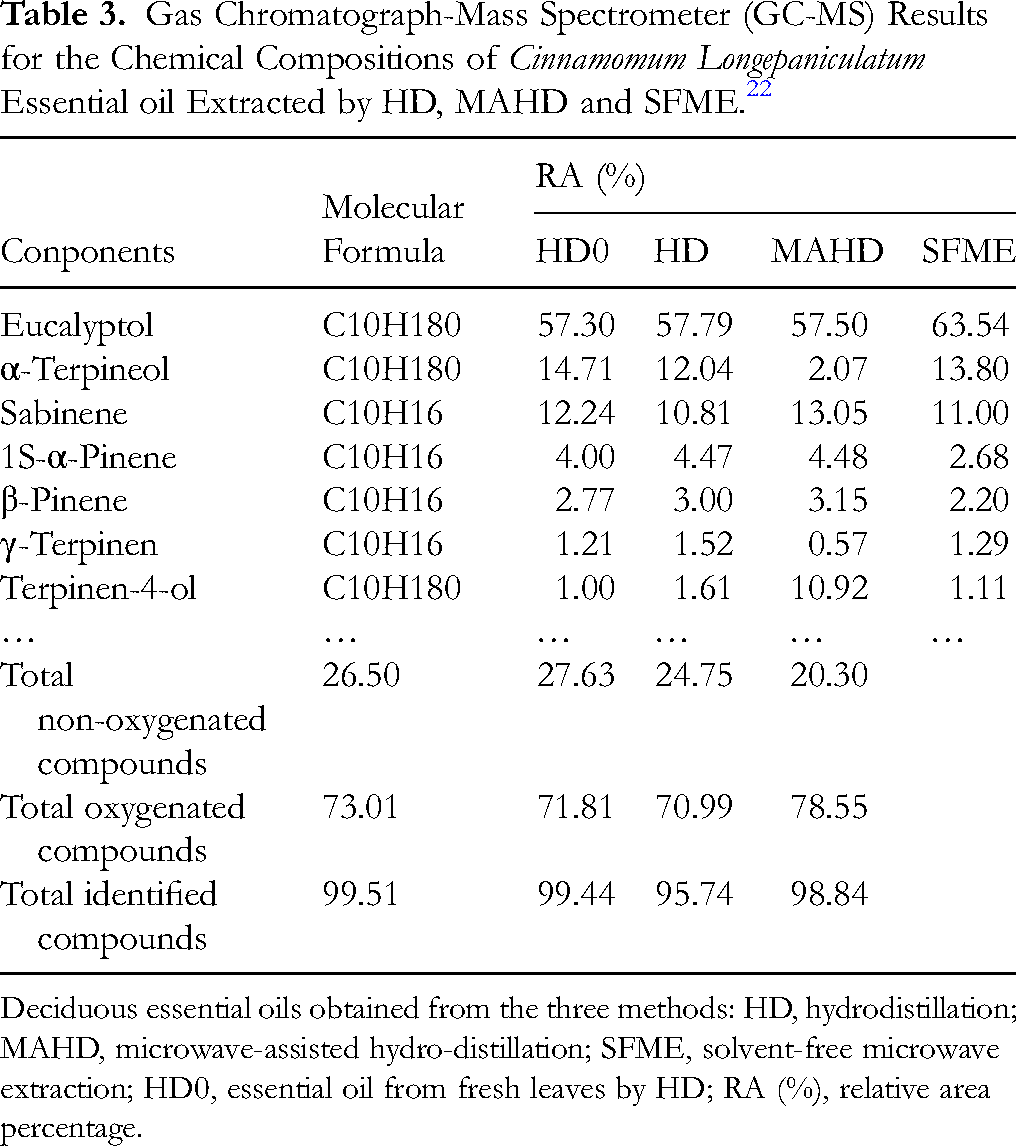
Deciduous essential oils obtained from the three methods: HD, hydrodistillation; MAHD, microwave-assisted hydro-distillation; SFME, solvent-free microwave extraction; HD0, essential oil from fresh leaves by HD; RA (%), relative area percentage.
Growth Environments Affecting CLEOs
Multiple research studies highlight the significance of the growth environment in determining EO components. For example, the Yibin-native variety of C. longepaniculatum contains approximately 2.5 times more EO than varieties cultivated in Taiwan, Jiangxi, and Guangdong provinces. 4 Research indicates that the microenvironment–including endophytic bacteria or fungi–significantly affects the composition and content of CLEOs.4,18,22,58 Differences in endophytic fungal metabolism between deciduous and fresh leaves may also contribute to the variation in EO contents. 22 Additionally, the presence of forest gaps has been observed to affect CLEOs synthesis. 59 This considerable variation underscores the pivotal role of environmental factors and symbiotic microbes in shaping the potency of CLEOs.
CLEOs in Different Varieties
Diverse plant varieties exhibit distinct growth characteristics and varying levels of adaptability to their respective environments. 17 This variability is further reflected in the differences in EO composition among varieties and phenotypes. For example, Zhao et al (2022) examined two C. longepaniculatum varieties (CLH, 20171026YBU016; CLL, 20171026YBU014) and found notable differences in leaf phenotypes and EO contents. The study reported variations in epidermal mesophyll, secretory idioblasts, vascular system, leaf thickness, and cross-section structure between the two varieties. 16 Consequently, the EO yields extracted from the leaves differed, measuring 1.85% for CLH and 1.35% for CLL, respectively. Additionally, the 1,8-cineole content in the corresponding CLEOs was 57.45% and 62.23%.16,17 These results highlight the significant influence of varietal diversity on the EO content of C. longepaniculatum.
Phenological Stages Affecting CLEOs
Phenological stages refer to specific developmental phases or growth periods in the life cycle of plants, animals, or other organisms. The effects of spatial and temporal distributions on the EO content in C. longepaniculatum have been explored. 58 Findings revealed that the highest content of EO was recorded in April and remained stable from June to November. 60 Significantly, C. longepaniculatum aged 11-20 years exhibited a higher EO content than other age groups. 60 In addition, trees cultivated on the positive slope displayed a higher EO yield than those on the negative slope in April. 60 However, the altitude did not significantly affect EO content. 60 Supporting the findings of Mo et al, Ning et al (2022) confirmed the effect of leaf age and season on the EO yield. Mixed leaves from trees aged 21-40 years exhibited higher EO yields compared to those from younger or older trees. 61 The optimal months for EO production were April, August, and December, while tender leaves growing in March demonstrated the lowest EO yield (0.5%). 61 In addition, the EO yield showed slight differences between air-dried and fresh leaves. 61 These studies underscore the complex influence of phenological stages on CLEOs content, offering valuable insights for optimizing EO yield and quality.
Pharmacological Actions
EOs and their main components, derived from various plant sources, exhibit various biological activities that have attracted attention in both traditional and modern medicine.62-68 Similarly, CLEOs possess several biological properties, including anti-inflammatory, antibacterial, anti-inflammatory, and anticancer effects (Table 4). Moreover, the antimicrobial mechanisms of CLEOs are comparable to those of other EOs, such as increasing cell membrane permeability and disrupting cellular and nuclear cytoplasm.
Summary of Pharmacological Activities of Cinnamomum Longepaniculatum and the Potential Mechanisms in Recent ten Years.

CLEO, C. longepaniculatum essential oil; MIC, minimum inhibitory concentration; MBC, minimal bacteriocidal concentration; MFC, minimal fungicidal concentration; DPPH, 1,1-diphenyl-2-picrylhydrazyl; ABTS, 2,2-azinobis-3 ethyl benzothiazoline-6-sulphonic acid.
Antibacterial Activity
CLEOs have gained significant attention for their remarkable antibacterial activity. Both CLEOs and their identified compounds have exhibited strong inhibitory effects against a range of Gram-positive and Gram-negative bacteria. 69 Several studies have highlighted the potent antibacterial activities of CLEOs, particularly their inhibitory effects against Salmonella enteritidis, Staphylococcus aureus, Escherichia coli, Shigella flexneri, S. enterica, and Pseudomonas aeruginosa.11,21
The antibacterial activities of CLEOs are attributed to their diverse composition. Li et al (2014) demonstrated the notable antibacterial effects of CLEOs and their five principal constituents (1, 8-cineole, γ-terpinene, safrole, terpinene-4-alcohol, and α-terpineol) exhibiting varying degrees of inhibition against S. enteritidis, E. coli, and St. aureus. 69 Among them, α-terpineol, a major component of CLEOs, possessed the most potent antibacterial activity. 69 In addition, isomeric forms of terpineol, including δ-terpineol, terpinen-4-ol, and α-terpineol, contribute to the distinct pleasant fragrance of the EOs derived from C. longepaniculatum leaves. 11 These terpineol isomers have shown significant antibacterial effects against several Gram-negative bacteria, particularly Sh. flexneri. 11 Moreover, EOs extracted from C. longepaniculatum leaves have demonstrated excellent antibacterial activity by inhibiting foodborne proliferation pathogens such as E. coli, St. aureus, and P. aeruginosa. 9 Furthermore, antifungal assays showed that three dermatophyte strains T. mentagrophytes, M. canis, and T. gypseum ceased growing within 72 h of exposure to the EOs. 71
The underlying antimicrobial mechanisms of CLEOs are similar to those of EOs extracted from other plants (Figure 3). 73 The constituents of CLEOs display synergistic effects. The core mechanism involves increasing the permeability of the cell membrane and wall, which leads to the leakage of intracellular contents such as proteins and β-galactosidase.11,21, 69 For instance, 1, 8-cineole, the major compound in CLEOs, plays a significant role in disrupting the outer membrane and altering the nucleoplasm concentration and distribution. 69 In E. coli, this results in reduced cell size, condensation of nucleoplasm, and agglomerated of cellular material to one side. 69 In St. Aureus treated with 1,8-cineole, notable structural damage is observed, including deformation in cell size and shape, condensed or concentrated nucleus cytoplasm, and cytoplasmic aggregation. 69 Similarly, the three isomers of terpineol disrupt microbial cell membrane and wall integrity, altering membrane permeability and causing wall disintergraion, which leads to cell collapse. This process facilitates the leakage of intracellular substances, including proteins, nucleic acids, and alkaline phosphatase. 11 These terpineols trigger a cascade of destructive events–membrane permeabilization, wall destruction, and solute leakage–ultimately leading to microbial cell lysis and death. 11 In fungi, the antifungal mechanism resembles these antimicrobial processes: CLEOs induce irreversible damage to the cell wall, membrane, and organelles, thereby weakening dermatophytes virulence and leading to cell death. 71

the Potential Underlying Antibacterial Mechanism of C. longepaniculatum Essential Oils (CLEOs).
Anticancer Activity
CLEO has demonstrated significant anticancer properties. 72 In vitro studies have reported the inhibitory effects of CLEO and its major compounds–safrole, α-terpineol and terpinene4-ol–on human lung cancer cells and breast cancer cells. 72 Wu et al determined its antitumor activity in human MCF-7 breast cancer cells and A549 human lung cancer cells. The proposed mechanism involved disruption of cell membranes, induction of cell cycle arrest at the G1 and S phases, and inhibition of cells cycle progression. These effects collectively triggered apoptosis, characterized by membrane shrinkage, decreased chromatin density with fragmentation, and mitochondrial deformation (Figure 4). 72

Proposed mechanisms underlying the anticancer, nematicidal, and anti-inflammatory activities of C. longepaniculatum essential oils (CLEOs). ACEs, acetylcholinesterase; NO, nitric oxide; PGE2, prostaglandin E2; 5-HT, 5-hydroxytryptamine. Anticancer effects may be mediated by increasing the proportion of cells in the sub-G1 phase and inducing G2/M phase cell cycle arrest through regulation of p53 and p21. Nematicidal activity may involve inhibition of acetylcholinesterase (ACEs) activity. Anti-inflammatory effects may be attributed to the suppression of pro-inflammatory mediators, including prostaglandin E2 (PGE2), histamine, 5-hydroxytryptamine (5-HT), and nitric oxide (NO).
Nematicidal Activity
CLEOs have exhibited toxicity against pine wood nematodes (PWN, Bursaphelenchus xylophilus), a major pest responsible for extensive pine forest damage in China. 21 CLEOs effectively killed B. xylophilus and caused elongation of their body shape. 21 Additionally, the nematicidal activity of CLEOs might be associated with their inhibitory effects on B. xylophilus acetylcholinesterase activity (Figure 4). 74
Antioxidant Activity
Free radicals are highly reactive molecules that cause oxidative stress and damage to cells, proteins, and DNA. 75 CLEOs can be used as antioxidants to protect cells from oxidative stress, potentially reducing the risk of chronic diseases. 76 Wang et al (2018) determined the antioxidant potential of CLEO using 1,1-diphenyl-2-picrylhydrazyl (DPPH) and 2,2-azinobis-3 ethyl benzothiazoline-6-sulphonic acid (ABTS) radical scavenging assays. The results revealed a prominent scavenging rate of DPPH radicals, reaching up to 96.50% at a 50% CLEO concentration, in a concentration-dependent manner. 23 However, lower concentrations of CLEOs exhibited strong efficacy in scavenging ABTS radicals, with a rate of 96.35% at 5% EO concentration. 23 In accordance with the aforementioned results, Cong et al (2016) confirmed the antioxidant property of CLEOs, demonstrating their DPPH radical scavenging ability. 77
Anti-Inflammatory Activity
CLEOs contain anti-inflammatory compounds that help alleviate inflammation-related conditions. The anti-inflammatory effect of CLEOs was assessed through various experimental models, including acetic acid-induced vascular permeability in mice, carrageenan-induced paw swelling in rat, and dimethyl benzene-induced ear edema in mice. 70 CLEOs were administered at different concentrations (0.5, 0.25, 0.13 mL/kg body weight), and a remarkable dose-dependent anti-inflammatory response was observed across all three models. This was characterized by reduced inflammatory cell infiltration, minimized connective tissue injury, and diminished paw thickness. 70 Cong et al (2016) also underscored the anti-inflammatory potential of CLEOs using LPS-induced inflammation in RAW264.7 macrophages and carrageenan-induced paw edema in rats. 74 The underlying mechanisms might be associated with the inhibition of peritoneal capillary permeability, along with reduced production of pro-inflammatory mediators such as prostaglandin E2, histamine, 5-hydroxytryptamine (5-HT), and nitric oxide (Figure 4).6, 77
Anxiolytic Activity
CLEOs were explored for their anxiolytic effects using mouse models. They demonstrated efficacy in relieving anxiety-related symptoms and helped restore neurotransmitter levels–downregulating 5-HT and norepinephrine (NE), and upregulating gamma-aminobutyric acid (GABA)–to baseline levels (Figure 5).21,78 The ability of CLEOs to cross the blood-brain barrier and their potential to mitigate anxiety, depression, and mood disorders were underscored, showing positive effects. 21 In addition, 1,8-cineole extracted from many plants has been shown to alleviate respiratory diseases. 79 It is therefore supposed that the application of CLEOs can also be extended to clinic settings to help alleviate tension and anxiety.
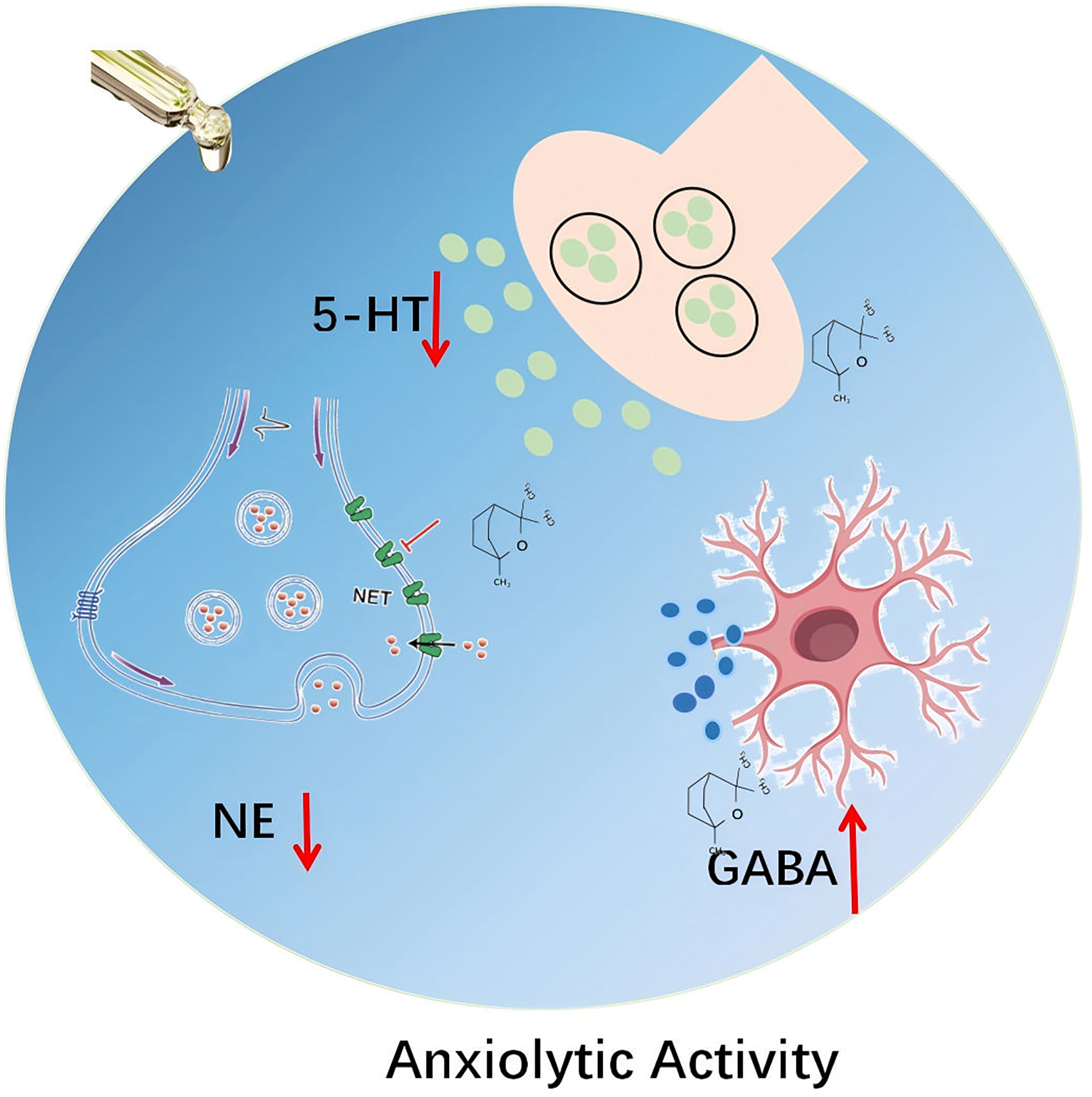
Proposed Anxiolytic Mechanism of C. longepaniculatum Essential Oils (CLEOs). The Anxiolytic Effects may be Mediated by Decreasing Levels of 5-Hydroxytryptamine (5-HT) and Norepinephrine (NE), While Increasing the Level of Gamma-Aminobutyric Acid (GABA).
Potential Applications
EOs derived from plants have found extensive applications in various sectors such as pharmaceuticals, cosmetics, and the food industry. 80 In the pharmaceutical sector, these compounds are valued for their transdermal-enhancing effects. 21 The high content of eucalyptol and camphor in the CLEOs makes them particularly effective in treating respiratory ailments such as colds, coughs, and bronchitis. These components help clear the airways and reduce inflammation, thereby offering a natural remedy for respiratory discomfort.
Beyond medicinal applications, the cosmetics industry is the largest consumer of EOs, frequently incorporating them into shampoos, lotions, cosmetics and perfumes.14,16 Additionally, the skin-soothing properties make them valuable ingredients in skincare formulations, particularly in products designed to reduce inflammation and promote overall skin health. 81
CLEOs are also valuable in the food industry. Abundant research has underscored the remarkable antibacterial properties of plant-derived EOs.82-84 Studies have revealed the potential of CLEOs as natural antimicrobial agents.14,21 Their potent antimicrobial activity can be utilized in food preservation to extend shelf life and inhibit the growth of harmful bacteria and fungi. This makes CLEOs as an attractive alternative to synthetic preservatives, aligning with the growing consumer demand for natural food additives.
CLEOs exhibit diverse biological effects, including antibacterial, antioxidant, anti-inflammatory, anticancer, and anxiolytic activities, many of which are closely linked to immunomodulation. They may help balance the immune system, enhance resilience against infections, and reduce inflammation, making them valuable in supporting overall health and well-being. Therefore, CLEOs holds potential as natural immunomodulators with broad therapeutic applications in aromatherapy and functional foods.
Discussion and Future Perspectives
Innovations in Processing Methods
Key technological research and equipment development for EO extraction, separation, and refinement are extremely important. The advancement of the C. longepaniculatum industry has encountered obstacles in the production, cultivation, processing, and market limitations, resulting in limited comprehensive benefits and an uncertain trajectory. 85 For example, The cultivation of C. longepaniculatum has become a pivotal economic venture in the Yibin region of Sichuan, China, known as the “Kingdom of Cinnamomum longepaniculatum”.14,86 Yibin is the primary producer of C. longepaniculatum in China, with an expansive cultivation area of 31,330 hectares. A carefully curated selection of more than 6500 high-quality seed trees is cultivated in Yibin.87,88 Consequently, the C. longepaniculatum industry has emerged as one of the most important cornerstones of the local economy, significantly benefiting local farmers. 86 However, deficiencies persist in CLEOs processing due to the absence of standardized processing facilities and corresponding technical guidance. The prevalent method for extracting CLEOs in Yibin still relies on family-operated workshops, raising concerns about utilization efficiency and environmental pollution. 89 Scarce large-scale factory processing of C. longepaniculatum crude EOs leads to incomplete extraction and low purity of CLEOs. The extraction process remains rudimentary, characterized by simplistic raw material pretreatment, underscoring the need for enhanced deep-processing capabilities and technical innovations.
Moreover, the creation of high-value EO derivatives is urgently required to elevate the industry's economic and scalable advantages. CLEO, a sensitive EO, is susceptible to decomposition caused by heat, light, and oxygen exposure. This degradation results in chemical alterations, leading to changes in color, undesirable odors, and reduced efficacy. 90 Furthermore, the physical characteristics of EOs, including low water solubility and high volatility, constrain their potential applications across various domains. 91 Innovative technologies are essential to safeguard EO stability and enhance their physicochemical properties. Fortunately, some researchers are aware of these issues and are addressing them. For instance, encapsulating CLEOs with β-cyclodextrin enhances their thermal stability. 38 The formation of inclusion complexes between CLEOs and β-cyclodextrin proves advantageous in broadening the application of CLEOs in the food, pharmaceutical, and personal care industries.
Deepening Research for more properties
Research on the pharmacological potentials of CLEOs has been far less extensive than that on other plant-derived EOs over the past decade. The bioactivities of EOs have garnered significant attention due to their potential therapeutic properties. EOs such as eucalyptol, terpinen-4-ol, and α-terpineol, derived from various plants have been extensively studied for their diverse pharmacological and health benefits. Consequently, researchers have explored the mechanisms underlying these bioactivities to better understand their potential applications. However, although CLEOs share major compounds with other well-studied EOs, in-depth research into their specific bioactivities and underlying mechanisms remains limited and is still urgently needed.
Conclusion
In conclusion, EOs extracted from C. longepaniculatum have demonstrated various pharmacological activities such as antibacterial, antioxidant, anti-inflammatory, anticancer, nematicidal, and anxiolytic activities. These properties support their broad potential applications across the food industry, agriculture, cosmetics, and pharmaceuticals. However, despite their potential, the C. longepaniculatum industry faces significant challenges related to production, processing, and market limitations. Optimizing extraction processes and reducing environmental pollution necessitate the establishment of standardized processing facilities and the implementation of advanced technical guidance. In the evolving landscape of EO utilization, bridging traditional wisdom with modern innovation is essential for fostering a thriving and diversified industry. Future research should focus on elucidating the relationship between chemical constituents and pharmacological effects of CLEOs, while refining processing techniques, including extraction, separation, and purification. Technological advancements, standardization, and the development of innovative products may unlock the full potential of the C. longepaniculatum industry, contributing not only to economic growth but also to public health and sustainable development.
Footnotes
Acknowledgements
The authors thank Yibin Sub-Center of Key Laboratory of Sichuan Province for Bamboo Pests Control and Resource Development for support local collaboration.
Author's Contribution
Authors' Note
Damir Dennis Torrico is currently affiliated with Department of Food Science and Human Nutrition, University of Illinois at Urbana-Champaign, Urbana, IL, USA.
Funding
This work was supported by Yibin Vocational and Technical College, Initial funding for doctor (ybzysc23bk01), Employment Internship Base Project of Yibin Vocational and Technical College (2024122462060), Research Project from Key Laboratory of Sichuan Province for Bamboo Pests Control and Resource Development (ZLKF202302). Professional Committee for the Integration of Industry and Education in Chinese Society for Educational Development Strategy (CJRHZWH2024-87).
Declaration of Conflicting Interests
The author(s) declared no potential conflicts of interest with respect to the research, authorship, and/or publication of this article.
