



Abstract
Panax notoginseng (Burk.) F. H. Chen, an esteemed herbal medicine in traditional Chinese medicine (TCM), is notable for its bioactive compounds, particularly Panax notoginseng saponins (PNS), which exhibit a diverse range of pharmacological effects, including anti-inflammatory, antioxidant, anti-apoptotic, and anti-tumor properties, thereby providing significant therapeutic benefits in the context of cardiovascular, nervous system, and immune disorders. The aim of this study was to elucidate the contemporary research trends associated with PNS and to provide a roadmap for future investigative directions. A comprehensive review of the literature on PNS published from 2000 to 2024 was conducted utilizing the Web of Science Core Collection (WoSCC) database, supplemented by analytical tools such as VOSviewer and CiteSpace, which facilitated the identification of several emergent research hotspots, namely “endoplasmic reticulum stress,” “gut microbiota,” “pyroptosis,” “ferroptosis,” and “network pharmacology.” The findings of this groundwork not only highlight the dynamic interest surrounding PNS within the scientific community but also delineate specific thematic avenues that warrant further exploration, thereby fostering future research initiatives aimed at fully elucidating the multifaceted therapeutic potential of PNS in various pathological contexts.
Keywords
Introduction
Panax Notoginseng saponins (PNS), which are mainly extracted from Panax notoginseng (Burk.) F. H. Chen, 1 Araliaceae family, have attracted considerable interest in the long history of traditional Chinese medicine (TCM) because of its wide-ranging therapeutic action. It mainly consists of 5 bioactive ingredients including notoginsenoside R1, ginsenoside Rg1, ginsenoside Rb1, ginsenoside Rd and ginsenoside Re, 2 which are recognized for their anti-inflammatory, 3 antioxidant, 4 and immune-modulatory effects. 5 Compared to other Panax species (eg, P. ginseng, P. quinquefolium), PNS uniquely combines stasis-dispelling and hemostatic properties, while its minor saponins exhibit superior bioavailability and vascular homeostasis modulation.6,7 The HPLC analysis and chemical structure of PNS is presented in Figure 1. 8 The emergence of modern scientific methodologies has brought about a significant shift in understanding, resulting in comprehensive studies that elucidate the molecular mechanisms underlying the pharmacological effects of PNS. Recent clinical trials and laboratory investigations have yielded strong evidence demonstrating the effectiveness of PNS in addressing chronic conditions, such as cardiovascular diseases, 9 neurological disorders, 10 and even cancer. 11 And numerous studies highlight PNS's antidepressant and anxiolytic potential through anti-apoptotic and anti-inflammatory pathways, 12 with analytical methods remain pivotal for PNS quantification and safety assessment. 13 This has sparked a growing interest in this traditional herbal remedy within the scientific community. Consequently, the rising recognition of PNS in contemporary pharmacological research underscores its therapeutic potential. In this study, we adopted bibliometric analysis to elucidate the contemporary research trends associated with PNS and to provide a roadmap for future investigative directions.
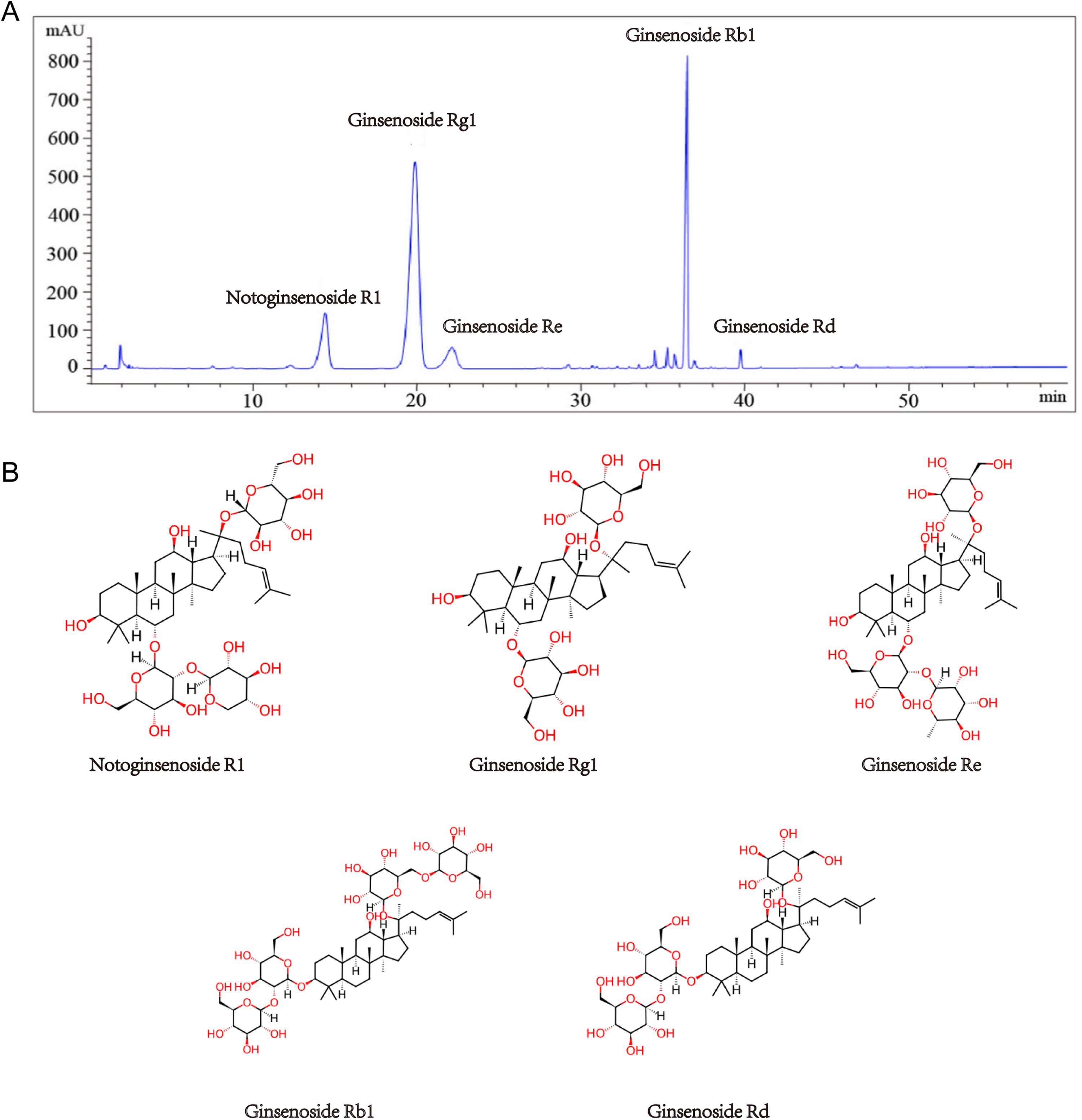
The Molecular Structure of the 5 major Components of Panax notoginseng Saponins (The Chemical Structures Were Downloaded from ChEMBL, and the Source of HPLC Analysis has Been Listed in the Acknowledgements and the Main Text).
Key Findings
1423 pieces of relevant literature were retrieved from databases according to our search strategy and 1364 publications met the inclusion criteria. From 2000 to 2024, the research on PNS presented an ascending trend over the past 2 decades. A total of 3423 keywords emerges during the analysis, among which 27 keywords occurred more than 30 times. According to the analysis of density and clustering conducted through VOSviewer, recent studies on PNS include “ferropotosis”, “pyrotosis”, “molecular docking”, “platelet aggregation”, “gut microbiota”, “obesity”, “drying kinetics”, and “synthetic biology”, all of which have emerged as hotspots in fundamental medical research (Figure 2).

Co-occurrence Analysis of Keywords in the Research on PNS. A: Top 27 Keywords; B: Keyword Density Map: 357 Keywords Were Incorporated and Deeper Yellow Color Indicates Higher Frequency of Occurrence; C: Cluster Analysis of Keywords: A Larger Size of the Circle Indicates a higher frequency of Occurrence and the Similar Colors Represent Related Clusters; D: Time-overlay Visualization of the Co-occurrence of Keywords: Purple Points Represent Earlier Occurrences While Yellow Points Represent Later Occurrences.
CiteSpace software was adopted to analyze the explosive degree of keywords. Table 1 shows the top 25 keywords that experienced rapid growth during a specific period, highlighting the research hotspots of PNS in academia. The table shows that keywords related to composition, biological activity, and mass spectrometry analysis have rapidly grown from 2000 to 2024. Keywords such as “mechanism”, “gut microbiota”, “metabolism”, “atherosclerosis”, “network pharmacology”, “inhibition”, and “endoplasmic reticulum stress” have rapidly grown, indicating that research on PNS is increasingly aimed at exploring its pharmacological effects and underlying mechanisms.
Top 25 Burst Keywords of Research on PNS (2000-2024).

CiteSpace software was also employed to analyze references in 1364 pieces of literature, and the scale factor K value was set to 5. Figure 3A illustrates the timeline view of reference clustering based on keywords. The horizontal axis represents the time sequence while the vertical axis lists the main keywords contained in the references, which includes “Cardio-vascular diseases”, “metabolite profiling”, “vasomotor tone”, and “biosynthesis”. Figure 3B shows that the references are primarily derived from categories of “agriculture & multidisciplinary”, “chemistry analysis”, “medicine research”, “urology & nephrology”, “biochemical research methods” and “pharmacology”.

Co-Occurrence Analysis of References in the Research on PNS. A: Timeline View of co-Citation Network: Nodes with Purple Circles Indicate Intermediary a Centrality ≥ 0.1, Indicating Highly Importance, Modularity Q Serves as the Evaluation index for Network (Q ≥ 0.3 Indicates a Significant Network Community Structure.the Silhouette Value Assesses Clustering Effectiveness by Measuring Network Homogeneity, Whose Value Closer to 1.0 Indicates Greater Homogeneity); B: Co-Citation Clustering Analysis (Modularity Q Value of 0.68 and Weighed Mean Silhouette Value of 0.91).
Implications and Future Directions
The traditional Chinese medicine Panax notoginseng (Burk.) F. H. Chen is a perennial erect herb belonging to the genus Panax within the Araceae family. It has been utilized as a classic Chinese medicinal material for over 2500 years. Its main components encompass saponins, flavonoids, polysaccharides, cyclopeptides, polyacetylenes, sterols, volatile oils, and amino acids. 14 Among these, panax notoginseng saponins (PNS) is the principal active component. Since the beginning of the twenty-first century, scholars have extensively conducted numerous research on PNS, mainly focused on improving purification methods, understanding pharmacological mechanisms, and enhancing clinical applications.
We retrieved 1364 publications related to PNS on WOSCC database, including 1231 original research and 133 reviews and analyzed the cluster of their keywords and sources afterwards. The keyword burst analysis reveals significant trends that align with the evolving research focus on this field. Notably, topics such as mechanism, gut microbiota, metabolism, atherosclerosis, network pharmacology, inhibition, and endoplasmic reticulum stress have seen substantial increases in research activity, highlighting the importance of PNS in various biomedical applications, particularly concerning complex diseases that involve multifactorial pathologies. Considering both the intensity of the burst and the novelty of initial, we conclude that “endoplasmic reticulum (ER) stress”, “gut microbiota”, “pyroptosis” and “ferroptosis” which are relevant to underlying pharmacological mechanism of PNS, and “network pharmacology” which acts as a novel research approach of PNS merit further discussion.
PNS Prevents ER Stress
The ER is an essential organelle found in eukaryotic cells, where it plays a crucial role in the synthesis, folding, and post-translational modifications of proteins. 15 ER stress is a cellular state that occurs when the ER's capacity to properly fold proteins becomes overwhelmed, 16 resulting in the accumulation of misfolded or unfolded proteins. This condition activates a signaling pathway known as the unfolded protein response (UPR), which seeks to restore normal cellular function by halting protein translation, degrading misfolded proteins, and initiating pathways that enhance the capacity for protein folding. 17 In recent years, research has increasingly focused on the underlying roles of ER stress in the pathogenesis of many diseases such as neurodegenerative disorders, metabolic syndromes, and cardiovascular diseases.18,19 Some researchers indicated that crosstalk between ER stress and oxidative stress had been shown to exacerbate kidney damage in diabetic nephropathy, 20 Others found the dysregulation of the UPR contributed to disease severity, suggesting that modulating ER stress could offer new strategies of treatment in autoimmune diseases. 19
Recent studies revealed that PNS had shown significant efficacies of mitigating signaling pathways including those involved in cell survival and apoptosis 21 and exerted protective effects against ER stress-induced apoptosis in various cell types. 22 Researches indicates that PNS could alleviate ER stress by downregulating the activation of specific pathways, which in turn promotes cell survival and function. 23 For instance, one study found that intervention with PNS significantly decreased the expression of CHOP, a pro-apoptotic factor that is typically induced during ER stress, suggesting that PNS may play a protective role against cellular apoptosis triggered by ER stressors. 24 Another study pointed out that PNS could boost the levels of chaperone proteins, which assist in protein folding and mitigate the accumulation of misfolded proteins, thus further supporting cellular resilience against ER stress. 25 The protective effects of PNS in diseases associated with ER stress have been increasingly reported during the last decade. In models of cerebral ischemia-reperfusion injury, the administration of PNS has been shown to reduce neuronal apoptosis and enhance functional outcomes. This improvement is likely attributed to the inhibition of ER stress pathways, which play a significant role in the cellular response to ischemic conditions. By mitigating ER stress, PNS may help protect neurons from the damaging effects associated with ischemia-reperfusion, ultimately leading to better recovery and preservation of neurological function. 26 Also, the cardioprotective effects of PNS have been noted, particularly in ameliorating cardiotoxicity caused by various compounds, indicating that PNS may play a protective role against ER stress in cardiac tissues. 25 Another study demonstrated that PNS could enhance the metabolic parameters in models of nonalcoholic fatty liver disease via its modulation of ER stress pathways, indicating the potential therapeutic effect of PNS in metabolic dysfunction. 27 Additionally, a preclinical study indicates that PNS has the potential to alleviate damage caused by ER stress in pancreatic beta cells. This protective effect contributes to enhanced insulin secretion and better regulation of glucose levels in the body. 28 Clinical observations have also supported these findings with reports indicating improved outcomes in patients receiving PNS as part of their treatment regimen as in ischemic injuries. 26 These experimental and clinical evidence collectively support the diverse role of the PNS in regulating ER stress, emphasizing its potential as a therapeutic approach for ER-stress related diseases.
PNS Influences gut microbiota
The human gut microbiota comprises a complex community of microorganisms, including bacteria, archaea, viruses, and fungi that play crucial roles in various physiological processes, such as food digestion, vitamin synthesis, and immunoregulation. Recent studies have demonstrated that a range of factors can influence the dynamic characteristics of gut microbiota, therefore, gaining insight into the composition and functionality of gut microbiota is crucial for elucidating its role in health and disease.29,30 Studies have shown that PNS can significantly influence the diversity and composition of microbial communities in the gut 31 and the promoting effect of PNS on beneficial bacterial species is a critical aspect of their role in gut health. 32 Furthermore, the enhancement of beneficial bacteria has been associated with better immune responses and decreased inflammation in the gut, highlighting its potential significance in therapeutic strategy of gastrointestinal disorders. By influencing the composition of gut microbiota and increasing the abundance of beneficial bacteria, PNS may play a significant role in the prevention and management of several gastrointestinal diseases, such as inflammatory bowel disease 33 and colorectal cancer. 34 Exploring the relationship between gut microbiota and traditional herbal compounds, like PNS, is crucial for gaining a deeper insight into the mechanisms that underpin herbal medicine.
PNS Inhibits Pyroptosis
Pyroptosis is a unique type of programmed cell death that involves the breakdown of cell membranes and the release of inflammatory substances. This process is predominantly initiated through the activation of inflammasomes, notably the NOD-like receptor family pyrin domain containing 3 (NLRP3) inflammasome. 35 The activation of inflammasomes is a key mechanism in pyroptosis, leading to the release of various cytokines and the modulation of inflammatory responses. 36 Recent studies have demonstrated that PNS and its components, including Notoginsenoside Rd, inhibit pyroptosis in various diseases by modulating the NLRP3 inflammasome and associated signaling pathways, thereby exerting a broad spectrum of organ-protective effects. In the cardiorenal system, PNS reduces the long non-coding RNA ANRIL in a dose-dependent manner 37 and directly inhibits the NLRP3/caspase-1/GSDMD signaling axis.38–40 This leads to significant reductions in the expression of pyroptosis-related proteins (IL-1β, IL-18) and relevant fibrosis markers, thereby improving cardiorenal syndrome (CRS), diabetic nephropathy (DN), and renal ischemia-reperfusion injury (RIRI). In the central nervous system, PNS combined with astragaloside IV (AST IV) synergistically inhibits pyroptosis and necroptosis in cerebral ischemia-reperfusion injury. 41 Additionally, Ginsenoside Rd activates the miR-139-5p/FoxO1/Keap1/Nrf2 antioxidant pathway to prevent ROS/TXNIP/NLRP3-mediated neuronal pyroptosis. 42 Moreover, PNS inhibits inflammatory cascades through the ROCK2/NF-κB pathway in renal ischemia-reperfusion injury (RIRI). 38
PNS Regulates Ferroptosis
Ferroptosis is a recently identified form of programmed cell death characterized by iron-dependent lipid peroxide accumulation. Unlike apoptosis and other forms of cell death, ferroptosis is specifically associated with excessive intracellular iron levels and the extent of lipid peroxidation. Research has shown that the main mechanism of ferroptosis includes several signaling pathways, especially the glutathione peroxidase 4 (GPX4) pathway. 43 Ferroptosis plays a crucial role in the pathogenesis and progression of various diseases, including tumors, 44 neurodegenerative disorders, 45 and cardiovascular conditions. 46 Recent studies indicate that PNS and its derivatives demonstrate multi-targeted and cross-organ protective effects in regulating ferroptosis. The Nrf2-Keap1 axis is the core regulatory system of cellular oxidative stress defense. Under normal physiological conditions, Kelch-like epichlorohydrin-related protein 1 (Keap1) acts as an E3 ubiquitin ligase aptamer to maintain low levels of antioxidant response by binding to nuclear factor E2-related factor 2 (Nrf2) and promoting its ubiquitination and degradation. Zhao Y .et al found that PNS promotes Nrf2 nuclear translocation and upregulates antioxidant proteins such as GPX4 and Solute Carrier Family 7 Member 11 (SLC7A11) by inhibiting USP2-mediated deubiquitination of Keap1. 47 Another research suggested that Astragaloside IV combined with PNS significantly inhibited lipid peroxidation in cerebral ischemia-reperfusion injury by activating Nrf2. 48 Additionally, notoginsenoside R1 alleviates high-altitude myocardial injury through the Nrf2/SLC7A11/GPX4 pathway, 49 while PNS combined with astragaloside IV synergistically improves Hif-1α/EGFR signaling in pulmonary fibrosis. 50 These findings suggest that components of TCM provide new approaches for treating cardiovascular and cerebrovascular diseases and fibrosis through the regulatory network of antioxidants, iron metabolism, and inflammation, establishing a theoretical basis for developing low-toxicity, high-efficiency drugs.
Practice of Network Pharmacology in Research on PNS
Network pharmacology is an emerging research methodology of vital function; it constructs a drug-target-disease network that aids in uncovering the mechanisms of drug action and their systemic effects. 51 As in TCM, network pharmacology serves as an essential tool in understanding the complex interactions between herbal compounds and biological systems, providing a comprehensive perspective by combining computational and experimental methods to clarify how herbal medicines produce their effects, 52 which in turn aids in the discovery of new therapeutic strategies. This is especially significant for TCM, where the interaction of various components can create synergistic effects that are often difficult to identify using traditional pharmacological research methods.
Studies have shown that network pharmacology is a powerful tool for mapping out the interactions of PNS with multiple targets and uncovering the complex web of its biological processes, including its involvement in signal pathways associated with anti-inflammatory effects, antioxidant activity, and neuroprotection,53,54 highlighting the multifaceted roles of PNS in health and disease. Studies have demonstrated that PNS could effectively suppress the activation of NF-κB, a transcription factor that plays a crucial role in the inflammatory response, which leads to the downregulation of inflammatory mediators expression levels. 21 Additionally, recent studies have emphasized the protective effects of PNS against oxidative injury to cellular components, especially in neuronal and cardiac cells. 55 It has also been found that PNS could scavenge free radicals and enhance the activities of antioxidant enzymes, such as superoxide dismutase and catalase, thereby mitigating oxidative damage. 56 By combining computational algorithms with experimental techniques, researchers have successfully predicted how PNS interacts with various molecular targets. Latest studies have successfully identified several key proteins implicated in metabolic pathways and signaling cascades that are influenced by PNS, such as those involved in neuroinflammation and cardiovascular diseases,57,58 which coincides with the existing experimental studies. However, several limitations hinder the full potential of network pharmacology, which includes the quality and completeness of the available data and the lack of standardization in the methodologies employed. 59 In a word, it is undeniable that this comprehensive approach enables a deeper understanding of the pharmacodynamic properties of PNS and reinforces its utilization in personalized medicine.
Summary of Insights
This study provides valuable insights into the current landscape and evolving trends in research on PNS, graphic summary is presented as Figure 4. 60 It reveals a significant rise in publications related to PNS over the last two decades, indicating an increasing interest in the pharmacological properties and therapeutic applications of PNS. Moreover, our findings underline 5 key hotspots identified through keyword burst analysis: endoplasmic reticulum stress, gut microbiota, pyrotosis, ferropotosis and network pharmacology, and discuss these emerging and promising direction of further exploring on PNS. Of course, we acknowledge the limitations of this study, for instance, we only retrieved data from the WOS database, for increasing number of scholars including Chinese publish their research findings in English to enhance accessibility, frequently referencing earlier studies in their review articles. However, there is also many research papers published in Chinese as PNS is a TCM, excluding those literature may bring some bias of the conclusion.

Graphical Summary.
In conclusion, this study may serve as a crucial resource for researchers interested in exploring the diverse roles of PNS and enhancing the understanding of its health benefits.
Review Methodology
The advanced search function of the Web of Science (WOS) was used with “Panax notoginseng saponins” as search term in the core collection database on Jan first, 2025, and types of literature were restricted to original research articles and reviews. The date range was January 1, 2000, to December 31, 2024, excluding non-English publications. Literature that met the inclusion criteria was collected, and a plain text file containing the full records was exported. VOSviewer (version 1.6.20) software was adopted to analyze keyword clustering while CiteSpace (version 6.3.1) software61,62 was utilized to examine the burst of keywords and reference clustering.
Supplemental Material
sj-docx-1-npx-10.1177_1934578X251352629 - Supplemental material for The Current Trends in Research on Panax notoginseng Saponins
Supplemental material, sj-docx-1-npx-10.1177_1934578X251352629 for The Current Trends in Research on Panax notoginseng Saponins by Zheng Xu, Shuoshi Wang, Kaishun Shi, Jie Huang, Yuebing Yue, Ying Lu and Xiaoping Zhang in Natural Product Communications
Footnotes
Abbreviations
Acknowledgements
We appreciated the work of Dr Yaru Wang’ team for their HPLC analysis of PNS, which was revealed in the article entitled “Panax notoginseng saponins alleviate diabetic retinopathy by inhibiting retinal inflammation: Association with the NF-κB signaling pathway” on Jan 30th, 2024. And we also appreciated the sources from ChEMBL.

Consent for Publication
Consent for publication was obtained from each author.
Authors’ Contributions
Zheng Xu: Conceptualization, Funding acquisition, Writing-original draft; Shuoshi Wang: Validation; Kaishun Shi: Visualization; Jie Huang: Methodology; Yuebing Yue: Data curation; Ying Lu: Writing-review & editing, Supervision; Xiaoping Zhang: Revision, Funding acquisition.
Funding
The authors disclosed receipt of the following financial support for the research, authorship, and/or publication of this article: This study was supported by the National Natural Science Foundation of China (grant number 82104593) and the Zhejiang Traditional Chinese Medicine Science and Technology Plan Project (grant numbers 2022ZQ045, 2025ZL056).
Declaration of Conflicting Interests
The authors declared no potential conflicts of interest with respect to the research, authorship, and/or publication of this article.
Data Availability Statement
The data will be available on reasonable requests.
Supplemental Material
Supplemental material for this article is available online.
References
Supplementary Material
Please find the following supplemental material available below.
For Open Access articles published under a Creative Commons License, all supplemental material carries the same license as the article it is associated with.
For non-Open Access articles published, all supplemental material carries a non-exclusive license, and permission requests for re-use of supplemental material or any part of supplemental material shall be sent directly to the copyright owner as specified in the copyright notice associated with the article.
