



Abstract
Objectives
Cuscuta chinensis Lam.(C. chinensis) is a common medicinal plant, rich in bioactive compounds. However, the anti-lung cancer active compounds of C. chinensis, and related molecular mechanisms are not clear yet.
Methods
The peaks of CLW in the fingerprinting were analyzed using LC/MS/QTOF. Total phenolic and flavonoid contents of CLW were evaluated utilizing Foline-Ciocalteu colorimetric and aluminum chloride assay. Cytotoxicity assay was performed for cell viability in vitro. Gene expression profiles were determined using RNA-seq analysis. The active compounds and potential targets were screened in silico. A herb-comound-target-disease network was constructed to prediction of key targets. Docking analysis of the active compounds with key targets were analyzed using Autodock Vina 1.1.2. Toxicity assessment was conducted using ToxTree v3.1.0.
Results
32 peaks in fingerprinting of CLW were tentatively identified, and the main chemical ingredients of CLW were predicted as flavonoids, glycosidic acids, lignans, phenylpropanoids, phenolic acids and resin glycosides, and further quantified its phenolics and flavonoids. CLW inhibited viability of LLC cells in a time and dose dependent manner. Moreover, RNA-seq analysis revealed 79 genes expression were significantly altered in LLC cells under CLW treatment. In addition, Gene Ontology biological processes (GOBP) analysis suggested that these genes are significantly associated with regulation of protein function and cell proliferation. Furthermore, in silico screening results identified 33 active compounds in C. chinensis. Besides, a RNA-seq analysis combined with network pharmacology effectively identified 8 chemical compounds highly related to Bone morphogenetic protein 1 (BMP1), Cyclin C (CCNC) and Heat shock protein 90β1 (HSP90B1) in lung cancer. Finally, molecular docking results and toxicity assessment demonstrated that medioresinol, (-)-pinoresinol, gitoxigenin and n-trans-feruloyltyramine shows a strong binding affinity with BMP1B, CCNC and HSP90B1, and were potential non-toxic.
Conclusions
This results suggesting that C. chinensis may provides a new promising lead compounds for lung cancer treatment.
Introduction
Lung cancer is a leading cause of cancer deaths in the world. It was estimated that 2.2 million new cancer cases and 1.8 million deaths were globally occurred at the 2020. The incidence and mortality rate of lung cancer was very high in China as well as Asia compared with Europe and Africa.1,2 Despite surgery, radiation therapy, chemotherapy, targeted therapy and immunotherapy has prolonged survival time and improved quality of life in lung cancer patients to some extent, 3 However, curative rate of these therapies is not high, and common exist toxic effect and resistance. 4 Therefore, lung cancer is a major serious public health problem all over the world today.
Historically, folk medicine was an effective therapeutic approach in China for a long time, and treated various disease including cancer from century to century. 5 Many traditional folk herbal medicine was used clinically for the treatment of lung cancer in single as well as combination with chemotherapy, radiation therapy, targeted therapy and immunotherapy. 6 For example, Ginseng, Astragalus membranaceus Bunge, Poria cocos, Angelicae Sinensis Radix, Scutellaria barbata, Bu-zhong-yi-qi-tang, Shi-quan-da-bu-tang, Kanglaite injection and Liu-jun-zi-tang are commonly used for treatment of lung cancer in China for many years, and received growing attention for its excellent efficacy and acceptable safety profile. 7
Cuscuta chinensis Lam. (C. chinensis) is called as Chinese Dodder, or Tu-Si-Zi in Chinese, belongs to genus Cuscuta of Convolvulaceae with about 200 species. As a common herbal medicine in China, the whole plant or seeds or aerial parts of this plant alone or combined with other herbal medicines was widely used to treatment of various diseases with oral or topical administration. 8 A bunch of pharmological studies have demonstrated significant anti-cancer properties of this herb in some cancers.9-12 Our previous studies have also shown that C. chinensis water extract (CLW) inhibited A549 and H1650 human lung adenocarcinomas cells viability and suppressed tumor growth in A549 xenograft-bearing mouse with favorable safety profile.13,14 It has been reported that some phytochemicals such as flavonoids, phenolic acids, poly-saccharides, steroids, alkaloids, lignans, volatile oils, resin glycosides and hydroquinones were isolated and identified from C. chinensis.8,12 Some flavonoids,12,15-21 phenolic acids,22,23 alkaloids, 12 resin glycosides 12 and hydroquinones 24 exhibited anti-cancer suppressive effect in several cancers. Except these, there are no other scientific documents systematically described anti-lung cancer active ingredients and its molecular mechanism of C. chinensis. Thus, in this study, we used LC-MS/QTOF analysis for identification of phytochemicals from CLW, and evaluated total phenol contents (TPC) and flavonoid contents (TFC) of it. Furthermore, we investigated cell viability inhibition effect of CLW on the LLC cells, and identified active ingredients of C. chinensis and related targets in lung cancer using a RNA-seq transcriptome analysis combined with in silico-based network pharmacology in order to determination of anti-lung cancer active compounds and its possible mechanism involved.
Materials and Methods
Materials
Gallic acid and quercetin were purchased from Weikeqi Biotech (Siquan, China). The other materials were used in this article same with our earlier published article by. 14 “Briefly, Methanol, acetonitrile, water, and 0.05% formic acid of HPLC grade were procured from TEDIA (Ohio, USA). The DMEM medium, fetal bovine serum (FBS), collagenase I, 3-[4, 5-dimethyl-2-thiazolyl]-2,5-diphenyl-2-tetrazoliumbromide (MTT), penicillin and streptomycin, dynabeads® mRNA purification kit, qubit®ssDNA Assay kit, and qubit®dsDNA HSAssay kit were purchased from Invitrogen (Grand Island, NY, USA). The RNA Extraction kit was obtained from Takara Bio (Tokyo, Japan). Dimethyl sulfoxide (DMSO) and TRIzol reagents were bought from Life Technologies (Carlsbad, CA, USA). RNase Zap hybrid solvent and Nuclease free water were purchased from Ambion (Austin, Texas, US). Agencourt RNAClean XP40 ml kit was purchased from Agencourt (California, US). DNA analysis kit and Agilent High Sensitivity DNA kit were obtained from Agilent Technologies (GBSF, CA, USA). MGIEasy RNA LabChip kit, MGIEasy DNA Adapters-96 (plate) kit, MGIEasy magnetic beads, MGIEasy cyclization module kit, MGI-SEQ-2000RS High-throughput sequencing reagent kit were purchased from Huada manufacture (Shenzhen, China)”.
C. chinensis Samples
Xinjiang Baokang Pharmaceutical Co., Ltd (Xinjiang, China) generously provided us the dried aerial parts of C. chinensis (host plant is Linum usitatissimum L) with a voucher specimen number TSC-YP-190223, 14 and identified by Dr Aikebaier Maimaiti of Xinjiang Medical University.
Preparation of C. chinensis Extracts
C. chinensis extracts was prepared according to,13,14 and obtained 6.17% deep brown powder. The sample was stored at room temperature for further experiments, and extracted it using 80 °C distilled water for 2 h. Then, 100 mg/mL extracts were filtered (0.22 μm membrane) and analyzed finger-printing of phytochemicals in CLW using LC/MS.
LC-MS/QTOF Analysis
An AcquityTM UPLC system (Waters Corp., Milford, MA, USA) were used and compounds were initially separated following the Zhang et al 25 “ZORBAX-SB-C18 column (100 mm × 2.1 mm i.d., 3.5 μm, Agilent, Palo Alto, CA) were used to separation of samples at 30 °C. A mobile phase (water with 0.05% formic acid) and B mobile phase (acetonitrile) were delivered under the 0–2.5 min, 12%–20%B (v/v); 2.5–12 min, 20%–28%B; 12–18 min, 28%–36%B; 18-20 min, 36%–50%B; 20–25 min, 50%–55%B; 25–27 min, 55%–80%B; 27–30 min, 80%–80%B; 30–32 min, 80%–12%; 32–40 min, 12%–12%B for 0.3 mL/min. Analysis time was 40 min, and peaks measured at 280 nm”. The identification of CLW phytochemical constituents was carried out by LC-MS/Q-TOF analysis according to Ismail et al 26 with injection of each sample for10 μL.
The data were acquired using Analyst TF 1.6.1 software (AB-SCIEX), installed with ChemSpider. The compounds tentative identification was achieved by comparing parent molecular ions [M−H]– and fragmentation pattern with the known standards and published data.
Total Phenolic Contents (TPC) of CLW
TPC was evaluated using Foline-Ciocalteu colorimetric method according to Ismail et al 26 described with some modification. Gallic acid standard solution dissolved in distilled water (1.0, 2.0, 3.0, 4.0 and 5.0 mgL−1 with R2 = 0.9993) for the preparation of a calibration curve. TPC of CLW were determined by colorimetric method at 775 nm.
Total Flavonoids Contents (TFC) of CLW
TFC was measured using aluminum chloride assay. 27 Quercetin standard solution dissolved in distilled water (2, 2.5, 3, 3.5, 4.0 and 4.5 mgL−1 with R2 = 0.9992) for the preparation of a calibration curve. TFC of CLW was measured at 510 nm.
Cell Culture
Shanghai Mingjin Biotechnology (Shang hai, China) generously provided lewis lung carcinoma (LLC) cells to our lab. LLC cells were cultured using DMEM medium with FBS (10% heat-inactivated) and penicillin-streptomycin (100 μg/mL). The temperature set at 37 °C, and a humidified atmosphere with containing 5% CO2 were provided to incubation of all cells. Different concentration of CLW extracts treatment were prepared using sterile distilled water.
Cell Viability Assay
After same portion of LLC cells (5000 cells/well) were incubated in 96-well plates for 24 h, Control and CLW (concentration rage, 0.195∼6.25 mg/ml) treatment were applied for 24 h, 48 h, and 72 h. Then, cell viability were measured using MTT colorimetric assay according to manufacturer's instructions and following the procedure by Maimaiti et al14,28 Microplate reader (Thermo Fisher Scientific Inc, Waltham, MA, USA) were used to measuring optical density of each sample under the 570 nm wavelength.
RNA Preparation and RNA-seq
Extraction of total RNA and RNA-seq libraries were preceded according to Maimaiti et al 14 Hisat software was used to comparing the reference genome with obtained alignments. StringTie was used to obtaining of transcripts assembly and expression prediction. Bioconductor edgeR were conducted to ranking differential expression genes. Significance of genes were obtained using P ≤ 1 × 10⁻⁵ cutoff values in the mean expression according to. 14
Gene Ontology (GO) Analysis
The Gene Ontology biological processes (GOBP) enrichment analysis were performed to evaluation of biological properties of significantly differential expressed genes by using DAVID database (https://david.ncifcrf.gov). Srplot server (http://bioinformatics.com.cn) were applied to visualization of significantly enriched GOBP terms (P-values < 0.05).
Potential Active Compounds Screening
Total of 129 compounds in C. chinensis were collected from Reaxys (https://www.elsevier.com/solutions/reaxys) and Traditional Chinese Medicine systems pharmacology database (https://old.tcmsp-e.com/tcmsp.php). Then, the SwissADME server (http://www.swissadme.ch/index.php) was used to assessment of Drug likeness of these phytochemicals. Selection of active compounds were carried out using Lipinski Rule of five and Ghose, Veber, Egan, and Muegge.
Target Prediction and Network Construction
The targets of selected active compounds in lung cancer were assessed by the three steps: Firstly, CLW-related target group A collected from gene expression profile of CLW in LLC cells identified by RNA-seq analysis. SEA database (http://sea.bkslab.org) and the SwissTargetPrediction database (http://www.swisstargetprediction.ch) were used to prediction of the targets of active compounds, and obtained target group B after removing duplicates. Then, the lung cancer-related target group C were downloaded from the GeneCards database (https://www.genecards.org) using “lung cancer” as a keyword to query. Then, common targets of active compounds were obtained after intersection of all target group. Finally, a herb-compound-target-disease network (H-C-T-D network) were constructed with Cytoscape 3.9.0 software for identification of key targets of the active compounds in C. chinensis.
Molecular Docking Analysis
Protein structure preparation for docking results. As a key targets, crystal structure of 3 proteins, namely, BMP1 (PDB ID: 6BTO), CCNC (PDB ID: 6T41) and HSP90B1 (also known as GRP94, PDB ID: 6C91) were extracted from Protein Data Bank (PDB) (https://www.rcsb.org). These targets were amended by removing original ligands and water molecules, correcting protein structure, and adding hydrogen atoms through PyMOL 2.5.2 and AutoDock tools1.5.7.
Ligand preparation. The 2D structures of all active compounds and corresponding inhibitors of key target proteins obtained from PubChem (https://pubchem.ncbi.nlm.ni- h.gov) database, and subsequently converted in to MOL.2 format. Then, these active compounds further were saved in pdbqt using Autodock tools 1.5.7.
Docking analysis. The key targets were used as receptors and set to be rigid. The active compounds were used as docking ligands and set to be flexible. Then, all receptors and ligand molecules were docked and calculated minimal binding affinity using Autodock Vina 1.1.2. Obtained results were further visualized and validated employing Discovery Studio2016 and PyMOL 2.3.0.
Prediction of Potential Toxicity of the Active Compounds
Potential carcinogenicity including genotoxic carcinogenicity and non-genotoxic carcinogenicity and mutagenicity (AMES test) of active compounds was assessed employing ToxTree v3.1.0 software (http://toxtree.sourceforge.net/).
Statistical Analysis
Statistical analysis of all the experiment were conducted using GraphPad Prism 6 software with One-way analysis of variance (ANOVA). P < 0.05 was considered as stastically significance.
Results
LC/MS fingerprinting
Using LC/MS/QTOF analysis, a total of 32 peaks of fingerprint of CLW were tentatively identified. The chemical ingredients of CLW belonging to different classes including flavonoids, glycosidic acids, lignans, phenylpropanoids, phenolic acids and resin glycosides (Figure 1 and Table 1). Among them, some flavonoids, phenolic acids and resin glycosides were well documented with potent bioactivity (Table 2). These compounds may better explained the bioactive potentials of CLW.

LC/MS Fingerprint of C. Chinensis Water Extract.
Phytochemicals Identified in Water Extract of Cuscuta chinensis Lam by LC-QTOF-MS-MS in the Negative ion Mode.

Bioactive Compounds Isolated from Cuscuta chinensis Lam.

Total Phenol and Flavonoid Contents
According to LC/MS/QTOF results, we further evaluated TPC and TFC of CLW. As indicated in Table 3, higher amount of TPC and TFC were observed in the CLW with the values of 15369.3 ± 582.5 mg/100 g DW and 6800.18 ± 55.75 mg/100 g DW, respectively.
Total Phenol(TPC) and Flavonoid (TFC) Contents of Water Extract of Cuscuta chinensis Lam.

Values are represented as the mean ± standard error mean (n = 3).
CLW Inhibited Cells Viability of LLC
To evaluation of anti-lung cancer bioactivity of CLW, cell viability of CLW treated LLC cells were determined. It was observed that CLW (Figure 2A, B, C) time and dose dependently reduced LLC cells viability with IC50 values of 5.44 ± 0.21, 2.07 ± 0.79 and 1.69 ± 0.23 mg/ml at these three time points, respectively, when compared with the control group.

CLW Inhibited LLC Cells Viability. (A) Cell Viability of CLW (0.195-6.25 mg/ml) Treated LLC Cells for 24 h. (B) Cell Viability of CLW (0.195-6.25 mg/ml) Treated LLC Cells for 48 h. (C) Cell Viability of CLW (0.195-6.25 mg/ml) Treated LLC Cells for 72 h. One-way ANOVA was used to Determination of cell Viability. All Experiments were Conducted Three Times (n = 3, Mean ± SD) and Significance with *p < 0.05, **p < 0.01.
RNA-seq Transcriptome and Go Analysis
Next, RNA-seq analysis were used to evaluation of gene expression regulatory effect of CLW on the LLC cells at 3.125 mg/ml for 24 h. As seen Figure 3(A, B) and Table S1, comparing with control, CLW treatment significantly regulated 79 genes expression in LLC lung cancer cells(P < 0.05). Among them, 47 genes including AL121594 (highest up-regulated gene, fold change = 18.50) were up-regulated, and 32 genes including RPS10 (highest down-regulated gene, fold change1 = −21.11) were down-regulated in LLC cells under CLW treatment (Figure 3B and Table S2). Moreover, the function of significantly differentially expressed genes (SDGs)were predicted via GO analysis (Figure 3C and Table S3). In the biological process, SDGs significantly enriched 10 GO categories. Among them, SDGs were mostly involved in positive regulation of fibroblast proliferation, trophectodermal cell differentiation, negative regulation of translation and ubiquitin-dependent protein catabolic process (P < 0.01).

CLW Treatment Regulates Genes Expression of LLC Cells. (A) The Global Gene Expression of LLC Cells with Treatment of CLW or Control for 24 h. The Different Expression Genes of CLW and Control were Represented with Green and Red Dots, and no Difference were Represented with Gray Dots. (B) Hierarchical Cluster Analysis. LLC Cells Treated with CLW for 24 h. Up-Regulated Gene Expression were Represented with Red, and Down-Regulated Gene Expression were Represented with Blue. The 79 Genes from LLC Cells was Significantly Altered with Treatment of CLW for 24 h. (C) The Main Category Terms of GO Analysis. All Experiments were Conducted three Times (n = 3, Mean ± SD) and Significance with *p < 0.05, **p < 0.01.
Active Compounds and Target Screening
In total,129 known compounds of C. chinensis were collected and listed in Table S4 with detailed information. Since evaluations of ADME are important approach for the filter out active agents for the drug development, 29 the rules of drug probability, including the Lipinski rule of five and the rules of Veber, Ghose, Muegge and Egan, were used to ADME evaluations of ingredients from C. chinensis. The results showed that 33 compounds were screened out as potential active compounds with drug-like properties, which accounted for 25.6% of all compounds (Table S5). Furthermore, SwissTargetPrediction and SEA database were applied to prediction of potential target of these active compounds, and 1119 targets were acquired after removing duplicates (Table S6). Then, 24168 lung cancer-related genes were also obtained from the GeneCards database (Table S7). Finally, Venn diagrams were generated with intersection of potential targets of active compounds, lung cancer-related genes and SDGs by RNA-seq analysis. As a result, 3 common target genes (BMP1, CCNC, and HSP90B1) were validated as key genes (Figure 4A).

Network of Active Compounds and the Targets. (A) Venn Diagram Analysis of Common Target Genes. The Common Genes Obtained from Significantly Expressed Genes in LLC Cells Identified by RNA-seq, Targets of Active Compounds from SEA and SwissTargetPrediction Database and Lung Cancer Related Targets from GeneCards Database. (B) Network of Active Compounds and the Key Target Genes. The Yellow Quadrangle Represented the Active Compounds from C. Chinensis, the Blue Quadrangle Represents Key Targets.
Construction and Analysis of Network
Cytoscape 3.9. 0 software was used to construction of H-C-T-D network with 3 key genes and potential active compounds. The results showed that 8 active compounds in C. chinensis connected with more than 1 targets. As it is observed, BMP1 was targeted by 5 active ingredients, including (-)-pinoresinol, medioresinol, n-trans-feruloyltyramine, n-cis-feruloyltyramine, and cuscuta propenamide 1, CCNC was targeted by 3 active ingredients, namely 4-(dimethylamino)-4'-(methylamino)benzophenone, gitoxigenin, and methyl(5S,11bR)-3-oxo1,2,-5,6,11,11b-hexahydroindolizino[8,7-b]indole-5-carboxylate), and HSP90B-1 was targeted by 1 active ingredient (n-trans-feruloyltyramine, Figure 4B). Therefore, 8 active compounds with BMP1, CCNC and HSP90B1 were selected for further analysis.
Docking Analysis
According to network results, we investigated possible interaction of 5 active compounds with BMP1, 3 active compounds with CCNC, and 1 active compounds with HSP90B1, respectively using of molecular docking approach. As shown in Table 4, all of the (12 pairs) receptor-ligand interactions were observed with affinity < −7 kcal/mol, demonstrating strong interaction between the potential targets and active compounds. As a target protein, BMP1B demonstrated highest binding score with medioresinol (−8.0 kcal/mol) and (-)-pinoresinol (−7.9 kcal/mol), which were higher than the binding score of BMP1B protein inhibitor E8P (−7.8 kcal/mol, Figure 5A, B, C and Table 4). The results showed that medioresinol was most closely related to BMP1B, with four hydrogen bonds formed with residues GLU A126, PHE B157, and ARG B18, as well as van der Waals forces with residues GLY A160, GLN B122, ILE B161, GLY B160, THR B156, ALA B153, ILE B90, ASN B155, GLY A124, HIS B97, HIS B103, GLU B94, and ILE B90 (Figure 5C and Table 4). Moreover, another active compound (-)-pinoresinol also closely interact with BMP1B by formed four hydrogen bonds with residues LEU A130, HIS A103, HIS A93, and HIS A93, and van der Waals forces with residues PHE A129, THR A106, ASN A128, SER A67, CYS A65, GLY A64, MET A132, TRP A102, VAL A69, and TYR A152 (Figure 5B and Table 4).

Docking Analysis of Medioresinol, (-)-Pinoresinol and Inhibitor E8P with BMP1B. (A) Binding of E8P (Green Stick) with BMP1B (Red Ribbon). Interaction of E8P with BMP1B Amino Acid Residues. Yellow Lines Represent Hydrogen Bonds. (B) Binding of (-)-Pinoresinol (Green Stick) with BMP1B (Red Ribbon). Interaction of (-)-Pinoresinol with BMP1B Amino Acid Residues. Yellow Lines Represent Hydrogen Bonds. (C) Binding of Medioresinol (Green Stick) with BMP1B (Red Ribbon). Interaction of Medioresinol with BMP1B Amino Acid Residues. Yellow Lines Represent Hydrogen Bonds.
Interaction Profile of the Selected Active Compounds of Cuscuta Chinensis Lam and Inhibitors with the key Target Proteins.

As can be seen in (Figure 6A, B and Table 4), the highest binding score of CCNC with gitoxigenin (−9.0 kcal/mol) and its inhibitor n-(4-chlorobenzyl)isoquinolin-4-amine (−9.2 kcal/mol) were observed. gitoxigenin was most closely related to CCNC, with three hydrogen bonds formed with residues ARG B157, HIS B154, and ALA B2, as well as van der Waals forces with residues GLY B3, PRO B194, and TYR B162 (Figure 6B and Table 4).

Docking Analysis of Gitoxigenin and Inhibitor n-(4-Chlorobenzyl)Isoquinolin-4-Amine with CCNC. (A) Binding of n-(4-Chlorobenzyl)Isoquinolin-4-Amine (Yellow Stick) with CCNC (Green Ribbon). Interaction of n-(4-Chlorobenzyl)Isoquinolin-4-Amine with CCNC Amino Acid Residues. Yellow Lines Represent Hydrogen Bonds. (B) Binding of Gitoxigenin (yellow Stick) with CCNC (Green Ribbon). Interaction of Gitoxigenin with CCNC Amino Acid Residues. Yellow Lines Represent Hydrogen Bonds.
As a showen in Figure 7(A, B) and Table 4, HSP90B1 displayed similar binding affinity with n-trans-feruloyltyramine (−8.2 kcal/mol) and inhibitor ganetespib (−8.3 kcal/mol,). N-trans-feruloyltyramine interact with HSP90B1 by formed a hydrogen bond with residue ASN C107, and van der Waals forces with residues ASP C110, THR C245, PHE C199, GLY C198, ALA C108, ASP C149, ALA C111, LEU C163, ASN C162, and LEU C191(Figure 7B and Table 4).

Docking Analysis of n-Trans-Feruloyltyramine and Inhibitor Ganetespib with HSP90B1. (A) Binding of Ganetespib (Yellow Stick) with HSP90B1 (Green Ribbon). Interaction of Ganetespib with HSP90B1 Amino Acid Residues. Yellow Lines Represent Hydrogen Bonds. (B) Binding of n-Trans-Feruloyltyramine (Yellow Stick) with HSP90B1 (Green Ribbon). Interaction of n-Trans-Feruloyltyramine with HSP90B1 Amino Acid Residues. Yellow Lines Represent Hydrogen Bonds.
Analysis of Potential Toxicity of Active Compounds
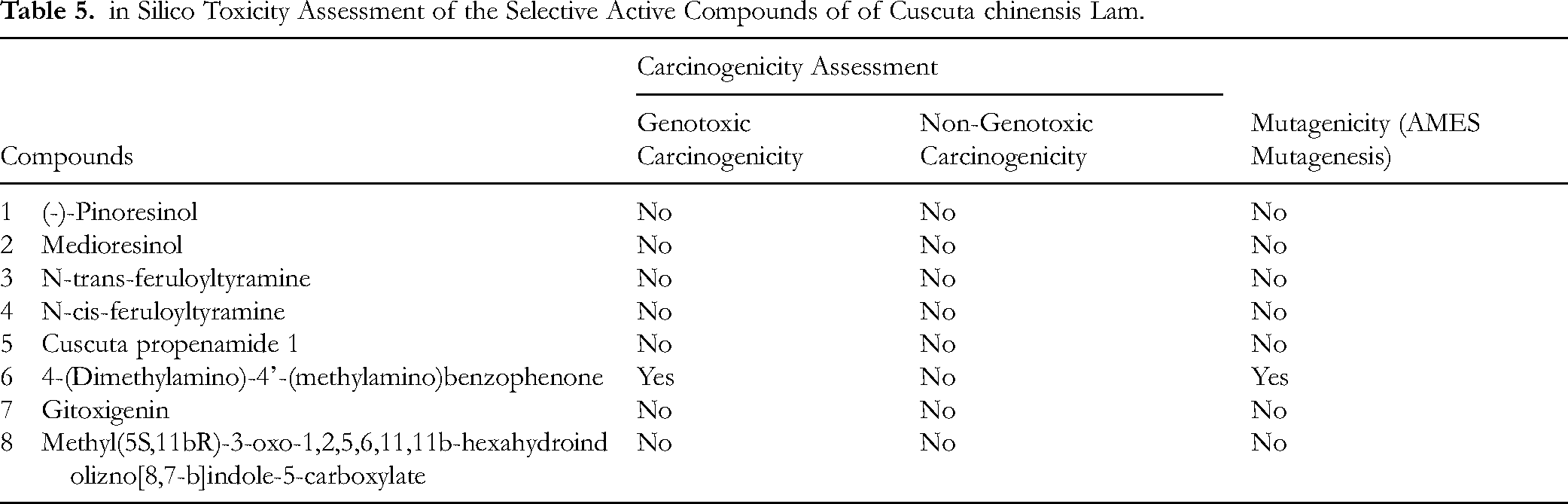
The in silico toxicity prediction of active compounds showed that (-)-pinoresinol, medioresinol, n-trans-feruloyltyramine, n-cis-feruloyltyramine, cuscuta propenamide 1, gitoxigenin and methyl(5S,11bR)-3-oxo-1,2,5,6,11,11b-hexahydroindolizno[8,7-b]in-dole-5-carboxylate were potential non-carcinogens and non-mutagens. However, 4-(Dimethylamino)-4'-(methylamino)benzophenone were assessed to be carcinogenic and mutagenic (Table 5).
in Silico Toxicity Assessment of the Selective Active Compounds of of Cuscuta chinensis Lam.
Discussion
As a traditional herbal folk medicine, C. chinensis has been commonly used to treatment of different diseases in China for a long time. 8 Many of pharmacological properties including cytotoxic effects of C. chinensis have been well documented.8,11 We recently published an article that CLW significantly inhibited lung cancer growth in vitro and in vivo. 14 However, its active ingredients and possible mechanisms for treatment of lung cancer is not clear yet. Therefore, we firstly analyzed chemical constituents of CLW using LC-MS/QTOF experiments and quantified its phenolics and flavonoids. Moreover, we rapidly identified active compounds from C. chinensis, and predicted potential targets for treatment of lung cancer by performing a RNA-seq combined with systematic in silico approach.
HPLC/MS analysis demonstrated that CLW is a reach source of flavonoids, lignans and glycosidic acids. In addition, high amount of of phenolics and flavonoids were observed in the CLW. Accordingly, our data were consistent with some reports that flavonoids, phenolics and lignans are the major compounds of C. chinensis.30,31 Moreover, a time and dose-dependent inhibition of LLC cells viability after treatment of CLW were observed using MTT assay. It is also reported that many of flavonoids and resin glycosides of CLW possesses strong anti-cancer effects in various cancers.12,16,20,32 Therefore, we speculated that some active compounds of CLW such as flavonoids, phenolics, lignans and glycosidic acids may inhibited LLC cell viability via regulating different signal pathways.
RNA-seq analysis is one of the valuable tool to study of gene expression profile, identification of new therapeutic targets and determination of signal pathways in cancer research.33,34 Therefore, to uncover potential mechanism of CLW in inhibition of LLC cells viability, CLW gene expression profile in lung cancer cells were evaluated using RNA-seq analysis. Approximately 79 genes were significantly regulated in LLC cells with CLW treatment. Furthermore, GO analysis indicated that these genes are mainly involved in protein function regulation and cell proliferation.
In silico compounds and target screening methods are more efficient, less costly and easier than conventional experiment procedure. It offers a promising alternative way to elucidating molecular mechanism of folk medicine.35,36 Thus, we screened the active ingredients and targets of C. chinensis with combination of RAN-seq and in silico approaches. Then, evaluated potential targets of active compounds in lung cancer by conducting network and docking analyses. The results showed that 8 active ingredients may interact with BMP1, CCNC, and HSP90B1 target proteins according to H-C-T-D network. It is reported that BMP1 is a member of tolloid metalloproteases family, plays important role in cancer growth and metastasis, and regulates extracellular tumor microenvironment. 37 Another target protein CCNC belongs to cyclin family, an essential regulator in cancer cells. It can regulates lung cancer cell cycle progression by combining with CDK8. 38 As a HSP family member, HSP90B1 may also be involved in tumor cell growth and T-cell receptor signaling. 39 Moreover, HSP90B1 is over expressed in lung cancer cells, and regarded as promising prognosis factor for NSCLC. 40 Based on the above results and literature survey, we hypothesizes that one or more active compounds of C. chinensis may exhibited potent anti-lung cancer effects via regulating BMP1, CCNC, and HSP90B1. Therefore, molecular docking analysis were performed to prediction of the corresponding interaction of 8 active compound with BMP1, CCNC, and HSP90B1, respectively. The results demonstrated strong binding affinity of BMP1 with medioresinol and (-)-pinoresinol. The binding score of BMP1 with medioresinol (−8.0 kcal/mol) and (-)-pinoresinol (−7.9 kcal/mol) higher than BMP1B inhibitor (E8P, −7.8 kcal/mol). Medioresinol forms strong hydrogen bonds with GLU A126, PHE B157 and ARG B18, and van der Waals forces with 13 residues. (-)-pinoresinol also forms strong hydrogen bonds with residues LEU A130, HIS A103, HIS A93 and HIS A93, and van der Waals forces with 10 residues. The BMP1 inhibitor (E8P) forms 3 hydrogen bonds (ALA B153, GLY B180, CYS B65) and van der Waals forces with12 residues. Moreover, gitoxigenin was closely interact with CCNC by formed 3 hydrogen bonds with ARG B157, HIS B154, and ALA B2, as well as van der Waals forces with 3 residues. The CCNC inhibitor (N-(4-chlorobenzyl)isoquinolin-4-amine) only forms van der Waals forces with 4 residues. In addition, similar binding score of CCNC with gitoxigenin (−9.0 kcal/mol) and CCNC with its inhibitor n-(4-chlorobenzyl)isoquinolin-4-amine (−9.2 kcal/mol) was observed. Besides, N-trans-feruloyltyramine strongly interact with HSP90B1. N-trans-feruloyltyramine forms hydrogen bonds with ASN C107, and van der Waals forces with 10 residues. The HSP90B1 inhibitor (ganetespib) only forms van der Waals forces with 8 residues. HSP90B1 displayed similar docking score with n-trans-feruloyltyramine (−8.2 kcal/mol) and HSP90B1 inhibitor (ganetespib,-8.3 kcal/mol). Taken together, (-)-pinoresinol, medioresinol, gitoxigenin and n-trans-feruloyltyramine showed a strong binding affinity with BMP1B, CCNC and HSP90B1, respectively. Since toxicity of therapeutic agents is important factor for the development new drugs, the major toxic effects like carcinogenicity and mutagenicity of the active compounds were predicited for the identification of novel anti-lung cancer drug candidates. 36 The results demonstrated that (-)-pinoresinol, medioresinol, gitoxigenin and n-trans-feruloyltyramine were potential non-carcinogens and non-mutagens. As dietary lignans, medioresinol and (-)-pinoresinol both exhibited chemo-protection effects on some hormone-dependent cancers. 41 It has been found that gitoxigenin possesses the cytotoxic effect on the lung cancer and other tumor cells. 42 It has also been observed that n-trans-feruloyltyramine could decrease human hepatocarcinoma cell proliferation.43,44 In addition, n-trans-feruloyltyramine inhibits melanogenesis in B16 melanoma cells through downregulation of tyrosinase. 45 In a short, the anti-cancer activities of these important active compounds in different cancers combined with our results indicating that (-)-pinoresinol, medioresinol, gitoxigenin and n-trans-feruloyltyramine may suppressed lung cancer via regulating BMP1B, CCNC and HSP90B1. However, our study are limited to prediction of anti-lung cancer known ingredients of C. chinensis and corresponding targets, additional experimental studies including SPR, siRNA, luciferase reporter assay and animal modelling need to consolidate our evaluations. This study provided rapid and efficient methods for the identification of active compounds and related targets of herbal medicine. In silico analysis combined in vitro experiment have many advantages including much more less timely and costly, and easier than conventional experiment procedure.46-50 It offers a promising alternative way to new drug development for the cancer. 51
Conclusion
In this study, we tentatively identified 33 chemical compounds of CLW and quantified its phenolics and flavonoids. Moreover, our in vitro study demonstrated potent anti-lung cancer effect of CLW in LLC lung cancer cells with significantly altering 79 genes. Then, combining RNA-Seq and systematic in silico analysis approaches, we successfully predicted the potential non-toxic anti-lung cancer active ingredients of C. chinensis, namely, medioresinol, (-)-pinoresinol, gitoxigenin and n-trans-feruloyltyramine might targeted BMP1, CCNC, and HSP90B1, respectively. These results indicated that C. chinensis may provides anti-lung cancer candidate drugs for the new drug development.
Supplemental Material
sj-xlsx-1-npx-10.1177_1934578X251337225 - Supplemental material for Identification of Phytochemicals and RNA-Seq Combined in Silico Analysis of Active Compounds and Lung Cancer Related Targets of Cuscuta chinensis Lam
Supplemental material, sj-xlsx-1-npx-10.1177_1934578X251337225 for Identification of Phytochemicals and RNA-Seq Combined in Silico Analysis of Active Compounds and Lung Cancer Related Targets of Cuscuta chinensis Lam by Taierpuke Maimaiti, Mourboul Ablise and Aikebaier Maimaiti in Natural Product Communications
Supplemental Material
sj-xlsx-2-npx-10.1177_1934578X251337225 - Supplemental material for Identification of Phytochemicals and RNA-Seq Combined in Silico Analysis of Active Compounds and Lung Cancer Related Targets of Cuscuta chinensis Lam
Supplemental material, sj-xlsx-2-npx-10.1177_1934578X251337225 for Identification of Phytochemicals and RNA-Seq Combined in Silico Analysis of Active Compounds and Lung Cancer Related Targets of Cuscuta chinensis Lam by Taierpuke Maimaiti, Mourboul Ablise and Aikebaier Maimaiti in Natural Product Communications
Footnotes
Acknowledgments
The Foundation of Natural Science of Xinjiang Uygur Autonomous Region (Grant number 2022D01A87) and Special Funds for Talents of Xinjiang Medical University (Grant number 0103010211) supported this study.

Ethical Considerations
Ethical Approval is not applicable for this article.
Statement of Human and Animal Rights
This article does not contain any studies with human or animal subjects.
Statement of Informed Consent
There are no human subjects in this article and informed consent is not applicable.
Funding
The authors disclosed receipt of the following financial support for the research, authorship, and/or publication of this article: This work was supported by the Natural Science Foundation of Xinjiang Uygur Autonomous Region, (grant number 2022D01A87) and Special funds for Talents of Xinjiang Medical University (grant number 0103010211).
Declaration of Conflicting Interests
The authors declared no potential conflicts of interest with respect to the research, authorship, and/or publication of this article.
Supplemental Material
Supplemental material for this article is available online.
References
Supplementary Material
Please find the following supplemental material available below.
For Open Access articles published under a Creative Commons License, all supplemental material carries the same license as the article it is associated with.
For non-Open Access articles published, all supplemental material carries a non-exclusive license, and permission requests for re-use of supplemental material or any part of supplemental material shall be sent directly to the copyright owner as specified in the copyright notice associated with the article.
