



Abstract
Our knowledge of the green macroalga Halimeda (Ulvophyceae, Chlorophyta) is still poor and underestimated from the phytochemical and pharmacological standpoints. Pharmacological and therapeutic potentials of chemically-diverse compounds derived from different species of the genus Halimeda are highly promising as antiviral, antimicrobial, cytotoxic, antiproliferative, cardioprotective, anti-inflammatory, anti-osteoarthritic, hypoglycemic, hepatoprotective and neuroprotective agents. This review highlighted the diverse phytochemical and pharmacological properties in different species of the genus Halimeda from 1969 to 2024 based on available literature and also discussed their mechanism of action.
Introduction
Marine algae have been considered an alternative source of high-quality food products that have attracted research in recent times, due to their abundance and biodiversity. 1 Marine algae are a source of natural antioxidants that have potential applications in oxidative stress and associated diseases. Numerous studies have shown the efficacy of seaweed extracts on plants including early seed germination, enriched crop performance, and productivity, offering a non-toxic alternative way for disease management, and improved antagonism to different stresses. Marine macroalgae have been the primary source of nutraceuticals since ancient times and have been utilized as a food source. Furthermore, they are currently employed in Chinese and Japanese traditional medicines. 2 The family Halimedaceae, represented by the genus Halimeda (Figure 1), is found worldwide, typically in shallow-water tropical and subtropics, marine habitats. Halimeda J.V. Lamouroux was the first species from the genus Halimeda discovered in 1812. 3 Halimeda abounds around coral reefs up to depths over 150 m. The thallus is constructed of flattened calcified segments with various shapes, alternating with non-calcareous joints (nodes). Growth forms erect, sprawling, or pendant, achieving a height (length) of a few centimetres up to a metre or more. 4 All or most medullary siphons traversing the nodes between segments fuse into a single unit in specimens of lineage and segments at the thallus base fuse with one another. Medullary siphons of specimens in lineage traverse the node without fusing in lineage divide frequently below the nodes and become entangled among one another. The segments of specimens in this lineage possess a continuous uncoordinated band along the distal perimeter instead of three or more pits as encountered in segments of specimens in all other lineages. Members of lineage possess club-shaped sub-peripheral utricles in their cortical region. Medullary siphons of specimens in lineage fuse over only a short distance at the nodes and retain their identity. 5 Halimeda species are important contributors to coral reef sediments and structure. 6 Crystal growth and associated cytoplasmic changes were observed in H. monile and H. incrassata by electron microscopy. Aragonite crystals were first formed at the filament wall surface. As the segments aged, the interarticular spaces became filled with crystals. No organic matrix was observed at the sites of crystallization. The crystals exhibited random orientation. Two unidentified cytoplasmic components, one of fibrillar spherical form and another of high electron density, were present in large numbers. 7 There are 69 species names within the literature currently, 48 are accepted taxonomically supported by the listed literature below the species name. 3 The high content of the macronutrients (K, N, P, and Ca) in the genus Halimeda extract might be responsible for improving the water status of the plant, therefore increasing its growth rate under normal and stressful circumstances. One of the most striking features of Halimeda extract or seaweeds generally is increasing the pigment content of plant leaves and this may be attributed to the presence of high betaines content in the seaweed extract that resulted in reducing the degradation of leaf chlorophyll under stresses instead of increasing its content or it may be due to the high nitrogen content in the seaweed extract, which is the main component in chlorophyll molecule. 8 Another opinion supporting the stimulation of chlorophyll content of seeds priming with seaweeds suggests that algal extract delays the loss of photosynthetic activity by preventing chlorophyll degradation. 9 Algae has been identified as a rich source of diverse natural products with diverse pharmacological activities. Though Halimeda has not triggered the most attention of researchers, the therapeutic potentials of pure compounds isolated from Halimeda are promising as antiviral, antimicrobial, cardioprotective, hepatoprotective, cytotoxic, antiproliferative, anti-inflammatory, anti-osteoarthritic, hypoglycemic, and neuroprotective. Some metabolites such as halitunal and halimedatrial have brought great attention as difficult issues in structure elucidation and total synthesis because of their uncommon structural complexity and interesting pharmacological properties. This review covers the literature on the genus Halimeda along with its chemical and medicinal potential during the period 1969 to 2024.

Different types of Halimeda species
Ecology of The genus Halimeda
Ocean warming and acidity are causing major rearrangement and destruction of coral reef ecosystems. Important primary producers and reef-builders, calcareous algae have a variety of morphologies, lifestyles, and adaptation mechanisms. 10 Halimeda can be found in a variety of environments, including the deepest regions of the photic zone, broad submerged plateaux or open shelves, and sandy lagoons with relatively shallow water that are typically home to seagrass and other macroalgae. The unusual internal structure of the algal segments, which causes a quick calcification and the subsequent filling of inter-utricular voids with aragonite crystals, is directly responsible for the significant contribution to carbonate formation. Temperature, light intensity, and seawater chemistry all affect the synthesis of carbonate. 11 Temperature significantly impacts H. jolyana physiological behaviour, causing changes in response variables and reduced biomass yield. Metal exposure and lower temperatures, particularly in its southern range, result in increased physiological stress. The highest temperature treatment ameliorates these effects. H. jolyana sensitivity to temperature variations and metal enrichment makes it a suitable candidate for local biomonitoring environmental changes. 12 Determining the genetic basis of algae that are at an evolutionary crossroads from unicellular to multicellular, from intracellular to extracellular calcifying, and from acidification-sensitive to acidification-tolerant remains a considerable challenge. Unique genetic traits linked to multinucleation, cell fragment regeneration, extracellular calcification, and tolerance of CO2 increases in seawater were revealed by genome analyses of H. opuntia and other algae. 13 Bioherms of calcareous green algae, as those in the genus Halimeda, are essential for paleoecological and stratigraphic archives. Because of a quick calcification process in their internal structure, they play a major role in the creation of sediments that are high in CaCO3. Although Halimeda bioherms can be found in reefs across the tropical belt today, extensive bioherms are only found in places like the Caribbean, Australia's Great Barrier Reef, and Indonesia's K-Bank. Data from two tiny Halimeda bioherms on the Salento Peninsula in Italy are presented, demonstrating that they record the same facies with alternating cycles of shallowing and deepening. 11
Traditional Medicinal Uses of Halimeda
A marine edible seaweed, Halimeda is a member of the Halimedaceae family, Bryopsidales order, and Bryopidopyceae class. It lacks common names and synonyms. 3 The species is widely distributed along the Mediterranean Sea and Red Sea.14,15 Halimeda has significant economic value due to its ability to produce hydrocolloids, which are used in the food and pharmaceutical industries. It is a rich source of natural antioxidants such as carotenoids, disclosed the presence of unique classes such as xenicane lactone, sym-triazine derivatives, unique bis-indole alkaloids, many sugars, and, bis-nor diterpene derivatives, high phenolic contents, high total flavonoid content, terpenoids, and it has numerous biomedical applications. 16 In Asia, seaweeds are historically eaten as sea vegetables, 17 while in the West, they are utilized as thickening or gelling agents. 18 With high levels of minerals (Mg, Ca, P, K, and I), vitamins, proteins, and indigestible carbs, and low levels of fats, 19 they can be regarded as low-calorie foods. 20 Numerous studies show that Halimeda extracts can also exhibit significant functional properties like antioxidant, 21 antimicrobial, 22 antiviral, 23 larvicidal 24 antimutagenic, anticoagulant, 25 antidiabetic, 26 anticancer, 27 and spermicidal properties. 28
Critical Assessment
In the past decades, the publication rate regarding the genus Halimeda has increased (Figure 2). Fifteen species named Halimeda representing about 31.25% of the accepted taxonomically species were investigated for their chemical and pharmacological activities, and five species were the most studied as potent drug sources, namely H. gracilis, H. incrassata H. macroloba, H. opuntia, and H. tuna. Halimeda is considered one of the most edible seaweeds owing to its high contents of nutritional components such as protein content (20.08 ± 0.33%), lipids (0.54 ± 0.01%), total carbohydrates (15.11 ± 0.35%), polysaccharides (70.04 ± 0.48%), sulfates (5.20 ± 0.08%), total soluble proteins (0.06 ± 0.07%), and polyphenols (43.93 ± 0.47%). Using an untargeted metabolomics method, this study examines the chemical profiles of several solvent extracts of Ephedra foeminea and evaluates their antioxidant potential. Jordanian E. foeminea samples were macerated in a variety of polarity solvents, including acetone, ethanol, methanol, dichloromethane/methanol, and ethyl acetate. Using techniques from GC–MS, LC–MS, and NMR, the resultant crude extracts were subjected to extensive chemical profiling and metabolomics investigation. Venn diagrams, PCA, and MESA were used to analyze the data. The crude extracts were subjected to the ABTS assay to assess antioxidant activity. The main chemical groupings found by MESA were fatty acids amino acids, carboxylic acids, and carbohydrates. The results showed that the most distinctive molecules and the most different chemical compositions were found in methanol and dichloromethane/methanol extracts. Although no statistically significant differences were found, the methanolic extract showed the highest antioxidant potency among the extracts (IC50 = 249.6 µg/mL) in the ABTS experiment. In summary, the solvent selection had a major impact on the metabolite extraction process from E. foeminea, with the methanolic extract exhibiting strong antioxidant activity that may be related to its wide range of bioactive metabolites. 29 Several bioactive compounds with diverse chemical structures, such as bromophenols, carotenoids, amino acids, hydrocarbons, fatty acids, terpenes sterols, and sulfated polysaccharides (Tables 1 and 2), were reported. Fatty acid derivatives were the major phytochemical class with terpenes, sulfides, hydrocarbons, bromophenols, and many fatty acid derivatives (Figure 3, Table 1). The genus Halimeda was characterized as a valuable source for developing novel natural products for clinical application. The most abundant fatty acids were palmitic acid and polyunsaturated fatty acid (PUFA) (n- 3 and n-6) in different percentages depending on species and time of collection. Campesterol and β-sitosterol were detected as major sterols. Reviewing the chemical diversity of Halimeda disclosed the presence of unique classes such as xenicane lactone, sym-triazine derivatives, unique bis-indole alkaloids, many sugars, and, bis-nor diterpene derivatives, high phenolic content, and high total flavonoid content. Variations in the chemical structure and diversity of the bioactive compounds in the genus Halimedia are species-specific, in addition to the biogeographical distribution, seasons of collection, environmental conditions, and analytical methods applied. Several biological and pharmacological applications of the genus Halimeda have been discussed, including antimicrobial, antiviral, antioxidant, antiproliferative, hepatoprotective, and neuroprotective with the major activity being antimicrobial (Figure 3). Finally, Lectin detected in H. renschii has been reported to potently inhibit the infection of the influenza virus.

Publication rate about the genus Halimeda.
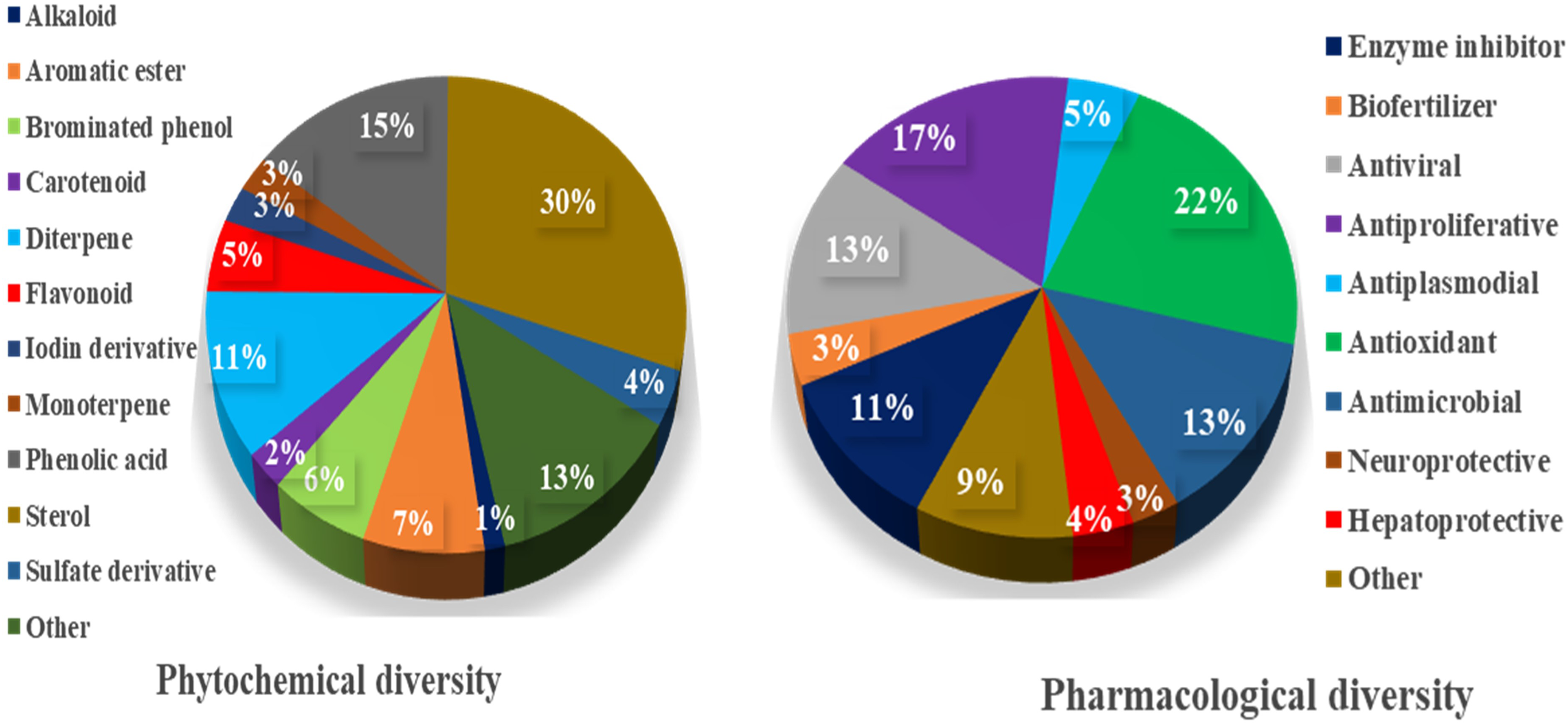
Phytochemical and pharmacological diversity of the genus Halimeda.
Biological Assays Related to the Therapeutic Potential of Some Halimeda Compounds

Biological Assays Related to the Therapeutic Potential of Halimeda Extracts

The presence of phenolic phytochemicals explains antioxidant activities. Four extracts represented 10.00% of studied extracts and four phytochemicals represented 7.84% of the detected phytochemicals investigated as in vivo antiproliferative and it did not cover all types of cell lines. Eight extracts represented 20.00% of studied extracts and four phytochemicals represented 7.84% of the detected phytochemicals investigated as in vivo antimicrobial using disk diffusion method not spectrophotometric method and one extract was detected as antibiofilm. one extract represented 2.50% of studied extracts without identification of phytochemicals responsible for each pharmacological activity such as spermicidal, neuroprotective, cardioprotective, nephroprotective and mosquito larvicidal. Two extracts represented 5.00% of the studied extracts without the identification of phytochemicals responsible for hepatoprotective activities. Four extracts represented 10.00% of studied extracts and five phytochemicals represented 9.81% of the detected phytochemicals investigated as in vivo enzyme inhibitors and it did not cover all types of enzyme inhibitors. Four extracts represented 10.00% of the studied extracts investigated as antiplasmodial without the identification chemical composition of these extracts. Silver nanoparticles were applied as an anti-inflammatory, antimicrobial, and seed germination. Since chemical processes involving proteins mostly take place in aqueous phases or at the interface between aqueous phases and biological membranes, pH is a crucial element that affects how well the human proteome functions. The pH of human and animal blood, as well as well-irrigated tissues like the brain and lungs, fluctuates around 7.35, which is the ideal pH for human proteome performance, which is compatible with the small pH range. The human proteome may be affected systemically by the rise in pCO2 levels brought on by contemporary, urban, and sedentary lifestyles. Although acute exposure to extremely high pCO2 levels has been the main focus of research, the human proteome is also impacted by persistently high CO2 levels. These consequences align with conditions such as mental and respiratory illnesses, diabetes, and obesity. These illnesses can be partially explained by the association between current lifestyle health problems and high CO2. Humans who are exposed to high CO2 on a regular basis have a lower pH (downregulated from 0.1 to 0.4 units below the ideal pH), which is likely to cause proteome dysfunction in both plants and animals. The cause of this problem includes misfolding, aggregation, charge distribution, and changed interactions with other molecules (such as metals, proteins, medicines, and nucleic acids). 30
Pharmacological, Natural Products and Applications of the Genus Halimeda
Halimeda copiosa Goreau & E. A.Graham 1967
Diterpenoid trialdehyde, halimedatrial

Chemical structures of compounds 1- 32.
Halimeda cuneata Hering 1846
Halimeda cuneata Metabolites
The highest total phenolics, condensed tannin, and flavonoids were detected in H. cuneate (3.64 mg catechin equivalents/g), collected from KwaZulu-Natal (South Africa). Based on UHPLC-MS/MS, methanol extract has different concentrations of protocatechuic acid
Halimeda cuneata Extracts
The methanol extract of H. cuneate collected from South Africa has antifungal, antibacterial, and AChE inhibitory activity. 36 The extract inhibited the growth of the Gram-positive bacteria, with B. subtilis being more susceptible than S. aureus (MIC = 6.25 mg/mL). The extracts tested had AChE inhibitory activity, with no seasonal variation in activity (IC50= 5.8 ± 0.9 to 8.2 ± 1.6 mg/mL), and galanthamine, the pure compound used as a reference had an IC50 of 0.0007 mg/mL. 37
Halimeda cylindracea Decaisne 1842
Halimeda cylindracea Metabolites
Alkaloid caulerpin
Halimeda cylindracea Extracts
Several extracts from H. cylindracea, collected from Indonesia, were tested as antibacterial. The antibacterial activity was evaluated against S. aureus, E. coli, and S. typhi. The ethyl acetate extract showed activity against all tested bacteria while acetone extract was active against S. aureus and E. coli only, n-hexane extract was active against S. aureus. The ethanol extract was not active for all tested bacteria. n-hexane, ethyl acetate, acetone, and ethanol extracts of macroalgae H. cylindracea were toxic toward Artemia salina Leach with moderate toxicity category with (LC50 = 134.90, 281.84, 338.84, and 295.12 µg/mL respectively). 39
Halimeda discoidea Decaisne 1842
Halimeda discoidea Metabolites
Unsaturated fatty aldehyde E-15-heptadecenal (
Halimeda discoidea Extracts
To determine whether H. discoidea has any antibacterial properties against broad-spectrum bacteria, yeast, and fungus, several solvent extracts of the Malaysian island's Kera were examined. The greatest activity was found in n-hexane extract, which was followed by ethyl acetate and chloroform extracts. The investigated fungi did not exhibit any antifungal activity at the minimum fungicidal concentration (MFC = 1.00 mg/mL to 2.00 mg/mL). While chloroform extract was effective against C. albicans, ethyl acetate extract was effective against S. epidermis, B. spizizenii, MRSA, and B. cereus (mean inhibition zones 7.0-9.0 mm). 40
Nutritional Values of Halimeda discoidea
In distilled water extract of H. discoidea, collected from Sri Lanka, protein (17.42 0.47%), lipid (0.83 0.02%), carbohydrate (13.61 0.21%), polysaccharide (68.44 0.30%), sulfate (5.20 0.17%), total soluble proteins (0.96 0.21%), and total polyphenol content (4.04 ± 0.00%). 41
Halimeda gigas W.R.Taylor 1950
With antibacterial agents S. aureus and B. subtillis (MIC = 4 and 8 g/mL, respectively), Halimedatrial
Halimeda goreaui W. R. Taylor 1962
The fatty acid composition of the Caribbean species H. opuntia, H. goreaui, H. copiosa, H. monile, H. simulans, and H. incrassata was detected. The six species possessed similar fatty acid compositions with some exceptions. Principal fatty acids were myristic acid (C14:0), palmitic acid
Halimeda gracilis Harvey ex J. Agardh 1887
Halimeda gracilis Metabolites
Pyridine 2,4-dimethyl
Halimeda gracilis Extracts
In crude ethanolic extract of H. gracilis, obtained from the Gulf of Mannar (India), which was tested for spermicidal activity, proteins, sugars, flavonoids, and alkaloids were found. Human spermatozoa were immobilized for 20 s by H. gracilis at a concentration of 10 mg/mL (EC50 = 2.05 mg/mL in 20 s). This was demonstrated using a dose- and time-dependent spermicidal experiment. Due to exposure to H. gracilis extract, which exhibited 88.5% cytotoxic incidence, the sperm plasma membrane was harmed. Artemia salina was evaluated with H. gracilis extract for cytotoxicity (LC50 = 34.8 g/mL). 28 The 2,2-diphenyl-1-picrylhydrazyl (DPPH) antioxidant analysis revealed that methanol extracts of H. gracilis and H. macroloba, which were obtained from the Tidung Island Coastal Region, increased in antioxidant activity in a dose-dependent manner. At 700 ppm, H. macroloba and H. gracilis have the maximum antioxidant activity in methanol extract, measuring 6.590% and 3.614%, respectively. 44 H. opuntia and H. gracilis ethanol extracts, collected from India, showed an antiplasmodial effect (IC50 = 60.77 and value of more than 100 μg/mL, respectively). 45 The antioxidant activity of the Indonesian-collected crude methanol extract of H. gracilis was around 18.55-23.94%, but that of H. macroloba was only about 13.49-17.88%. When compared to H. macroloba, was lower than H. gracilis’ crude methanol extract antibacterial activity against V. harveyi and S. maltophilia.. 46 The Ag-nanoparticles of aqueous extract of H. gracilis, collected from Olaikuda (India), showed the highest resistance against K. pneumoniae and P. mirabilis. The Ag-nanoparticles synthesized from H. gracilis had a maximum growth-promoting effect and the highest seed germination in the case of Raphanus sativus var. longipinnatus. This may be due to the easy penetration of Ag-nanoparticles for their nano-size. 47
Non-Pharmaceutical Applications of Halimeda gracilis
Textiles are crucial for sustenance and fashion, with nearly one million dyes available. However, azo-reactive dyes, accounting for 30% of dye materials, contribute to soil and water pollution, deteriorating soil and water quality, and posing health risks. In vitro conditions were used to eliminate Corafix Yellow GD3R dye (CYGD3R) using H. gracilis collected from the Mandapam, Tamil Nadu. To determine the most suitable ideal circumstances for the extreme removal of dye, process variables influencing the adsorption capacity of CYGD3R, such as dye concentrations, biosorbent concentrations, pH, incubation duration, and temperature, were optimized. After 72 h of incubation, the medium supplemented with 300 mg/L of dye and 200 mg/L of biosorbent at 25 °C showed the highest dye removal (88%) at pH 6. 48 H. gracilis achieves maximum removal of Cu (II) at pH-4.49, 1.98 g/L sorbent dosage, 119.43 rpm agitation speed, and 60.21 min contact time. 49 H. gracilis achieves maximum removal of Cr(VI) at pH 4.9, sorbent dosage 2.2 g/L, agitation speed 136 rpm, and contact time 47 min. 50
Toxcitiy of Halimeda gracilis
The Halimeda gracilis was shade-dried after being gathered from the Gulf of Mannar coastal region. The zebrafish model was used to test the methanolic extract of H. gracilis for acute toxicity and anti-diabetic effects. The zebrafish were divided into six groups for the acute toxicity investigation, and they were given doses of 6.25, 12.5, 25, 50, and 100 mg/L of methanolic extract of Halimeda gracilis. They were then monitored at intervals of 0, 24, 48, 72, and 96 h. Analysis of anti-diabetic activity Streptozotocin was used to cause diabetes (STZ). The zebrafish were split up into six groups: conventional control (metformin-treated), diabetic Zebrafish with three doses of the methanolic extract of H. gracilis, positive control, and control group. No notable behavioural alterations were observed in the acute toxicity trial, and the LC50 was found to be 100 mg/L. When compared to the control group, test groups in the diabetic study demonstrated significant alterations in pancreatic β-cell regeneration, decreased vacuolization in the islets of Langerhans, and a significant decrease in both fasting and postprandial blood glucose levels. When comparing the methanolic extract of H. gracilis treated fish to the control group, photos of the regenerated caudal fins taken 24, 48, and 72 h after amputation showed a considerable amount of limb regeneration. 26
Nutritional Values of Halimeda gracilis
In distilled water extract of H. gracilis, gathered from the coast of Galle (Sri Lanka), protein content (20.08 0.33%), lipid (0.54 0.01%), carbohydrate (15.11 0.35%), polysaccharide (70.04 0.48%), sulfate (5.20 0.08%), total soluble proteins (0.06 0.07%), and polyphenol content (43.93 ± 0.47total %). 41
Halimeda incrassata (J.Ellis) J.V.Lamouroux 1816
Halimeda incrassata Metabolites
Caulerpin
Halimeda incrassata Extracts
H. incrassata aqueous extracts at concentrations more than 0.20 mg/mL protect against hydrogen peroxide-mediated cell death. H. incrassata extract can also reduce hydrogen peroxide-induced ROS generation. At doses greater than 0.05 mg/mL, show protection against methyl mercury chloride-induced neuronal death as well as methyl mercury chloride-mediated ROS production. After depleting GSH intracellular pools with either hydrogen peroxide or methyl mercury chloride, there was no rise in baseline levels. 55 The strongest antioxidant activity was found in an aqueous extract of H. incrassata obtained from the Havana city shore (Cuba), which inhibited the formation of thiobarbituric acid reactive substances (TBARS) during the spontaneous lipid peroxidation of rat brain homogenates (IC50 = 0.340 mg/mL). Aqueous extract of H. incrassata (0. 5 mg/mL) reduced in vitro hydrogen peroxide production via two separate metabolic pathways involving glutamic and malonic acids. H. incrassata aqueous extract (at dosages of 50, 100, and 200 mg/Kg) demonstrated a neuroprotective effect in vivo on the gerbil model of bilateral carotid occlusion by lowering ischemia-induced locomotor and exploratory activity. 56 The antioxidant activity of H. incrassata obtained from Bajo de Santa Ana (Cuba) was investigated in vitro in smooth muscle cell migration and lipoprotein oxidation. The aqueous extract inhibited lipoprotein oxidation mediated by Cu2+, and H. incrassata extracts produced dose-dependent suppression of thiobarbituric acid reactive substances (TBARS), (IC50 = 0.8 mg/mL), and conjugated dienes production. The strong antioxidant activity might be due to the phenolic content ischemia. 57 The hydrophilic extracts of H. incrassata obtained from Bajo de Santa Ana (Cuba) were shown to have in vivo atheroprotective potential coupled with antioxidant activity. The phenolic content was 0.13 ± 0.05 mg of gallic acid equivalents (GAE)/g DW in the aqueous extract and 0.47 ± 0.09 mg in the fraction phenolic acids (FPA). In the presence or absence of EDTA, the H. incrassata extract prevented deoxyribose oxidation (IC50 = 1.91 ± 0.09 mg/mL) (IC50 = 2.95 ± 0.01 mg/mL). In vivo antioxidant activities of H. incrassata fraction phenolic acids (FPA) were examined in rats with CCl4-induced liver damage. H. incrassata pre-treatment reduced liver TBARS levels by roughly 50%. The FPA from H. incrassata also boosted the activity of the catalase enzyme. 58 n- Hexane, ethyl acetate, and methanol extracts of Jamaican H. incrassata were discovered as anti-proliferation against the human melanoma A375 cell line, however, there was no substantial anti-proliferation (IC50= 30, 6.691, and 15.70 g/mL, respectively). 59
Halimeda macroloba Decaisne 1841
Halimeda macroloba Metabolites
Minerals such as Fe, Mn, Zn, and Cu are also abundant in Halimeda. Minerals are essential components of antioxidant enzymes. Minerals such as Zn, Cu, and Mn are required for superoxide dismutase action. Polyphenolic and related phenolic chemicals were isolated from H. macroloba and H. opuntia, both collected in the same season in Okinawa, Japan. H. macroloba had a significant level of epigallocatechin

Chemical structures of compounds 33- 52.
Halimeda macroloba Extracts
Researchers are becoming more interested in the green synthesis of gold nanoparticles (AuNPs) due to the wide range of biological and environmental uses for these particles. The innovative, environmentally friendly synthesis of AuNPs utilizing extract from green macroalgae, Halimeda macroloba (HM), and assess their potential for photocatalysis. Under solar radiation, the green-produced HM-AuNPs capacity for photocatalytic degradation was tested against the dyes methylene blue (MB) and methylene orange (MO). After 90 min in the sun, the HM-AuNPs demonstrated 97.23% and 89.91% photocatalytic activity against MB and MO, respectively. The study overall findings suggested that using HM-AuNPs mediated by H. macroloba is a viable method for degrading industrial colours. 65
H. macroloba contains alkaloids, steroids and triterpenoids, saponins, flavanoids, tannins, and glucosides that can be utilized to keep skipjack tuna fresh physically, chemically, and microbiologically. With a score of 8.43, the physical organoleptic evaluation findings concerning the ideal characteristics of meat's appearance, fragrance, and texture were seen in the A5 concentration treatment (600 ppm). Following that, the chemical test results revealed that treatment A5 (600 ppm) had the greatest protein content and total volatile base (TVB) values, with a percentage value of 22.9%. Furthermore, the TVB value for the A4 treatment (400 ppm) was 9.24 mg/100 g. Meanwhile, the microbiological analysis indicated that the total plate count (TPC) value of 0.5105 col/g was discovered in treatment A5 (600 ppm). 66
The ethanol extract from the Indonesian H. macroloba had the greatest yield content, totaling 2.32%. Using the DPPH technique, the ethanol extract had an IC50 of 121.445 ± 1.03 mg/L, the n-hexane extract had an IC50 of 181.945 ± 1.95 mg/L, and the ethyl acetate extract had an IC50 of 228.67 mg/L. The antioxidant capacity of the ethanol extract was 516.50 ± 70 mol trolox/g extract, the ethyl acetate extract was 482.00 ± 41 mol trolox/g extract, and the n-hexane extract was 323.50 ± 70 mol trolox/g extract when measured using the ferric reducing antioxidant power (FRAP) method. Furthermore, the CUPRAC (cupric ion reducing antioxidant capacity) technique revealed that the ethanol extract contained 159.85 ± 70 mol trolox/g. 67
In vitro assay of H. macroloba, collected from Malaysia, water extract was detected as an α-glucosidase inhibitor, (IC50 = 6.388 mg/mL). 68 The antibacterial efficacy of crude extracts of green algae H. macroloba obtained from Lae-Lae Island (Indonesia) against shrimp pathogenic bacteria (V. harveyi, A. hydrophilla, and V. parahaemolyticus) was investigated. At a concentration of 4 g/25 μl, the ethyl acetate extract was the most effective antibacterial agent. The inhibition zones for A. hydrophilla (the most sensitive microbe) and V. harveyi growth were 8.27 mm and 8.23 mm, respectively (the inhibition zone for ciprofloxacin, which was employed as a positive control, was 15.2 mm). 69 Methanol and acetone extracts of H. macroloba collected from Mandapam coast (India) were tested invitro potent activity against P. aeruginosa, P. mirabilis, S. aureus, E. coli, S. pneumoniae, C. albicans, Candida spp, with the disc diffusion method. H. macroloba exhibited a broad spectrum of antifungal and antibacterial activity, the overall activity profile indicated the methanol extract of H. macroloba contained more antimicrobial activity.70,71 The body scrub is a cosmetic product that contains slightly rough material that can remove dead skin cells. H. macroloba has the potential to be used as a scrub. H. macroloba deposits CaCO3 in the thallus which makes the texture of Halimeda flour rougher than that of other flour so that it is potentially used as a scrub. Formulation of body scrub using 3% H. macroloba and 2% konjac flour (an emulsion-forming agent which contains high glucomannan) was carried out by mixing water base (glycerine, propylene glycol, aquadest) and oil base (stearic acid, cetyl alcohol, DEA, perfume) at temperatures of 70 °C and 80 °C. Body scrub produced contained moisture of 58.49-75.15%, pH 6.48-6.93, viscosity 10 106.67-14 900.00 cP, whiteness 67.74%-95.96%, with spread ability 1.63-2.17 cm. The highest macro mineral content was calcium with an average of 8.24 mg/g, while the highest micromineral was iron with an average of 16.85 ppm. 72
Toxicity of Halimeda macroloba
After an overnight fast, female Wistar albino rats were given a single oral dosage of 50, 300, and 2000 mg/kg BW (body weight). For 14 days, the rats were observed twice daily after being starved for 4 h and then every 30 min. BW, hematological, biochemical, histopathological, and gross morphology were all analyzed to ascertain the overall toxicity behaviour. Single-dose 70 % alcohol H. macroloba extract at increasing levels did not cause any notable abnormalities or deaths. No behavioural or body wight changes. Most of the biochemical and hematological markers were within normal limits. Showed no discernible alterations. At the same time, some reported minor differences that might or might not be brought on by H. macroloba extract without any gross morphological abnormalities or lesions. Histopathological investigations revealed that HME had no adverse effects on organs. Administering 70 % alcohol H. macroloba extract at doses as high as 2000 mg/kg BW did not cause acute toxicity or impairment to the kidney, liver, or pancreas. Nevertheless, no deaths or negative effects were reported from the study's restricted test dose of 2000 mg/kg, BW 73
Nutritional Values of Halimeda macroloba
The nutritional values and heavy metals of H. macroloba, collected from Phuket (Andaman coast), were detected. The young parts and the old parts of the thallus of freshly collected H. macroloba were analyzed separately for six proximates, five macro minerals, and two heavy metals. Old and young thallus parts of H. macroloba contained low energy (21.75 ± 4.95 and 20.85 ± 5.08 kcal/100 g) and low fat (0.04 ± 0.01 and 0.01 ± 0.02 g/100 g). It is a rich source of insoluble fibre (3.60 ± 0.11 and 3.59 ± 0.06 g/100 g). H. macroloba contains significantly higher calcium in the old segment (3923 ± 288 mg/100 g) than in the new segment (2443 ± 510 mg/100 g). The heavy metals cadmium and lead were found in concentrations considered to be safe for consumption. H. macroloba may have the potential as an excellent source of calcium, but calcium bio-accessibility needs to be studied as well as safety. 74
Halimeda monile (J.Ellis & Solander) J.V.Lamouroux 1816
Caffeic
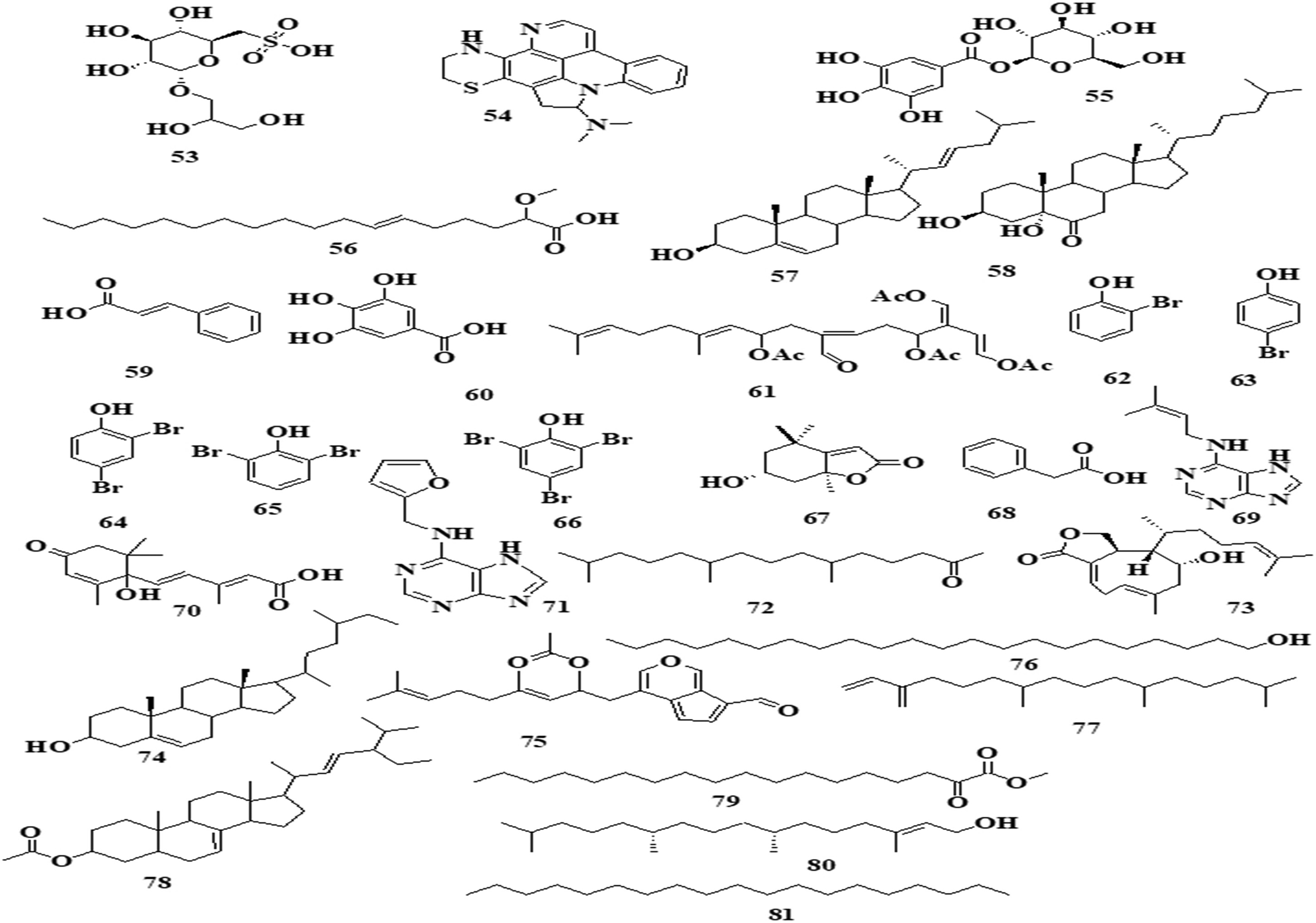
Chemical structures of compounds 48-81.
Halimeda opuntia (Linnaeus) J.V. Lamouroux 1816
Halimeda opuntia Metabolites
Halimedatrial
Halimeda opuntia Extracts
The antimicrobial, antiplasmid, and cytotoxic activities of H. opuntia, collected from the Red Sea coast (Egypt) were investigated. H. opuntia extracts exhibited antibacterial activity against six species of microorganisms, with significant inhibition against S. aureus. Comparative antibacterial studies showed that Halimeda extract showed equivalent or better activity as compared with commercial antibiotics when tested against S. aureus. Further tests conducted using the dilution method showed the extract as having a bacteriostatic mode of action against the tested microorganisms. The methanol extract showed significant cytotoxicity (LC50 < 500 μg) on brine shrimp. H. opuntia showed high cytotoxic activity (LC50 = 192.3 μg). Also, the ability of methanol extract of the algal extract to cure R-plasmids of certain clinical E. coli isolates. The active fraction of H. opuntia could cure plasmids of E. coli at curing efficiencies of approximately 78%. The active fraction mediated plasmid curing resulted in the subsequent loss of antibiotic resistance encoded in the plasmids as revealed by the antibiotic resistance profile of cured strains. 1 Hepatoprotective properties of the aqueous extract and tetrahydrofuran-extracted phenolic fractions of H. opuntia, collected in Bajo de Santa Ana, Havana City, (Cuba) were detected in rats with chemically induced liver injury. Reverse transcription/polymerase chain reaction (RT/PCR) analysis showed increased superoxide dismutase (SOD) and catalase (CAT) gene expression and activities in the group treated with free phenolic acid (FPA) fractions of H. opuntia, suggesting inducing effects on both enzymes. Also, rats treated with FPA fractions displayed lower liver thiobarbituric acid reactive substance (TBARS) levels than those observed for rats in the CCl4-treated group. The total polyphenolic content of the aqueous extract of H. opuntia was 97.2 ± 7.3 µg of GAE/g DW. The hepatoprotective properties of H. opuntia, Wistar rats with CCl4-induced liver injury were treated with an FPA fraction with a total polyphenol content of 5.92 ± 0.85 µg of GAE/g DW. Pre-treatment with H. opuntia (80 mg/kg) led to 20% and 25% reductions in serum and liver TBARS levels, respectively. 86 Sulfated and pyruvylated galactans were isolated from H. opuntia. They represent the only important sulfated polysaccharides present in the cell walls of these highly calcified seaweeds. Their backbone comprises 3-, 6-, and 3,6-linkages, constituted by major amounts of 3-linked 4,6-O-(1'-carboxy) ethylidene-d-galactopyranose units in part sulfated on C-2. Sulfation on C-2 was not found in galactans from other seaweeds of this order. Also, a complex sulfation pattern, comprising 4-, 6-, and 4,6-disulfate galactose units was detected. 87 Proteolytic processing with papain, followed by ethanol precipitation, yielded the anticoagulant potential of sulfated polysaccharides (SP) isolated from the green algae H. opuntia collected from Prado municipality (Brazil). Agarose gel electrophoresis verified the existence of SP and showed distinct populations in each component. It has been demonstrated that the anticoagulant action mechanism depends on two coagulation factors, IIa and Xa, with IIa having a greater potency. This fraction will be evaluated at the medical clinic in subsequent evaluation. 25 The total phenolic content of the methanol extract of H. opuntia was determined according to the Folin-Ciocalteu method, yielding a result of 55.04 ± 0.98 mg GAE/g of extract. As determined by the aluminum chloride colorimetric method, the total flavonoid content of the extract was 40.02 ± 0.02 mg QE/g of extract. Antioxidant activity was determined by using a 2,2-diphenyl-1-picrylhydrazyl (DPPH) assay with different concentrations that ranged between 200 and 1000 µg/mL, H. opuntia as the highest in DPPH reduction (63.61% at 1000 µg/mL) and total antioxidant capacity (TAC) (57.36 ± 0.004 mg AAE/g extract at 1.0 mg/mL). The cytotoxic activity of this seaweed was pre-screened against a panel of cell lines including human breast adenocarcinoma (MCF-7 and MDA-MB-231), human hepatocellular carcinoma (HepG2), human colorectal adenocarcinoma (HT-29), and mouse embryonic fibroblast (3T3) using the MTT assay. The content of total lipids in H. opuntia was 1.60 ± 0.002%. Total carotenoids were 115.57 ± 0.98 µg/g, while chlorophyll a and chlorophyll b were 148.73 ± 2.60 µg/g and 290.83 ± 9.46 µg/g, respectively. H. opuntia extracts at 100 and 200 mg/kg were administered orally to alloxan-induced diabetic rats once daily for 15 days. Serum glucose levels, complete blood count (CBC), and kidney function of rats were measured at the end of the experiment. The liver function of the pancreas was also observed. The pre-prandial and postprandial glucose levels in the group treated with H. opuntia extracts (100 and 200 mg/kg) were significantly reduced compared with those of the diabetes group. Additionally, the levels of CBC, kidney function, and liver function in the 100 and 200 mg/kg H. opuntia extract were significantly different from those in the diabetes group. 88
Non-Pharmaceutical Applications of Halimeda opuntia
H. opuntia extract can enhance the growth characteristics and some biochemical contents of maize exposed to saline conditions at the vegetative stage. The salted maize plants were foliar sprayed twice daily with an aqueous extract of H. opuntia, collected from Hurghada City cost line, Red Sea (Egypt). The foliar treatment with H. opuntia extracts significantly increased the dry and fresh weight of the shoot and root and also improved the potassium, carotenoids chlorophyll a, and chlorophyll b contents compared to the control (untreated stressed plants). Generally, proline, carbohydrates, and sodium contents were decreased, while phenols, protein, and alkaloids were increased in treated plants in comparison with untreated maize plants. 89 Because of their many industrial uses, seaweeds high in protein are considered to have commercial value. In this study, bioplastic film was made using the green seaweed Halimeda opuntia. A thin bioplastic film with enhanced physical and mechanical properties was generated by adjusting the ratio of polyvinyl alcohol (PVA) to seaweed biomass. The resulting films’ thickness, tensile strength, elongation at break, Young's modulus, resistance to moisture absorption, and solubility were all evaluated. Better mechanical and physical properties were exhibited by the bioplastic films generated when the percentage of algae in the PVA concentration was increased.90,91 The Carbon quantum dots CQDs synthesized from H. opuntia exhibit a specific capacitance of 311 F g−1. Recently, carbon quantum dots also referred to as zero-dimensional nanomaterials have become highly desirable materials for a wide range of technological applications in energy conversion, storage, and optoelectronics. They have excellent optical qualities, low toxicity, good biocompatibility, favourable charge transfer, and electronic conductivity, and they can be synthesized easily and affordably. Due to excellent optical properties and electrochemical performances, these CQDs synthesized using H. opuntia could potentially be used in energy storage and conversion applications. 92
Halimeda renschii Hauck 1886
Lectin, named HRL40 from the H. renschii was collected from the coast of Yakushima, Kagoshima Prefecture, (Japan), HRL40 exhibited a strict binding specificity for high-mannose N-glycans having an exposed (α1-3) mannose residue in the D2 arm of branched mannosides and did not have an affinity for monosaccharides and other oligosaccharides examined, including complex N-glycans, an N-glycan core pentasaccharide, and oligosaccharides from glycolipids. Potently, it inhibited the infection of the influenza virus with a half-maximal effective dose ED50 = 2.45 nM through high-affinity binding to a viral envelope hemagglutinin (KD, 3.69 × 10⁻¹¹ M). HRL40 consisted of two isolectins (HRL40-1 and HRL40-2). Both isolectins had the same molecular weight of 46,564 Da and were a disulfide-linked tetrameric protein of an 11,641 Da polypeptide containing at least 13 half-cystines. 93 The effectiveness as an antimicrobial methanol extract of Halimeda sp (H. macrophysa, H. gracillis, H. opuntia, and H. renschii), collected from the waters of the Gulf of Lampung, Indonesia was detected against S. typhi, S. aureus, E. coli, and B. subtilis. The phytochemical test results showed extracts H.renschi and H. gracilis containing steroids and saponins compounds, while alkaloids, terpenoids, tannins, and flavonoids are not contained in those extracts. 94
Halimeda stuposa W.R.Taylor 1950
Xenicane lactone, 4-hydroxydictyolactone
Halimeda tuna (J.Ellis & Solander) J.V.Lamouroux 1816
Halimeda tuna Metabolites
β-Sitosterol (
Campesterol (
Halimeda tuna Extracts
The crude polysaccharide (PSHT) that was extracted from H. tuna, was collected from the coastal area Skhira, Sfax, Tunisia, and its immunomodulatory and anti-inflammatory qualities. Through the scavenging of 1, 1-diphenyl-2-picryl hydroxyl free radical, the reduction of Fe3+/ferricyanide complex, and the inhibition of nitric oxide, PSHT demonstrated antioxidant action in vitro. Hemolysis was avoided and the integrity of the erythrocyte membrane was preserved by PSHT. Additionally, our findings demonstrated that PSHT significantly reduced levels of malondialdehyde and advanced oxidation protein products while raising glutathione peroxidase and superoxide dismutase activity in erythrocytes in the rat paw model. It's interesting to note that PSHT reduced the levels of pro-inflammatory molecules like nitric oxide, granulocyte-macrophage colony-stimulating factor (GM-CSF), and tumor necrosis factor-alpha (TNF-α) while also boosting the viability of murine RAW264.7 macrophages and having an anti-inflammatory effect on lipopolysaccharide-stimulated cells. 103
The neurotoxic, apoptotic, and antiproliferative effects of chloroform and methanol extract from H. tuna, collected from Urla, Inciralti, Candarli, and Ayvalik coastline (Turkey), on the MCF-7 breast cancer cell line, were investigated (IC50= 0.002441 and 0.02719 μ g/mL, respectively). There was a less toxic effect with chloroform extracts than with methanol extracts at any dilution, but the difference was not statistically significant. The algal extracts showed significant toxic effects at different dilutions. The toxic effects were due to increased oxidative stress and resulted in apoptosis. 104 The ethanol extracts of H. tuna, collected from the Karachi coast (Pakistan), showed mosquito larvicidal activity against fourth instar larvae of Aedes aegyptii., (LC50 ≈1500 ppm). 24 Mouse neuroblastoma cell line, NA2B. NA2B cells were treated with chloroform and methanol extracts of H. tuna, collected from Urla, Inciralti, Candarli, and Ayvalik coastline (Turkey), with significant neurite inhibition with moderate damage by the neurotoxicity-screening test (NST), (IC50 = 0.00505 and 0.00506μg/mL, respectively). 105 The antioxidant activity of n-hexane, chloroform, ethyl acetate, and methanol extracts of the H. tuna collected from the coast of Chabahar (Iran), was the highest antioxidant capacity according to DPPH, was related to the chloroform extract (72.85% inhibition at the concentration of 1 mg/mL). In the ferrous ion chelating activity, the highest percentage of chelating was allocated to the methanol extract (81.46%). 106 The chloroform, ethanol. methanol and aqueous extract of H. tuna collected from the Tuticorin coast, Tamil Nadu, Southeast coast of India, were examined for antibacterial against S. aureus, S. typhimurium, S. paratyphi, K. oxytoca, E. coli, P. mirabillis, L. vulgaris, Pseudomonas sp., K. pneumonia and V. cholerae (Inhibiting zone diameter = 2 ± 1.25 to 17 ± 1.63 mm at 50 µL and 100 µL) and antifungal activity against A. niger, A. flavus, A. alternaria, C. albicans, E. floccossum, T. mentagrophytes, T. rubrum, Pencillium sp. and Rhizopus sp. (Inhibiting zone diameter = 2 ± 1.25 to 14 ± 4.78 mm at 50 µL and 100 µL), minimum inhibitory concentration (MIC = 15.62 to 500 µg/mL), minimum bactericidal concentration (MBC = 31.25 to 500 µg/mL) and Minimum fungicidal concentration (MFC = 31.25 to 500 µg/mL) were calculated. 107 Indonesian H. tuna methanol extract had cytotoxic activity against lung cancer cells (A549) with an IC50 value of 2771 µg/mL. 108 The inhibitory activity of the methanol extract, ethyl acetate fraction, and water fraction of H. tuna against α-amylase and α-glucosidase was detected. Phytochemical testing was conducted on the methanol extract and the fractions with the highest inhibitory activity using gas chromatography-mass spectrometry (GC-MS). The results demonstrated that the ethyl acetate fraction (IC50 = 0.88 ± 0.20 mg/mL) inhibited α-amylase relatively similar to acarbose (IC50 = 0.76 ± 0.04 mg/mL). The methanol extract (IC50 = 0.05 ± 0.01 mg/mL) and the ethyl acetate fraction (IC50 = 0.01 ± 0.00 mg/mL) exhibited stronger inhibitory activity against α-glucosidase than acarbose (IC50 = 0.27 ± 0.13 mg/mL). 102
Halimeda xishaensis C.K.Tseng & M.L.Dong 1980
Halimedin

Chemical structures of compounds 82-93.
Future Perspectives
The reported data of wild Halimeda biomass regarding its phytoconstituents has shown some large gaps in our perception of the phytopharmacological biodiversity and health benefits of Halimeda. The roles performed by each metabolite also need to be investigated. Existing biological research on several Halimeda species is particularly limited to their total extracts or fractions, while the isolated components have received much less interest. Further studies should be comprehensively done to identify metabolites and their actual contribution to the medicinal properties of Halimeda, in addition to the mechanisms and their possible synergistic interactions. This would guide the safe and effective application of Halimeda species in modern phytotherapy. From a medicinal viewpoint, the antiproliferative potential of the genus Halimeda represents an indispensable future research theme. Many studies have shown the cytotoxic properties of Halimeda species. This mechanism of action should be considered in future research to best appreciate this potential. Antimicrobial potential is another considerable challenge because the current reported antimicrobial data are mostly restricted to crude extracts and fractions of Halimeda species. Although some crude extracts and fractions exhibited broad-spectrum antimicrobial activities, a further detailed investigation of the antimicrobial properties of Halimeda following standardized protocols, involving purified metabolites, is therefore highly recommended. Investigating bioactive metabolites obtained from the genus Halimeda should include more structure-activity relationship studies, as well as illuminating their possible mechanisms of action. Discovering the cellular and molecular features of the biological activities of Halimeda metabolites will be valuable in designing new bioactive compounds. Synthetic analogs of bioactive metabolites of genus Halimeda should be developed, focusing on improving the safety, efficacy, and increasing its economic production as a food source with further investigation as a natural source of drugs.
Conclusions
In this review, we outlined the phytochemical and pharmacological activities of fifteen different Halimeda species, accounting for ∼31% of the currently accepted species. Some species are a pivotal source of natural phytotherapy. In general, Halimeda species are distinguished by their antimicrobial, anti-proliferative, antioxidant, anti-inflammatory, anti-osteoarthritic, hypoglycemic, enzyme inhibition, and wound-healing pharmacological activities due to their chemically diverse bioactive components.
Footnotes
Abbreviations
Acknowledgments
Authors would like to thank their home universities for supporting this work.

Ethical Considerations
In this study, animal experiments were not applicable.
Author Contributions/CRediT
M.I.R. and A.A.S. collected a complete survey of all compounds and their biological activities isolated from genus Halimeda. M.I.R. and H.S. wrote the manuscript. S.H.R., I.AMA., A.A.S, and H.S. revised the surveyed literature data. E.Z.A., A.A.S. and U.R.A. discussed the results scientifically and contributed to the design and editing of the review. All authors reviewed the final manuscript references.
Funding
The author(s) disclosed receipt of the following financial support for the research, authorship, and/or publication of this article: This research did not receive any specific grant from funding agencies in the public, commercial, or not-for-profit sectors.
Conflicting Interests
The authors declared no potential conflicts of interest with respect to the research, authorship, and/or publication of this article.