



Abstract
Celery (Apium graveolens L.) seeds, derived from the herbaceous plant of the Apiaceae family, are valued for both their culinary and medicinal applications. These seeds are utilized as a flavoring agent in various cultures and are also employed in traditional therapies to address a range of ailments. Rich in trace elements and petroselinic acid, celery seeds possess significant nutritional value. Additionally, they contain a variety of bioactive compounds and demonstrate a broad spectrum of pharmacological activities. Topically, they can act as a mosquito repellent and possess antimicrobial properties. When consumed internally, it has been reported to have effects such as improving reproductive capacity, hepatoprotection, treatment of gout, anticancer activity, antioxidant properties, anti-inflammatory effects, hypotensive action, hypolipidemic effects, and treatment of neurodegenerative diseases. Furthermore, in numerous animal experiments and clinical trials, no toxicity has been observed. This comprehensive review explores the pharmacological applications and biological activities associated with these intriguing natural flavors, aiming to delineate their potential as alternative therapeutic agents and dietary supplements for health promotion. It is anticipated that this information will serve as a valuable reference for the future development and utilization of celery seeds.
This is a visual representation of the abstract.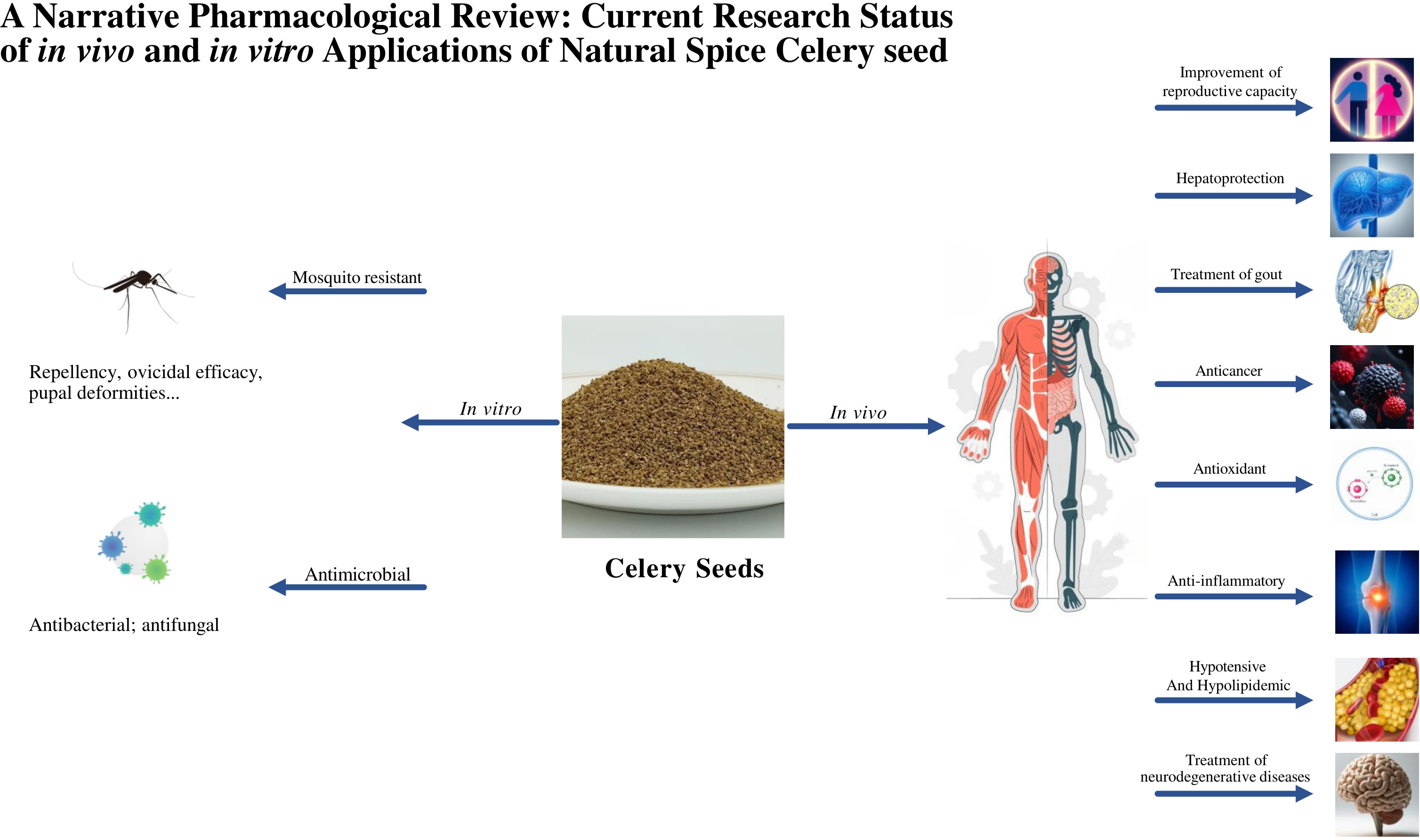
Introduction
Apium graveolens L., commonly known as “celery,” belongs to the Apiaceae family, as specified by The Plant List (http://www.theplantlist.org). The seeds of celery have a long-standing medicinal history, with records of their use in ancient civilizations such as China, India, and Persia. For several centuries, they have been incorporated into various traditional medical systems. Furthermore, these seeds are commonly utilized in contemporary culinary practices worldwide, often served as an appetizer before meals, included in salads, and used as flavors and condiments. 1 The fragrance of celery seed oil is notably intense to females, akin to that of herbal remedies, while males perceive its scent as fresh, reminiscent of moss and mushrooms. 2 Plant seeds generally contain higher amounts of calcium, magnesium, iron, sodium, and potassium compared to other parts of the plant; particularly, spices like celery seeds possess the highest phosphorus content. 3 Additionally, celery seeds are rich in trace elements such as iron, copper, and manganese. 4 They contain 49.4% to 75.6% petroselinic acid, an unsaturated fatty acid with potential applications in the development of functional foods, nutritional supplements, and the pharmaceutical industry.5,6 Celery seeds also harbor a spectrum of bioactive compounds, including phthalides, luteolin, d-limonene, apigenin, and linalool, which contribute to their pharmacological properties. 7 Recent advances in pharmacological research have progressively uncovered the extensive pharmacological effects of celery seeds, demonstrating their capacity to modulate various physiological functions in the human body. In clinical practice, celery seeds are commonly crushed and mixed with oil to create a preparation known as “ta zi,” which is applied topically to the Shenque acupoint for the treatment of functional dyspepsia. Alternatively, they are made into tea bags for brewing to address hyperlipidemia associated with liver dysfunction, with both methods demonstrating significant therapeutic effects. Notably, it has been found that celery seeds enhance reproductive capabilities in both males and females, exhibit anti-inflammatory and antioxidant properties, and reduce blood lipid levels. Furthermore, they have shown direct therapeutic efficacy in various organs against diseases such as cancer, gout, multiple degenerative neurological disorders, and liver damage.8,9 In addition to these internal applications, celery seeds have also been observed to possess effective mosquito-repellent and antimicrobial activities when used externally.
Currently, there is a lack of systematic reviews addressing the advancements in the pharmacological research of celery seeds. 10 Furthermore, several valuable applications remain underexplored. 10 We conducted a comprehensive search of PubMed for articles published up to April 2024, using the keywords “celery seed” and “A. graveolens seed.” This search yielded 253 potentially relevant articles.Ultimately, 62 studies were selected based on their explicit discussion of the use or pharmacological effects of celery seed extracts or compounds derived from celery seeds. These studies are included for detailed analysis in this review. Therefore, this review aims to provide a comprehensive overview and discussion of the pharmacological research related to celery seeds. We anticipated that this review will serve as a valuable reference for future research and development in this area.
Celery Seeds are Used Internally
Improvement of Reproductive Capacity
Extracts of celery have been shown to significantly increase the quantity of spermatozoa, Sertoli cells, and primary spermatocytes. 11 Additionally, another study indicated that celery seed oil effectively mitigates the decline in testosterone, cholesterol, and antioxidant capacity induced by di-(2-ethylhexyl) phthalate (DEHP) in male rats, restores the expression of steroidogenic enzymes, protects sperm maturation, and enhances sperm function. 12 Furthermore, celery seeds have demonstrated potential protective and beneficial effects not only on male reproductive function but also on female sexual health. In a double-blind, randomized, placebo-controlled clinical trial, administration of celery seed powder three times a day for six weeks significantly improved sexual desire, arousal, lubrication, and reduced pain in married women with female sexual dysfunction, thereby enhancing their sexual quality of life. 13 Collectively, these studies suggest that celery seeds may have a positive impact on the reproductive capacity of both males and females.
Hepatoprotection
Celery seeds have historically been used for liver protection across various ethnic groups, such as in India 14 and Persia. 15 The methanol extract of celery seeds has been shown to effectively mitigate acute liver injury in rats induced by paracetamol, 14 thioacetamide, 14 and tetrachloromethane (CCl4). 16 This extract reduces elevated serum biochemical markers associated with liver damage, including alanine transaminase (ALT), aspartate aminotransferase (AST), and alkaline phosphatase (ALP). In Persian traditional medicine, celery seeds are considered an effective anti-obstructive agent for the liver and spleen, capable of escorting drugs to the liver. 15 In addition, celery seeds have been found to have potential anti-liver fibrotic activity in modern studies. The 60% ethanol extract of celery seeds significantly inhibits the proliferation of HSC-LX2 cells, demonstrating a notable difference when compared to both the 95% ethanol extract and the aqueous extract. Furthermore, the petroleum ether fraction of the 60% ethanol extract exhibits a stronger inhibitory and apoptotic effect on HSC-LX2 cells than the other extraction components. Moreover, the enhancement of the anti-fibrotic capacity of celery seed extracts is primarily attributed to the increased concentrations of apigenin, aesculetin, and butylphthalide. 17
Studies indicate that celery seed extract did not significantly affect the P450 enzyme system, suggesting it may not produce notable changes in the metabolism of individuals taking the drug. 18 Interestingly, another study found that a 50 mg/mL celery seed extract exhibit a high level of inhibition, over 80%, against Cytochrome P450 proteins(CYP)3A4, CYP3A5, CYP3A7, and CYP2D6. 19 Further research is warranted to explore the effects of celery seed extract on the liver system.
Treatment of Gout
Celery seeds have demonstrated potential for the prevention and treatment of gout, primarily due to their capacity to inhibit xanthine oxidase(XO) activity and reduce serum uric acid concentrations. 20 In a specific study, hyperuricemia was induced in mice using potassium oxonate and yeast extract. Treatment with the aqueous extract of celery seeds (CSAE) and the oil extract of celery seeds (CSOL) resulted in significant reductions in serum uric acid and XO levels. Concurrently, both CSAE and CSOL contributed to a decrease in the levels of reactive oxygen species in the serum, while the levels of superoxide dismutase (SOD) and glutathione peroxidase (GSH-Px) were increased. 21 In rats with acute gouty arthritis induced by intra-articular injection of monosodium urate crystals, treatments with CSAE and CSOL were administered. 21 Furthermore, the levels of interleukin (IL)-1β and tumor necrosis factor α were reduced, while the level of IL-10 was increased. 21 The results indicated that ankle swelling was alleviated and the infiltration of inflammatory cells around the ankle was diminished. The components apigenin and apiin found in celery seeds play significant roles in this process. They decrease the rate of oxidative cytochrome C and uric acid production by inhibiting XO activity. 22 Apigenin also inhibits uric acid reabsorption through urate transporter 1 and glucose transporter 9, promoting uric acid excretion and subsequently lowering uric acid levels. 23 Additionally, a network pharmacology study has revealed that the treatment of gout with celery seeds is closely associated with the phosphatidylinositol-3-kinase(PI3 K)/protein kinase B signaling pathway, rat sarcoma signaling pathway, and hypoxia-inducible factor 1 signaling pathway. 24 These studies suggest that the preventive and therapeutic effects of celery seeds on gout are derived from the synergistic action of multiple mechanisms.
Anticancer
Various seeds from Apiaceae plants have shown potential preventive effects on the occurrence of breast tumors, with celery seeds, in particular being discovered to effectively reduce the circulating levels of 17β-estrogen and prolactin in rats with 17β-estrogen-induced breast cancer. 25 The methanol extract derived from celery seeds has been demonstrated to exhibit a dose-dependent inhibitory effect on the activity of hepatic ornithine decarboxylase (ODC) in rats with liver cancer. This inhibition is accompanied by an increase in the rate of DNA synthesis. Furthermore, the extract is capable of reducing the activities of quinone reductase, glutathione-S-transferase and serum γ-glutamyl transpeptidase, while also causing a depletion of tissue glutathione (GSH). 1 Additionally, it has been shown that the celery seed extract can effectively modulate the expression of specific molecules. Notably, it downregulates the expression of cyclin A, B-cell lymphoma-2 and cyclin-dependent kinases 2, while simultaneously upregulating the expression of B-cell lymphoma-2-associated X in human gastric cancer BGC-823 cells. These research findings suggest that the molecular mechanisms underlying the suppressive effects of celery seed extracts on cell proliferation and apoptosis may be associated with the arrest of the cell cycle at the S phase. 26
Various constituents within celery seeds have been identified as inhibiting cancer occurrence and progression through multiple pathways. Perillyl alcohol, derived from celery seeds, promotes apoptosis in tumor cells while sparing normal cells and is capable of reverting tumor cells to a differentiated state, thereby aiding in the regression of various tumors, including those of the pancreas, breast, and liver. 27 Similarly, 3-N-butylphthalide (NBP) effectively inhibits apoptosis in co-cultured T cells by targeting Lysine Acetyltransferase 7 to suppress programed cell death ligand 1 expression, which in turn alleviates the progression of lung cancer through the modulation of the programed cell death protein 1/ programed cell death ligand 1 pathway. 28 Sedanolide, a phthalide compound obtained from celery seed oil, facilitates autophagy in J5 cells by influencing the autophagy-related signaling pathways of PI3 K, tumor protein p53, and nuclear factor kappa-B, thus displaying potential inhibitory effects against the advancement of hepatocellular carcinoma. 29 Among the phthalides extracted from celery seed oil, both NBP and sedanolide have demonstrated efficacy in reducing benzo[a]pyrene-induced forestomach cancer in mice, decreasing the incidence from 68% to 30% and 11% respectively, alongside observed reductions in tumor multiplicity, which were 67% and 83% for NBP and sedanolide, respectively. 30 Seselin, methoxsalen, and 3H-isobenzofuran-1-one, derived from celery seeds, have been shown to effectively inhibit tumor progression and prolong survival in mice following the inoculation of B16 F10 melanoma cells. 31 Furthermore, perillyl alcohol extracted from celery seeds significantly reverses levels of malondialdehyde, XO activity, ODC activity, and [3H] thymidine incorporation in renal DNA triggered by ferric nitrilotriacetate, thereby minimizing events associated with tumor promotion. At the same time, markers of serum toxicity, including blood urea nitrogen and creatinine, are markedly reduced, and levels of renal glutathione and its dependent enzymes are substantially restored, alleviating ferric nitrilotriacetate-induced nephrotoxicity. 32 It can be seen that celery seeds can play a role in the prevention and treatment of a variety of cancers by regulating the secretion of sex hormones, regulating the cell cycle and antioxidant activity.
Antioxidant
The essential oil derived from celery seeds has demonstrated notable antioxidant properties against DPPH radicals, exhibiting an IC50 value of 81.6 µg/L. 2 In tests involving aldehydes and carboxylic acids, both essential oils from parsley seeds and celery seeds, when applied at a concentration of 500 µg/mL, successfully inhibited over 70% of nonanal oxidation after 40 days, with parsley seed essential oil achieving an even higher inhibition rate exceeding 95%. Furthermore, these essential oils have shown significant inhibitory effects on the formation of malondialdehyde from squalene when subjected to ultraviolet irradiation. This effectiveness is likely attributable to their high levels of myristicin and limonene. 33
The high polyphenol content in celery seed oil is indicative of its enhanced medicinal value. Polyphenols and brassicasterols have been found to have a significant correlation with antioxidant capacity. 34 Sedanolide, a compound resembling phthalides and extracted from celery seed oil, has been noted for its antioxidant properties. Research indicates that several substances found in celery seeds show considerable inhibitory effects on cyclooxygenase enzymes (COX-I and COX-II), as well as topoisomerase-I and topoisomerase-II. Importantly, L-tryptophan 7-[3-(3,4-dihydroxy-4-hydroxymethyl-tetrahydro-furan-2-yloxy)-4,5-dihydroxy-6-hydroxymethyl-tetrahydro-pyran-2-yloxy]-5-hydroxy-2-(4-hydroxy-3-methoxy-phenyl)-chromen-4-one has revealed notable antioxidant activity. 35 Additionally, the methanol extract of celery seed essential oil, abundant in γ-selinene, 2-methylpropanal, and Z-9-octadecenamide, demonstrated a remarkably high capacity for scavenging superoxide anions. 36 In summary, celery seed can exert antioxidant effects through a variety of substances, and due to its ability to resist ultraviolet oxidation, it seems that it can be considered for additon to sunscreen skincare products.
Anti-Inflammatory
Celery seeds are a traditional anti-inflammatory agent with anti-prostanoid therapy activity. 37 Beyond human use, in India, they are also utilized for the anti-inflammatory and analgesic treatment of chronic osteoarthritis in horses, 38 serving as an important resource to complement conventional or adjunctive therapies for inflammatory diseases. 39 As a folkloric therapeutic practice, the combined use of celery seeds and honey has been demonstrated to effectively enhance pulmonary function in patients with bronchial asthma. 40 The ethanol and n-hexane extracts of celery seeds both significantly reduced abdominal spasms in the acetic acid test, chronic phase pain in the formalin test, and edema in the carrageenan and croton tests. Nonetheless, it was only the n-hexane extract that showed pain relief during the acute phase in the formalin test. In the hot plate test, neither extract produced a notable effect, suggesting that the primary actions of celery seeds are peripheral analgesic and anti-inflammatory. 41 Celery seed extract has been shown to effectively reduce gastric acid secretion and alkalinize gastric environment, thereby protecting the gastric mucosa and resisting gastric ulcers induced by HCl/ethanol solutions. The presence of tannins and flavonoids in the extract could be responsible for this effect. 42 When co-administered with nonsteroidal anti-inflammatory drugs, celery seeds can mitigate gastric irritation caused by nonsteroidal anti-inflammatory drugs and exhibit synergistic anti-inflammatory activity, with its supercritical extract showing a sevenfold higher specific activity. 18 Celery seeds have the potential to improve the effectiveness of salicylates and prednisone for managing chronic inflammation, in addition to mitigating the gastric toxicity and lymphocytopenia that can occur with steroid usage. Moreover, these seeds might assist in managing the inflammatory aspects of osteoarthritis induced by microcrystalline hydroxyapatite and pseudo-gout, which are associated with calcium pyrophosphate crystals. 43 Moreover, combining celery seeds with Mesna can help to lessen the harsh effects of cystitis caused by ifosfamide and cyclophosphamide. This approach lowers the concentrations of pro-inflammatory cytokines, including tumor necrosis factor-α, IL-1β, and IL-6, while also enhancing the function of antioxidants such as superoxide dismutase (SOD), glutathione peroxidase (GSH-Px), and catalase. In addition, it reduces the intensity of hematuria, alleviates mucosal swelling, and hampers the advancement of ulcers and fibrosis.44,45
The anti-inflammatory properties of celery seeds are likely due to the specific compounds they possess. Notably, celery extracts, with luteolin as a primary component, have shown considerable positive effects on colitis in a rat study. 46 In addition, the intra-articular administration of NBP has the ability to reduce the expression of Forkhead box O3, which is enhanced by the PI3 K/protein kinase B signaling pathway, thus leading to a decrease in chondrocyte apoptosis in a rat model of osteoarthritis. Moreover, NBP enhances the levels of extracellular matrix components, including collagen II and aggrecan, in chondrocytes affected by osteoarthritis and in cartilage explants, which helps to slow down the progression of the disease. 47 However, Sedanolide, a phenolic compound rich in celery seed oil and related to NBP, does not exhibit significant protective effects against toxicity induced by H2O2 and tert-butyl hydroperoxide. 48 In summary, celery seeds may provide beneficial therapeutic effects for conditions such as gastritis, cystitis, and particularly arthritis, due to their active compounds, including luteolin, sedanolide, and NBP. It can also be utilized in conjunction with other anti-inflammatory medications to mitigate the risk of side effects associated with those drugs.
Hypotensive and Hypolipidemic
Celery seeds have been demonstrated to significantly lower blood pressure, fasting blood glucose levels, and lipid profiles in individuals with hypertension, in addition to reducing blood urea nitrogen, creatinine, ALT, and AST levels, thus improving liver and kidney functions.49,50 In addition, celery seed has been shown to effectively alleviate symptoms of anxiety and depression in patients with hypertension. 51 The primary constituents believed to be responsible for the hypoglycemic properties of celery seeds are the polyphenols. Notably, chrysoeriol-7-O-glucoside has shown greater inhibitory activity against α-glucosidase in comparison to other compounds, whereas apigenin has imparted the strongest inhibition on α-amylases; nonetheless, glycosides may reduce this inhibitory capacity. 52 Prolonged administration of different aqueous solutions derived from n-hexane, methanol, and ethanol of celery seeds have also proven effective in decreasing blood pressure among hypertensive rats, while also elevating heart rate. Analysis of the component proportions indicates that this outcome may correlate with the elevated amounts of active hydrophobic components, particularly n-butylphthalide. 53 Moreover, celery seeds might demonstrate antihypertensive properties by impeding Ca2+ entry into vascular smooth muscle cells and regulating voltage-dependent potassium channels. 54
Celery seeds have been demonstrated to significantly lower serum levels of total cholesterol (TC), triglycerides (TG), and low-density lipoprotein (LDL) in rats loaded with olive oil, while also notably elevating high-density lipoprotein (HDL) levels. 55 Research suggests that these seeds may help mitigate DEHP-induced obesity and atherosclerosis by decreasing the activity of peroxisome proliferator-activated receptor-α, altering the lipid profile, reducing vascular oxidative stress, and inhibiting the activity related to thiobarbituric acid reactive substances, which results in some improvement in liver function. 56 Furthermore, celery seeds have shown efficacy in lowering glucose, TG, and cholesterol levels in streptozotocin-induced diabetic rats, boosting both insulin and HDL levels, diminishing liver and pancreatic damage, and controlling hyperglycemia and hyperlipidemia effectively in diabetic rats. 57 Notably celery seed oil did not have a significant impact on hepatic phospholipid levels. The aqueous extract derived from celery seeds has been shown to notably decrease lipid levels in the serum and liver of hamsters fed a high-fat diet. It also possesses significant abilities in ferrous ion chelation and DPPH radical scavenging in vitro, likely due to its high concentration of soluble arabinogalactan. 58 Additionally, the compound 9(Z)-octadecenamide, extracted from the methanol fraction of celery seeds, demonstrates a remarkable hypolipidemic effect on TG, TC, LDL, the LDL/HDL ratio, and hepatic TG, alongside certain antioxidant properties. 59 Other substances, including seselin, methoxsalen, and 3H-isobenzofuran-1-one, obtained from celery seeds, significantly lowered TC, TG, and LDL levels while facilitating a notable increase in HDL levels in rats that exhibited hypertriglyceridemia as a result of Triton WR 1339 administration. In a comparative analysis, the ethyl acetate extract of celery seeds showed more potent in vitro antioxidant activity and anti-adipogenic benefits relative to other extracts when tested on 3T3-L1 adipocytes, effectively diminishing the transcription levels of genes such as CCAAT enhancer binding protein α, peroxisome proliferator-activated receptor γ, fatty acid binding protein 4, and fatty acid synthase. 60 In general, celery seed is rich in a variety of natural compounds, which can comprehensively regulate metabolism, and balance blood pressure, blood lipids and blood glucose.
Treatment of Neurodegenerative Diseases
Celery seeds have also been shown to effectively ameliorate a variety of neurological disorders. A clinical study has found that celery seed extract can effectively combat anxiety and depression in patients with hypertension. 7 Current research on the effects of celery seeds on the nervous system primarily focuses on one of its key components, NBP, which has been frequently mentioned in previous reviews for its roles in cancer prevention, anti-fibrosis of the liver, and antimicrobial activity. A search for “3-n-butylphthalide” in PubMed reveals over 500 related publications, and several comprehensive reviews have discussed the protective effects of NBP on various neurological conditions such as stroke, diabetes-related neurological diseases, cognitive impairments, epilepsy, cerebral edema, Alzheimer's disease, and Parkinson's disease.5,61–63 This paper primarily discusses the pharmacological and therapeutic studies related to celery seeds themselves and does not intend to delve deeply into the pharmacological effects of NBP.
Celery Seeds are Used Externally
Mosquito Resistant
The essential oil extracted from celery seeds has proven effective in eliminating early fourth instar larvae of Aedes aegypti, with 24-h exposure resulting in LC50 and LC90 values of 16.10 and 29.08 ppm, respectively. Extended exposure durations further increase the lethality of the celery seed essential oil towards Ae. aegypti instars. Moreover, this essential oil significantly decreases the biting behavior of Ae. aegypti on humans and shows a mild adulticidal effect, with LD50 and LD95 values of 6.6 and 66.4 mg/cm², respectively. However, the level of protection begins to decline between 2.5 and 3 h after application.64,65 Importantly, the hexane fraction of celery seed oil exhibits the most significant repellent characteristics when compared to other fractions, demonstrating considerable effectiveness against various mosquito species. At a concentration of 250 mg/mL, this fraction can inhibit mosquito bites for as long as 3.5 h, thereby offering a lasting form of defense. 66
Research has shown that the ethanolic extract derived from celery seeds produces considerable neurotoxic effects on the early fourth instar larvae of Ae. aegypti, leading to increased larval mortality. When applied at a concentration of 100 ppm, this extract results in a notable degree of morphological deformities in the larvae, whereas concentrations between 200 and 300 ppm result in lethal deformities during the pupal stage. 67 Additional research has indicated that concentrations of 100%, 10%, 1%, and 0.1% of celery seed essential oil produce repellency efficacies of 75%, 36%, 30%, and 25%, respectively, against Ae. aegypti. Furthermore, these concentrations exhibit ovicidal efficacies of 100%, 100%, 29%, and 16%, respectively. 68 Furthermore, sedanolide at a dosage of 50 µg/mL has shown a 100% lethal impact on both the nematode Caenorhabditis elegans and the early fourth instars of Ae. aegypti, highlighting its significant insecticidal and nematicidal effects. 69 The potent larvicidal properties of bioactive compounds found in celery seeds, including α-phellandrene, α-terpinene, and γ-terpinene, resulted in more than 80% mortality at a concentration of 0.1 mg/mL. In particular, carvacrol, α-pinene, and β-pinene were shown to significantly inhibit the activity of acetylcholinesterase in Aedes albopictus, with IC50 values recorded at 0.057, 0.062, and 0.190 mg/mL, underscoring their potential as effective agents for mosquito control. 70 To summarize, celery seeds have a long-lasting repellent effect on Ae. aegypti, and at appropriate concentrations can be used as a natural insecticide to effectively kill larvae and pupae of Ae. aegypti.
Antimicrobial Activity
Celery seeds, along with their various bioactive compounds, have demonstrated notable antimicrobial and antifungal properties. An evaluation of the essential oil extracted from celery seeds was conducted to determine its antimicrobial effectiveness against Pseudomonas aeruginosa, Escherichia coli, Bacillus subtilis, Staphylococcus aureus, Candida vini, Aspergillus niger, and Penicillium expansum through the impedimetric assay. The minimal inhibitory concentrations were determined to be 30, 10, 20, 3, 30, 40, and 40 µL/mL, respectively. 2 Furthermore, Celery seeds have been demonstrated to effectively inhibit the proliferation of Campylobacter jejuni, as reported in a previous study. 71 It exhibits potent antimicrobial activity against Pseudomonas putida and Pseudomonas stuartii, while showing no activity against E. coli, as documented in another research. 19 A purified substance, referred to as “compound exhibiting anti-Helicobacter properties,” was isolated through high-performance liquid chromatography and has a molecular weight of 384.23 and an empirical formula of C24H32O4. This substance demonstrated a targeted inhibitory(MIC) effect against Helicobacter pylori, with a minimum inhibitory concentration of 3.15 mg/mL and a minimum bactericidal concentration varying between 6.25 and 12.5 mg/mL. No impact was observed on C. jejuni or E. coli, according to existing literature. 72
Celery seeds have yielded compounds such as bergapten and methoxsalen, which exhibit weak to moderate antimicrobial activity against several bacterial strains, particularly gram-positive bacteria. 73 The compounds sedanolide, senkyunolide-N, and senkyunolide-J, extracted from celery seeds’ methanol solution, have demonstrated the ability to cause complete mortality in Panagrellus redivivus at concentrations of 25, 100, and 100 µg/mL, respectively. 69 Sedanolide has demonstrated inhibitory effects on the growth of Candida albicans and Candida parapsilasis at a concentration of 100 µg/mL. 69 Volatile oil extracted from celery seeds, specifically NBP and its derivatives, have shown inhibitory activity against a variety of plant pathogenic fungi, with the substituent at the 6-position having a major influence on the antimicrobial activity of NBP. 74 NBP has demonstrated antifungal properties against C. albicans, exhibiting a MIC of 128 μg/mL. When combined with fluconazole, NBP shows synergistic antifungal activity against drug-resistant strains of C. albicans, lowering the fluconazole MIC from over 512 μg/mL to a range of 0.25–1 μg/mL. The antifungal action is linked to the suppression of hyphal growth, the promotion of intracellular reactive oxygen species accumulation, and a decrease in mitochondrial membrane potential. 75 Furthermore, Senkyunolide-A, isolated from celery seed oil by supercritical carbon dioxide extraction, has been shown to have a clear regulatory effect on skin barrier function and epidermal defense pathways. Research utilizing DNA microarrays has suggested that Senkyunolide-A plays a role in the enhancement of genes associated with detoxification and anti-inflammatory processes. This compound effectively manages the environment of Malassezia, which diminishes its attachment to cells and lowers sebocyte lipid production by 40%. A three-week clinical application of Senkyunolide-A led to a notable decrease in the intensity of dandruff, redness, itching, and scalp histamine levels when compared to both baseline treatment and placebo. 76
Moreover, celery seeds possess antifungal properties that are employed in managing plant diseases. These seeds significantly hinder the growth of pathogens such as Rhizoctonia solani, Fusarium oxysporum, and Alternaria fasciculata, primarily due to their active compounds, including p-(2-aminoethyl)phenol, 3-(3,4-dimethoxybenzoyl) propionic acid, and p-heptylphenol. 77 Additionally, they are capable of addressing powdery mildew caused by Podosphaera fusca in cucumber plants by enhancing the activity of various defense-related enzymes such as β-1,3-glucanase, chitinase, phenylalanine ammonia-lyase, peroxidase, and polyphenol oxidase. 78 In summary, celery seeds possess a significant quantity of antibacterial compounds, which confer upon them a broad spectrum of antibacterial properties.
Safety
Celery seed is regarded as a safe natural remedy and does not interfere with the metabolism of other medications you may be taking. 18 In clinical studies, no significant side effects or adverse reactions were reported in patients with hypertension who used 4 celery seed capsules (equivalent to 1.34 g of celery seed extract) daily for 4 weeks.49–51 Similarly, no significant side effects or adverse effects were reported after 6 weeks of treatment of female sexual dysfunction patients with 3 celery seed capsules (equivalent to 1.5 g of celery seed extract) per day. 13 Celery seed is also safe for topical application. 64 Continuous use of 2 mL of celery seed essential oil at a concentration of 250 mg/mL over a period of 6 months, followed by a 3-month follow-up, totaling 9 months, did not result in skin irritation or any other adverse reactions. 66
In a toxicology study involving rats, an ethanol extract of celery seed was administered at doses of 150 mg/kg and 5000 mg/kg once daily for 28 days. All rats survived, and no visible or behavioral signs of toxicity were observed throughout the study period. Additionally, there was no significant difference in body weight compared to the control group. Biochemical indicators and histopathological examinations revealed no significant gastric, liver, nephrotoxicity, or ocular toxicity. 79 In summary, celery seed is a safe and effective natural product that is unlikely to cause toxic side effects or adverse reactions, whether utilized in vivo or in vitro.
Discussion
Celery seeds are a globally popular spice and seasoning, with an estimated yearly production of celery seed oil reaching approximately 50 tons. Around 50% is generated in India. Other nations involved in production include the United States, southern France, the Netherlands, Hungary, Israel, and China. 80 As scientific knowledge continues to evolve, it has become increasingly evident that celery seeds offer both practical applications and noteworthy medicinal benefits. This review highlights recent research advancements in various areas, including reproduction, inflammation, antioxidant properties, blood lipid levels, blood pressure management, cancer treatment, gout, liver damage, anthelmintic effects, and antibacterial functions. In everyday use, celery seeds are commonly consumed either directly or in powdered form, while in research, their essential oil is predominantly utilized for study. A comprehensive analysis indicates that celery seeds are a daily condiment with multiple bioactivities and medicinal value.
This article is presented as a narrative review; therefore, the reviewed studies were not subjected to systematic screening. Instead, all relevant literature was manually screened and included in the discussion to the fullest extent possible. The quality of the research varied significantly. Additionally, some of the topics reviewed, such as “improvement of reproductive capacity” and “hepatoprotection”, appear to lack sufficient evidence due to limited research. While the antioxidant activity is generally considered an in vivo effect, the majority of existing relevant studies have been conducted in vitro, resulting in inadequate strength of evidence. Furthermore, research on the safety of celery seeds requires further depth and expansion. Celery seeds serve a dual purpose by diminishing the activity of XO, which leads a decrease in the production of uric acid. In addition, celery seeds inhibit the reabsorption of uric acid via urate transporter 1 and glucose transporter 9. Consequently this results in enhanced excretion of uric acid and a decrease in its overall levels, contributing to their significant therapeutic effect against gout. Furthermore, their capacity to hinder XO activity may be a key mechanism in potential cancer therapies, likely associated with the presence of apigenin and apiin. Research has also shown that celery seeds in effectively improving blood pressure, fasting blood glucose levels, and lipid profiles in individuals suffering from hypertension. A synthesis of multiple studies indicates that long-term consumption of celery seeds can safely and effectively combat lipodystrophy, regulate blood sugar, and contribute to vascular health, exerting beneficial effects on a variety of metabolic disorders. Beyond its metabolic regulatory capabilities, celery seeds have been shown to improve fatty liver disease, diabetes, obesity, atherosclerosis, and to work synergistically to improve hypertension by modulating calcium ion influx.Moreover, in traditional medicine, celery seeds play a significant role in alleviating arthritis-associated fever and pain. Contemporary studies have shown that celery seeds are similarly beneficial in addressing gastritis and cystitis. Furthermore, celery seeds can be co-administered with various anti-inflammatory drugs to achieve a detoxifying and synergistic effect, enhancing the anti-inflammatory action while mitigating the gastric irritation caused by nonsteroidal anti-inflammatory drugs. Concurrently, celery seeds can potentiate the therapeutic effects of salicylates and prednisone in chronic inflammation, and when used in combination with Mesna, can partially ameliorate the severe cystitis induced by ifosfamide and cyclophosphamide.
Furthermore, it has been suggested that celery seed tea can promote rest and sleep. 81 Celery seeds, which are rich in NBP, have also demonstrated preventative and therapeutic effects on a variety of neurodegenerative diseases. Moreover, studies have indicated that celery seeds exhibit no significant toxic side effects, 79 and it has been proven safe for clinical patients as well.13,49 Celery seeds clearly serve as a commonly used traditional remedy with a rich history in both everyday practices and medical applications, and they are considered safe and benign.
The rational and effective utilization of celery seeds can improve health and prevent and treat a variety of diseases, especially those related to metabolism. Celery seeds exhibit effective mosquito-repellent and antimicrobial properties when used extracorporeally. Applying essential oil extracted from celery seeds onto the skin can offer effective protection against mosquitoes for as long as four hours. Moreover, the addition of methanol extracts of celery seeds and their various compounds to water bodies where mosquitoes breed can be lethal to mosquito larvae due to their neurotoxicity, and it can also induce deformities in mosquito larvae and pupae, effectively killing immature mosquitoes in the water.Additionally, research has identified that celery seeds possess a moderate acaricidal effect on Hyalomma dromedarii. 82 Celery seeds have demonstrated inhibitory effects on both fungal and bacterial proliferation. Studies have revealed that multiple substances extracted from celery seeds can effectively suppress the growth of C. albicans. Clinical research has shown that celery seeds, as well as Senkyunolide-A, can significantly improve skin symptoms induced by Malassezia. Bergapten and methoxsalen, found in celery seeds, demonstrate significant antimicrobial properties against gram-positive bacteria. In a particular study, scientists were able to isolate a compound from celery seeds that has distinct inhibitory effects on H. pylori.
In summary, as a traditional folk remedy, celery seeds are widely used in China and other Asian/European countries. They hold significant value for application and development both in vivo (Table 1) and in vitro (Table 2). A comprehensive understanding of their traditional uses, pharmacological research, and side effects is essential before clinical application. To enhance their application level in the near future, in-depth research on their mechanisms of action and quality control is required.
In Vivo Applications of Celery Seed and Its Extracts.

In Vitro Applications of Celery Seed and Its Extracts.

Footnotes
Acknowledgements
This work was supported by Liaoning Provincial Administration of Traditional Chinese Medicine (LZYYF 2023 2-18).
Author Contributions
Han Gao reviewed the literature and wrote the manuscript. Guanhua Lv supervised the study and revised the manuscript. Rongwei Huang revised and approved the manuscript. All authors have read and approved the final manuscript.
CRediT Authorship Contribution Statement
Guan-hua Lv: Writing – review & editing, Supervision, Funding acquisition. Han Gao: Writing – original draft, Investigation. Rong-wei Huang: Writing – review & editing, Conceptualization.
Data Availability
No data was used for the research described in the article.
Declaration of Conflicting Interests
The authors declared no potential conflicts of interest with respect to the research, authorship, and/or publication of this article.
Declaration of Generative AI and AI-assisted Technologies in the Writing Process
During the preparation of this work the author(s) used Kimi AI in order to assiting with translation and text editing. After using this tool/service, the author(s) reviewed and edited the content as needed and take(s) full responsibility for the content of the publication.
Funding
The authors disclosed receipt of the following financial support for the research, authorship, and/or publication of this article: This work was supported by the Liaoning Provincial Administration of Traditional Chinese Medicine, (grant number LZYYF 2023 2-18).

Statement of Human and Animal Rights
The name of the Institutional Ethics Committee is IEC of the Second Affliated Hospital of Liaoning University of Traditional Chinese Medicine. Approved No.of ethic committee: 2023(KT)-034-02(FS). This manuscript is a narrative review and human and animal Rights is not associated with our manuscript.