



Abstract
In the absence of vaccines, chemotherapy remains a viable alternative for the control of African trypanosomiasis. To facilitate the eradication of African trypanosomiasis, there is the need to pay attention to the chemotherapeutic potential of secondary metabolites obtained from natural sources. Despite the increasing level of attention paid towards the pharmacological and medicinal properties of trypanocidal molecular prototypes from plants, integrative synthesis of research methods relevant to this progress is lacking. Furthermore, the potential applications of machine learning in the discovery of plant-derived antitrypanosomal secondary metabolites have not been well explored. The aim of this study is thus to provide a critical appraisal of the antitrypanosomal potential of plant molecular prototypes in the context of research progress made, as well as to highlight standard and emerging investigative tools applicable in the drug discovery process. It explores the phytochemical, pharmacological and medicinal properties of plant-derived antitrypanosomals in the light of traditional and emerging research approaches. In vitro, in silico, and in vivo strategies and investigations that may be employed are highlighted. Finally, promising machine learning tools that may be of particular benefit in future antitrypanosomal investigations are also discussed. These insights may ultimately facilitate optimization, target identification and clinical investigations in the drug discovery and development process against African trypanosomiasis.
Keywords
Introduction
Trypanosomiasis is probably a very ancient group of protozoan diseases dating back to about 100 million years ago.1‐3 The family of Trypanosomatidae belongs to the order Trypanosomatida and the class of Kinetoplastea. In accordance with morphological features and host relationships, nine genera of trypanosomatids are generally recognized. These include monoxenous forms (Crithidia, Blastocrithidia, Herpetomonas, Leptomonas and Wallaceina), heteroxenous genera (Trypanosoma, Leishmania, Endotrypanum and Phytomonas) and traditionally recognized morphotypes. 4
In several developing nations, kinetoplastids are responsible for morbidity- and mortality-related neglected tropical diseases which include leishmaniasis (cutaneous, visceral, and mucocutaneous), Chagas disease (American Trypanosomiasis) and sleeping sickness (Human African Trypanosomiasis) that are caused by Leishmania spp, Trypanosoma cruzi, and Trypanosoma brucei (T. brucei), respectively. 5 Blood sucking vectors such as tsetse fly of Trypanosoma spp and sandflies for Leishmania spp transmit these parasites into their hosts.6,7 Low-income nations and disadvantaged groups are particularly at risk of infection which results in significant economic toll.
African trypanosomiasis (AT), a tsetse-transmitted disease of humans and livestock caused by the Trypanosoma genus, is of considerable health and economic concerns in various sub-Saharan African countries.8,9 In the absence of vaccines, chemotherapy and control of the tsetse vector (Glossina spp) remain the only economically viable means of disease management. However, issues of drug resistance and toxicity pose serious challenges to chemotherapy. Moreover, fly re-invasion, deforestation, hunting, expansion of agriculture, and environmental degradation continue to plague vector control strategies.10‐12
Traditionally, different causative species of animal and human AT are managed with distinct commercially available drugs.13,14 Animal AT may be treated with isometamidium, homidium, diminazine, pyritidium and quinapyramine, while human AT is typically treated with nifurtimox, eflornithine, pentamidine, melarsoprol and suramin (Figure 1A, B). Despite the challenges associated with chemotherapy, recent advances in the treatment of human AT is encouraging.15,16 The recent development of new drugs such as fexinidazole, acoziborole and pafuramidine have exhibited promising initial clinical trials. 17 Indeed, the elimination of human AT by 2030 may be a realistic target due to current advances in diagnosis and treatment. 16 However, the impact of animal AT on livestock productivity is still of considerable economic concern.

Chemical structures of drugs commonly used for the treatment of (A) human African trypanosomiasis and (B) animal African trypanosomiasis.
In tandem with the need for alternative sources of chemotherapy against trypanosomes, research on the possible medicinal benefits of natural products is worthy of consideration. These benefits are usually due to the combined effects of primary and secondary metabolites, with the latter playing particularly significant pharmacological roles. In view of reported antitrypanosomal activities of plants in different parts of the world, secondary metabolites from plant sources serve as alternative sources of novel agents for the control and management of AT.18,19 However, the mechanisms of antitrypanosomal action and resistance remains largely unexplored.
Moreover, even though increasing number of reviews have highlighted the medicinal and pharmacological potential of plant-derived antitrypanosomal secondary metabolites, 20 insights into the progress of relevant research methods that can facilitate the development of such potential have not been well crystallized. Furthermore, the potential applications of machine learning in the identification and drug discovery process of plant-derived antitrypanosomal secondary metabolites are scanty. The present study thus sheds light on the antitrypanosomal potential of plant prototypes in the context of research progress and tools that may be of ultimate benefit in the control of African trypanosomiasis.
Methodology
This study aims to provide critical insights into the antitrypanosomal potential and research progress of plant-derived natural products. Inclusion criteria involved the collation of 121 articles (published from 1973-2024) that relate to the phytochemical, pharmacological and medicinal properties of trypanocidal molecular prototypes in the light of traditional and emerging research approaches, subject to specific key words and phrases. Data analysis involved descriptive and qualitative appraisal of content and textual structure. Initial appraisal of literature was based on credibility and recency in relation to the inclusion criteria. Critical appraisal on the basis of objective analysis of text and content was also performed. The literature review was conducted using databases and resources such as Scopus, Web of Science, World flora online, Google Scholar, PubMed, PubChem and DrugBank. Key words and phrases that were employed in the search included ‘’African trypanosomes’’, ‘’African trypanosomiasis’’, ‘’ antitrypanosomal AND secondary metabolites’’, ‘’antitrypanosomal’’, and ‘’machine learning AND antitrypanosomals’’, ‘’plant-derived secondary metabolites’’, plant-derived antitrypanosomals’’, plants AND antitrypanosomals’’, research approaches AND antitrypanosomals’’, plants OR antitrypanosomals’’, research approaches OR antitrypanosomals’’, ‘’molecular prototypes AND antitrypanosomals’’, ‘’molecular prototypes OR antitrypanosomals’’ and ‘’discovery AND antitrypanosomals’’.
Life Cycle Overview of African Trypanosomes
The life cycle of pathogenic parasites involves a variety of mammalian species, as well as insects, which are responsible for the majority of mammalian transmission. 21 As a result, the life cycle includes the development of infection and survival inside different hosts (invertebrate and vertebrates), as opposed to free-living protozoans. 21 Since kinetoplastids exhibit a variety of morphological forms, these diverse physical features are connected with various life cycle phases in different species. Different morphological forms can be distinguished at each stage of an organism's life cycle, depending on the organism.
African trypanosomes tend to exhibit distinct developmental stages which can occur in both the mammalian host and the tsetse-fly vector: slender metacyclic trypomastigotes, stumpy metacyclic trypomastigotes, epimastigotes, and procyclic forms22,23 (Figure 2). During a blood meal, an infected tsetse fly injects the metacyclic forms of the parasites which can result in infections with T.b gambiense, T.b rhodesiense or T.b brucei. Trypanosomes therefore penetrate the lymphatic system and end up in the bloodstream. Metacyclic forms differentiate into the proliferative slender forms which can invade other parts of the host such as the adipose tissues, the central nervous system and the skin. After reaching a certain threshold of cell density, differentiation of long slender forms may lead to stumpy non-proliferative parasites. These stumpy forms are then picked up by a tsetse fly during a blood meal after which they may differentiate into procyclic forms. Procyclic forms found in the midgut of the tsetse fly then differentiate into epimastigotes. When parasites reach the salivary glands they can continue to proliferate and differentiate into the non-proliferative metacyclic forms to keep the cycle going22,23 (Figure 2).

The life cycle of T. brucei: The life cycle of T. brucei alternates between the vector and the mammalian host. The procyclic and metacyclic forms are dominant in the vector while the long slender and short stumpy forms are restricted to the mammalian host.
Symptoms of African trypanosomiasis depend on the stage of parasitic infection. Initial transmission into the bloodstream may exhibit signs of headache, fever, fatigue and general malaise, while progression into the lymphatic system can lead to lymphadenopathy with associated heightened fever, chills and hepatosplenomegaly. 17 Advanced infection may lead to the invasion of the central nervous system. Characteristic symptoms of advanced infection include disorientation, apathy, anxiety, abnormal speech, paresthesia, anesthesia, convulsions, seizures and coma, as well as the disruption of the circadian cycle that can result in daytime somnolence and nocturnal insomnia, hence the name sleeping sickness. 17
Pharmacological and Medicinal Properties of Antitrypanosomal Plants
Plants remain a major source of secondary metabolites with promising antitrypanosomal activities. Traditional medicinal practices, ingrained in cultures for centuries, have harnessed the healing power of plant extracts to combat various ailments, including parasitic infections. Indigenous communities, often the guardians of age-old wisdom, possess extensive knowledge of plants with antitrypanosomal properties that serves as an invaluable heritage passed down through generations.
Several plants display potent antitrypanosomal properties, with active compounds holding promise for drug development. Acanthospermum hispidum DC, a species within the Asteraceae family, has been shown to exhibit potent antitrypanosomal effects. 24 Faidherbia albida (Delile) A.Chev and Pericopsis laxiflora (Benth. ex Baker) Meeuwen have demonstrated potency in combating Trypanosoma evansi and Trypanosoma congolense. 25 An aqueous extract of Dicliptera paniculata (Forssk.) I.Darbysh immobilized approximately 90% of T. brucei brucei in vitro. 26 The array of bioactive molecules in plants includes alkaloids, flavonoids, terpenoids, tannins, saponins, cardiac glycosides, coumarins, phenylpropanoids, iridoids, benzenoids, lignans and phenolics that may exert inhibitory effects on distinct aspects or lifestyles of the parasite.20,26
Albizia gummifera (J.F.Gmel.) C.A.Sm., a prevalent deciduous tree found in several tropical regions, is traditionally believed to possess medicinal attributes against bacterial infections, malaria, skin disorders, and stomach pains. 26 Its antibacterial, antitrypanosomal, antiplasmodial, and anticancer properties may be attributed to spermine alkaloids, oleanane saponins, and triterpenes. 26 Despite its widespread distribution, limited documentation exists, thereby warranting further exploration compared to other tropical trees.
Hydromethanol extracts from Echinops kebericho Mesfin roots displayed dose-dependent reduction in motility of trypanosomes at different concentrations. 27 A study by Emiru et al (2021) 28 demonstrated changes in white blood cell counts, emphasizing the need for a favorable therapeutic index. The reduction in lymphocyte count and increase in neutrophils at different dosages should however be carefully assessed for overall safety and efficacy. Fluorescence microscopic examination of T. brucei treated with Acanthospermum hispidum DC extracts revealed changes in cell morphology and disruptions in the organization of mitochondria, nucleus, and kinetoplast of the parasite. 79 These observations suggest the potential of plant-derived compounds to influence the cell cycle of parasites.
Antitrypanosomal investigation recorded the potency of the ethyl acetate extract from the leaves of Ocimum gratissimum Linn. (Labiatae), with an IC50 and selectivity index of 2.08 ± .01 μg/mL and 29, respectively. 29 Extracts from Trema orientalis (L.) Blume, Pericopsis laxiflora (Benth. ex Baker), Jatropha curcas L., Terminalia catappa L., and Vitex doniana Sweet also demonstrated significant antitrypanosomal activities within the IC50 range of 2.1‐17.2 μg/mL. 29 Moreover, Nekoei et al (2022) 20 identified Chrysanthemum cinerariifolium Vis., Keetia leucantha (K.Krause) Bridson, Teclea trichocarpa (Engl.) Engl and Terminalia avicennioides Guill. & Perr as plants with potential antitrypanosomal properties.
Common Approaches for Detection of Trypanosomes
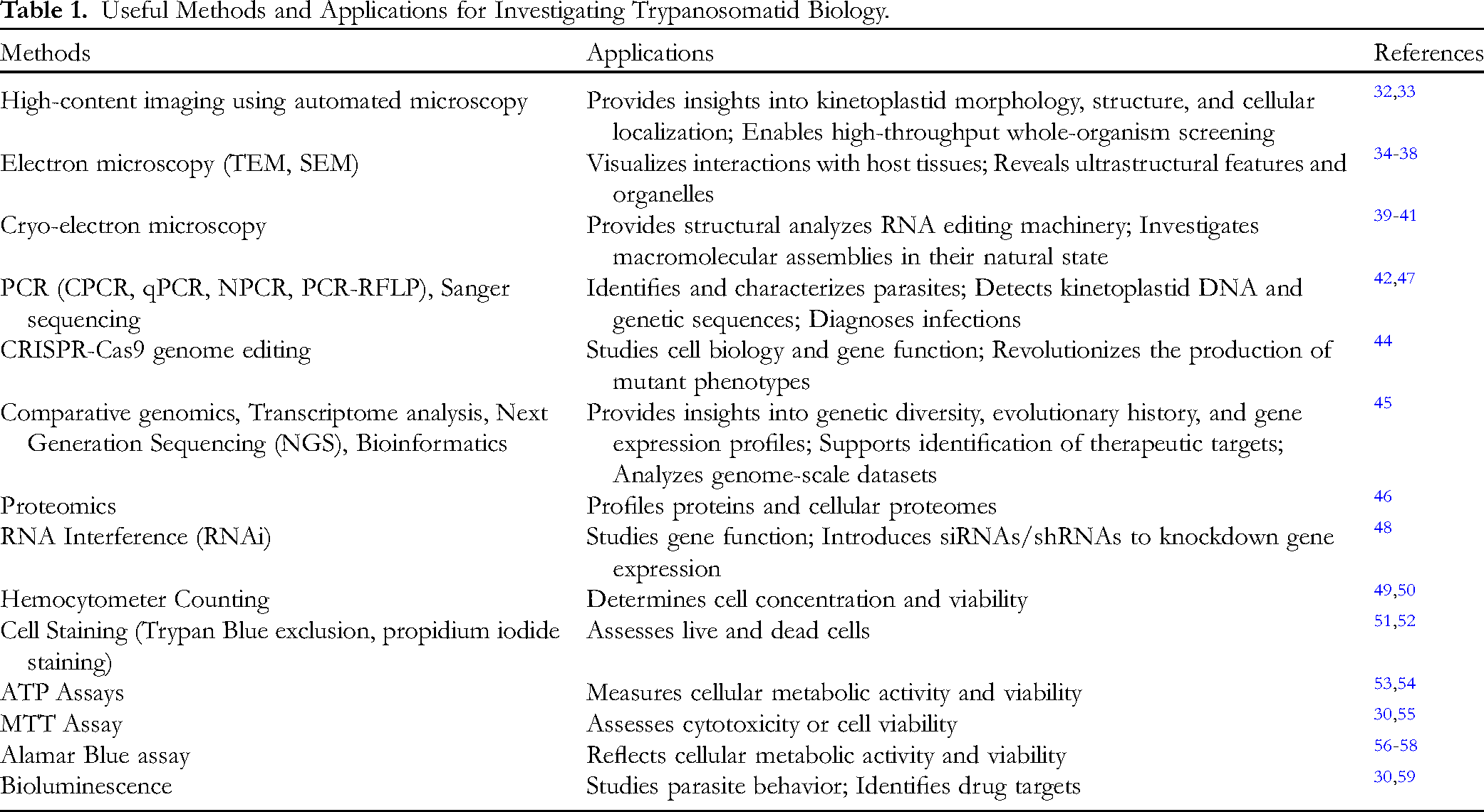
Several techniques are employed in the investigation of trypanosomatid and kinetoplastid biology. Cell viability and growth kinetics studies are fundamental in parasite research, serving the purpose of examining metabolism, screening of drug activity and toxicity, and elucidating basic mechanisms of parasite lifestyle.30,31 Assessing cell viability directly impacts the extraction of parasites from host cells and facilitates the study of their gene expression and physiological functions. 31 Common techniques that are helpful in the assessment of cell viability of trypanosomatids include hemocytometer counting, cell staining (such as trypan blue exclusion, propidium iodide staining), alamar blue assay, ATP assay, MTT assay, and flow cytometry.
Microscopy techniques have played a vital role in advancing our understanding of kinetoplastids by providing valuable insights into their morphology, structure, and cellular localization. 32 One notable development is the application of high-content imaging using automated microscopy for in vitro whole-organism screening against live parasites. 33 Electron microscopy has provided valuable information about the invasion mechanisms, tissue tropism, and pathogenicity of parasites.34‐37 Researchers have accomplished high-resolution imaging using transmission electron microscopy or scanning electron microscopy, showing the ultrastructural features and associated organelles. 38 Cryo-electron microscopy has also made it easier to structurally analyse complexes that are unique to kinetoplastids, such as the RNA editing machinery. By enabling the observation of macromolecular assemblies in their natural state, cryo-electron microscopy offers hitherto unattainable insights into the molecular structure and functionality of these complexes.39‐41 Combining traditional microscopy techniques with cutting-edge approaches such as automated microscopy and cryo-electron microscopy has provided a deeper understanding of the cellular and molecular mechanisms.
Molecular techniques are indispensable in the identification and characterization of parasites. PCR techniques, such as conventional single-step PCR (CPCR), quantitative real-time PCR (qPCR), nested PCR (NPCR), and PCR-restriction fragment length polymorphism (PCR-RFLP), are widely used to detect different genetic sequences of kinetoplastids, including kinetoplastid DNA (kDNA), internal transcribed spacer (ITS) region, and small subunit ribosomal RNA (ssurRNA). 42 Santos et al (2022) 43 suggested that the most common molecular method for diagnosing kinetoplastid infection is Sanger sequencing of amplicons resulting from positive PCRs targeting conserved genes, such as 18S rDNA and gGAPDH. Moreover, CRISPR-Cas9 genome editing, which has revolutionized the production of mutant phenotypes in a high-throughput manner, may also be useful in the study of trypanosomatid cell biology. 44
Comparative genomics and the identification of novel therapeutic targets are made easier by insights into the genetic diversity, evolutionary history, and gene expression profiles of parasites provided by whole-genome sequencing and transcriptome analysis. In the analysis and interpretation of Next Generation Sequencing data, bioinformatics is also indispensable. The TriTrypDB database serves as an integrated resource, offering access to genome-scale datasets for kinetoplastids. 45 It integrates genome annotation and analyses from various sources with functional genomics datasets, allowing researchers to examine individual genes or chromosomal spans in their genomic context. 45 Moreover, the database supports complex queries that combine multiple data types, facilitating comprehensive exploration of parasite genomics. 45 In addition, proteomics tools are useful in the identification and quantification of proteins in trypanosomatids. Jardim et al (2018) 46 discussed the importance of protein profiling and cellular proteome analysis in kinetoplastids. They highlighted the use of cell disruption techniques, such as silicon carbide homogenization and hypotonic lysis, coupled with differential centrifugation to separate organelles based on particle size and density (Jardim et al, 2018). 46 By analyzing the proteome, researchers may gain insights into their protein composition, modifications, and dynamics. Table 1 highlights a selection of techniques commonly applied in the detection of trypanosomatids.
Useful Methods and Applications for Investigating Trypanosomatid Biology.
Common Approaches for Investigation of Activity and Mechanisms of Action
Isolation of antitrypanosomal secondary metabolites from their plant sources through a bioactivity-guided process has been a traditional approach for a long time. In this process, crude extracts and fractions are usually prepared using the modified Kupchan method of solvent extraction (Figure 3). 60 A typical bioactivity-guided isolation begins with a crude extraction of the plant material using the appropriate solvent. After ascertaining the activity of the crude extract, it is then fractionated using solvents of varying polarities. The bioactivities of these fractions are also determined to assess the merit for subsequent characterization. High Performance Liquid Chromatography (HPLC) facilitates the purification of compounds, while a combination of mass spectrometry (MS), nuclear magnetic resonance (NMR) spectroscopy, ultraviolet-visible spectroscopy (UV-VIS) and Infrared (IR) spectroscopy enables structural elucidation of the isolate.

Schematic for modified Kupchan method of liquid-liquid extraction. Crude extracts and fractions are usually prepared from air-dried pulverized plant material using the modified Kupchan method of solvent extraction. Solvents of varying polarities are used in the extraction and fractionation through a bioactivity-guided process. At any point within the process, the bioactivity of an extract or fraction is ascertained before it is considered for subsequent fraction or purification. The Kupchan method gives rise to fractions of varying polarities: WB = butanol (BuOH) fraction, FH = hexane (Hex) fraction, FD = dichloromethane (DCM) fraction, FM = methanol (MeOH) fraction, Aq = Aqueous fraction.
Initial activities of compounds are typically assessed through the determination of half-maximal inhibitory concentrations (IC50) or half-maximal effective concentrations (EC50). Trypanosomes treated with compounds can be investigated in vitro for growth inhibition using any appropriate cell viability assay in vitro,61,62 with Alamar Blue (resazurin) and MTT assays being common examples. Compounds are also investigated for their cytotoxicities by employing normal cells such as macrophages. To gain preliminary insights into mode of antitrypanosomal action, it is common to investigate the effects of compounds on the cell death and cell cycle of the parasite. Analysis of cell death and cell cycle in the parasites may employ a flow cytometry-based detection of annexin-V-7-amino actinomycin-D and propidium iodide, respectively. 61
Target identification of the antitrypanosomal compound is another critical aspect of activity profiling. Target identification of compounds may employ the preliminary generation of resistant strains of the parasites and the subsequent utilization of RNA sequencing (RNAseq) for transcriptome analysis of resistant strains. 63 Here, total RNA is isolated and converted to complementary DNA (cDNA), after which sequencing library is prepared for subsequent sequencing on a new generation sequencing platform. 63 Alternative identification may also consider changes in a protein's thermal stability upon ligand binding in a cellular thermal shift assay (CETSA). 64 In this approach, cell lysates of the parasites may initially be treated with antitrypanosomals at varying concentrations/temperatures to induce changes in folding and aggregations between bound and unbound proteins. Proteome analysis may then be utilized for possible identification of bound protein targets of antitrypanosomals. 64 In addition, presumptive predictions of targets can be explored through the guidance of available softwares such as INVDOCK, TarFisDock, PubChem, ChEMBL and DrugBank. 65
Loss/gain-of-function libraries have also proven useful in target identification and elucidation of trypanocidal activity. Overexpression libraries were employed in the target identification of difluoromethylornithine and DDD85646. 66 Using a gain-of-function library, Carter et al (2022) 67 identified novel aspects of melarsoprol resistance. Also, by using appropriate genomic libraries, RNAi offers the possibility of screening for mutant phenotypes of interest in T. brucei. 68 RNAi involves the introduction of small interfering RNAs (siRNAs) or short hairpin RNAs (shRNAs) that specifically target genes, allowing researchers to knockdown gene expression and evaluate resultant phenotypic effects. 48 RNAi library was utilized to screen for potential genes involved in the action and resistance of human AT drugs. 68 The screening of pentamidine, eflornithine, suramin and melarsoprol, have all benefited from the power of RNAi. 68
Structure-activity relationship studies are in silico investigations that are frequently applied in modern drug discovery. In a typical approach, a formal hit assessment of selected chemical series towards establishing a tractable structure-activity relationship profile is performed. There is the general employment of synthetically tractable derivatives that conform to the Lipinski rule of 5. 69 Pharmacokinetic properties such as lipophilicity, solubility, permeability and metabolic stability are important parameters to investigate. Several freely available software can facilitate the calculation of physicochemical parameters. Structure-activity relationships are also defined by exploring the effects of steric and electronic changes on the activities of compounds. Medicinal chemistry tools such as the Craig plot can be used for the design of structurally diverse analogues before synthesis. 70 Structure-activity relationship studies have been applied to several synthetic antitrypanosomals.71,72
There is a gradual increase in the number of in vivo studies for natural antitrypanosomals.71,73 It is common practice to precede in vivo studies with preliminary in vitro analysis of pharmacokinetic properties such as lipophilicity, solubility, permeability and metabolic stability. The most promising compounds from this in vitro profiling would then be evaluated in vivo. In vivo experiments may be preclinical (usage of laboratory animals) or clinical (trials involving humans). While preclinical studies provide basic information about a drug's safety, it is not a substitute for investigating how the drug will interact with the human body. The discovery and development of most prototypes would involve some form of pharmacological optimization through structural modifications during preclinical and clinical investigations.
Insights into Mechanisms of Action of Antitrypanosomal Molecular Prototypes
There has been a significant progress in the in vitro screening of plants that are routinely used in several traditional remedies for the treatment and management of human and animal AT. The main aim has been geared towards the characterization of the active principles behind the efficacy of these remedies, optimization of the pharmacological properties of the active agents and determination of their mechanisms of action and resistance. Through this, the antitrypanosomal properties of plant species such as Morinda lucida Benth (M. lucida), Acanthospermum hispidum DC (A. hispidum), Zanthoxylum zanthoxyloides (Lam.) B. Zepernick & Timler (Z. zanthoxyloides), and Bidens pilosa L (B. pilosa) were investigated.6,61,74‐79 There has also been a successful identification of active antitrypanosomal agents, structural modification of promising ones and elucidation of the potential mechanisms of action.6,61,74‐79
It has been shown that secondary metabolites tend to be multifactorial in mode of action. The ability of M. lucida, Z. zanthoxyloides and B. pilosa to induce apoptosis-like and necrosis-like cell death in trypanosomes through phosphatidylserine externalization have been reported.6,61,74,75,78 The induction of cell cycle arrest with corresponding inhibition and distortion of cell growth and cell morphology as potential trypanocidal routes was also demonstrated.61,75,76 The subsequent identification of antitrypanosomal tryptophan esters in Bidens pilosa also lent credence to tryptophan-mediated activities in the parasite. 78 Moreover, the observation of oxidative damage-mediated mechanism of action in both Z. zanthoxyloides and A. hispidum provided insights into the possible role played by reactive oxygen species in growth inhibition of trypanosomes.76,79
Alkaloids such as chelerythrine, emetine, sanguinarine, and chaconine induced apoptosis-like cell death in the bloodstream form of T. brucei. 80 According to Sepúlveda-Boza and Cassels (1996), 81 several naturally occurring substances exhibit trypanocidal effect by interfering with the parasites’ redox balance, acting either on the respiratory chain or on cellular defenses against oxidative stress. Mechanistically, studies have reported that natural products disrupt trypanosomal redox balance, affecting cellular defenses against oxidative stress and the respiratory chain. 82 This may be related to the effect of oxidative damage exhibited by skimmianine and 9-oxo-10, 12-octadecadienoic acid. 76 Table 2 and Figure 4 highlight the bioactivities and chemical structures of some promising antitrypanosomal plant prototypes based on in vitro threshold potencies of IC50 (EC50) values <5.0 µM. Even though the selection is certainly far from exhaustive, it provides an overview of the few structural prototypes that may be considered for further investigation (Table 2; Figure 4).

Chemical structures of promising antitrypanosomal prototypes. Activities of compounds are defined in Table 2. skimmianine (1), 9-oxo-10, 12-octadecadienoic acid (2), tryptophan butyl ester (3), molucidin [(R = CH3); ML2-3 (R = H); MLF-52 (R = CH2CH3)](4), derivative of dehydrodieugenol B (5), 24-hydroperoxy-24-vinylcholesterol (6), onopordopicrin (7), isoobtusi-lactone A (8), 16α-hydroxy-cleroda-3,13(14)-Z-dien-15,16-olide (9), 3β,13β-dihydroxy-urs-11-en-28-oic acid (10), dihydrochelerythrine (11), 6-acetonyldihydrochelerythrine (12), dioncophylline E (13), 22-hydroxyclerosterol (14), letestuianin C (15), abruquinone K (16), abruquinone L (17), abruquinone A (18), abruquinone D (19), cynaropicrin (20), schkuhrin I [(R = AC); schkuhrin II R = COCHOHCHMe](21), waltheriones L (22), saropeptide (aurantiamide acetate) (23), oregonin (24), hirsutanone (25), cardamomin (26), miltirone (27).
Antitrypanosomal Activities of Some Promising Plant Prototypes.

Selections are based on compounds with in vitro threshold antitrypanosomal IC50 (EC50) values < 5.0 µM.
Structural modification may also provide useful insights into mechanisms of action. The cytotoxicity of various synthetic analogs of fagaramide, an N-alkylamide naturally distributed in various species of Zanthoxylum, was previously investigated. 98 Fagaramide was later isolated from the root of the plant species of Z. zanthoxyloides as tortozanthoxylamide through bioactivity-guided chromatography and spectroscopy. 75 In order to improve the pharmacology of the compound, putative chemical derivatives based on structural analysis of available functionalities were designed. 77 The design was guided by labile bond cleavage analysis of the mass fragmentation, the utilization of pyrrolidine as a compact moiety and the ultimate goal of reducing aliphaticity. 77 Even though the modification resulted in a reduction of long-term inhibition, it led to the improvement of selectivity indices, suggesting that optimization via chemical derivatization may generate a reliable source of potent AT chemotherapy if critical attention is paid to the study and development of appropriate chemical functionalities. 77
In silico investigations have also provided insights into mechanisms of action of antitrypanosomal plant prototypes. Results obtained from applications of 2D and 3D models by Araujo et al (2021) 83 revealed the importance of the structural features related to the biological response of a dehydrodieugenol B derivative isolated from Nectandra leucantha that can aid in the design of new neolignan-based compounds with better biological activity. An in silico molecular docking study identified possible targets of antitrypanosomal plant prototypes based on their phytochemical classes. 99 In the study, T. brucei proteins such as adenosine kinase, pteridine reductase 1, dihydrofolate reductase, trypanothione reductase, cathepsin B, heat shock protein 90, sterol 14α-demethylase, nucleoside hydrolase, triose phosphate isomerase, nucleoside 2-deoxyribosyltransferase, UDP-galactose 4′ epimerase, and ornithine decarboxylase were investigated for their possible interactions with compounds isolated from Nigerian medicinal plants. 99 Docking studies revealed binding interactions of aurantiamide acetate (sourced from Crateva adansonii DC) with trypanosomal enzymes sterol-14α-demethylase and trypanothione reductase. 100 It was found that the α-methylene-γ-lactone moiety was necessary for both antitrypanosomal effects and cytotoxicity of sesquiterpene lactones, while antitrypanosomal selectivity was facilitated by 2-(hydroxymethyl) acrylate, 3,4-dihydroxy-2-methylenebutylate and cyclopentenone functionalities. 101
In vivo antitrypanosomal exploration may encompass a wide range of natural products such as flavonoid aglycones, glycosides, phenolics and phenylpropanoids. 71 Tasdemir et al (2006) 71 assessed the in vivo efficacy of flavonoids and related analogues in mice infected with T. brucei brucei (STIB795). Administered intraperitoneally at a dose of 50 mg/kg, none of the compounds succeeded in completely eliminating the parasites. Even though the most potent trypanocidal agent, 7,8-dihydroxyflavone (IC50 = 68 ng/mL), significantly decreased parasitemia levels, mice experienced relapse at a relatively extended mean survival of 13 days. 71 In an in vivo antitrypanosomal assay by Sirak et al (2024), 73 anemonin (isolated from Ranunculus multifidus Forsk), caused the elimination of parasites at all the tested doses and prevented relapse, compared to diminazene aceturate-treated mice in which the parasites reappeared.
The toxicity assessment of chalcones and hydrazides demonstrated that the substances were not fatal to adult Balb/c mice, except for the observation of slight bloating and photosensitivity one week post-administration. 102 In another study, antiparasitic effects of canthin-6-one, 5-methoxycanthin-6-one, canthin-6-one N-oxide, as well as that of the total alkaloids of Zanthoxylum chiloperone stem bark, were examined in Balb/c mice infected either acutely or chronically with Trypanosoma cruzi. parasitemia was significantly reduced following oral treatment with canthin-6-one, while the total alkaloids led to high levels of parasitological clearance, thereby demonstrating trypanocidal activity in the mouse model of acute or chronic infection. 103
Potential Applications of Artificial Intelligence for Investigation of Trypanocidal Prototypes
Analyzing complex datasets to identify patterns and trends related to secondary metabolites using machine learning (ML) algorithms can efficiently process large datasets, recognize complex patterns, and unveil correlations that may not be apparent through traditional methods. 104 Adulteration of herbal medicine remains an issue of considerable concern as it compromises quality, thereby requiring reliable methods of detection.105,106 ML algorithms combined with multi-source data have proven effective in enhancing the accuracy of adulteration detection. 106 For example, Uncaria tomentosa (UT) is susceptible to adulteration with low-value Uncaria guianensis (UG). Kaiser et al (2020) 107 applied classification and regression algorithms to analyze UV and LC-PDA data, identifying and quantifying adulteration in UT. Infrared spectroscopy offers non-destructive, rapid, and cost-effective advantages for qualitative analysis. 108 Also, Yang et al (2019) 109 trained SVM models using manually extracted NIR and FT-MIR characteristic wavelengths to identify adulteration in Panax notoginseng powder.
Automation and optimization of screening processes facilitated by ML algorithms leads to quicker identification of potential secondary metabolites, reducing the time and resources required for screening and prediction of compounds. By training algorithms on existing data, ML models can learn the characteristics of known secondary metabolites. This learned knowledge can then be used to predict potential bioactive compounds in new datasets. 110 Genes within metabolic pathways has been predicted using ML classifiers such as support vector machine, logistic regression, and decision tree-based models.104,111 Another study used an ML model to predict drug inhibitory side effects on metabolic network by relying on network topology, inhibitor and enzyme functional classes, logic-based representation, and a combination of abduction and induction methods. 112
Target identification of natural products, particularly with antitrypanosomal secondary metabolites, has been challenging. Even though Omics are commonly employed, they are often laborious and time-consuming. BANDIT, a Bayesian machine-learning approach, has been used to predict drug binding targets with 90% accuracy. NeoDTI, a CNN-based tool, mines large-scale graph data and automatically learns topology-preserving representations of secondary metabolites, facilitating drug-target interactions prediction. 113 Openchem, a DL toolkit, enables drug discovery and molecular modeling applications using DL algorithms, while MANTRA 2.0, a transcriptional profile-based drug target identification, uses a microarray dataset to reveal the mechanism of action based on existing drugs and metabolites transcriptional signatures. 113
By utilizing genome information to identify biosynthetic gene clusters (BGCs) related to secondary metabolites, ML algorithms can analyze genomic data to predict and characterize BGCs associated with the biosynthesis of secondary metabolites. 114 This aids in prioritizing areas of the genome for further exploration. Genome mining is increasingly used to identify secondary metabolites such as polyketide synthases, non-ribosomally synthesized peptides, ribosomally synthesized peptides, alkaloids, and terpenes. 110 Next-generation sequencing techniques and bioinformatics pipelines are used to predict BGC assembly lines and putative encoded structure using ML algorithms. Using BGC databases and computational tools, plant-derived secondary metabolites can be predicted based on previously identified pathways.
ML, coupled with mass spectrometry or NMR data, can efficiently dereplicate known compounds from complex mixtures, saving time and resources. 115 Fast identification of known secondary metabolites is necessary, and dereplication is key in the process. Previously, dereplication techniques used high-performance liquid chromatography connected with UV or photodiode array (PDA) detectors. 116 However, UV/PDA-based detection lacks structural information, necessitating a more powerful instrument to capture additional spectral properties. Mass spectrometry-based dereplication using AI/ML (MS) has been widely used for dereplication in non-deterministic polynomials (NPs) due to its sensitivity, accuracy, and rapidity. 104 Molecular networking (MN) has gained attention in the NP community for dereplication and delineation of novel secondary metabolites from various sources with minimal manual interference.
Moreover, a new algorithm called PeakDecoder, can identify individual molecules in complex mixtures. The analytical and computational workflow provides capabilities for fast analysis of new metabolites of interest, and is broadly useful in environmental and biological metabolomics research. 115 PeakDecoder represents a step towards universal software for molecular identification and may enable error rate calculations for different analytes. 117 These and similar three-dimensional modeling techniques can be integrated into a comprehensive metabolic engineering platform.
Molecular prototypes can benefit from ML-based quantitative models to help predict blood‐brain barrier permeability. 118 Through the utilization of deeper-net models, deep learning algorithms can aid in the prediction of improved aqueous solubility. 119 Zushi (2022) 120 proposed a new ML-based QSAR approach that can predict the properties and toxicities of compounds using analytical descriptors of mass spectrum and retention index obtained via GC-MS without requiring exact structural information. The model, which is based on the XGBoost ML method, performed well on a chemical standard mixture measurement, with similar results to those of model validation. It also performed well on a measurement of contaminated oil with spectral deconvolution, suggesting that it is suitable for investigating unknown-structured chemicals detected in measurements. 120
In the future, quantum computing may provide an unimaginable boost to ML algorithms. Quantum ML is a rapidly emerging field that explores the utilization of quantum computers in improved performance of ML as compared to classical computers. Quantum computing offers characteristic advantages over classical computing that can benefit the discovery of antitrypanosomal molecular prototypes from plant sources. Since quantum states give rise to probability distributions that can generate statistical patterns hard to achieve with classical computing, it allows for an exponentially more compact encoding of classical information. It also provide speedups in several algebraic operations such as Fourier transforms, vector inner products, matrix eigenvalues and eigenvectors. 121 The advent of quantum algorithms such as variational quantum eigensolvers (VQE) and quantum phase estimation algorithm (PEA) would greatly facilitate the treatment of physical systems with accurate ab initio quantum calculations. 121
Conclusion and Future Directions
In this study, insights into the lifestyle of African trypanosomes, experimental methods of antitrypanosomal characterization and research progress made in the consideration and investigation of secondary metabolites as alternative sources of antitrypanosomal agents, are provided. It also provides extensive insights that contribute significantly to the understanding of secondary metabolites’ role in treating AT. It underscores the pivotal role of plant-derived natural products in drug discovery, laying a solid foundation for future research and development in this field.
As in all fields of drug discovery and development, bridging the gap from discovery to clinical application remains an essential and challenging step. Reports of plant-derived antitrypanosomals that have successfully passed through clinical and translational studies for the purpose of drug development are scanty if not lacking. Further experimental validation and clinical trials are necessary to affirm the efficacy and safety of these natural compounds for human use. A few molecular prototypes discussed in this study have shown considerable promise to necessitate further exploration in pre-clinical studies or undergo pharmacological optimization via structural modification. For instance, it may be useful to carry out further studies on the family of abruquinones due to their particularly significant potencies on the parasite (Table 2).
A comprehensive investigation would involve studies into toxicity, target identification, structure-activity relationships and pharmacological optimization. Insights into target-based mode of action of antitrypanosomals are required if novel drugs that may outwit resistance to commercially available antitrypanosomal drugs are to be developed. Advent of quantum computing and modern applications of machine learning can significantly facilitate the detection of trypanosomal infections, identification of prototypes and targets, and elucidation of mechanisms of action. Overall, combination of the insights and recommendations provided in the present study may facilitate further investigations and ultimate identification of novel antitrypanosomal drugs to supplement the existing cohort of commercially available drugs.
Footnotes
Acknowledgment
I am grateful to colleagues, faculty members and students at the Department of Biological Sciences, University of Environment and Sustainable Development, PMB, Somanya, Ghana, for their encouragement during the preparation of this manuscript.
Author Contribution Statement
AKD: Study-conceived and designed; Writing-original draft, Review & Editing
Declaration of Conflicting Interests
The author declared no potential conflicts of interest with respect to the research, authorship, and/or publication of this article.
Data Availability
All data used or generated from this study can be found in this manuscript.
Funding
The author received no financial support for the research, authorship, and/or publication of this article.
