



Abstract
Background
The uncontrolled use of antimicrobial drugs has led to the widespread of drug-resistant microbes such as MRSA, which has been regarded as clinically important problem. The essential oil is that some can be developed as natural antibiotics. Antibacterial activity of the Citrus spp. against the resistant and susceptible strains of S. aureus has been reported. However, to date, information on the phytochemical and bioactive characterization of the of C. nagato-yuzukichi essential oil (CNEO) in scarce.
Purpose
this study aimed to evaluate chemical composition, antibacterial activity against MSSA, MRSA, and E. coli, of the CNEO and their major components. Additionally, we determined their association with vancomycin and antibiofilm activity against MRSA strain of CNEO and their major components.
Study design and Method
In this work, the composition of CNEO was determined by GC-MS. Disk diffusion method, agar plate dilution method, MIC, MBC, checkerboard assay, and biofilm growth method were determined to assess their antibacterial activities.
Results
GC-MS analysis revealed 99.73% of the constituents of CNEO. The major components of CNEO were d-limonene (60.06%), γ-terpinene (8.40%), β-phellandrene (7.31%), α-terpineol (3.14%), and β-myrcene (2.34%). CNEO showed antibacterial activities against MRSA (DIZ: 26.78 mm, MIC: 16 mg/mL), with a similar trend to d-limonene (DIZ: 17.42 mm, MIC: 128 mg/mL) and α-terpineol (DIZ: 19.40 mm, MIC: 2 mg/mL). In combination effect, the results showed the additive interaction of vancomycin with CNEO and α-terpineol on the MRSA (FIC indexes: 0.5 < to ≤1.0).
Conclusion
The integrated analysis in the present study suggested that CNEO or its major components components may be a promising alternative therapy to antibiotic-resistant bacterial infections.
Introduction
Antibiotic-resistant bacterial infections are an urgent global threat that threatens modern healthcare. 1 The effective treatment of bacterial infections is medical technologies such as transplantation, chemotherapy and surgery. 2 The uncontrolled use of conventional antibiotics and synthetic antimicrobial drugs has led to the widespread emergence of drug-resistant microbes such as methicillin-resistant Staphylococcus aureus (MRSA) and multidrug-resistant strains of Klebsiella pneumonia, which has been regarded as clinically important problem. 3 For example, the resistance of MRSA was produced by a mecA gene encoding the penicillin-binding protein 2a or 2′ (PBP2a or PBP2′), which was integrated into the chromosomal element (SCCmec) of methicillin-sensitive S. aureus. 4 In addition, the mecA gene can be detected by DNA-DNA hybridization and polymerase chain reaction (PCR). 5 Treatment of these infections has become more difficult due to the emergence of multidrug resistance. 6 Vancomycin has been used as a potent chemotherapeutic drug for the treatment of MRSA. 4 Although vancomycin is effective against bacterial infections, its utility is limited due to side effects such as renal injury. 7 Therefore, it is a challenge to find alternative and more efficient ways to treat infections. 3 This has led to a renewed interest in the use of essential oils as alternative therapies for the treatment of staphylococcal infections. 8 Essential oils and their components target bacterial cell walls and cytoplasmic membranes, increasing their permeability and causing membrane damage. 9 In addition, they show antibiofilm activity, multidrug efflux transporter, and inhibiting ATP synthesis.10,11 Regarding the potential of essential oils to produce natural antimicrobials, several plants like tea tree, cinnamon, lemon, lemongrass, and thyme provided interesting results. 10 Therefore, the components enhancing the antibacterial activity of vancomycin can reduce the dosage of vancomycin in chemotherapy to avoid the side effects should have the potency of treating bacterial infections drugs. 9
Citrus, a genus within the Rutaceae family, is one of the largest plant species, encompassing 40 different species. 12 C. nagato-yuzukichi Tanaka grows wild in the Kitaura District centering on Tamagawa in Hagi, Yamaguchi Prefecture, Japan, and has been classified as a close relative of C. junos. 13 The quality characteristics of the fruit are highly flavored and acidic. 13 In Yamaguchi Prefecture, Japan, the fruits of this plant are harvested in late summer when the peel is still green and have long been used as a juice and spice. 14 In addition, the terpenoid d-limonene has been reported to be the main constituent of the essential oil extracted from the peel of C. nagato-yuzukichi Tanaka. 14 However, to date, information on the phytochemical and bioactive characterization of C. nagato-yuzukichi essential oil (CNEO) is scarce. Previous studies with d-limonene demonstrated that both components interact with the bacterial cell wall, causing changes in membrane permeability and resulting in cell death against methicillin-susceptible S. aureus (MSSA). 15 In addition, α-terpineol showed antibacterial activity against MSSA. 16 Therefore, this study aimed to evaluate chemical composition, antibacterial activity against MSSA, MRSA, and Escherichia coli, of the CNEO and their major components. Additionally, we determined their association with vancomycin and antibiofilm activity against MRSA strain of CNEO and their major components.
Results
Chemical Composition of the Essential Oil
The CNEO were obtained in 0.41% (No. 1), 1.02% (No. 2), 1.09% (No. 3), 2.37% (No. 4), 3.02% (No. 5), and 1.85% (No. 6) yields by steam distillation (Table S1). The chemical composition (peak area %) of the essential oil (No. 3) via GC–MS analysis resulted in the identification of 92 chemical components (99.73%) in C. nagato-yuzukichi (Figure S1, Table 1). The essential oil contained high amounts of monoterpene hydrocarbons (46 components, 93.22%). In addition, d-limonene (60.06%) was the major compound in the oil. Other major monoterpenes were γ-terpinene (8.40%), β-phellandrene (7.31%), α-terpineol (3.14%), β-myrcene (2.34%) α-phellandrene (1.96%), and α-pinene (1.44%). Other constituents of the essential oil were identified as 18 sesquiterpenes (2.94%), 8 aldehydes (2.34%), 4 alcohols (0.61%), and 3 esters (0.14%) respectively. In addition, (E)- β-farnesene (1.69%) and β-elemene (0.11%) were the major sesquiterpenes in the oil. Octanal (1.04%) and decanal (0.86%) were also the major aldehydes. Several other components were identified, including 1-octanol (0.43%) as an alcohol, octanoic acid (0.07%) as a fatty acid, and octyl acetate (0.06%) as an ester. As a result of the analysis of major monoterpene, α-pinene and β-myrcene contents in the present experiment was not influenced by samples (Table 2). γ-Terpinene showed its highest concentration in the sample No. 6, the content of γ-terpinene was 0.61 ± 0.25 mg/mL (Table 2). While α-terpineol showed its highest values in sample No. 1, the content of α-terpineol was 0.78 ± 0.30 mg/mL (Table 2). In addition, γ-terpinene was not detected in the sample No. 4.
Chemical Composition of C. nagato-yuzukichi Essential Oil (CNEO) Analyzed by GC–MS

*Retention indices were experimentally measured using C7–C30 Saturated Alkanes 49451-U on the DB-WAX UI column. Identification methods: MS, by comparison of the mass spectra with those from computer mass libraries, NIST 20 library and Wiley; RI, by comparison of RI with those reported in literature.
Quantitative Analysis of Volatile Components in CNEO (No. 1-6) Used in the Study by GC-MS*.
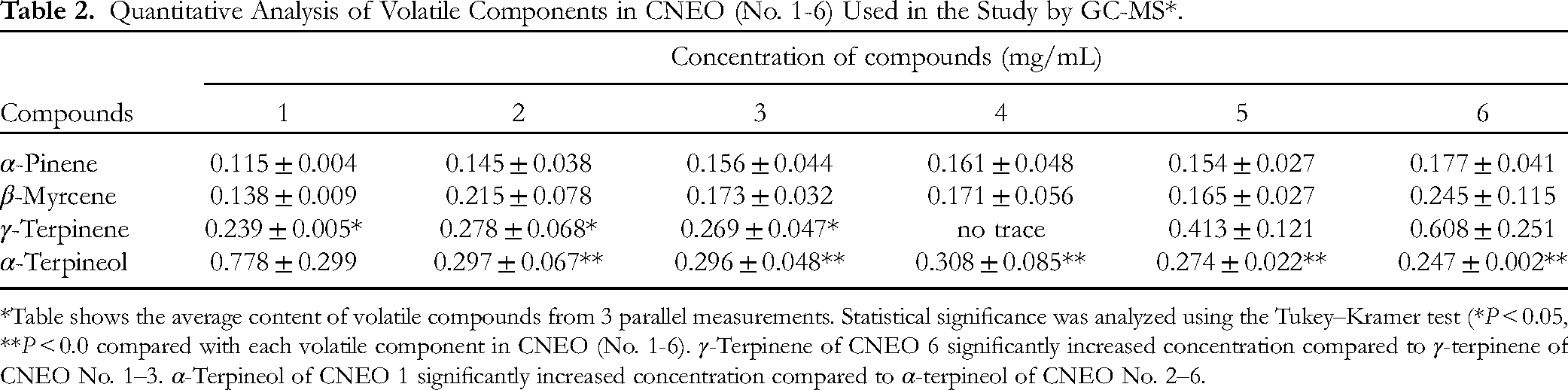
*Table shows the average content of volatile compounds from 3 parallel measurements. Statistical significance was analyzed using the Tukey–Kramer test (*P < 0.05, **P < 0.0 compared with each volatile component in CNEO (No. 1-6). γ-Terpinene of CNEO 6 significantly increased concentration compared to γ-terpinene of CNEO No. 1–3. α-Terpineol of CNEO 1 significantly increased concentration compared to α-terpineol of CNEO No. 2–6.
PCR Amplification of mecA Gene
Identification of MRSA strains was performed by detection of mecA gene in S. aureus strains using PCR assay. The results revealed that Staphylococci isolates carried mecA gene. The PCR-amplified DNA products of this gene of clinical isolates are shown in Figure S2.
Antibacterial Activity
The antibacterial activities of CNEO were investigated against three pathogenic bacteria MSSA, MRSA, and E. coli, using the disk diffusion method and measuring the diameter of inhibition zone (DIZ). A clear zone of inhibition was formed against all pathogenic bacteria in the presence of the essential oil (No. 1) (Table 3). Gram-positive bacterium S. aureus possessed higher sensitivity (DIZ: 36.87 mm) to the essential oil (No. 1) compared to Gram-negative bacterium E. coli (DIZ: 17.39 mm) (Table 3). Our results showed that CNEO had antibacterial effects on the tested MRSA (DIZ: 26.78 m) (Table 3, Figure 1). To verify which major components of the oil are active against different bacterial strains, each major component of the oil was tested. A clear zone of inhibition was formed against all pathogenic bacteria in the presence of d-limonene and α-terpineol (Table 3). However, a clear zone of inhibition was only formed against Gram-negative bacteria in the presence of α-pinene (Table 3). In addition, it was confirmed that no inhibition zones were observed against any of the bacteria in a pH-adjusted solution equivalent to pH 5.27 of CNEO (No. 3) (data not shown). This assay shows that CNEO, d-limonene and α-terpineol, and α-pinene exhibit antibacterial activities.

Antibacterial activity of C. nagato-yuzukichi essential oil (CNEO) (No. 1-6) against MRSA by disk diffusion method. (A and B) Disks were treated with 30 μL of CNEOs, or 30 μg of vancomycin for 24 h. Vancomycin was used as a positive control. 1: CNEO No.1, 2: CNEO No.2, 3: CNEO No.3, 4: CNEO No.4, 5: CNEO No.5, 6: CNEO No.6.
Antibacterial Activity of CNEOs (No. 1-6) or Their Major Components Against Escherichia coli, Methicillin-Susceptible S. aureus (MSSA), and MRSA by Disk Diffusion Method

*Disks were treated with 30 μL of CNEOs or their major components, or 30 μg of vancomycin (MRSA) for 24 h. Vancomycin was used as a positive control (MRSA). At least two independence experiment was performed. DIZ: diameter of inhibition zone. N.T.: not tested. N.D.: not detected.
MIC and MBC Test
To evaluate the antibacterial activities of CNEO, d-limonene and α-pinene, and α-terpineol in detail, we performed the measurement of the minimum inhibitory concentration (MIC) using the agar plate dilution method and the microdilution method. Using the agar plate dilution method, the obtained MICs of CNEO (No. 3) were 8 mg/mL (MSSA) and 32 mg/mL (MRSA) (Table S2). α-Pinene and α-terpineol sgowed antibacterial activities against all strains (Table S2). The minimum bactericidal concentration (MBC) was also measured using the microdilution method. The MIC index was calculated as MBC/MIC. The calculated MIC indexes showed that the essential oils were bactericidal against all pathogenic bacteria (Table S3). In addition, d-limonene, α-pinene, and α-terpineol had antibacterial activity against all strains (Table S4). These MICs were used to determine the concentrations used in the subsequent experiments. Next, the synergistic potential of CNEO (No. 3) or α-terpineol and vancomycin against MRSA were evaluated by the checkerboard assay. These results show the combination of CNEO (No. 3) or α-terpineol, and vancomycin (Alone MIC: 2.0 µg/mL) has an additive antibacterial activity (ΣFIC: 0.8 and 1.0) against MRSA.
Inhibitory Effect of the Essential oil on Biofilm Formation
Biofilm formation contributes to the resistance of S. aureus to protection from desiccation, antimicrobials, metabolic cooperation, and increased genetic diversity via horizontal gene transfer. 11 The results showed that the concentrations of 1/2–1 MIC of CNEO (No. 3) almost inhibited biofilm formation (Figure S3). The 1/2 MIC concentration of CNEO (No. 3) showed 51.45% inhibition and the MIC concentration inhibited 77.45% of the biofilms.
Discussion
The essential oil is that some can be developed as natural antibiotics. 10 Commonly, Citrus essential oils are byproducts remained in manufacturing processes of several products. 17 Antibacterial activity of the Citrus spp. against the resistant and susceptible strains of S. aureus has been reported.18,19 However, the CNEO, there have been many studies on its constituent components, but has not yet been reported on its antibacterial activity. The primary objective of this study was to analyze the chemical composition and concentration of CNEO and their major constituents, and to investigate the essential oil, and their major components in both single effect and combination interaction with vancomycin. The results revealed extraction yields of CNEO (0.41-3.02%) were in similar ranges of amount with the previous studies (0.44%). 14 In, addition, present study showed that CNEO is rich in monoterpenes with the major component (81.25%) being d-limonene, β-phellandrene, α-terpineol, β-myrcene. This is like previous reports. 14 Usually, the chemical composition of EOs which is influenced by the raw plant material (genotype, part of the plant, harvest time, geographical, ecological conditions and cultural techniques) and extraction method. 20 In addition, earlier reports 20 showed that α-terpineol concentration was affected by sampling time, and the effect of sampling time was significant (Table 2). d-Limonene and α-terpineol has been reported to show antibacterial activity against MSSA.15,16 Therefore, the chemical composition analysis of CNEO indicated that the key components of CNEO exhibited antibacterial activity. This study used MSSA, MRSA (clinical isolate), and E. coli to evaluate antibacterial activities of CNEO. The chosen MRSA strain was shown to carry the mecA gene. The results revealed antibacterial activity of CNEO (No. 1-6) against MRSA. In addition, it appeared that α-terpineol had higher effectiveness against MSSA, MRSA (clinical isolate), and E. coli strains than that observed in d-limonene. The antibacterial activity of α-terpineol and d-limonene against E. coli is similar to previous reports. 21 In addition, the combination of CNEO or α-terpineol, and vancomycin showed an additive antibacterial activity against MRSA. We further examined the inhibitory effects of biofilm formation of MRSA. 2MIC and MIC concentrations of CNEO nearly completely inhibited. The mechanism of antibiofilm activity which could be downregulation the genes associated with the flagellar apparatus, and inhibition of exopolysaccharide synthesis, has been reported. 11 Furthermore, the mechanism of antibiofilm activity of CNEO and α-terpineol may be due to impaired cell wall, that Citrus EOs and α-terpineol impaired the cell wall.15,22 However, since essential oils contain many of the components, the influence of other components must also be considered. These things suggest that essential oils have the potential to inhibit various pathogens and could be a promising alternative therapy to tackle resistance problems. However, due to the limitations of the included studies, further studies regarding the biological activities of essential oils and their components, such as toxicity in vivo, and clinical studies are also required to calculate the effective doses are important to estimate the possibility of these products are required to further validate our findings.
Conclusions
This study, for the first time, demonstrates that CNEO exhibited antibacterial activities against clinical isolates of MRSA, MSSA and E. coli. The additive effects of CNEO or α-terpineol with vancomycin toward the clinical isolates of MRSA, and antibiofilm activity were also revealed. The findings of this study revealed that CNEO or their major components may be promised alternative therapy to antibiotic-resistant bacterial infections and reduced the emergence of antibiotic-resistant strains as well as the possible side effects.
Supplemental Material
sj-doc-1-npx-10.1177_1934578X241306650 - Supplemental material for Antibacterial Activity and Chemical Characterization of Peel Essential Oil of Citrus Nagato-Yuzukichi Tanaka and Its Constituents
Supplemental material, sj-doc-1-npx-10.1177_1934578X241306650 for Antibacterial Activity and Chemical Characterization of Peel Essential Oil of Citrus Nagato-Yuzukichi Tanaka and Its Constituents by Daisuke Imahori, Satoshi Umeda, Miharu Kubota, Takuya Muraoka, Yoji Yoshimi, Shigeharu Oie and Hiroyuki Tanaka in Natural Product Communications
Footnotes
Abbreviations
Acknowledgements
We appreciated Ms. Rina Miyagi (Division of Pharmaceutics, Faculty of harmaceutical Sciences, Sanyo-Onoda City University) for their support on sample preparation.
Author Agreement Statement
We the undersigned declare that this manuscript is original, has not been published before and is not currently being considered for publication elsewhere.
We confirm that the manuscript has been read and approved by all named authors and that there are no other persons who satisfied the criteria for authorship but are not listed. We further confirm that the order of authors listed in the manuscript has been approved by all of us.
We understand that the Corresponding Author is the sole contact for the Editorial process. He/she is responsible for communicating with the other authors about progress, submissions of revisions and final approval of proofs.
Consent for Publication
Consent to publication is not applicable for this article.
CRediT Authorship Contribution Statement
Daisuke Imahori: Writing – original draft, Project administration, Conceptualization. Satoshi Umeda: Data curation, Formal analysis, Software. Miharu Kubota: Data curation. Rina Miyagi: Data curation. Takuya Muraoka: Data curation, Formal analysis. Yoji Yoshimi: Writing – original draft, Methodology, Data curation, Software, Project administration. Shigeharu Oie: Writing – original draft, Methodology, Data curation, Project administration. Hiroyuki Tanaka: Writing – review & editing, Supervision, Conceptualization.
Declaration of Conflicting Interests
The authors declared no potential conflicts of interest with respect to the research, authorship, and/or publication of this article.
Ethical Approval
Ethical Approval is not applicable for this article.
Funding
The authors received no financial support for the research, authorship, and/or publication of this article.

Statements and Declarations
There are no human subjects in this article and informed consent is not applicable.
Supplemental Material
Supplemental material for this article is available online.
References
Supplementary Material
Please find the following supplemental material available below.
For Open Access articles published under a Creative Commons License, all supplemental material carries the same license as the article it is associated with.
For non-Open Access articles published, all supplemental material carries a non-exclusive license, and permission requests for re-use of supplemental material or any part of supplemental material shall be sent directly to the copyright owner as specified in the copyright notice associated with the article.
