



Abstract
Background
Diabetes mellitus (DM) is characterized by irregular carbohydrate, protein, and fat metabolism, leading to elevated blood glucose levels. DM patients are at a high risk of developing dyslipidemia and cardiovascular and chronic kidney diseases. This study evaluated the impact of Jimson weed on blood glucose, lipid profile, and renal indices using rat models.
Methodology
The rats were divided into six classes, with rats in each class receiving alloxan intraperitoneally orally twice daily for 14 days. The rats were assigned into six classes (A-F), (n = 6). Rats in classes A-E were intraperitoneally injected with 2 g of alloxan dissolved in 20 mL of distilled water (100 mg/kg body weight). Rats in class F received neither alloxan nor any form of treatment. Rats in classes A, B, and C were given 100, 200, and 400 mg/kg of Jimson weed leaf extract, while rats in class D received 5 mg/kg body weight of Glibenclamide. Rats in class E were given normal saline (0.1 mL) only. Blood glucose levels were measured using a Glucometer, and lipid profile and renal markers were assayed using approved procedures. Docking analysis targeted key proteins with potential roles in lipid dysregulation and renal dysfunction associated with diabetes.
Results
The study found that diabetes in the rats led to abnormalities in lipid profiles, electrolytes, urea, and creatinine serum levels. In diabetic control rats, the level of total cholesterol increased by over 216.67%, while the concentrations of triacyglycerol and low density lipoprotein also showed a similar trend. Notably, there was a reciprocal impact on the high-density lipoprotein, which decreased by a similar magnitude in diabetic controls compared to normal control rats. In the other calculated indices; atherogenic and coronary risk indices, Cl-, urea, and creatinine levels were elevated, and a decreased cardio-protective index, Na+, and K + . Jimson weed ethanol extract alleviated these impacts. The study also investigated compounds’ molecular properties and docking results targeting key proteins in lipid metabolic pathways and immune response. The compounds showed promising binding affinities to acetyl-CoA carboxylase (ACC), fatty acid synthase (FASN), 3-hydroxyl-3-methyl-glutaryl-CoA reductase (HMG-CoAR), and melanoma 2 (AIM2) proteins.
Conclusion
Jimson weed offers a promising option for treating T2DM, cardiovascular, and renal complications, as it exhibits hypolipidemic, cardioprotective, and renal protective properties, overcoming limitations in traditional medicines.
Keywords
Introduction
Diabetes mellitus (DM) is a metabolic disorder marked by severely elevated blood glucose levels due to inadequate or absence of insulin and insulin resistance.1–4 DM can be basically categorized into three viz: Type 1 diabetes mellitus (T1DM), Type 2 diabetes mellitus (T2DM), and gestational diabetes mellitus, each with different etiologies, characteristics, and treatment protocols. T1DM is spawned by the destruction of β-cells, leading to defective insulin secretion by the pancreas. It occurs in children, while T2DM is due to inadequate insulin or insulin resistance, and it is more common in adults. Gestational diabetes occurs only during pregnancy. 2 DM is accompanied by other health complications leading to regular hospitalization, economic burden, low quality of life, and consequent premature death. 2 DM is a global health and economic menace. Diabetes is a chronic disease that has affected about 537 million people across the globe; and, it is expected to increase to about 643 million in 2030 and 783 in 2045.5,6 The disease burden is substantial with approximately new 22·2 million cases, 459·9 million prevalent cases currently, and a recorded 1·6 million deaths in 2019.7,8 Globally, DM is more prevalent in low-income and middle-income regions. DM risk factors include obesity and overweight, poor nutrition, lack of exercise, and a sedentary lifestyle. 9
Insulin resistance as a correlation of T2DM is complicit with a dysregulated lipid profile evidenced by elevated concentrations of very-low-density lipoprotein (VLDL), triglycerides (TG), and a marked decline in serum high-density lipoprotein (HDL). This perhaps could be the reason for compulsory lipid profile checks during routine clinical checks. There are undeniable reports of dysregulated lipid profiles in diabetic animal models.10–13 End-stage renal disease (ESRD) is one of the weighty intricacies of DM. 14 More so, chronic kidney disease (CKD) in diabetic patients increases the likelihood of cardiovascular diseases and hypoglycemia, culminating in greater morbidity and mortality. Further, renal deterioration in T2DM individuals is affiliated with disruption in glucose and medication metabolism, leading to slow treatment response and greater multiplicity of care. 15
Insulin therapy has been a treatment option in the management of CKD in T2DM. However, several drawbacks of insulin therapy, like increased risk of hypoglycemia, weight gain, and cardiovascular syndromes, have been a major concern to clinicians. Recently, glucagon-like peptide-1 (GLP-1) receptor agonists, dipeptidyl peptidase-4 (DPP-4) inhibitors, and sodium-glucose cotransporter type 2 (SGLT2) inhibitors have proven effective in the treatment of T2DM by being allied with low risk of hypoglycemia and cardiovascular, and body weight perturbations. However, SGLT2 inhibitors are reported to have their limitations, which include diminished glucose-lowering capacity, low uptake of SGLT2, genital infections, and diabetic ketoacidosis.16–18 Thus, the search for alternative treatment options with minimal or no deleterious effects has been extensive. Jimson weed and some other plants have proven anti-diabetic properties. 19 Medicinal plant products have been used as treatment options to manage various diseases, especially by rural community dwellers. 20 The increased use of medicinal plants could be ascribed to their availability, acceptability by most cultures, low cost, and acclaimed efficacy. More so, medicinal plants are the precursors of modern medications.21–23 Jimson weed is a medicinal plant that originated in North America and has recently spread globally. It is botanically called Datura stramonium. Other names of Jimson weed include Thorn's Apple, Angel's Trumpet, and Loco weed. Rural community dwellers use it to manage infertility, cough, epilepsy, asthma, and all kinds of pain. As a result of its intoxicating effects, some youths add it to alcohol to boost intoxication. 24 Previous authors have documented Jimson weed's nephroprotective, hepatoprotective, and antioxidant potentials.21,25,26 Chemical constituents’ analysis of Jimson weed revealed an appreciable quantity of phytochemicals, minerals, and other phytoconstituents, which account for their various pharmacological properties. 27 Ample evidence exists suggesting the anti-diabetic potential of Jimson weed. 27 Surprisingly, so far as we know, there is limited information on using the leaves of Jimson weed, as all previous studies were carried out using seed and root extracts. In light of the relationship between lipid profile and renal dysregulation in T2DM, this study evaluated the impact of Jimson weed ethanol extract on lipid profile and renal indices using a rat model.
Materials and Methods
Materials
Distilled water, fully grown Jimson weed leaves, female albino rats (Wistar strain), chemicals, and reagents (standard grade) were used in this study.
Methods
Plant Collection and Extraction
Completely grown leaves of Jimson weed collected from a compound in Amaozara community Afikpo, Ebonyi State, were confirmed by Authorities in Botany in the Applied Biology department, Ebonyi State University, Nigeria (EBSU/H/397). The leaves were extensively cleaned, dried, and ground into powder. The powdered sample (800 g) was immersed in ethanol (98%) at room temperature and randomly shaken for 72 h. After 72 h, the mixture was filtered, and the filtrate obtained was drained to eliminate ethanol. This was finally kept safe in a sealed box. 21
Animal Study and Experimental Design
Female albino rats (119-123 g) were procured from the Animal Science Unit, University of Nigeria. The rats were kept safe for one week before the experiment to get used to the environment at the Animal House of Divine Analytical Laboratory, Nsukka. The rats had boundless access to food and water. At the expiration of the one week, the rats were assigned into six classes (A-F), (n = 6). Rats in classes A-E were intraperitoneally injected with 2 g of alloxan dissolved in 20 mL of distilled water (100 mg/kg body weight). Rats in class F received neither alloxan nor any form of treatment. Rats in classes A, B, and C were given 100, 200, and 400 mg/kg of Jimson weed leaf extract, while rats in class D received 5 mg/kg body weight of Glibenclamide. Rats in class E were given normal saline (0.1 mL) only. All treatments were by oral route twice daily for 14 days. All animals had equal and boundless permission for food and water. The body weight of the rats was recorded daily. All global standards for safely utilizing animal models in research studies were strictly followed. This study was approved by the Research Ethics Unit of the Biochemistry Department, Ebonyi State University (EBSU/BCH/21/006B). The protocols subscribe to the global conventional use of animal models in research that is Animal Research: Reporting of In vivo Experiments (ARRIVE) guidelines for animal study research. Animals whose blood glucose levels exceeded 180 mg/dL were considered diabetic and used for the study. Upon completion of the study, the animals were sacrificed, and blood samples were taken using approved procedures for further biochemical assay.
Blood Glucose and Body Weight Measurements
Fasting blood samples were taken from all classes through tail vein puncture, and blood glucose levels were measured using a Glucometer. Briefly; the rats were starved for a duration of twelve hours to eliminate postprandial blood glucose effects. Blood samples were obtained from the tail vein by puncture, a convenient method for obtaining small volumes of blood in rats. The collected blood was transferred onto a glucose test strip that is used in a glucometer; this device uses glucose enzymatic reaction, the glucose oxidase reaction to determine glucose levels. Up on interacting with glucose in the blood sample the enzyme breaks down the glucose and produce an electrical signal. The glucometer then filters this signal into a measurable value which gives the measure of the blood glucose level. The glucose measurement principle is as follows; the enzymatic oxidation of glucose by, glucose oxidase, oxidizes glucose in the blood sample to produce hydrogen peroxide. However, this reaction is picked up electrochemically by the glucometer; it translates the reaction into a readable electrical signal in form of numbers, which is an indication of the blood glucose level. Daily measurements of body weights were performed using an electronic weighing balance.
Lipid Profile and Cardiovascular Risk Assay
Total cholesterol (TC) and High-density lipoprotein (HDL) were quantified using Allain and Roschlaw 28 The procedure is outlined and expressed in mg/dL. Triacylglycerol (TG) was quantified commercial Randox kit based on Tietzprotocol. 29 Low-density lipoprotein (LDL) was estimated using Friedewald et al 30 calculation method wherein LDL = TC-(HDL + TG). The cardio-protective index (CPI), atherogenic coefficient (AC), Atherogenic index (AI), and Coronary risk index (CRI) were estimated following the calculation procedure as described by Uti et al 31
Estimation of Kidney Function Indices
The quantity of creatinine was estimated using Bartels and Bohmer's outlined procedure. 32 Na+, K+, and Cl- were assayed using commercial kits following the enclosed guidelines. 33 Blood urea was quantified based on the biostrip enzymatic reaction outlined by Kumar et al. 34
In Silico Studies
The chemical profile of Jimson weed obtained by the gas chromatography-mass spectrometry (GCMS) was as given by Rautela et al. 35 The identified chemical compounds were downloaded from the PubChem database (https://pubchem.ncbi.nlm.nih.gov/). In contrast, targeted proteins acetyl-CoA (PDB ID: 2PGQ), fatty acid synthase (PDB ID: 2PX6), HMG-CoA reductase (PDB ID: 1HW8), and melanoma 2 (AIM2) (PDB ID: 3RN2) were downloaded from the PDB database (https://www.rcsb.org/). The proteins were prepared using the software chimera1.14 (https://www.cgl.ucsf.edu/chimera/). Here, nonstandard residues were removed, other chains of the receptors deleted, hydrogen atoms and gastiger charges added, and allowed to run 200 decent steps and 10 conjugated gradient steps for refining of the proteins. The prepared proteins were saved as protein data bank file format (pdb). The chemical components of the plant downloaded were uploaded into another software pyrx as chemical table fie (SDF) where it was also prepared by minimizing all imported ligands and converting to PDBQT format alongside the proteins in preparation for the docking using Autodock Vina. 36 The gid boxes were set at X-84.17, Y-102.71, Z-26.57 for acetyl-CoA, X52.96, Y-62.77, and X-25.0 for fatty acid synthase, X-59.76, Y-72.75, Z-25.0 for HMG-CoA reductase, and X-75.91, Y-45.96, Z-57.91 for AIMS2 protein respectively.
Statistical Analysis
All data derived from this study were analyzed statistically using GraphPad Prism 7. Results were displayed as mean ± standard deviation. A one-way ANOVA was employed plus a post hoc Turkey test and P < .05 was accepted as significant.
Results
Effect of Ethanol Leaf Extract of JW on Lipid Profile and Cardiovascular Risk Indices in Alloxan-Induced Diabetic Rats
There were undesirable changes in the lipid profile and cardiovascular indices in the diabetic rats as illustrated by elevated total cholesterol (TC), triacylglycerol (TG), low-density lipoprotein cholesterol (LDL-C), atherogenic coefficient (AC), atherogenic index (AI), and coronary risk index (CRI). The elevated lipids (TC, TG, and LDL-C) and cardiovascular indicators (AC, AI, and CRI) were significantly lowered in the rats treated with Jimson weed and Glibenclamide. We also observed an improvement in High-density lipoprotein cholesterol (HDL-C) concentration and cardioprotective index (CPI) in the treated classes (Figures 1 and 2). These trends hint at the hypolipidemic and cardioprotective capability of Jimson weed.

Effect of treatment on lipid profile. A-Total cholesterol, B- Triacylglycerol, C- Low-density Lipoprotein, D- High-density Lipoprotein. (n = 6). Values with different superscripts are significantly different (P < .05).

Effect of treatment on cardiac health indices. AI-Atherogenic index, AC- Atherogenic coefficient, CRI-Coronary risk index, CPI-Cardioprotective index. (n = 6).Values with different superscripts are significantly different (P < .05).
Impact of Ethanol Leaf Extract of JW on Electrolytes, Urea, and Creatinine serum Levels in Alloxan-Induced Diabetic Rats
We observed hyperglycemia-induced aberrations in the animals’ electrolytes, urea, and creatinine serum levels. Amazingly, Jimson weed ethanol extract and glibenclamide alleviated these impacts. Meanwhile, these aberrations (increase in electrolytes, urea, and creatinine) were progressive in rats that were not treated (Figure 3).

Effect of treatment on renal function indices. Values with different superscripts are significantly different (P < .05).
Docking Results/ Molecular Properties of the Docked Compounds from Their 2D and 3D Interactions
From the docking results, the following compounds Ergocalciferol, Ergost-5-en-3-ol, 6H-cyclohepta(b)quinoline, 7,8,9,10-tetrahydro-11-pyrrolidino, −24-N- Propylidenecholesterol, 5,24-Stigmastadienol, and Glybenclamide (Figure 4), exhibited lowest docking scores, with highest binding affinities towards the targeted proteins, acetyl-CoA carboxylase (ACC), fatty acid synthase (FASN), 3-hydroxyl-3-tmethyl-glutaryl-CoA reductase (HMG-CoAR), and melanoma 2 (AIM2) proteins (Table 1). Analysis of the binding interactions between the docked complexes and the proteins indicated the presence of varying bonding interactions ranging from pi-pi bonds, zigna bonds, and hydrophobic interactions to more stable conventional hydrogen bonds (Figures 5–8). Notably, Ergocalciferol, and Ergost-5-en-3-ol exhibited a higher number of binding interactions with acetyl-CoA carboxylase, than glibenclamide (Figure 5), and a similar observation was seen between (24E)-24-N-Propylidenecholesterol and fatty acid synthase compared to glibenclamide (Figure 6), with Ergocalciferol, and (24E)-24-N-Propylidenecholesterol showing equivalent binding interactions with HMG-CoA reductase compared to glibenclamide (Figure 7), and 6H-cyclohepta(b)quinoline, 7,8,9,10-tetrahydro-11-pyrrolidino-, Ergocalciferol and Ergost-5-en-3-ol exhibiting a stable binding interaction with Melanoma 2 (AIM2) compared to glibenclamide (Figure 8).


(A-F): A-2D interaction between Ergocalciferol and acetyl-CoA carboxylase, B- 3D interaction between Ergocalciferol and acetyl-CoA carboxylase, C-2D interaction between Ergost-5-en-3-ol and acetyl-CoA carboxylase, D-3D interaction between Ergost-5-en-3-ol and acetyl-CoA carboxylase, E-2D interaction between Glibenclamide and acetyl-CoA carboxylase, F-3D interaction between acetyl-CoA


(A-H): A-2D interaction between 6H-cyclohepta(b)quinoline, 7,8,9,10-tetrahydro-11-pyrrolidino- and melanoma 2 (AIM2), B- 3d interaction between 6H-cyclohepta(b)quinoline, 7,8,9,10-tetrahydro-11-pyrrolidino-and Melanoma 2 (AIM2), C-2D interaction between Ergocalciferol and Melanoma 2 (AIM2), D-3D interaction between Ergocalciferol and Melanoma 2 (AIM2), E-2D interaction between Ergost-5-en-3-ol and Melanoma 2 (AIM2), F-3D interaction between Ergost-5-en-3-ol and Melanoma 2 (AIM2), G-2D interaction between Glibenclamide and Melanoma 2 (AIM2), G-3D interaction between Glibenclamide and Melanoma 2 (AIM2).
Docking Scores.
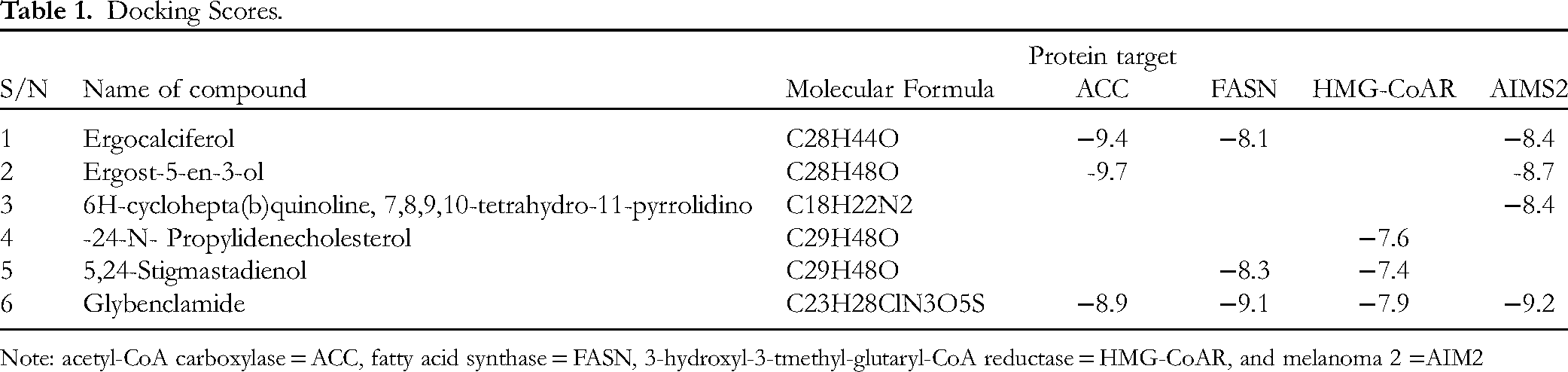
Note: acetyl-CoA carboxylase = ACC, fatty acid synthase = FASN, 3-hydroxyl-3-tmethyl-glutaryl-CoA reductase = HMG-CoAR, and melanoma 2 =AIM2
Physicochemical Properties, Absorption, Distribution, Metabolism, and Toxicity Characteristics of top-Posed Compounds
The physicochemical properties, absorption, distribution, metabolism, and toxicity characteristics of the substances under investigation and the reference medication glibenclamide were analysed.
Table 2 provides information on the physicochemical properties of various compounds. Ergocalciferol, Ergost-5-en-3-ol, and −24-N-Propylidenecholesterol have similar molecular weights of approximately 400. In contrast, Glibenclamide has a significantly higher molecular weight of 494, which is close to the maximum allowed molecular weight for recommended drugs. In addition, Glibenclamide has the greatest number of rotatable bonds (11), suggesting its higher level of structural complexity compared to the other compounds. Regarding H-bond Acceptors/Donors, most compounds exhibit comparable quantities of H-bond acceptors and donors. However, an exception is observed in the case of 6H-cyclohepta(b)quinoline, which does not possess any H-bond donors.
Physicochemical Properties of top-Posed Compounds and Standard Drug Glibenclamide.

The absorption, distribution, metabolism, and pharmacokinetic profile (Table 3) can be summarized as follows: 6H-cyclohepta(b)quinoline has strong gastrointestinal (GI) absorption, in contrast to other substances that have poor absorption. Glibenclamide has a greater inhibitory effect on numerous CYP enzymes than other drugs, suggesting a higher likelihood of drug interactions. Only 6H-cyclohepta(b)quinoline can permeate the blood-brain barrier (BBB), while all drugs including Glibenclamide have the same bioavailability score.
Absorption, Distribution, and Metabolism and Pharmacokinetic Profile of the top Posed Compounds and Standard Drug Glibenclamide.

The compound's lipophilic and rugged profile is displayed in Table 4. When considering the topological polar surface area (tPSA), all chemicals, including Glibenclamide, exhibit identical TPSA values. Ergost-5-en-3-ol and −24-N-Propylidenecholesterol have larger logP values than the other compounds, suggesting greater lipophilicity. Glibenclamide has more breaches in terms of Lipinski, Ghose, Veber, and Lead likeness criteria than other compounds.
Lipophilic and Drug-Able Profile of the top Posed Compounds and Standard Drug Glibenclamide.

The toxicological and excretion characteristics of the substances are shown in Table 5. Ergocalciferol and Ergost-5-en-3-ol have reduced levels of acute oral toxicity compared to other substances. Only 6H-cyclohepta (b) quinolone is classified as possibly carcinogenic. Aside from Ergocalciferol, the majority of substances display hepatotoxicity. Regarding additional toxicity indicators, it has been observed that Glibenclamide exhibits suppression of the Human Ether-a-go-go-Related Gene and MATE1, which suggests the possibility of cardiac and renal harm. Compared to the other substances mentioned, Glibenclamide is notable for its higher molecular weight, more intricate structure, increased capability for inhibiting CYP enzymes, and more concerns regarding toxicity. Ergocalciferol and Ergost-5-en-3-ol have lower toxicity levels and simpler pharmacokinetic characteristics.
Toxicological and Excretion Profile of the top Posed Compounds and Standard Drug Glibenclamide.

Discussion
Elevated triacylglycerol (TG), low density lipoprotein (LDL-c), and cardiovascular risk are correlated with elevated blood glucose levels in type 2 diabetes. 37 So, dyslipidemia and type 2 diabetes are closely interrelated conditions, often coexisting and influencing each other's pathophysiology
So far as we know, there is limited information on the use of the leaves of Jimson weed, as all previous studies were carried out using seed and root extracts. Considering the relationship between lipid profile and renal dysregulation in T2DM, this study evaluated the impact of Jimson weed ethanol extract on lipid profile, cardiovascular risk indicators, and renal indices using a rat model since we had previously established the hypoglycemic property of this plant. We observed undesirable alterations in the lipid profile and cardiovascular risk indicators in diabetic rats as illustrated by elevated TC, TG, LDL-C, and cardiovascular indicators. The cardiovascular indicators assayed were AC, AI, and CRI. We also assayed the cardioprotective index (CPI). The elevated lipids (TC, TG, and LDL-C) and cardiovascular indicators (AC, AI, and CRI) were significantly lowered in the rats treated with Jimson weed. We also observed an improvement in HDL-C concentration and CPI in the treated classes. These trends hint at the hypolipidemic and cardioprotective capability of Jimson weed. Previous authors have reported the lipid-reducing properties of Jimson weed. 38 We have previously reported the blood glucose-lowering property of this plant which hints at the anti-diabetic capability of Jimson weed. 21
Increased TC, TG, LDL-C, and lowered HDL-C increases the risk of cardiovascular disease, especially in diabetics. These aberrations in lipids panels as a result of diabetes have been widely reported in humans and rats. 37 Maintenance of an ideal lipid profile level in T2DM individuals to a greater extent enhances glycemic control and thus leads to enhanced treatment outcomes. 39
Cardiovascular indicators (AC, AI, and CRI) sometimes called lipid ratios are helpful indices in the evaluation of cardiovascular risk because they give a better representation of interactions among the lipid components. Individuals with a high CRI (TC/HDL-C) ratio are at higher risk of atherosclerosis and stroke. 40 The elevated cardiovascular indicators in diabetic rats were lowered in rats treated with Jimson weed. Herbs have been proven to lower cardiovascular indicators in animal models and humans.41,42 Toxicants like alloxan can inhibit lipolytic enzyme activity, leading to the formation of cholesterol deposits on the arterial walls and a consequent rise in AI and CRI. Amazingly, Jimson weed extract markedly lowered the AC, AI, and CRI. The remarkable elevation in the cardioprotective index (CPI) shown by the extract-treated rats adds more credence to the antiatherogenic capacity of Jimson weed.
Cardiovascular disease ranks first in the hierarchy of premature global death score and, thus, a global health threat. Risk factors for cardiovascular disease include smoking, diabetes mellitus, advanced age, increased lipid levels, and elevated blood pressure. 43 Increased LDL-C is affiliated with atherosclerosis outcome. Atherosclerosis is a disorder marked by the deposition of lipid plaques in the artery's walls. These lipids, mainly cholesterol, TG, and LDL-C deposited in the arterial walls, cause the narrowing and bursting of the arterial walls, culminating in myocardial infarction. 44 Thus, it can be said that escalated levels of TC, TG, and LDL-C are fingered in the perpetuation of atherosclerosis and its associated complications. Interestingly, herbal medications have proven effective at combating atherosclerosis and related complications. 45 Jimson weed extract also proved effective at combating atherosclerosis in this study. This effect could result from the active principles present in Jimson weed as it contains some active compounds like flavonoids, phenols, tannins, alkaloids, and cardiac glycosides. 26 These active compounds could have synergistically hindered cholesterol production or enzymes needed in cholesterol synthesis. Some active compounds in herbs have the capacity to repress LDL-C receptors while enhancing lipid breakdown. 45 The repression of enzymes involved in hepatic cholesterol production is crucial for curbing atherosclerosis. 46 Inhibition of HMG-CoA reductase, an enzyme that converts HMG CoA to mevalonate and subsequently to cholesterol, could be the apparatus employed by Jimson weed extract to produce the remarkable decline in TG and LDL-C levels.
Recent studies underscore the efficacy of plant-derived bioactive substances in the management of diabetes mellitus. Flavonoids, alkaloids, tannins, and terpenoids exhibit promise antidiabetic benefits via many pathways. 47 These chemicals regulate essential metabolic pathways by suppressing digestion enzymes such as α-amylase and α-glucosidase, augmenting insulin secretion and sensitivity, and diminishing oxidative stress.47,48 They specifically target proteins and receptors implicated in glucose metabolism, including GLUT4, IRS-1, and PPARs 48 (p20). Furthermore, these phytoconstituents affect processes such as glycolysis, gluconeogenesis, and glycogen production. 49 The varied antidiabetic capabilities of these natural chemicals present a viable alternative to traditional therapies, possibly diminishing side effects and the financial burden of diabetes management 49
DM, cardiovascular disease and chronic kidney disease (CKD) have an interwoven alliance. Expectedly, diabetic rats had severe renal dysregulations in the present study. CKD could culminate in end-stage renal disease (ESRD) whereby the kidney is unable to carry out its physiological activities leading to high mortality outcomes and socioeconomic burden. DM and hypertension are the commonest causes of ESRD globally. 50 Thus, regular evaluation of kidney function indices in diabetic individuals is crucial for the effective management of DM and delay/or boycotting of the emergence of CKD. Renal failure increases insulin resistance, and hence, more insulin is needed in diabetic patients. More so, renal failure can trigger anemia.51,52 Anemia further enhances insulin resistance by tissues, notably skeletal tissues. The use of erythropoietin to boost insulin sensitivity in anemic diabetics asserts this report.
Oxidative stress arises due to an escalated production of reactive oxygen species (ROS) more than endogenous antioxidants. 53 Oxidative stress enables the manifestation of several diseases like DM, cancer, cardiovascular diseases, and diabetic kidney diseases. 54 On this note, antioxidant-based medications could be an effective treatment alternative. The therapeutic use of plant-derived antioxidants in managing DM and kidney diseases is vast. Jimson weed has been reported to have glucose-reducing, blood-boosting, and antioxidant attributes. 54 In sum, the observed restoration of impaired renal indicators in the diabetic rats given Jimson weed extract could be attributed to Jimson's glucose-reducing, blood-boosting, and antioxidant capacities.
Electrolyte imbalance is a prominent feature in diabetics. Electrolytes are charged endogenous molecules essential for the maintenance of physiological homeostasis. These charged molecules play substantial roles in muscle contraction, membrane function, hormone production and function, neurotransmission, and maintenance of fluid and acid-base balance. 55 Due to these numerous roles, any imbalance (low or high concentration) triggers serious pathological consequences, most importantly kidney disorders. The electrolytes assayed in this study are sodium (Na+), potassium (K+), and chloride (Cl-). We observed a remarkable decline in Na + and K + serum concentrations while the Cl- level was heightened. This result is in tune with previous similar studies. 55 Individuals with diabetes usually present with excessively lowered Na + levels (hyponatremia). Hyponatremia emanates from hyperglycemia-induced osmotic fluid changes of water transport from intracellular to extracellular space accompanied by dilution of Na + serum level. The body, on its own, through a cascade of reactions, can attempt to minimize excessive blood glucose levels by increasing urine production, which could cause a dilution in serum K + . Some authors have contradicting reports on serum Cl- levels. 56 While we observed a rise in serum Cl- (hyperchloremia) in our study, these authors reported a decrease in Cl- (hypochloremia). The different study subjects used could be responsible for these contrary reports. Unachukwu and colleagues used diabetic patients in hospital admission who are faced with constant vomiting, diuretic use, and established neuropathy. 56 All these factors enhance Cl- loss and hypochloremia. Meanwhile, in our study using a rat model, elevated Cl- levels could be orchestrated by ketoacidosis. Ketoacidosis has been reputed to contribute to hyperchloremia in diabetics. 55
Urea is a key by-product of protein catabolism. The kidney is responsible for its removal through urine. Creatinine, a by-product of muscle creatine catabolism, is also removed by the kidney after filtration by the glomeruli. Thus, serum urea and creatinine concentrations aid in evaluating renal functioning capacity. Impaired urea and creatinine levels depict a decline in renal functional capacity, culminating in diabetic kidney disease. Measuring the glomerular filtration rate (GFR) by estimating serum creatinine level is one of the prominent protocols in evaluating kidney disease. Elevated serum creatinine and reduced GFR are trademarks of diabetic kidney disease (DKD). 57 As usual, alloxan injection triggered diabetes in the rats in the present study, with resultant elevations in serum urea and creatinine levels. Intriguingly, oral administration of the rats with Jimson weed extract remarkably reversed this abnormal trend. Bearing in mind that about 40% of individuals faced with diabetes challenges present with DKD and its cohorts like cardiovascular disease, coupled with the high cost of antidiabetic medications with their accompanying deleterious effects, Jimson weed could be explored in mitigating diabetes induced DKD.
The docking results indicate that Ergocalciferol, Ergost-5-en-3-ol, 6H-cyclohepta(b)quinoline, 7,8,9,10-tetrahydro-11-pyrrolidino, −24-N-Propylidenecholesterol, 5,24-Stigmastadienol, and Glibenclamide exhibit high binding affinities to proteins associated with metabolic pathways and immune response. These chemicals are promising therapeutic possibilities for illnesses associated with aberrant lipid metabolism and immune system dysfunction. 58 The research findings also demonstrate many bonding interactions between the docked compounds and the targeted proteins, such as pi-pi bonds, sigma bonds, hydrophobic contacts, and typical hydrogen bonds. Ergocalciferol and Ergost-5-en-3-ol have higher binding affinities with acetyl-CoA carboxylase than Glibenclamide, indicating their potential as more powerful inhibitors of this enzyme. 59 The compound (24E)-24-N-Propylidenecholesterol has equivalent binding interactions with fatty acid synthase to Glibenclamide, indicating similar efficacy. The robust associations identified between particular chemicals and the Melanoma 2 (AIM2) protein imply the possible use of these compounds to mediate immunological responses, particularly in instances where AIM2 is impaired, such as autoimmune disorders and specific malignancies.60–62
The docking results indicate that several compounds, such as Ergocalciferol, Ergost-5-en-3-ol, 6H-cyclohepta(b)quinoline, 7,8,9,10-tetrahydro-11-pyrrolidino, −24-N- Propylidenecholesterol, 5,24-Stigmastadienol, and Glybenclamide, have demonstrated promising affinities for specific target proteins: acetyl-CoA carboxylase (ACC), fatty acid synthase (FASN), 3-hydroxyl-3-tmethyl-glutaryl-CoA reductase (HMG-CoAR), and melanoma 2 (AIM2) proteins. These findings have important biochemical consequences, as they indicate possible therapeutic approaches for controlling the function of these proteins, which have a role in many physiological processes related to diabetes, such as lipid metabolism and immune response. ACC is a crucial enzyme that plays a role in producing fatty acids. The binding of substances such as Ergocalciferol and Ergost-5-en-3-ol to ACC indicates that they may have a role in regulating lipid metabolism. This might be achieved by reducing ACC activity, which could have consequences for disorders such as obesity, metabolic syndrome, and dysregulation of lipids in diabetes, and may be a possible mechanism employed by Jimson Weed in the modulation of dyslipidemia associated with diabetes.
FASN is an essential enzyme involved in the production of fatty acids. The interaction between (24E)-24-N-Propylidenecholesterol and FASN suggests a possible method for controlling lipid synthesis. This discovery has potential significance in relation to cancer, as FASN is frequently increased in cancer cells to meet their elevated metabolic requirements and in diabetes to prevent abnormal lipid levels. 63 HMG-CoAR, an enzyme that plays a crucial role in the mevalonate pathway responsible for synthesizing cholesterol, acts as a bottleneck in this process. The binding interactions between Ergocalciferol and (24E)-24-N-Propylidenecholesterol indicate that these chemicals may have a regulatory function in cholesterol metabolism, which might have ramifications for cardiovascular health and lipid diseases. 64
The AIM2 protein, or Melanoma 2 protein, is a sensor for DNA located in the cytosol. It has a vital function in the innate immune response, activating inflammasomes.65,66 The strong affinity between 6H-cyclohepta(b)quinoline, 7,8,9,10-tetrahydro-11-pyrrolidino, Ergocalciferol, and Ergost-5-en-3-ol and AIM2 suggests that they can regulate the immune response. This could be significant in conditions characterized by uncontrolled inflammation, such as autoimmune diseases, diabetic kidney disease, and cancer. The observed specific binding interactions, including pi-pi bonds, sigma bonds, hydrophobic interactions, and conventional hydrogen bonds, offer valuable insights into the molecular mechanisms that govern the interactions between ligands and proteins. This knowledge can guide the rational development of new therapeutic agents that target these proteins.
The primary function of the Melanoma 2 (AIM2) protein is to participate in innate immunity by facilitating the development and activation of inflammasomes in response to cytosolic 65 DNA. Nevertheless, AIM2's role in diabetic kidney disease (DKD) is currently being explored as a new field of study, indicating a possible connection between AIM2 and the development of DKD. Inflammasomes, such as AIM2, are complex assemblies of several proteins involved in developing different inflammatory conditions, including diabetic kidney disease (DKD). Inflammasome activation results in the secretion of pro-inflammatory cytokines, including interleukin-1β (IL-1β) and interleukin-18 (IL-18), which contribute to inflammation and tissue damage in diabetic kidney disease (DKD). 67
Studies have shown that the expression of AIM2 is elevated in the renal tissues of diabetic persons with diabetic kidney disease (DKD). Smyth et al 68 discovered that AIM2 expression was higher in renal biopsies from people with diabetic kidney disease (DKD) compared to individuals without diabetes. This indicates a possible involvement of AIM2 in the inflammatory mechanisms that contribute to diabetic kidney disease (DKD). Activation of AIM2 has been associated with renal inflammation in many experimental settings. Yuan et al 69 conducted a study that showed how the absence of AIM2 reduced inflammation and fibrosis in the kidneys of mice with DKD. This emphasizes the role of AIM2 in developing inflammation associated with DKD. AIM2 can engage with other components of the inflammasome, including NLRP3, which is also associated with diabetic kidney disease (DKD). The interaction between AIM2 and NLRP3 may enhance the inflammatory response in DKD. 70
Overall, AIM2 seems involved in the inflammatory mechanisms that contribute to diabetic kidney disease (DKD), maybe by triggering the activation of inflammasomes and the release of cytokines. The compounds Ergocalciferol, Ergost-5-en-3-ol, and 6H-cyclohepta(b)quinoline, 7,8,9,10-tetrahydro-11-pyrrolidino bind to AIMS2 with affinities similar to glibenclamide. This suggests that these compounds found in Jimson weeds have the potential to be used in the treatment of kidney complications related to diabetes.
Limitations of the Study
This study has some limitations. Since the physiological status of the body varies between the two species of rats and humans, it's important to note that the results may not be exactly the same. The primary constraints of the study include the brief duration of the assessment and its exclusive focus on the female population. The study employed fixed doses and an oral administration schedule for the extract, potentially leading to variations in its bioavailability and efficacy. The present work used molecular modelling to gain insight into hypothetical interactions, but did not mention the biological activities. This study's limitations should be considered in future studies to avoid these constraints and improve upon the positive outcomes discovered in this study.
Future Research Directions
A potential future study avenue may entail executing extended investigations utilizing both male and female rats to encompass a wider physiological response to the Jimson weed extract. Furthermore, human clinical trials may be structured to assess the translational significance of the findings in a therapeutic context, including species-specific variations in metabolism and physiological responses.
Subsequent research should investigate diverse dosage regimens, including other delivery methods (eg, intravenous or intraperitoneal) and dose modifications, to enhance bioavailability and effectiveness. Furthermore, integrating in vivo biological activity experiments with molecular modeling predictions would yield more robust evidence for the extract's possible therapeutic processes, facilitating a more thorough assessment of its bioactivity. This methodology will rectify the deficiencies in the existing research, enhancing its significance and usefulness to human health.
Conclusion
Because sustained high blood sugar levels, impair cardiovascular structures and function, cardiovascular diseases, perturbed lipid metabolism, and chronic kidney disease are often the consequences of type 2 diabetes mellitus (T2DM). Since cardiovascular diseases remain the number one killer in the world, it is important to investigate new treatments. Uniquely, T2DM patients are at a high risk of developing chronic renal disease that affects their quality of life. This study served to establish that Jimson weed has a potential of significantly reducing blood sugar levels, cholesterol levels as well as offer some protection to the heart and kidney. Since the available medications to treat the interaction between T2DM, CVD, and renal disorders remain suboptimal, Jimson weed provide a reasonable option. In particular, additional investigations into its possible uses in this complications may offer some insights, creating a new path towards the treatment of these diseases. From the observations, in this study, Jimson weed could fit into future treatment plan for managing such complicated disorders
Footnotes
Acknowledgment
The work was supported by the Researchers Supporting Project (RSP2024R393), King Saud University, Riyadh, Saudi Arabia.
Authors’ Contributions:
Declaration of Conflicting Interests
The authors declared no potential conflicts of interest with respect to the research, authorship, and/or publication of this article.
Ethics Approval
This study was approved by the Biochemistry Department Research Ethics Committee of the Ebonyi State University Abakaliki, (Approval number: EBSU/BCH/ET/21/006B) on 25 October 2021. All protocols for the safe use of animals were adhered to stringently. The protocols subscribe to the global conventional use of animal models in research that is Animal Research: Reporting of In vivo Experiments (ARRIVE) guidelines for animal study research.
Funding
The work was supported by the Researchers Supporting Project (RSP2024R393), King Saud University, Riyadh, Saudi Arabia.

Statement of Animal Rights
All procedures involving animals in this study were conducted in accordance with the Biochemistry Department Research Ethics Committee of the Ebonyi State University Abakaliki, (Approval number: EBSU/BCH/ET/21/006B) approved protocols.