



Abstract
Introduction
Essential oils are intricate blends of plant-derived compounds known for their diverse biological activities, such as cytotoxic, anti-inflammatory, antioxidant, antimicrobial, and antifungal effects. 1 Antioxidants present in essential oils help mitigate oxidative stress by neutralizing harmful radicals, thereby safeguarding cells and promoting overall health. 2 Moreover, secondary metabolites in essential oils, including phenolic compounds, sesquiterpenes, and monoterpenes, are well-recognized for their strong anti-inflammatory properties, mainly by regulating immune response pathways and decreasing inflammation. 3 Chronic inflammation and oxidative stress are interconnected pathogenic processes that contribute to cancer development and progression. 4 Essential oils have remarkable pharmacological and biological characteristics that make them useful for treating a variety of diseases. Thus, research is necessary to find out more concerning the medicinal uses of essential oils.
The genus Psychotria stands out among the essential oils of the family Rubiaceae that are derived from natural sources. This genus, which has more than 2000 species, is primarily found in tropical and subtropical regions. various indigenous cultures are familiar with it from its various traditional medical uses.5,6 Although the chemical compositions of the various Psychotria species can differ, common compounds found across many species include flavonoids, terpenoids, alkaloids, and tannins.5-7 These species display a diverse array of biological properties, including antibacterial, anti-inflammatory, antioxidant, and antiparasitic activities.5,6 Research on Psychotria species (P. asiatica, P. eurycarpa, P. leiocarpa, P. poeppigiana, and P. serpens) has shown distinct compositions, even though the chemical makeup of Psychotria species’ essential oils has received little to no attention. These studies demonstrate that essential oils contain monoterpenes, sesquiterpenes, and oxygenated sesquiterpenes.8-12
In Vietnam, the genus Psychotria has approximately twenty-five species, nine of which have been traditionally employed in medicine. Psychotria laui has a long-standing history in Vietnamese medicine, where it is utilized for its anti-inflammatory and analgesic effects, especially in the management of joint pain and digestive issues.13-16 Additional research into the chemistry and biological functions of P. laui is essential to enhance our understanding of this species. The objective of this work was to analyze the chemical composition of the essential oil extracted from P. laui leaves and evaluate its cytotoxic, anti-inflammatory, and antioxidant potential. This is the first study that, as far as we know, describes the components and biological properties of the essential oil that is extracted from P. laui leaves.
Materials and Methods
Hydrodistillation of Essential oil
P. laui leaves were obtained in January 2024 from Quang Tri Province, Vietnam, with geographical coordinates at 16°38′31.9″N 106°51′36.5″E and co-author Dr Anh Tuan Le (VAST, Vietnam) verified the authenticity of the leaves. The University of Education, Hue University, Vietnam's Faculty of Chemistry has preserved a voucher specimen (PLL-QT-2024). After being freshly picked, the 1.2 kg of leaves were finely chopped and thoroughly cleaned. The essential oil was obtained via hydro-distillation using a 2 L Clevenger apparatus. After the distillation, the essential oil was separated from the aqueous layer and collected with the help of a separating funnel. The process was tuned for maximum oil extraction over 4.0 h. Following extraction, the oil was chilled until additional analysis and dried using Na2SO4.12,17-19
Analysis of the Volatile Compounds
The volatile components of P. laui leaf essential oil were analyzed using a Shimadzu GC-MS QP2010 Plus system from Kyoto, Japan, which integrates mass spectrometry (MS) and gas chromatography (GC) techniques. Following the standard procedures from our earlier research, the chemical components of P. laui leaves were identified with accuracy and dependability.12,17-19 The GC-MS analysis was conducted using a Shimadzu GCMS-QP2010 Plus chromatograph, which was equipped with a fused silica Equity-5 capillary column (30 m × 0.25 mm, 0.25 μm film thickness, Supelco, USA). The temperature program was as follows: the column temperature was initially set to 60 °C for 2 min, then increased to 240 °C at a rate of 3 °C/min, where it was maintained for 10 min, and subsequently raised to 280 °C at a rate of 5 °C/min for an additional 15 min. The injector and interface temperatures were maintained at 280 °C.
DPPH Radical Scavenging Activity
Following established protocols, laboratory conditions were modified as needed, and the capacity of the test sample to scavenge free radicals generated by DPPH was evaluated. The antioxidant activity of P. laui essential oil was determined using the DPPH radical scavenging assay. L-Ascorbic acid, a well-established antioxidant, was employed as the positive control, while a solvent or buffer solution devoid of both the essential oil and L-Ascorbic acid served as the negative control.12,17,19,20
Anti-Inflammatory Assay
The study investigated the ability of essential oil derived from P. laui leaves to inhibit nitric oxide (NO) production in RAW 264.7 cells stimulated with lipopolysaccharide (LPS). The concentration of nitrite, which serves as an indicator of NO presence in the culture media, was quantified using the Griess reaction. Comprehensive methodologies for these assessments can be found in our earlier studies. The anti-inflammatory effects were assessed by measuring the decrease in NO production in LPS-stimulated RAW264.7 macrophage cells. Dexamethasone, recognized for its anti-inflammatory properties, was used as the positive control, while untreated RAW264.7 cells or those treated with the solvent acted as the negative control.12,17,19,20
Cytotoxicity Assays
The cytotoxicity of the essential oils was assessed using the sulforhodamine B (SRB) assay on the SK-LU-1 cell line (human lung adenocarcinoma). Detailed methodologies for conducting cytotoxic assays are provided in our prior reports. The cytotoxic effects of the essential oil were tested on the SK-LU-1 cell line, with ellipticine used as the positive control due to its established anticancer properties. The negative control consisted of a solvent or buffer solution devoid of both the essential oil and Ellipticine.12,20
Statistical Analysis
All the experiments were triplicated with the data were described as the mean ± standard deviation (SD). The data were analyzed using Microsoft Excel 2020 (Washington, USA). 21
Results
Phytochemical Analysis
P. laui leaves yielded 0.12% (v/w) of essential oils upon extraction. As presented in Table 1 and Figure 1, a total of 78 compounds were identified, comprising 98.8% of the total oil content. The main chemical classes found are oxygenated sesquiterpenes (67.1%), sesquiterpene hydrocarbons (18.1%), oxygenated monoterpenes (7.6%), and monoterpene hydrocarbons (1.7%). The main constituents of P. laui leaf essential oil, selected based on their concentrations exceeding 3%, include spathulenol (10.4%), thujopsan-2-α-ol (9.5%), 7-epi-α-eudesmol (6.5%), 14-hydroxy-9-epi-(E)-caryophyllene (4.4%), epi-α-cadinol (3.9%), α-muurolol (3.8%), 1-epi-cubenol (3.5%), and δ-cadinene (3.2%).

Gc of the essential oil from Psychotria laui leaves.
Chemical Compounds in Psychotria laui Leaf Essential Oil.
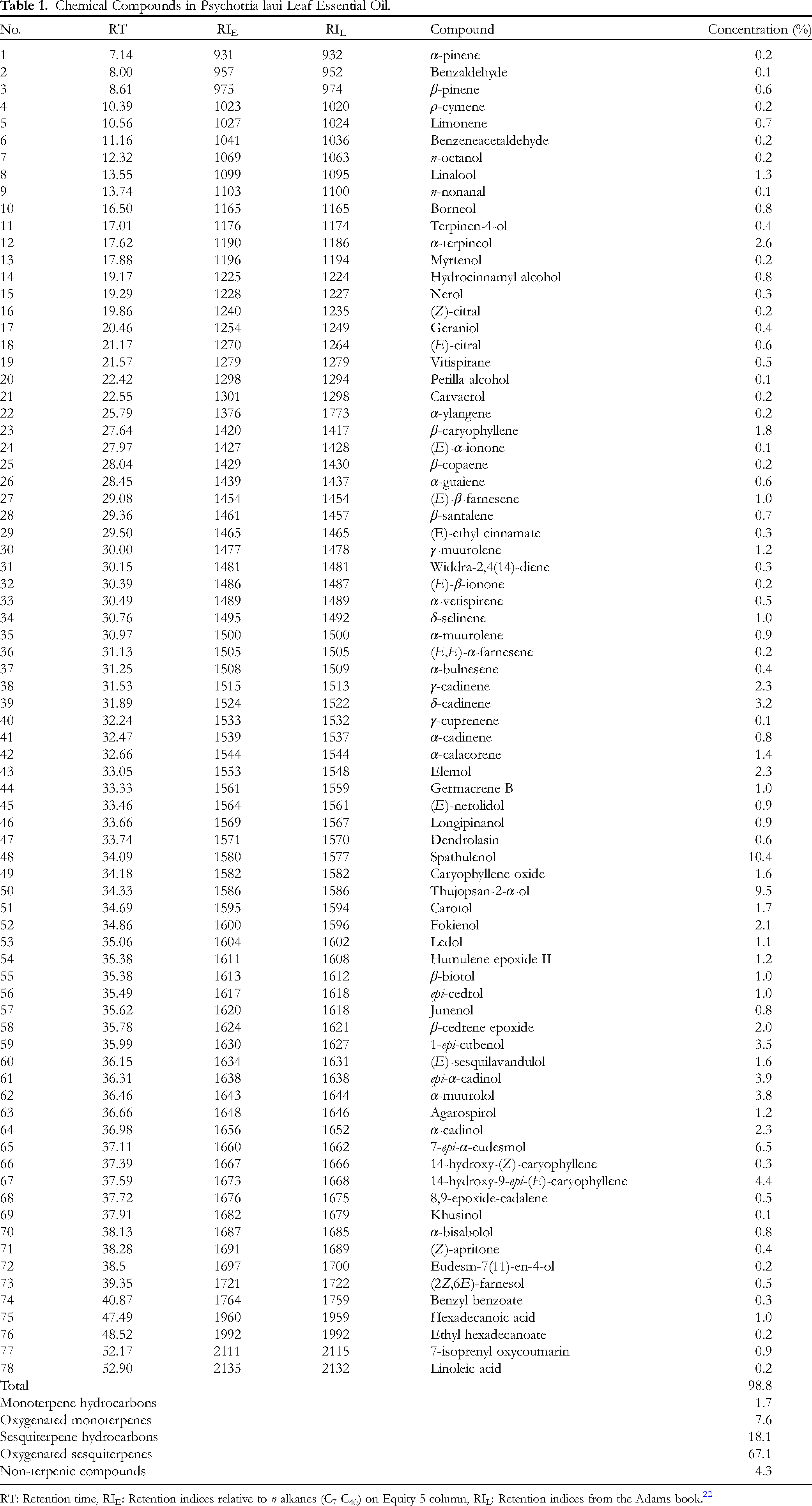
RT: Retention time, RIE: Retention indices relative to n-alkanes (C7-C40) on Equity-5 column, RIL: Retention indices from the Adams book. 22
DPPH Radical Scavenging Activity
The antioxidant activity of the essential oil was evaluated using the DPPH assay, as illustrated in Table 2. The essential oil exhibited no significant antioxidant activity, demonstrated by an IC50 value exceeding 500 µg/mL.
IC50 Values of DPPH Scavenging of Leaf Essential oil of Psychotria Laui.
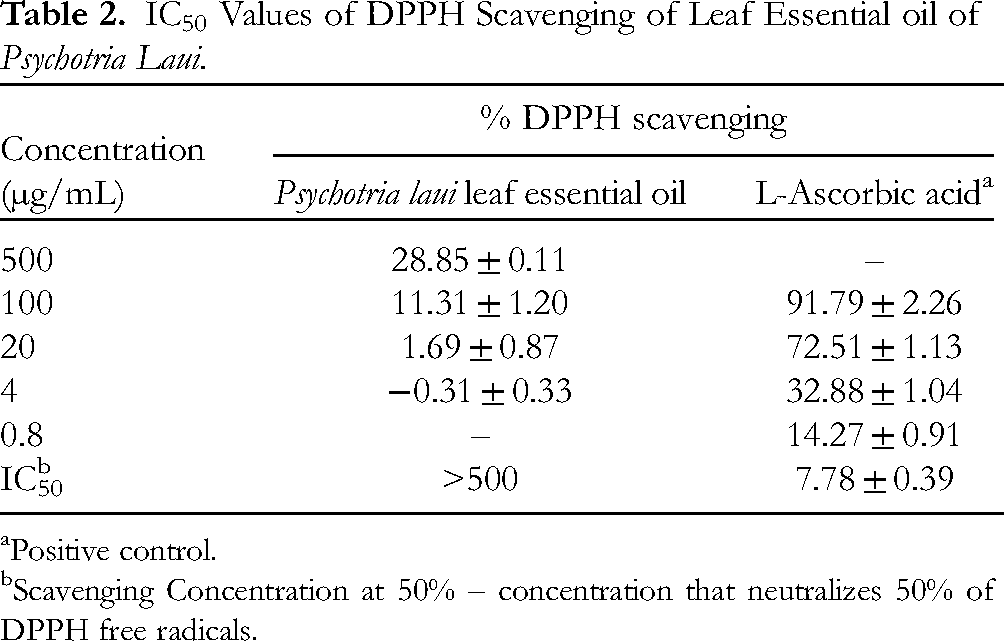
Positive control.
Scavenging Concentration at 50% – concentration that neutralizes 50% of DPPH free radicals.
Anti-Inflammatory Effect
Nitric oxide (NO), a key mediator of inflammatory responses, is overproduced in various clinical disorders. To explore this, we measured the inhibitory effects of P. laui essential oil on NO production in LPS-induced RAW264.7 macrophage cells, as presented in Table 3. The essential oil exhibited a significant reduction in NO production, with an IC50 value of 19.48 ± 1.53 µg/mL. In comparison, the positive control, dexamethasone, demonstrated an IC50 value of 13.71 ± 1.48 µg/mL.
in vitro Anti-Inflammatory Activity of Leaf Essential oil of Psychotria Laui.

Positive control.
Concentration that inhibits 50% of cell growth.
Anti-Cancer Effect
Another study examined the effects of P. laui leaf essential oil on the proliferation of the SK-LU-1 cell line utilizing the SRB assay. The findings revealed significant cytotoxicity, with an IC50 value of 8.49 ± 0.73 μg/mL (see Table 4).17,20
Cytotoxicity of the Essential oil from Psychotria laui Leaves Against Human Cancer Cell Lines.

aPositive control; SK-LU-1: Human lung adenocarcinoma cell line.
The half-maximal inhibitory concentration.
Discussion
This study centered on essential oils derived from the leaves of P. laui, utilizing GC-MS analysis to identify the various components of the leaf essential oil. The antioxidant, anti-inflammatory, and anticancer effects were evaluated using DPPH, NO inhibition, and MTT assays, respectively.
The essential oil yield from P. laui leaves was 0.12% (v/w). In comparison, P. poeppigiana leaves produced a higher yield of 0.4% (w/w). 11 P. eurycarpa flowers yielded 0.0629%, which is lower than P. laui. 8 The essential oil yield from P. leiocarpa leaves was 0.1%, slightly less than that of P. laui. 9 P. serpens, using its aerial parts, had a yield of 0.05% (w/w), the lowest among the compared species. 10 Lastly, P. asiatica leaves yielded 0.08% (v/w), which is also lower than P. laui. 12 The observed differences in the chemical profiles between P. laui and other Psychotria species are based on a comparative analysis of their essential oil compositions. Specifically, we have analyzed the concentration and diversity of key chemical classes and individual compounds. P. laui leaves’ essential oils contain three main constituents: spathulenol (10.4%), thujopsan-2-α-ol (9.5%), and 7-epi-α-eudesmol (6.5%). Prominent research in this field has investigated P. poeppigiana's essential oil and determined that its primary components are bicyclogermacrene (25.21%) and germacrene D (29.38%). 11 Likewise, the principal constituents of P. eurycarpa's floral essential oil were linalool (49.2%) and methyl salicylate (34.1%). 8 Germacrene D (17.6%) and bicyclogermacrene (35.6%) were the two main constituents of P. leiocarpa leaf essential oil. 9 Significant components of P. serpens were found in another investigation, including linalool (10.0%) and 1-octen-3-ol (23.2%). 10 Major components of P. asiatica essential oil were identified to include (E)-citral, 10-epi-γ-eudesmol, and (Z)-citral, with respective values of 20.6, 15.9, and 10.5%. 12 Based on these results, Psychotria plants may be useful suppliers of essential oils with a high concentration of oxygenated sesquiterpene hydrocarbons. Variations in the results can be ascribed to pertinent characteristics, collecting times, and geographic disparities, among other things.
There was no noticeable antioxidant action in the essential oil, as indicated by its IC50 value of more than 500 µg/mL. Similarly, the DPPH scavenging assay revealed negligible antioxidant activity in P. asiatica leaf oil. 12 Conversely, the IC50 value of 12.78 ± 1.36 μg/mL for the P. poeppigiana leaf essential oil showed considerable antioxidant activity. 11 Furthermore, the P. serpens essential oil showed notable ferric ion reduction activity (TEAC value of 46.31 μmol Trolox × g−1) and strong ABTS+ radical scavenging activity (IC50 value of 0.438 mg/mL). Its IC50 value of 1.250 mg/mL indicated that it was not very effective at scavenging DPPH radicals. 10
The essential oil's IC50 value of 19.48 ± 1.53 µg/mL showed that it significantly suppressed NO production. On the other hand, the positive control, dexamethasone, had an IC50 value of 13.71 ± 1.48 µg/mL. P. asiatica leaf oil has an IC50 for NO inhibition in RAW 264.7 cells of 29.08 ± 1.54 µg/mL, according to earlier research employing the MTT test. 12 Research on the potential anti-inflammatory effects of essential oils from the Psychotria genus is generally limited. The anti-inflammatory properties of P. laui leaf oil are likely due to its primary compounds, including spathulenol, thujopsan-2-α-ol, and 7-epi-α-eudesmol. Spathulenol, a sesquiterpene, has been recognized as a significant volatile component in the essential oils of various aromatic species within the Myrtaceae family.23-27 Examples of these species include Eugenia calycina, E. uniflora, Psidium cattleianum, P. guineense, and P. guajava.23-27 Studies on spathulenol-rich essential oils have demonstrated notable anti-inflammatory properties.27-29 Another important molecule is 7-epi-α-eudesmol, a sesquiterpenoid of the eudesmane class. The eudesmane sesquiterpenoids found in the fruits of Alpinia oxyphylla are a diversified group with notable anti-inflammatory characteristics. The ability of these compounds to decrease the generation of NO in LPS-stimulated BV-2 cells has been assessed; IC50 values range from 21.63 to 60.70 μM, indicating moderate to substantial NO suppression. Additionally, these compounds partially inhibited the production of TNF-α and IL-6 in LPS-stimulated BV-2 cells. The mRNA expressions of TNF-α, IL-6, COX-2, and iNOS were significantly reduced, while the protein expressions of COX-2 and iNOS were also downregulated.30,31
The results showed considerable cytotoxicity with an IC50 value of 8.49 ± 0.73 μg/mL (Table 4).17,20 However, in a comparable study evaluating P. asiatica leaf essential oil, SK-LU-1 cells demonstrated a higher IC50 value of 39.75 ± 1.79 μg/mL. 12 These findings draw attention to the small but growing corpus of research regarding the potential anti-cancer properties of essential oils sourced from the Psychotria genus. The leaf extract of Dasymaschalon dasymaschalum, spathulenol, has been shown to have strong cytotoxic effects on human lung cancer cell lines (NCI-H187), with an IC50 value of 6.6 μg/mL. 32 Conversely, spathulenol isolated from the aerial parts of Glycosmis parviflora demonstrated cytotoxicity against human lung cancer cell lines, SK-LU-1, with an IC50 value of 41.86 ± 2.58 μg/mL. 33 Spathulenol also exhibits cytotoxicity against human gastric adenocarcinoma (AGS), murine melanoma (B16-F10), human hepatoblastoma (HepG2), human leukemia (HL-60 and K562), and human ovarian cancer (OVCAR-3).27,34,35 Several studies have demonstrated the moderate to strong cytotoxic effects of essential oils (EOs) enriched in spathulenol against a variety of cancer cell lines, such as colorectal cancer (CACO-2), human hepatocellular carcinoma (Hep-G2), human ovarian carcinoma (HeLa), human hepatocellular carcinoma (Bel-7402), ovarian carcinoma (A-549, MCF-7, and A2780).36-40 In addition to its cytotoxic effects, spathulenol has been linked to several biological activities, such as the suppression of the human ABCB1 efflux pump and its anticancer, immunomodulatory, and antibacterial qualities.40,41
Significant concentrations of spathulenol, thujopsan-2-α-ol, and 7-epi-α-eudesmol have been identified in the essential oil extracted from P. laui leaves, suggesting potential applications in cytotoxic and anti-inflammatory contexts. Notably, the presence of thujopsan-2-α-ol points to possible therapeutic benefits, although its biological functions have not been documented previously. Our study assessed the antioxidant, anti-inflammatory, and anticancer properties of P. laui essential oil. It is important to highlight several limitations: Firstly, the essential oil showed no antioxidant activity in our assays, suggesting a potential ineffectiveness in scavenging free radicals or providing protection against oxidative stress. Secondly, while the oil demonstrated significant anti-inflammatory effects, as shown by a marked reduction in nitric oxide production in LPS-induced RAW264.7 macrophage cells, this finding is derived from in vitro models, which may not fully capture the complexity of in vivo inflammatory responses. Finally, the essential oil displayed potent cytotoxic effects in the SK-LU-1 cell line. However, this result is limited to a single cancer cell line, necessitating further research to explore its efficacy against a broader range of cancer types and in animal models. Addressing these limitations in future studies will be crucial for a more comprehensive understanding of the biological activities of P. laui essential oil.
Conclusion
Our work is the first of its kind since it provides new information on the biological characteristics and chemical composition of the essential oil derived from P. laui leaves. A total of seventy-eight distinct compounds were identified in the essential oil extracted from P. laui leaves, with the three primary components being spathulenol (10.4%), thujopsan-2-α-ol (9.5%), and 7-epi-α-eudesmol (6.5%). Minimal antioxidant activity was found in the DPPH experiment, with an IC50 value higher than 500 µg/mL. The reduction in NO production in LPS-induced RAW264.7 macrophage cells was used to measure the anti-inflammatory potential. A substantial difference was seen in the results (IC50 = 19.48 ± 1.53 µg/mL). Moreover, the SK-LU-1 cell line had strong cytotoxic effects, with an IC50 value of 8.49 ± 0.73 µg/mL. Further investigation into P. laui leaf essential oil is warranted due to its promising anti-inflammatory and anticancer characteristics.
Footnotes
Acknowledgments
This research is funded by University of Education, Hue University under grant number “T.24.TN.104.03”.
Authors Contributions
Tien Dong Tran and Ty Viet Pham conceived and designed research. Tien Dong Tran, Anh Tuan Le, Thang Quoc Le, and Ty Viet Pham conducted experiments and analyze data. Tien Dong Tran and Ty Viet Pham wrote the manuscript. All authors read and approved the manuscript.
Declaration of Conflicting Interests
The authors declared no potential conflicts of interest with respect to the research, authorship, and/or publication of this article.
Funding
The authors disclosed receipt of the following financial support for the research, authorship, and/or publication of this article: This research is funded by University of Education, Hue University under grant number “T.24.TN.104.03”.
Ethical Approval
Not applicable, because this article does not contain any studies with human or animal subjects.
Statement of Human and Animal Rights
Not applicable, because this article does not contain any guidelines followed for performing experimental procedures.
Informed Consent
Not applicable, because this article does not contain any studies with human or animal subjects.
Trial Registration
Not applicable because this article does not contain any clinical trials.
