



Abstract
Detailed chemical composition of the essential oil of Micromeria myrtifolia Boiss. & Hohen., as well as its antioxidant and enzymatic activity, was analyzed. The most abundant constituents of the oil were sesquiterpene hydrocarbons, β-caryophyllene (40.8%) and α-copaene (17.9%), followed by oxygenated sesquiterpene, caryophyllene oxide (13.5 %). Antioxidant activity of the oil was tested via 8 different methods based on reduction of both radicals and stable metal cations. The oil of M. myrtifolia showed weaker, but still comparable activity with the known antioxidants, butylated hydroxyanisole and disodium edetate, that are used as positive controls. In addition, the essential oil of this aromatic plant species revealed strong inhibitory effects against tyrosinase and α-amylase. Present results suggest the use of the essential oil of endemic M. myrtifolia in a wide variety of applications in food and pharmacological industries.
Micromeria species (family Lamiaceae) are used in folk medicine as herbal teas as a substitute for mint, mostly for treatment of intestine pain and inflammation, fever, asthma, and disorders of respiratory system. 1 Micromeria myrtifolia Boiss. & Hohen. is native to flora of Israel, Lebanon, and Turkey. 2,3 Its aerial parts are traditionally used as tea infusion in the treatment of cold and flu 4 and skin disorders. 1 The essential oil composition of this species from Lebanon and few localities from Turkey is described, 2,3,5 and there are very few studies on its biological activity, such as antioxidant, 3 antifungal, 6 and cytotoxic activities. Therefore, it seems reasonable to perform a detailed investigation of the chemical composition of the essential oil as well as the antioxidant and enzyme inhibitory activity of M. myrtifolia.
The yield of essential oil of M. myrtifolia was determined as 0.2% (v/w), and the chemical composition is presented in Table 1. A total of 16 compounds were identified in the oil. The major class of the compounds was sesquiterpene hydrocarbons (76.3%), with β-caryophyllene (40.8%) and α-copaene (17.2%) as the most abundant representatives. Next were oxygenated sesquiterpenes (17.3%) with caryophyllene oxide (13.5%) as the major one.
Chemical Composition of the Essential Oil of Aerial Parts of Micromeria myrtifolia.
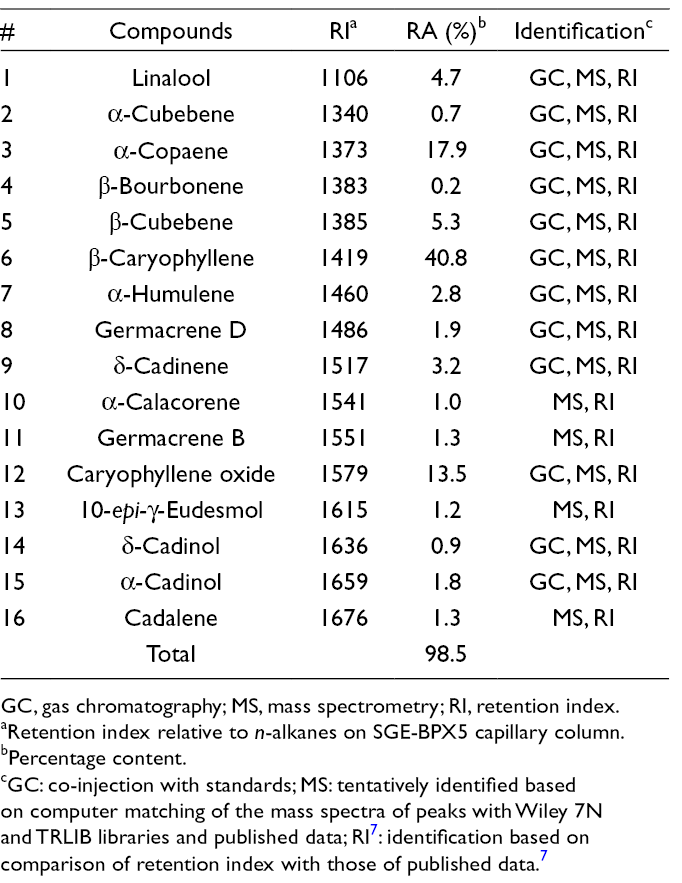
GC, gas chromatography; MS, mass spectrometry; RI, retention index.
a Retention index relative to n-alkanes on SGE-BPX5 capillary column.
bPercentage content.
The chemical composition of the essential oil of M. myrtifolia has already been reported, 2,3,5 and the results are comparable, which suggests quite a high stability of the oil against different environmental factors. Ozek et al 5 reported very low yield of the oil (0.03%) from the plant material collected at Bilecik (Turkey), with the major compounds being β-caryophyllene (42.56%) and caryophyllene oxide (8.69%). Carikci analyzed the oil of M. myrtifolia from Antalya and Tekirgad (Turkey), where the major compounds were β-caryophyllene (40.5%) and caryophyllene oxide (33.9%), respectively. Finally, the majors of the essential oil of the same species from Lebanon were again β-caryophyllene (15.5%) and caryophyllene oxide (14.8%). 3
Generally, essential oil composition within the Micromeria species is mostly comprised of oxygenated mono and sesquiterpenes. For instance, the oil of M. fruticulosa is rich in pinocarvone, borneol, and α-bisabolol, 8 and that of M. pseudocroatica in borneol and camphor. 9
The antioxidant activity of the essential oil of M. myrtifolia was assayed by 8 different assays, and results are presented as IC50 values (Table 2), meaning the concentration of the oil required to reduce 50% of antioxidant. The oil was very successful in β-carotene bleaching test, very close to butylated hydroxyanisole, which was used as positive control.
Antioxidant Activity of the Essential Oil From Micromeria myrtifolia.

BHA, butylated hydroxyanisole; EDTA, disodium edetate; CUPRAC, cupric reducing antioxidant capacity; FRAP, ferric reducing antioxidant power; DPPH, α,α-diphenyl-β-picrylhydrazyl; ABTS, 2,2′-azino-bis(3-ethylbenzothiazoline-6-sulfonic acid).
Different superscript letters in the same row indicate significant difference (P < 0.01). “-”, not determined. xInhibition (%) at 2 mg/mL concentration. yEffective concentration (EC50; mg/mL) at which the absorbance was 0.5 for reducing power and phosphomolybdenum assays. zInhibition concentration (IC50; mg/mL) at which 50% of the DPPH radicals were scavenged. wInhibition concentration (IC5 0; mg/mL) at which 50% of the ferrous ion-ferrozine complex was inhibited.
Furthermore, the oil was able to scavenge stable radicals, which was tested via α,α-diphenyl-β-picrylhydrazyl (DPPH) and 2,2′-azino-bis(3-ethylbenzothiazoline-6-sulfonic acid) (ABTS) spectrophotometric assays, reaching IC50 values of 25.36 ± 1.61 and 54.06 ± 2.4 mg/mL, respectively. Moreover, Formisano et al. 3 subjected the essential oil of M. myrtifolia to DPPH assays and their results are comparable with those presented here. These results are expected, because the oil of M. myrtifolia is not rich in potential terpenoid antioxidants, such as linalool and α-terpineol. 3 The essential oil from M. myrtifolia was also tested for its inhibitory activity against tyrosinase and α-amylase (Table 3), and in both cases the results for the oil are comparable with those for positive probes.
Enzyme Inhibitory Activities (IC50; mg/mL) of the Essential Oil From Micromeria myrtifolia. x

xDifferent superscripts in the same row indicate significant differences (P < 0.01). “-”, not determined.
Experimental
Plant Material
The aerial parts (leaves, buds, and flowers) of M. myrtifolia Boiss. & Hohen. were collected from Nebiler village, Kavaklidere-Mugla on April 2016 (37°27′08″ N, 28°23′40″ E, 1055 m), authenticated by Dr Olcay Ceylan, and deposited at the Department of Biology, Mugla Sıtkı Koçman University (Mugla-Turkey), under the accession no. O.1486.
Isolation and Analysis of the Essential Oils
The air-dried and grounded plant material (2.5 kg) was submitted for 5 hours to hydrodistillation by using a British-type Clevenger apparatus. The constituents of the oil were analyzed by means of gas chromatography-flame ionization detector (GC-FID) and GC-mass spectrometry (MS). Briefly, the GC-FID analysis of the essential oil was performed using a Thermo-Finnigan Trace GC/A1300 (E.I.) equipped with an SGE/BPX5 MS capillary column (30 m × 0.25 mm i.d., 0.25 µm). Helium was the carrier gas, at a flow rate of 1 mL/min. Injector temperature was set at 220°C. The program used was 50°C to 150°C at a rate of 3°C/min, held isothermal for 10 min, and finally raised to 250°C at 10°C/min. Diluted sample (1/100, v/v, in methylene chloride), 1.0 µL, was injected manually and in the splitless mode. Quantitative data of the oil was obtained from FID area percentage data. The GC-MS analysis of the oil was performed with a Thermo-Finnigan Trace GC/Trace DSQ/A1300 (E.I. Quadrapole) with the same column and an electron ionization system with I.E. of 70 eV. Carrier gas was He at a flow rate of 1 mL/min. Injector and MS transfer line temperatures were set at 220°C and 290°C, respectively. The temperature program was same as described above. The identification of compounds was based on comparison of their relative retention times with those of authentic samples on the SGE/BPX5 capillary column and by matching their mass spectra with those obtained from authentic samples and/or the Wiley 7N and TRLIB libraries spectra and published data. 7
Biological Activity
Antioxidant activities of the samples were investigated by using β-carotene-linoleic acid, phosphomolybdenum, free radical scavenging DPPH radical and ABTS radical cation, ferrous ion chelating, and reducing power assays (potassium ferricyanide, cupric ion reducing, and ferric reducing antioxidant power). For enzyme inhibitory activities, the essential oils were analyzed toward α-amylase and tyrosinase. All assays are already described in the literature. 10 Results of biological activities are presented as IC50 values, which represent the concentration of the oil (mg/mL) required to inhibit 50% of the initial concentration of oxidant/enzyme.
Statistical Analysis
All the assays were carried out in triplicate. The results were expressed as mean and standard deviation values. Statistical differences between the samples were analyzed using Student’s t-test (α = 0.01). All the analyses were carried out by using SPSS v22.0 software.
Footnotes
Declaration of Conflicting Interests
The author(s) declared no potential conflicts of interest with respect to the research, authorship, and/or publication of this article.
Funding
The author(s) disclosed receipt of the following financial support for the research, authorship, and/or publication of this article: This work was supported by project No. RO0418 (sustainable systems and technologies, improving crop production for higher quality of production of food, feed, and raw materials, under conditions of changing climate) funded by the Ministry of Agriculture, Czech Republic.