



Abstract
Objectives
Houttuynia cordata Thunb., a member of the Saururaceae family, has been demonstrated to have potential in the treatment of different diseases. For the first time, aristolactam BII was isolated from the aerial part of Houttuynia cordata Thunb. and the anti-inflammatory effect of the extract and aristolactam BII was evaluated.
Methods
After using chromatography to separate and obtain the compound, Nuclear Magnetic Resonance was used to identify the compound. An in vivo model of carrageenan-induced paw edema on mice was performed to test the anti-inflammation of the extract and compound. Furthermore, a ligand docking experiment was performed to determine the binding free energy of aristolactam to inflammatory proteins including COX-1, COX-2.
Results
The findings showed that aristolactam BII effectively reduced the severity of the edema, similar to diclofenac, whereas the methanol extract showed low effectiveness. Particularly, the swelling rate of 50 mg/kg aristolactam BII treated mice was only 26.2 ± 7.1% (p < 0.01) after 5 h treatment. The in silico results described that aristolactam BII might inhibit COX-1 and COX-2 via creating h-bonds at the sites of Ser 530 residues.
Conclusion
Our results demonstrate the potential anti-inflammatory activity of aristolactam BII. This study would provide more fundamental knowledge about the bioactivities of aristolactam BII isolated from Houttuynia cordata.
Introduction
Inflammation is a response frequently in the body by the immune system to harmful external or internal factors. The inflammatory response is a protective reaction and emits signals that help the body detect damaging substances through the swelling-heat-redness-pain expression. However, sometimes excessive damage can damage tissues and organs. This serious harm also occurs in patients with COVID-19 through a “cytokine storm” that results in a persistent inflammatory response, leading to life-threatening and even fatal. 1 Although many non-steroidal anti-inflammatory drugs are produced with analgesic, anti-inflammatory, and antipyretic effects, patients are still facing some unexpected side effects such as gastrointestinal complications, heart failure, liver, kidneys, brain, and lungs. 2 Therefore, it is necessary to find potential active substances derived from rich nature to improve patients’ health.
Houttuynia cordata Thunb. is a perennial herb of the Saururaceae family which grows in high moisture areas. Leaves are heart-shaped, pointed at the tip, and light yellow flowers subtended by four white and petaloid bracts. 3 This plant, in addition to using the whole plant as a vegetable, is also used in folk medicine to treat diseases such as pharyngitis, pneumonia, dysentery, enteritis, hemorrhoids, and some other skin diseases. 3 With its characteristic chemical constituents, including volatile oils, alkaloids, flavonoids, and phenolic acids, H. cordata could be a potential candidate for research on pharmacological effects, including antimicrobial, antiviral, anti-inflammation and anti-cancer. 4 H. cordata inhibited inflammation by reducing the level both pro- and anti-inflammatory cytokines (TNF-α, IL-1β, IL-4, IL-6, IL-8).5,6 H. cordata was found to inhibit iNOS/NF-κB/Ca+/MAPK/Akt signaling cascades.7–10 In addition, H. cordata inhibited the complement system and macrophage activation, 11 inhibit the histamine release, and IgE binding activity.12,13 Additionally, the aqueous extract of H. cordata leaves can improve cardiac and renal injury in diabetic patients. 14 The active ingredient 2-undecanone extracted from this plant significantly inhibited B[a]P-induced lung tumorigenesis without causing apparent toxicity in in vivo rats. 15 The ethyl acetate extract of H. cordata can inhibit viral infection for up to 6 days, and the components quercitrin and quercetin when combined have good antiviral activity against coronavirus infections and dengue fever. 16 Finally, several active substances have the potential to inhibit biofilm formation in certain bacteria such as methicillin-susceptible Staphylococcus aureus, methicillin-resistant Staphylococcus aureus, and Pseudomonas aeruginosa.17,18
Aristolactams are a group of compounds found in H. cordata that includes aristolactam BII (Cepharanone B), aristolactam AII, piperolactam A, caldensin. 19 Numerous plant species’ aristolactams have been identified and utilized as traditional remedies.20–22 A scientific study have shown that aristolactam I may be an effective anti-inflamatory agent via a mechanism independent of NFκB. 23 Aristolactam BII has the potential in treating neuroinflammatory complications through a reduction of NO production by up to 30% in macrophages challenged with LPS, like aristolactam AII and piperolactam A. 24 Some evidence suggests that aristolactam may be a good candidate for the treatment of neurodegenerative diseases, primarily Alzheimer's through inhibition of phospholipase A2.25,26 Additionally, aristolactam BII shows crucial neuroprotective effects on glutamate-damaged primary cultures of rat cortical cells by directly reducing the nitric oxide generation. 27
In this study, we focused on investigating the anti-inflammatory activity of the methanol extract and the active substance aristolactam BII isolated from H. cordata. After extracting and isolating the active ingredient, the inflammation inhibition was tested using an in vivo assay of the carrageenan-induced edema model on mice. A docking model has been applied to predict the binding of aristolactam BII and different inflammatory proteins.
Results
The Isolation and Identification of Compounds
After using chromatography to separate and obtain the substance, NMR was used to check the identification of the active substance obtained. The test results showed that the obtained substance was identified as aristolactam BII (Figure 1, Figure S1).

Structure of aristolactam BII isolated from aerial parts of H. cordata.
Aristolactam BII: Pale yellow needle-shaped crystals; 1H NMR (600 MHz, DMSO-d6): δ 4.04 (3H, s, OCH3-4), 4.06 (3H, s, OH3-3), 7.14 (1H, s, H-9), 7.57 (1H, m, H-6, H-7), 7.86 (1H, s, H-2), 7.95 (1H, dd, J = 8.5, 1.0 Hz, H-8), 9.13 (1H, d, J = 8.0 Hz, H-5), 10.83 (1H, br.s, -NH); 13C NMR (125 MHz, DMSO): δ 121.7 (C, C-1), 110.8 (CH, C-2), 155.3 (C, C-3), 150.7 (C, C-4), 135.2 (C, C-4a), 120.2 (C, C-4b), 127.7 (CH, C-5), 125.7 (CH, C-6), 127.1 (CH, C-7), 129.3 (CH, C-8), 126.2 (C, C-8a), 104.9 (CH, C-9), 135.1 (C, C-10), 123.5 (C, C-10a), 168.6 (C, C = O), 57.0 (OCH3-3), 60.1 (OCH3-4).
Both the methanol extract and the isolated standard aristolactam BII were analyzed using UHPLC-ESI-MS under identical conditions. Standards were employed to characterize the constituents of aristolactam BII, while the extract was selected to encompass the entire chromatogram and capture the most pertinent wavelengths. Using the above method, we identified 13 compounds from the methanol extract of H. cordata. Figure S2 illustrates the identification of unknown compounds in the methanol extract of H. cordata, with each compound specified by its retention time. Particularly, aristolactam BII appeared prominently at a retention time of approximately 14.93 min in the chromatograms and exhibited significant absorbance at 365 nm. In the chromatogram of the extract, the amount of aristolactam BII was approximately 186 μg/mg of the extract (Figure S2a). Additionally, aristolactam BII has been identified using electrospray ionization mass spectrometry (ESI-MS), with a mass-to-charge ratio (m/z) value of 280.3 au (Figure S2b, Table S1).
The Anti-Inflammation Assay of H. cordata Extract
The anti-inflammatory activity of the methanol extract of H. cordata was evaluated via the inhibitory effect of the extract on the carrageenan-induced paw edema model. The percentage of increasing paw volume was recorded in Figure 2a. In diclofenac-treated mice, paw edema was significantly reduced during the tested period, especially at 4 h (p < 0.05). The methanol extract (50 mg/kg) exhibited moderate anti-inflammatory activity (p > 0.05). This efficacy of the extract is not as high as diclofenac treatment, which suggests further experiments to enrich or isolate the key anti-inflammatory compound from the extract.

The increasing rate of paw edema after treating H. cordata extract (a) and representative images of the paws of the extract treated mice (b). Each bar shows the mean values (n = 6) and error bar as standard error (*: p < 0.05). Saline was used as a negative control, diclofenac was used as a positive control and normal paw was the paw without carrageenan treatment. The representative images were recored after 4 h (b).
Representative images of inflammatory mouse paws in the extract-treated group, negative control and diclofenac-treated group are exhibited in Figure 2b. The percentage of paw volume in diclofenac-treated mice group was clearly reduced. However, the extract-treated group possessed a middle range of decrease which is not equivalent to the diclofenac group. 3
The anti-inflammation effect of aristolactam
The inhibitory effect on acute inflammation of aristolactam was determined using a mouse model. The animals were peritoneally given with tested compound, negative and reference drug for 1 h before carrageenan injection to induce paw inflammation. The change in paw edema was recorded during 5 h and expressed in Figure 3a. The result showed that aristolactam effectively reduced the swelling after 5 h (p < 0.01) at a concentration of 50 mg/kg and 25 mg/kg (p < 0.05). Particularly, the swelling rate of 50 mg/kg treated mice was approximately 26.2 ± 7.1% and that of 25 mg/kg treated mice was 53.84 ± 12.9% after 5 h treatment. Diclofenac-treated mice also exhibited a similar result (p < 0.05). The tested concentrations of the methanol extract and aristolactam BII were safe for animals following the results of in vitro cytotoxicity test on HEK 293 cells (Figure S3) and the formula of Interagency Coordinating Committee on the Validation of Alternative Methods (estimated lethal doses LD50 > 586 mg/kg). 28

The increasing rate of paw edema after treating aristolactam BII (a) and representative images of the paws of aristolactam BII treated mice (b). Each bar shows the mean values (n = 6) and error bar as standard error (*: p < 0.05; **: p < 0.01). Saline was used as a negative control, diclofenac was used as a positive control and normal paw was the paw without carrageenan treatment. The representative images were recored after 5 h (b).
The percentage of increasing paws in diclofenac-treated mice or aristolactam BII in the concentration of 50 mg/kg was presented in Figure 3b. A remarkable decline in the paw volume of mice treated with aristolactam BII and diclofenac was observed.
Ligand Docking
For an explanation of which pathway aristolactam BII inhibits inflammation in our experiment, a ligand docking experiment was performed to determine the binding free energy of aristolactam to inflammatory proteins including cyclooxygenase-1 (COX-1) and cyclooxygenase-2 (COX-2). Table 1 expressed that aristolactam BII was effectively bound to COX-1 and COX-2 with low energy (−56.5 and −51.5 kcal/mol) compared to that of diclofenac (−17.6 and −23.5 kcal/mol). This result partially explains the efficiency in edema reduction of aristolactam in the tested model. In XP docking results, aristolactam BII was grasped closely with COX-1 and COX-2 via one h-bond formation at Ser 530 (Figure S4).
The MM-GBSA Binding Free Energies Estimations (kcal/mol) of Aristolactam BII and the Reference Drug Diclofenac.
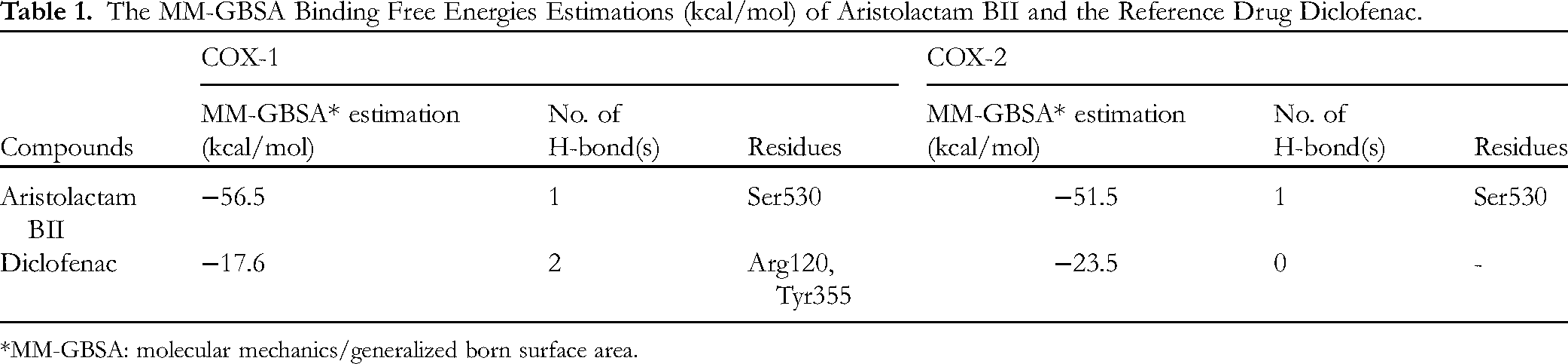
*MM-GBSA: molecular mechanics/generalized born surface area.
Discussion
In this study, aristolactam BII in methanol extract of H. cordata was found to have a m/z value of 280.3 au and a retention time of 14.93 min (Figure S2), which is consistent with the findings of Yingxue Wu et al, who discovered aristolactam BII with a m/z of 279.9 au and a retention time of 14.5 min. The percentage of aristolactam BII in dried H. cordata was 874 μg/g (Table S1), compared to 32.9 μg/g in the Yingxue study. 29 The variation in aristolactam BII levels could be attributed to the location and timing of H. cordata leaf harverst.
A polysaccharide called carrageenan employs a biphasic procedure to produce pro-inflammatory and inflammatory mediators, successfully causing acute inflammation. 30 The first period initiates via the release of histamine, kinins, and serotonin after the first few hours of administration of the phlogistic drug. The second period begins via the production of the prostaglandin-like molecules after 2–3 h. Both steroidal and nonsteroidal anti-inflammatory medicines are effective tools to manage the second phase.31,32 As a result of carrageenan's quick and efficient action, in vivo tests to determine if medicines can reduce inflammation frequently employ carrageenan-induced animal models. The procedure has been established and is simple to follow. Therefore, this model has been used widely in several studies to examine the protective effect of extracts or compounds against inflammation response.33–38
Aristolactam, an alkaloids, showed potential anti-inflammatory activity in this study (Figure 3). Alkaloids are compounds containing basic nitrogen, produced by plants to fight against herbivores, bacteria and fungi. Thousands of alkaloids have been reported in plants, animals, bacteria, and fungi. Many of them possess a variety of remarkable activities, including antiviral, antibacterial, anti-inflammatory, and anticancer properties. 39 The potential activity of alkaloids might be explained by the ionization and stable salt-forming capacities. The outstanding characteristic of alkaloids is the ability of protons to accept of basic nitrogen and amines that donate hydrogen atoms. 40 Ionization enhances the hydrophilicity and central nervous system permeability of compounds. Additionally, the basic group of alkaloids enables stable salt formation in biological media, enhancing the stability, solubility and activity of this group. 41 Plant alkaloids are a significant family of compounds with anti-inflammatory action. They downregulate the development of various pro-inflammatory factors, such as cytokines, lipid mediators, histamine, and inflammatory response enzymes. 42 Many studies expressed the potential anti-inflammation of alkaloids obtained from plant and marine organisms.41,43–48
Several studies mentioned the anti-inflammatory effect of H. cordata extract in vivo. 49 Rats treated with oxaliplatin showed a significant reduction in the number of withdrawal responses and withdrawal latency after receiving an ethanol extract of H. cordata (1000 mg/kg/day) for 15 days. 50 Administration of H. cordata extract (100 and 400 mg/kg) significantly reduced lung inflammatory response in a mouse model of acute lung injury caused by lipopolysaccharide (LPS). 5 In mice, the supercritical extract of H. cordata (200 mg/kg) inhibited inflammatory cell infiltration, exudation, and albumin leakage. Additionally, H. cordata water extract 500 mg/kg reduced anaphylactic reaction and IgE-mediated allergic response. 12 In our study, the methanol extract demonstrated weak anti-inflammation efficacy at the concentration of 50 mg/kg in the in vivo animals (p < 0.05) (Figure 2). The low activity might be explained by the low concentration of the tested extract compared to other studies.
Aristolactam BII was isolated from H. cordata methanol extract, which may have anti-inflammatory properties similar to diclofenac in a mouse model caused by carrageenan (Figure 3). The activity of aristolactams, might come from phenanthrene chromophore.21,22 Aristocholic acid or aristolactams are well-known anti-inflammatory agents. Previous research demonstrated the anti-inflammation of aristolactam. Particularly, aristolactam I exerted anti-inflammation against IL-6 (IC50 = 52 ± 8 μM) and TNFα (IC50 = 116.8 ± 83.25 μM). 51 Aristolactams including aristolactam BII, piperolactam, aristolactam FII exhibited effective antiinflammatory activity by inhibiting 3α-Hydroxysteroid dehydrogenase. 52 Particularly, the IC50 of aristolactam BII was 4.6 μg/mL, similar to positive control indomethacin (4.6 μg/mL). Aristolochic acid IVa (100 mg/kg, i.g.) could suppress LPS-triggered inflammation, by decreasing luciferase activities of TNFα at 3 h in TNF-IRES-Luc mice. 53 In our study, aristolactam BII at a concentration of 25 mg/kg, i.p. effectively reduced inflammation after 5 h of induction. Our study supports the effective anti-inflammation of aristolactam BII.
Aristolactam BII's anti-inflammation effect may be associated with the inhibition of COX-1 and COX-2 by creating h-bonds at the sites of Ser 530 residues, according to in silico studies (Figure S4). Our results aligned with previous study which demonstrated the activity mechanism of aristolactams might be by inhibiting PLA2, cyclooxygenase and lipooxygenase pathways. 54 Our findings suggested that the aristolactam BII isolated from the H. cordata methanol extract may have an anti-inflammatory effect. However, this study has a number of shortcomings. First, aristolactam BII alone was separated from the H. cordata methanol extract, and a small quantity of the compound was gathered. Second, a carrageenan-induced mouse model was used in this study to assess the extract's and compound's anti-inflammatory properties, and a docking model was used to predict the mechanism. For future researches, separating and comparing the bioactivities of other active compounds, such as aristolactam BII derivatives. It is best to use additional isolating techniques to increase the yield, including changing the extracting solvents, using soxlet, using microwave or ultrasound -assisted extraction methods. Furthermore, various in vitro investigations should be conducted to elucidate the anti-inflammatory mechanism of the compounds including testing the expressions of proteins relating to inflammatory signalling pathways using western blot or real-time polymerase chain reaction. Additionally, various activities such as anti-cancer, anti-microbial, anti-diabetic, etc properties should be examined to enrich the bioactivities of aristolactam BII.
Materials and Methods
Materials
Diclofenac and carrageenan were purchased from Sigma-Aldrich (St Louis, MO, USA). Silica gel (60 N, spherical, neutral, 40-50 µm) was purchased from Kanto Chemical Co., Inc. (Tokyo, Japan). Plethysmometer was obtained from Panlab, Havard Apparatus. Infrared spectra were obtained using IR Prestige-21 spectrometer (Shimadzu, Kyoto, Japan), NMR spectra were obtained using the Bruker Avance 500 spectrometer (Bruker, MA, USA) and Bruker Avance 600 spectrometer (Bruker, MA, USA), internal reference is TMS. Analytical TLC was performed on pre-coated silica gel 60F254 plates (0.25 or 0.50 mm thickness, Merck KGaA, Darmstadt, Germany). Spots were detected under UV radiation (254 nm and 365 nm) and by spraying the plates with 10% sulfuric acid followed by heating with a heat gun. Carrageenan and diclofenac were obtained from Sigma-Aldrich (St Louis, MO, USA). The LC-MS analysis was performed on an Agilent 1260 Infinity UHPLC system (Santa Clara, CA, USA) coupled with a G6125B Single-Quad MSD and Kinetex C18 column (150 4.6 mm. i.d., 5 mm).
Methods
Plant material
H. cordata was collected in April 2021 from a farm in Thua Thien Hue, Vietnam, situated at 16°22'14.0″N 107°42′12.4″E. The identification was confirmed by Hue University of Agriculture and Forestry, and a voucher specimen (HC-RR-2021) has been securely stored in the Faculty of Chemistry at Hue University of Education. After harvesting plants, it is advisable to store fresh plant material in a cool, dark place to minimize degradation. Subsequently, for air-drying, spread the plant material in a single layer in a well-ventilated area, avoiding direct sunlight. Oven drying was used at temperatures of approximately 40–60°C or 104–140°F to prevent the loss of volatile compounds. Utilize a grinder suitable for the plant's texture and toughness to achieve the desired consistency. Finally, the dried and ground plant material was stored in airtight containers to prevent exposure to moisture and air.
The isolation of the extract and compounds
The dried aerial parts of H. cordata (1.0 kg) were extracted with MeOH (3 times, 3.5 L each) at room temperature to yield 47 g of a dark solid extract. The crude extract was then suspended in water and sequentially fractionated with chloroform (CHCl3) (each, 5.0 L × 3 times) to get the CHCl3 (HCC, 26 g), and the water (HCW, 19 g) layers after solvent removal under vacuum. The HCC fraction was chromatographed on a silica gel column and was eluted with the gradient of n-hexane–ethyl acetate (60:1; 50:1; 40:1; 30:1; 20:1; 10:1; 5:1; 2.5:1; 1:1; 0:1, v/v) to get 9 sub-fractions, HCC1 (3.41 g), HCC2 (2.72 g), HCC3 (3.38 g), HCC4 (2.35 g), HCC5 (1.47 g), HCC6 (1.73 g), HCC7 (3.45 g), HCC8 (3.32 g), and HCC9 (4.17 g), respectively. The thin layer chromatography (TLC) diagram of the HCC6 fraction (major fraction, 1.73 g) contained some of obvious, well-separated spots. Thus, further purification was first carried out on this fraction. The fraction HCC6 (1.73 g) underwent chromatography on a YMC RP-18 column with acetone–MeOH (1:3, v/v) as the eluent. This process yielded a higher amount of a sub-fraction, and further purification of this sub-fraction (30 mg) was carried out using acetone as the solvent, resulting in the isolation of aristolactam BII (25.2 mg).
The chemical structures of aristolactam BII and the H. cordata methanol extract were elucidated through 1H-NMR, 13C-NMR, and LC-MS analyses. The LC-MS analysis was performed with a mobile phase consisting of acetonitrile (A) and water (B) containing 0.1% formic acid in both channels with the gradient elution as follows: 0–30 min: 10–90% A, 30–31 min: 90–10% A, 31–36 min: 10% A. The flow rate was kept at 0.6 mL/min and the injection volume was 10 µL. The ESI-MS detection was carried out in the positive mode with the fragmentor value of 150 V. The gas temperature was 350 °C at the flow of 12 L/min. The nebulizer gas pressure was 35 psig. The capillary voltage was 3000 V.
Experimental Mice
Swiss albino mice weighing 18 ± 2 g at 6 to 8 weeks of age were brought to the laboratory from the Pasteur Institute in Ho Chi Minh City, Vietnam. For at least a week, they were kept in standard husbandry settings with a 12 h light/dark cycle to acclimate to the lab setting. They were fed on an ad libitum basis and given free access to distilled water and standard fare. The trials utilized mice that were in good health. The animal received humane care according to the Basel Declaration (2010) and Vietnamese legislation (Law of Animal Husbandry, Law No.32/2018/QH14).
The anti-inflammation assay of H. cordata extract and aristolactam
Using the previously reported procedure, the carrageenan-induced paw edema method was used to assess the anti-inflammatory properties of compounds 1–3. 54 Before applying on mice, the cytotoxicity of the H. cordata extract and aristolactam BII was tested on HEK 293 cells using SRB assay. Five groups of six mice each were formed out of the original population. Mice each received intraperitoneally at a dosage of 50 mg/kg of the methanol extract and 12.5, 25 and 50 mg/kg of compound as a pretreatment. As negative and positive controls, mice were given saline (0.9% w/v NaCl, i.p) and diclofenac (10 mg/kg, i.p), respectively. After 1 h, subplantar injection was administered to each mouse with 40 μL of 1% carrageenan (suspended in saline) to induce edema in the right hind paw. Before carrageenan treatment (C0) and after carrageenan injection at chosen time intervals of 1, 2, 3, 4 and 5 h, the paw volume was measured using a plethysmometer (Ct).
The following equation was used to determine the anti-inflammatory activity:
Docking Analysis
Following previous protocol, the in silico study was carried out using Maestro software, Schrödinger 2021–3, and crystal structure data from the RCSB Protein Data Bank (RCSB PDB). Aristolactam BII was docked with enzymes that are involved in the metabolism of the inflammation such as COX-1 (PDB 6Y3C) and COX-2 (PDB 5IKT). The Protein Preparation Workflow tool will be used to prepare the proteins that were chosen for docking experiments based on their high resolution. In this step, missing hydrogen atoms are added, side chains are supplemented, het states are created, hydrogen bonds are optimized, and extraneous water molecules are eliminated. In order to direct the binding process between ligands and proteins, receptor grids will be created at the locations of native ligands in each structure after the proteins have been prepared. The Glide Docking method will then be used to dock the chemical structures of aristolactam BII with the receptor grids. The MM-GBSA method will be used to estimate the free energy of the corresponding complexes that form between the ligands and receptors.
Statistical Analysis
The collected data were described as the mean ± standard error. An ANOVA was used to analyze the data using Graphpad Prism statistical software program (Graphpad prism, version 8.0, San Diego, CA) and p-values less than 0.05 were considered statistically significant.
Conclusions
H. cordata is an herb which possesses several beneficial effects for human health. In this study, methanolic extract of this plant expressed anti-inflammation activity in the in vivo models. From this extract, isolated aristolactam BII showed potential anti-inflammation activity similar to diclofenac in an inflammatory mouse model induced by carrageenan injection. The results showed that aristolactam BII had a strong edematous effect similar to positive control. The in silico study demonstrated that inhibition of COX-1, via h-bonds formation at the positions of Arg 120 and Ser 530 residues, and inhibition of COX-2, via Ser 530 and Trp 387, may related to the anti-inflammation activity of aristolactam BII. This revealed that the H. cordata methanol extract and the aristolactam BII compound isolated from that might have the anti-inflammatory function.
Supplemental Material
sj-docx-1-npx-10.1177_1934578X241271634 - Supplemental material for The anti-inflammatory effect of the extract and aristolactam BII isolated from aerial parts of Houttuynia cordata Thunb
Supplemental material, sj-docx-1-npx-10.1177_1934578X241271634 for The anti-inflammatory effect of the extract and aristolactam BII isolated from aerial parts of Houttuynia cordata Thunb by Ty Viet Pham, Duc Viet Ho, Nguyen Hoai Nguyen, Gia-Buu Tran, Thi Xuan Thao Tran, Minh Thanh Dat Nguyen, Nguyen Huy Hoang Vo, Kieu Anh Tran, and Bich Hang Do in Natural Product Communications
Footnotes
Acknowledgements
The authors would like to express their sincere gratitude to Hue University of Agriculture and Forestry for the identification of the plant using this project.
Author's Note
Data Availability: The data in this study are available from the corresponding author on reasonable request. Ethical Statement: The study has been strictly followed by the Declaration of Basel (2010), Vietnamese legislation (Law of Animal Husbandry, Law No.32/2018/QH14) and the guideline for preclinical and clinical trials of traditional medicines and pharmaceuticals (Decision 141/QD-K2DT of Administration of Science Technology and Training, The Ministry of Health of Vietnam, 2015).
Conflict of Interest
The authors declare that they have no competing interests.
Funding
The authors received no financial support for the research, authorship, and/or publication of this article.

Supplemental Material
Supplemental material for this article is available online.
References
Supplementary Material
Please find the following supplemental material available below.
For Open Access articles published under a Creative Commons License, all supplemental material carries the same license as the article it is associated with.
For non-Open Access articles published, all supplemental material carries a non-exclusive license, and permission requests for re-use of supplemental material or any part of supplemental material shall be sent directly to the copyright owner as specified in the copyright notice associated with the article.
