



Abstract
Objective
The objective of our study was to investigate the chemical composition and the biological activities of different parts of Securidaca longipedunculata from South Africa.
Methodologies
The chemical analysis methods, including chromatography and spectroscopy, were employed to identify the diverse array of compounds present in the roots, leaves, and stems of S longipedunculata.
Results
The proximate analysis revealed that the leaf extracts had higher (P < .05) crude protein, gross energy, and ether extract contents when compared to the stem bark and the root bark. A similar trend was observed with the mineral analysis where copper, iron, magnesium, and zinc were in abundance in the leaves. Concurrently, bioassays reveal significant biological activities, such as antioxidant, antimicrobial, and anti-inflammatory properties, associated with these plant parts. The extracts demonstrated high lipid peroxidation inhibitory activity at the concentration of 250 μg/mL, with the highest percentage inhibition of 94% recorded in the dark leaf extract, followed by 92% and 73% at the concentrations of 125 and 62.5 μg/mL, respectively. The antimicrobial analysis revealed that the root bark extract was active against Escherichia coli, Pseudomonas aeruginosa, and Enterococcus faecalis with the average minimum inhibitory concentration of 1.67 mg/mL (dark type) and 0.63 mg/mL (light type).
Conclusion
Our findings emphasize the medicinal potential of S longipedunculata and underscore the importance of understanding its chemical makeup in explaining its therapeutic effects. This research provides valuable insights into the pharmacological properties of S longipedunculata, offering a foundation for further exploration in drug development and natural product discovery.
Introduction
In recent years, the traditional medicine practice has been gaining attention as a contributor to healing some modern diseases. However, traditional herbal medicines have been an integral aspect of human culture since ancient times. 1 Many local plants have gained interest as candidates for drug manufacturing due to their endowment with bioactive compounds. Securidaca longipedunculata Fresen (violet tree) belongs to the Polygalaceae family and exists in different climatic ranges from tropic to arid zones. 2 It is a small tree with alternate leaves variable in size, shape, and it is crowded toward the tips of the stem. 3 It is used in traditional African medicine to fill the gap in local healthcare. 4 It is used to treat different illnesses such as malaria, tuberculosis, sexually transmitted diseases, fever, and other ailments.4,5 In Limpopo province the vhaVenda society uses the roots for mental disorders and as a protection against children's illnesses during breastfeeding. It is also believed that many African people use the powdered roots as a sexual boost (an aphrodisiac) for men. 6 The plant is known for its phenolic compounds with a broad spectrum of demonstrated health benefits. The protection of indigenous species is highly important as they have evolved adaptive mechanisms to cope with conditions and circumstances in their habitats. S longipedunculata for instance has adapted to drought conditions in mountainous regions.
Low-income communities worldwide, especially rural communities, rely heavily on traditional medicine since the use of modern medicine is beyond their reach. The efficacy of these medicinal plants lies within their secondary metabolites that produce a definite physiological action in individuals. Research has proven that screening for secondary metabolites of medicinal plants, exhibiting pharmacological properties has become a focal point recently. 7 Various categories of phenolic compounds are present, encompassing phenols, phenolic acids, phenyl propanoids, flavonoids, lesser-known flavonoids, tannins, and quinones. 7 These phenolics exhibit anti-allergenic, antimicrobial, anti-inflammatory, and antitumor activities. The antioxidant capacity of these polyphenolics increases their potential health benefits against numerous illnesses due to their free radical scavenging properties. 7
In the South African context S longipedunculata is highly regarded as medicinal and a magical tree, particularly by the vhaVenda tribe of the Limpopo province where the plant grows. 8 Unfortunately, this plant is a threatened and protected species due to its medicinal benefits and overuse of the plants and its harvest. The plant roots are targeted by the majority of those utilizing this plant, thus putting the plant in peril of extinction as the plant cannot endure constant harvesting. S longipedunculata is among the indigenous species that have been found to contain unique properties, with a long history of use in different healthcare systems to treat various ailments and to promote both human and livestock health.9,10 In addition, different plant parts secrete highly valuable phytochemicals including the phenolic compounds, alkaloids, diterpenoids, steroids, alkaloids, and other complex compounds that are used to combat infections.9,11 The roots and the bark are taken orally either powdered or as infusions for treating chest pains, headache, inflammation, abortion, ritual suicide, infertility problems, venereal diseases.12,13
To our knowledge limited literature exists on phenolic compounds of the leaves of S longipedunculata. Hence the aim of this study is to investigate the chemical composition, antibacterial and antioxidant activity, and the phytochemical constituents contained in different plants parts of S longipedunculata.
Materials and Methods
Collection of the Plant Materials
Late in November 2021, the root, stems, and leaves of S longipedunculata from the mountainous regions of the Vhembe district in Limpopo Province, South Africa, were collected. The study focused on S longipedunculata to verify information regarding its informal trade in the Vhembe area and the local belief in its therapeutic properties, including its use as an aphrodisiac. 9 The plant specimens were confirmed, authenticated and a voucher specimen (UNIN 121579) was deposited at the Larry leach herbarium of the University of Limpopo. 9 During the drying process (Figure 1), the plant materials were kept at room temperature, shielded from sunlight. The bark was separated, chopped into smaller pieces to facilitate faster drying and ground into a fine powder using a commercial grinder. 9 The resulting powdered plant materials were stored in airtight containers away from sunlight to prevent potential photo-oxidation reactions.9,14

Plants parts (1stem bark, 3root bark, and 2leaves) investigated.
Extraction
The plant materials were extracted by mixing 1 g of the group plant materials into 10 mL of distilled water and centrifuged for 1h in intervals of 30, 20, and 10 min, respectively. After extraction, the extracts were filtered through Whatman No. 1 filter paper into preweighed glass vials and freeze-dried. Thereafter, the extract was reconstituted to 10 mg/mL of water. 13
Proximate Analysis
The moisture, ash, crude protein (CP, N × 6.25), fat, and starch content of the plant samples were determined through proximate analysis following the procedures outlined by the Association of Official Analytical Chemists (AOAC). The aforementioned components of the proximate analysis were carried out following the methodologies as described by.15,16 In addition, the atomic absorption spectrometry (ASS) (Sciex API 500 with MPX 2 Multiplexingn LC, Bio tech, America) was used to analyze the following minerals: Cu, Fe, Mn, Mg, and Zn.16,17
Extraction of Minerals
The minerals Cu, Fe, Mn, Mg, and Zn were analyzed from varying parts of S longipedunculata through the AAS after digestion of the leaf sample. 17 Nitrogen in different plant samples was analyzed through the Kjeldahl method.15,17
The moisture, ash, CP(N × 6.25), fat, and starch content of the plant samples were determined through proximate analysis following the procedures outlined by the AOAC. The aforementioned components of the proximate analysis were carried out following the methodologies as described by Piispanen et al and Radha et al.15,16
Extraction of Phenolic Compounds
A 2 g sample was accurately weighed into a 50 mL centrifuge tube with a screw-cap. And 15 mL of 50% methanol/1% formic acid was added and the tubes tightly capped. Thereafter the samples were vortexed for 1 min, followed by extraction in an ultrasonic bath for 1 h. A 2 mL sample was then withdrawn and centrifuged at 14 000 rpm for 5 min. The clear supernatant was then transferred into 1.5 mL glass vials for analysis.
Liquid Chromatography-Mass Spectrometry Analysis
A Waters Synapt G2 Quadrupole time-of-flight (QTOF) mass spectrometer (MS) connected to a Waters Acquity ultra-performance liquid chromatograph (UPLC) (Waters, Milford) was used for high-resolution UPLC-MS analysis. Column eluate first passed through a Photodiode Array (PDA) detector before going to the mass spectrometer, allowing simultaneous collection of UV and MS spectra. Electrospray ionization was used in negative mode with a cone voltage of 15 V, desolvation temperature of 275 °C, desolvation gas at 650 L/h, and the rest of the MS settings optimized for best resolution and sensitivity. Data were acquired by scanning from 150 to 1500 m/z in resolution mode as well as in MSE mode. In MSE mode 2 channels of MS data were acquired, one at a low collision energy (4 V) and the second using a collision energy ramp (40−100 V) to obtain fragmentation data as well. Leucine enkaphalin was used as lock mass (reference mass) for accurate mass determination and the instrument was calibrated with sodium formate. Separation was achieved on a Waters HSS T3, 2.1 × 100 mm, 1.7 μm column. An injection volume of 2 μL was used and the mobile phase consisted of 0.1% formic acid (solvent A) and acetonitrile containing 0.1% formic acid as solvent B. The gradient started at 100% solvent A for 1 min and changed to 28% B over 22 min in a linear way. It then went to 40% B over 50 s and a wash step of 1.5 min at 100% B, followed by re-equilibration to initial conditions for 4 min. The flow rate was 0.3 mL/min and the column temperature was maintained at 55 °C. Compounds were quantified in a relative manner against a calibration curve established by injecting a range of catechin standards from 0.5 to 100 mg/L catechin.
Data were processed using MSDIAL and MSFINDER (RIKEN Centre for Sustainable Resource Science: Metabolome Informatics Research Team, Kanagawa, Japan).18,19
Antimicrobial Activity
The broth microdilution assay by Eloff 20 and the modified version by Masoko and Eloff 21 to suit the bacterial growth requirements were used. The antimicrobial activity of the plant extracts was evaluated by determining the minimal inhibitory concentration against Escherichia coli, Pseudomonas aeruginosa, and Enterococcus faecalis. The minimum concentration of the plant extract to inhibit the growth of pathogenic microorganisms showed as minimum inhibitory concentration (MIC). The MIC values which are equal or less than 1.0 mg/mL were considered significant antimicrobial activity.
Quantitative Free Radical Scavenging Activity
The free radical scavenging activity of the extracts was determined by using the DPPH method13,15 with modifications. Briefly, different concentrations of the extracts (250-62.5 µg/mL) were prepared to a volume of 1 mL of the solution. L-ascorbic acid (Sigma) was used as standard by preparing the same concentration range as the extracts. To these solutions, 2 mL of 0.2 mmol/L DPPH solution dissolved in methanol was added and vortexed thoroughly. The solutions were left to stand in the dark for 30 min at room temperature. The control solution was prepared by adding 2 mL of 0.2 mmol/L DPPH to 1 mL of distilled water. After the elapsed time, the solutions were analyzed with a UV/VIS spectrophotometer set at a wavelength of 517 nm. The experiment was run in duplicate and repeated 3 times. Free radical scavenging activity of the extracts was expressed as percentage inhibition of DPPH from the control solution.14,15 The percentage was calculated as follows:

Statistical Analysis
The information gathered for this research underwent examination through a one-way analysis of variance conducted with statistical analysis software (SAS) version 9.2.1 (Raleigh), as specified in the Sasser guide from 2010. Mean separation was achieved using Duncan's multiple range test at a significance level of P < .05. The correlation among phenolic compounds was explored through Principal Component Analysis (PCA). Additionally, multivariate cluster analysis and plotting were carried out using the commercial statistical package PAST version 4.02 (Oslo, Norway).
Results
Proximate Analysis
The proximate analysis of varying parts of S longipedunculata was carried out and the results are presented in Table 1. The proximate analysis revealed that the leave extract from both types of the plant extracts had a higher (P < .05) CP, gross energy, and ether extract contents, when compared to the stem bark and the root bark. There was no significant difference (P < .05), between the protein content contained within the leaves of both types, however, the CP content in the leaves varied (P > .05) significantly with that of the stem bark and the root bark. In addition, the ash content contained in the leaves of both types of the plant extract were statistically similar and varied from the root and stem bark. There were no significant differences (P > .05) between the means for the dry matter, and moisture content.
Proximate Analysis Composition of Varying Parts of Securidaca longipedunculata (DM Bases) g/100 g, Unless Stated Otherwise.

a,b,c,d Means in the same row sharing similar superscript are not significantly different (P < .05).
Nutrient: GE = gross energy.
Sample type: DLeaf Extract = Dark leave extract, DRoot Bark = Dark root extract, DStem Extract = Dark stem extract, LLeaf Extract = Light leave extract, LRoot Bark = Light root extract, LStem Extract = Light stem extract.
3SEM = standard error of the mean.
Mineral Analysis
The mineral composition (mg/kg) of varying parts of S longipedunculata is presented in Table 2. The results on mineral composition have shown that different parts of S longipedunculata contain varying levels of copper, iron, magnesium, and zinc. The leaves and the stem bark of the dark S longipedunculata type exhibited higher (P < .05) levels of copper (39.61 and 39.62 mg/kg), respectively, as compared to the leaves and the stem bark of the light type (9.95 and 9.99 mg/kg, respectively). There was no significant difference across the means of all the plant parts in relation to copper levels, except for the DLeaf Extract and DStem Extract. The root bark of both types, thus the DRoot Extract and LRoot Extract exhibited a significantly higher (P < .05) iron content (621.66 and 770.8 mg/kg, respectively) compared to the (DLeaf Extract, DStem Extract, LLeaf Extract, and LStem Extract) which contained iron levels of 264.94, 177.79, and 177.8, respectively. Higher (P < .05) magnesium contents were discovered in the dark leaves of S longipedunculata (370 mg/kg) compared to the light leaves of S longipedunculata (225.58 mg/kg). There was no significant difference with magnesium levels between the means of DRoot Bark, LRoot Barkt, and LStem Extract. There was a significant difference (P < .05) between DLeaf Extract, DStem Extract, and LLeaf Extract.
Mineral Composition (mg/kg) of Varying Parts of Securidaca longipedunculata.

a,b,c,d,e Means in the same row sharing similar superscript are not significantly different (P < .05).
1Sample type: DLeaf Extract = Dark leave extract, DRoot Bark = Dark root extract, DStem Extract = Dark stem extract, LLeave Extract = Light leave extract, LRoot Bark = Light root extract, LStem Extract = Light stem extract.
SEM = standard error of the mean.
Phenolic Compounds
The phenolic compounds identified in S longipedunculata plant parts are presented in Table 3. In the present study, about 59 compounds were detected in different parts of the plant. These compounds were found to belong to various classes such as flavonoids, lignans, iridoid o-glycosides, and phenolic glycosides. The main components of the phytochemical fraction and its derivatives in S longipedunculata extracts were flavonoids and derivatives, the majority of these compounds being the quercetin derivatives (Table 3). Compound 1 was identified as 6.11-dihydroxy-2.2 (6.11-dihydroxy-2.2-dimethylpyrano [3.2-c] xanthen-7(2H)-one), at the average retention time of 4.101 min based on precursor ion [M−H]—at m/z 309.0766. Compound 2 was identified as tuliposide b based on precursor ion [M−H]—at m/z 295, 1014. Compound 5, having a precursor ion [M−H]—at m/z 285.061 at 10.369 min was tentatively identified as 1-o-caffeoylglucose, it is a glycoside which is functionally related to hydroxycinnamic acids. Compound 6, having a precursor ion [M−H]—at m/z 341. 0898 at 10.481 min, was identified as pyranojacareubin. Compound 7, having a precursor ion [M−H]—at m/z 391.1198 at 10.893 min, was identified as caryoptosidic acid, this compound was detected in abundance in the dark leaves extract.
Quantified Individual Phenolic Compounds in Securidaca longipedunculata (mg/kg).

Sample type: DLeaf Extract = Dark leave extract, DRoot Bark = Dark root extract, DStem Extract = Dark stem extract, LLeave Extract = Light leave extract, LRoot Bark = Light root extract, LStem Extract = Light stem extract.
Compounds 10, 12, and 14 identified as (2S)-2'-methoxykurarinone, trans-o-coumaric acid 2-glucosidewas, and 6'-O-alpha-D-glucopyranosylloganic also exist in abundance in the dark leaves extract (DLeaf extract). Compound 7, having a precursor ion [M−H]—at m/z 391.1198 at 10.893 min, was identified as caryoptosidic acid; this compound was detected in abundance in the dark leaves extract (DLeaf extract). Compound 19 identified as loganic acid had a precursor ion [M−H]—at m/z 477.1596 at 13.278 min. Loganic acid is the most abundant compound in this study. It is synthesized from 7-deoxyloganic acid by the enzyme 7-deoxyloganic acid hydroxylase. Compound number 26 was tentatively identified as phenylethyl primeveroside. Quercetin 3-(2Gal-apiosylrobinobiosid and quercetin 3-lathyroside were identified a precursor ion of [M−H]—at m/z 741.194 and [M−H]—at m/z 595.1334, respectively. Compound 38 was identified as iryantherin-D, it is reasonably present in the stem barks. Compound 39 was identified as rutin. Rutin is a flavonol glycoside which comprised of quercetin and rutinose. The highest quantity was in the leafy part of the plant. Compound 56 had a precursor ion [M−H]—at m/z 887.2138 at 21.093 min, was identified as selligueain B. Selligueain B is a somewhat astringent, sweet-tasting trimeric proanthocyanidin. When quantifying these results (Table 4) it was suggested that the leaf extract had the most phenolic compounds. Loganic acid was the most abundant compound in the plant parts, the dark leaf extract contained the most (1733.5 mg/kg) followed by (418.1 mg/kg), (11.5 mg/kg), (175.0 mg/kg), 43.6, and 11.6 mg/kg in dark root bark, dark stem extract, light leaf extract, light root extract, and light leaf extract, respectively (Table 4).
Phenolic Compounds Content (mg/kg) in Securidaca longipedunculata.

Sample type: DLeaf Extract = Dark leaf extract, DRoot Bark = Dark root extract, DStem Extract = Dark stem extract, LLeaf Extract = Light leaf extract, LRoot Bark = Light root extract, LStem Extract = Light stem extract.
SEM = standard error of the mean.
SD = standard deviation.
Total Ion Chromatograms
The results on phenolic compounds of S longipedunculata as presented using the chromatograms in Figure 2, these results suggested that the most endowed part of the plant is the leaf and that the dark leaves have the most phenolic compounds in comparison to the light leaves extract. The root barks appear to contain least quantities of phenolic compounds. The LCMS/MS analysis of plant parts showed different peaks at different retention times. The chromatograms A and D which are the leaf extract showed populated multiple peaks, confirming its endowment with phenolic compounds. Some of the compounds were detected at early retention times. The chromatogram of the stem and roots barks showed less phenolic compounds in comparison to the leaves (Figure 2).
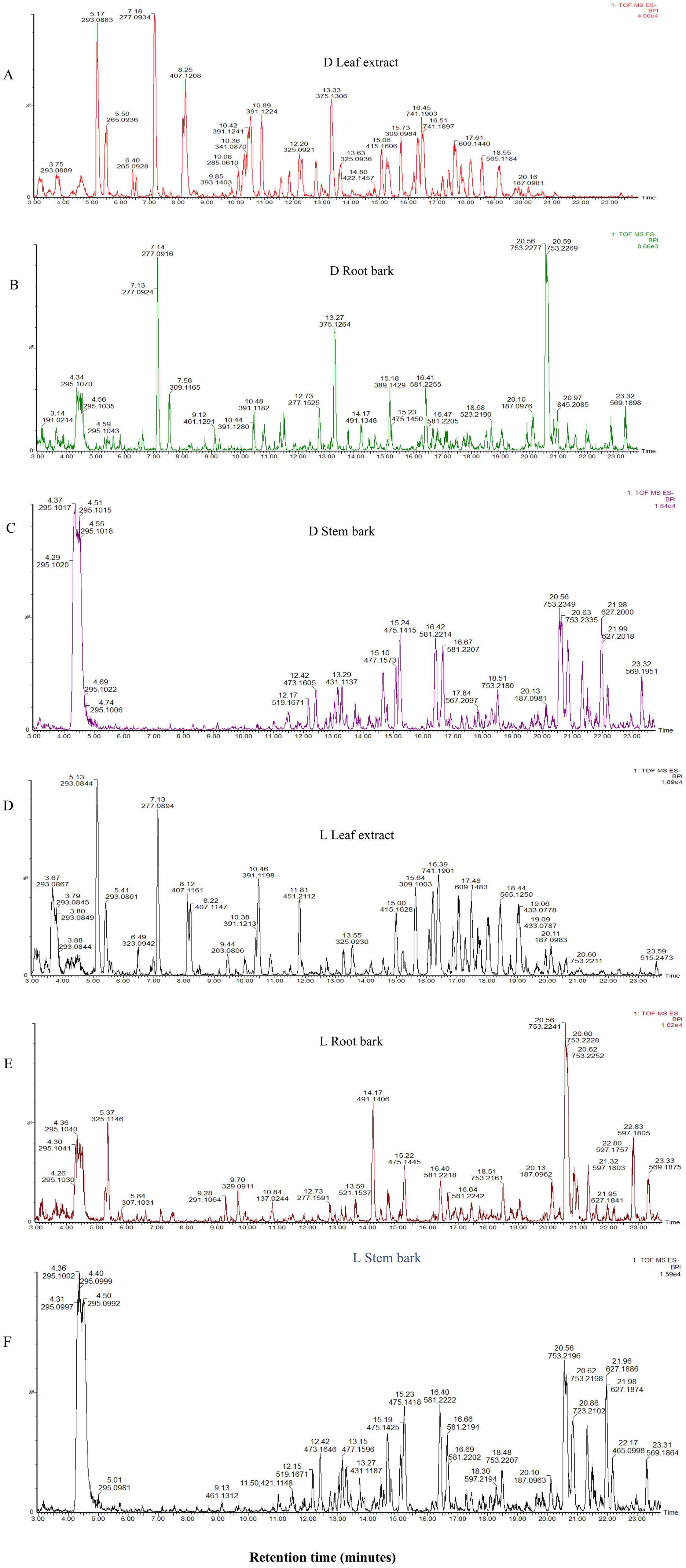
Chromatograms (A) DLeaf Extract; (B) DRoot Bark; (C) DStem Bark; (D) LLeaf Extract; (E) LRoot Bark; and (F) LStem Bark of Securidaca longipedunculata detected at different retention times.
Principal Component Analysis
Principal component analysis was carried out to further investigate possible variations among different parts of S longipedunculata. The results are presented in Figure 3. Based on PCA analysis of the phenolic compounds of the plant, the leaf extracts presented some variation in terms of the content of the phenolic compounds dominating the PC1 with the variant of 65.35%. High component loadings for component 1 (PC1) were contributed by the leaf extract, while the light root bark and the stem barks of both varieties had a negative contribution to the loading plots. Principal component analysis confirms that most of the phenolic compounds in S longipedunculata are clustered in the leafy parts of the plant.

Principal component analysis scatter plot of the phenolic compound.
Antibacterial Activity
The results on antibacterial activity of S lonipedunculata against selected bacterial species are presented in Table 5; these results validate the claims by communal farmers and tribal communities in praising the plant for its antimicrobial activities. To validate this ethnopharmacological use, bacterial species of importance to livestock were selected, including the 3 different strains (E coli, P aeruginosa, and E faecalis). Using microdilution assay, the minimum concentration of the plant extract to inhibit the growth of pathogenic microorganisms was taken as MIC. The MIC values which are equal to or less than 1.0 mg/mL were considered significant antimicrobial activity. 16 The leaf extract of the light S longipedunculata exhibited the weakest antimicrobial activity. The significant activity against the selected bacterial species was observed in the root bark of the light variety it was active against all the selected bacterial species with the average MICs of 0.63 mg/mL. The root bark of the dark variety had a relatively higher MIC averaging at 1.67 mg/mL, indicating the extracts exhibited weaker antimicrobial activity against the selected bacterial species. The stem bark of the light plant type was active against P aeruginosa with an MIC of 0.63 mg/mL. It was also remarkable that the gram-negative bacteria (E coli and P aeruginosa) were generally more susceptible to the plant extracts.
Minimum Inhibitory Concentrations (MIC (mg/mL)) of Various Parts of Securidaca longipedunculata Against Selected Bacterial Species.
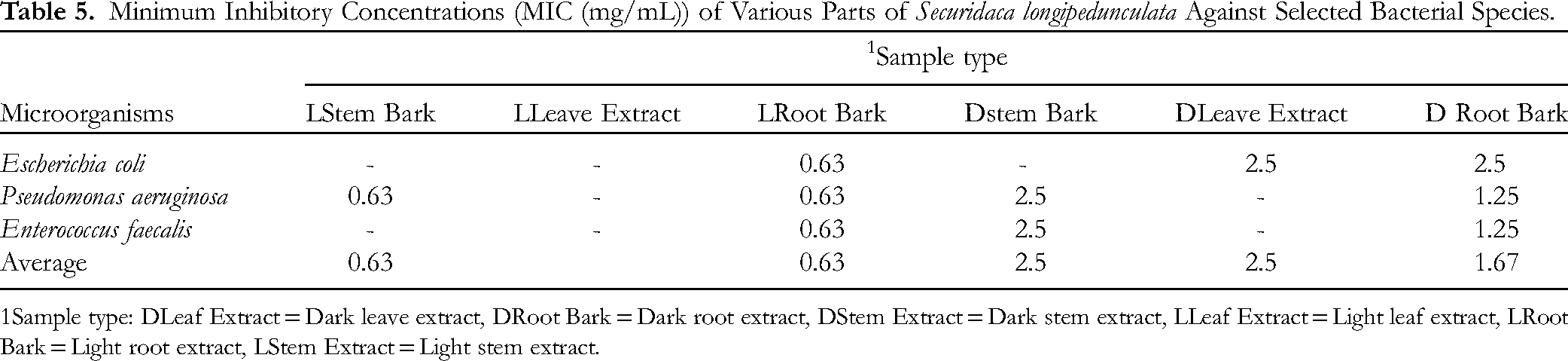
Sample type: DLeaf Extract = Dark leave extract, DRoot Bark = Dark root extract, DStem Extract = Dark stem extract, LLeaf Extract = Light leaf extract, LRoot Bark = Light root extract, LStem Extract = Light stem extract.
Antioxidant Activity (DPPH)
Figure 4 registered the highest scavenging percentage in DSL leaf and DSL root bark. High percentages were observed at the concentrations of 250 and 125 µg/mL. Surprisingly, the dark stem bark showed a high scavenging percentage in comparison to the light leaf extract which contains higher phenolic compounds. However, DSL stem bark and LSL stem bark contain the highest quantities of Ampelopsin 199 and 221 mg/kg, respectively.
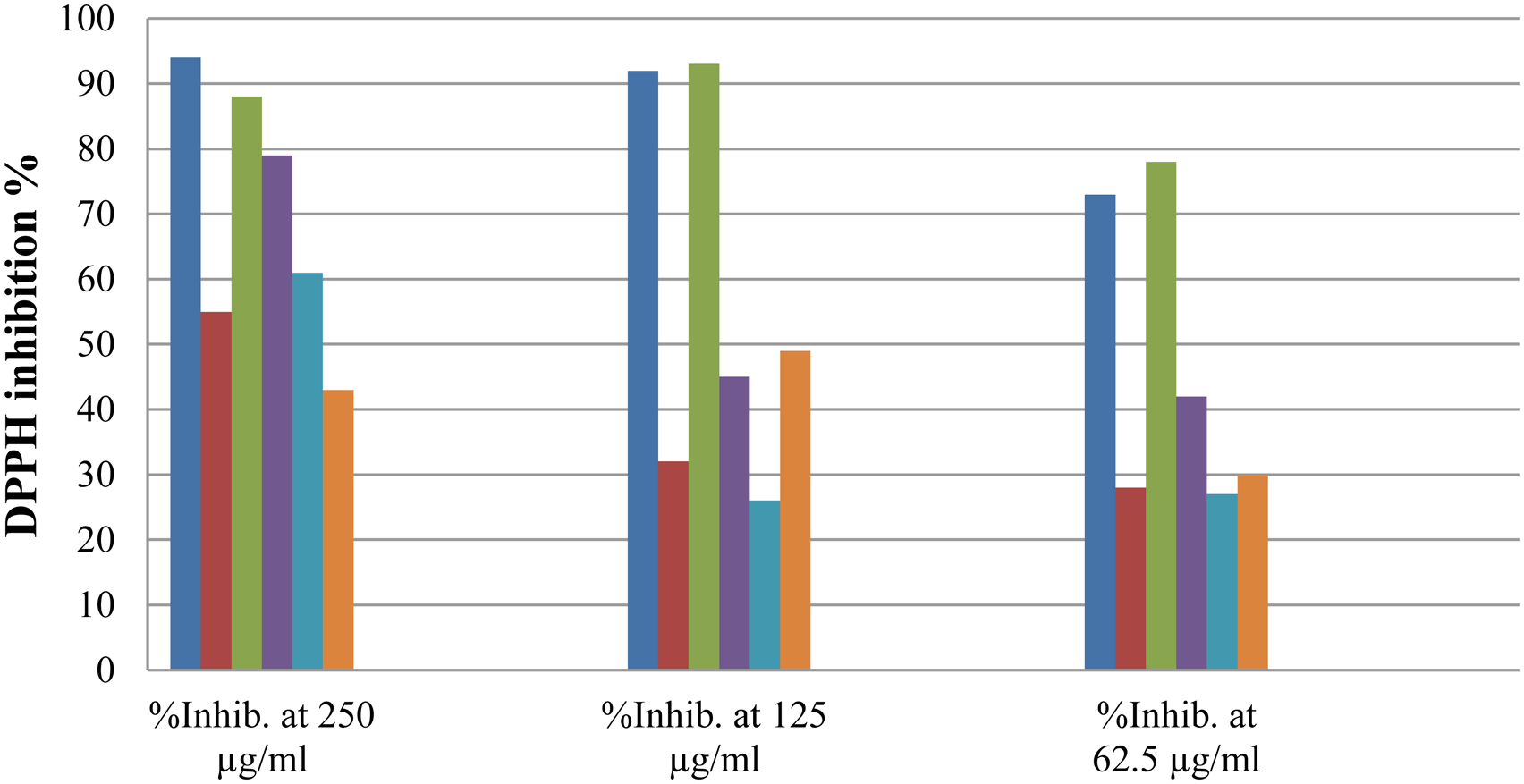
DPPH scavenging activity (%) of Securidaca longipedunculata extracts.
The extracts demonstrated high free radical scavenging activity at the concentration of 250 μg/mL, the highest percentage inhibition of 94% was recorded in the dark leaf extract (DLS Leaf Extract) at the concentration of 250 μg/mL, followed by 92% and 73% at the concentrations of 125 and 62.5 μg/mL, respectively (Figure 4).
Discussion
The use of medicinal plants in therapeutics and as nutritional supplements date back before recorded history, however, it has become a popular practice in recent years. 16 In sustainable human health management, medicinal plants have played a vital role which has led to the growing interest in alternative therapies and therapeutic use of plants. 22 The curative effect of indigenous plant products for ethnomedicinal and nutritional objectives has motivated scientists to search for bioactive compounds present in these plants. 16
The results recorded in this study indicated that S longipedunculata can be considered for both medicinal and therapeutic use due to the presence of nutrients and phytochemicals it contains, however, there is lack of literature on its nutritional composition to compare with the current findings. Most plants and/or plant parts contain considerable minerals, and their existence and quantity are highly associated with the plant's family, history, and phytochemical characteristics. 16
In our study, the analysis of minerals from S longipedunculata unveils a promising array of essential elements vital for both human and animal health. Iron, a cornerstone mineral crucial for oxygen transport and metabolism, is found within the plant, presenting potential benefits for combating anemia and enhancing overall vitality. Zinc, another pivotal micronutrient, plays diverse roles in enzymatic function, immune response, and wound healing. Its presence in S longipedunculata hints at potential therapeutic applications for immune support and tissue repair. 16
Magnesium, often dubbed the “forgotten mineral,” is abundant in S longipedunculata, offering potential benefits for cardiovascular health, muscle function, and nerve transmission. Its inclusion underscores the plant's potential as a natural source of this essential nutrient, vital for maintaining overall wellbeing. Furthermore, copper, though required in smaller quantities, is no less significant, contributing to various physiological processes such as iron metabolism, connective tissue formation, and antioxidant defense. Its presence in S longipedunculata adds to the plant's nutritional profile, potentially enhancing its value as a dietary supplement or medicinal herb.16,23 Recently scientists and nutritionists realised the importance of the physiological value of elements in animal health.. 24 Literature regarding the mineral contents of S longipedunculata is lacking.
The screening of active metabolites of different plants and or plant parts has been extensively investigated using LC-MS.18,19 Flavonoid and phenolic glycosides are likely to exhibit effective bioactive properties across a wide range of activities, highlighting their potential as therapeutic agents. 25 Flavonoids glycosides were the dominant compounds in this study; most of them contain quercetin as their basic structures which are known for their strong antioxidant, immunomodulatory, and anticancer activities. 26 Furthermore, one of the key benefits associated with flavonoid glycosides is their potent antioxidant activity. These compounds can scavenge free radicals and reactive oxygen species, thereby protecting cells and tissues from oxidative damage. This antioxidant action is crucial for maintaining cellular health and may contribute to the prevention of various chronic diseases, including cardiovascular disease, neurodegenerative disorders, and certain cancers.25,26
Previous studies reported the presence of polyphenolic compounds in S longipedunculata, such as chlorogenic acid, caffeic acid, p-coumaric acid, rutin, and quercetin. 4 Phenolic acids such as 4,5-dicaffeoyl-D-quinic acid, 4 caffeic acid, and 3,4,5-tricaffeoyl-D-quinic acid from quercetin, 27 p-coumaric acid, cinnamic acid, caffeic acid, and chlorogenic acid were detected in S longipedunculata. 27 Tuliposide B serves as the precursor of the antimicrobial lactone tulipalin B. 28 It has antibacterial and antifungal properties. 29 Caryoptosidic acid, also known as caryoptosidate, was discovered in abundance in the dark leaf extract. This acid belongs to the class of organic compounds known as iridoid o-glycosides. 28 Iridoid glycosides extracted from diverse medicinal plants exhibit therapeutic advantages in addressing various conditions, including neurological disorders, diabetes mellitus, cardiovascular issues, and even cancer.30–32 Other studies suggested caryoptosidic acid exhibits notable anti-inflammatory properties, which can be valuable in alleviating various inflammatory conditions such as arthritis, dermatitis, and other inflammatory disorders. Its ability to modulate inflammatory pathways suggests its potential as a natural remedy for managing inflammation-related symptoms and promoting overall wellbeing. Moreover, caryoptosidic acid has demonstrated promising antioxidant effects, contributing to cellular defense against oxidative stress and free radical damage. This antioxidative activity is crucial in combating oxidative damage implicated in aging, chronic diseases, and degenerative conditions, potentially conferring protective effects on cells and tissues.25,33 The current study aligns with existing literature by confirming the presence of iridoid glycosides, specifically caryoptosidic acid, in S longipedunculata leaf extract. These compounds, as mentioned in previous research, have established therapeutic benefits, including addressing neurological disorders, diabetes, cardiovascular issues, cancer, and potential applications in arthritis treatment. Additionally, the study concurs with the literature by identifying flavonoids, particularly quercetin derivatives, as prominent components in the phytochemical fraction of S longipedunculata extracts. This alignment strengthens the understanding of the plant's potential therapeutic properties based on both existing knowledge and current research findings.
Furthermore, the efficacy of loganic acid in addressing rheumatoid arthritis and inflammation has been demonstrated. 32 and it has been reported that iryantherin-D exhibited potent in vitro antibacterial activity against Staphylococcus aureus. Quercetin and rutinose are proposed to have a protective function in conditions such as liver diseases, cataracts, and cardiovascular diseases. 34 Proanthocyanidins, present in various plants and foods, are a category of flavan-3-ol units that can exist as oligomers or polymers. These compounds exhibit a range of beneficial effects, such as antioxidative, antimicrobial, hypolipidemic, and cardioprotective properties. 34
The presence of different phytochemicals in S longepeduculata may well explain its uses as antimicrobial, anthelmintic, and antimalarial. It is proven that the plant has multipurpose benefits, mostly used by rural communities, however, safe levels of inclusion has not been established.35,36 Furthermore, due to the fact that bacteria are becoming more resistant to several formulated classes of drugs as a result of prolonged use and growing misuse by some patients 37 plant sources could act as alternatives to medicines such as antibiotics. This study revealed that there is significant activity against the selected bacterial species which was observed in the root bark of the light leaf extract which was active against all the selected bacterial species. This study agrees with the reports of 30, and Ogunmefun and Gbile 38 who reported that the aqueous extract of the root bark decoction of medicinal plants can cure diseases such as gonorrhea, fungal infections, and pneumonia. In addition, a study states that the extract of the root bark was effective on P aeruginosa and C albicans at a MIC of 80 mg/mL. Furthermore, a previous study by Daji et al 28 reported that torachrysone 8-β-gentiobioside has shown antibacterial activity against methicillin-resistance.
It has been reported that caffeic acid has a stronger in vitro antioxidant activity which might contribute to the increased antioxidant activity. 39 Arisugacin C concentrated in the leaf extracts of S longipedunculata is believed to have some activity in acetylcholinesterase inhibition. 40 Icariside is an active flavonoid monomer, which has been proven to restore postprostatectomy erectile dysfunction in rats. 26 The proven antioxidant properties of S longipedunculata plant parts were supported by previous studies. 26 The root barks of S longipedunculata have very high antioxidant and anti-inflammatory properties. 30 Ampelopsin is known for a broad range of biological functions including hypoglycemic 41 antioxidant, 30 and anti-inflammatory. 33 Furthermore, Ampelopsin is believed to have excellent antioxidant activity mainly because it is similar to tertiary butylhydroquinone. 33 Ampelopsin exhibits favourable antioxidant activity that may mitigate cellular oxidative stress and stimulate the potential of cellular vitality, thus accomplishing the prevention of neurodegenerative diseases, cardiovascular diseases, cancer, and other diseases. 33 The antioxidant properties of the root bark extract of the plant have been reported to be much lower than in the leaves.26,34
Limitations of the Study
The limitation experienced in this study was the lack of prior research to support our findings.
Conclusion
The analysis of S longipedunculata revealed the presence of phytochemicals along with significant antioxidant and antimicrobial activities. Based on this we conclude that the plant has potential therapeutic and medicinal value. The results further highlight possible use in various pharmaceutical and healthcare applications. Further research and exploration into its specific bioactive compounds and mechanisms of action could enhance our understanding and utilization of this plant in modern medicine and natural product-based therapies.
Footnotes
Acknowledgments
We would like to thank Professor Peter Masoko for allowing us to utilise his resources to screen for metabolites in the plant extracts in the Department of Biochemistry, Microbiology and Biotechnology, Faculty of Science and Agriculture, University of Limpopo, and further acknowledge Mr Matotoka MM for assisting in the screening of the plant extracts.
Author Contribution
KS and NAS were involved in conceptualization and writing the manuscript; SL, MM, and JWN in technical editing; and NAS in revise the manuscript.
Availability of Data and Materials
Not applicable.
Consent for Publication
Not applicable.
Data Availability
Not applicable.
Declaration of Conflicting Interests
The authors declared no potential conflicts of interest with respect to the research, authorship, and/or publication of this article.
Ethical Consent Approval to Consent
Not applicable.
Funding
The authors received no financial support for the research, authorship, and/or publication of this article.
