



Abstract
For the first time, the current review fully provides information on the phytochemicals, applications, and pharmacological aspects relating to 3 Dalbergia species, Siamese Rosewood (Dalbergia cochinchinensis Pierre ex Laness.), Indian Rosewood (D sissoo Roxb.), and Brazilian Rosewood (D nigra (Vell.) Benth.). Based on chromatographic separation, phytochemical studies on these plants have, to date, resulted in the isolation and structural elucidation of 136 secondary metabolites. Among them, flavonoids and simple phenols are major components, whereas terpenoids, quinones, benzofurans, benzophenols, phytosterols, stilbenes, phthalates, xanthones, and lignans have been also detected. Dalbergia rosewoods are heavy and strong, taking an outstanding polish, and are very suitable for furniture. They are also used as natural dyes, raw materials for removing contaminants from water, and might be a rich resource of essential oils, polysaccharides, and active glycosidase enzymes. Dalbergia crude extracts and their secondary metabolites have a wide range of pharmacological actions, such as anti-inflammatory, anti-oxidative, anti-aging, anti-bacterial, anti-nociceptive, anti-diarrheal, anti-pyretic, gastrointestinal, biocontrol activities, but sexual and anti-osteoporosis activities are the most valuable.
Introduction
Traditional herbs with low toxicity and few side effects are always an excellent alternative to expensive pharmaceuticals. Many clinically relevant medications have been discovered as a result of screening natural sources such as microbial fermentation, phytochemical isolation, or pharmacological assay based on plant extract materials. 1
The genus Dalbergia belonging to the subfamily Faboideae of the pea family contains small- to medium-sized trees, shrubs, and lianas.2–5 This genus is native to the tropical areas of central and southern America, Africa, Madagascar, and especially southern Asia.2–6 Many Dalbergia species are valuable timber trees, prized for their ornamental and frequently fragrant wood, which is high in aromatic oils. The rosewoods are the most well known, named after the scent of the wood when cut. D cochinchinensis Pierre ex Laness. (Siamese rosewood) is a vulnerable plant distributed in Vietnam, China, Laos, and Thailand.7–10 D sisoo Roxb., also known as Indian rosewood or Shisham, is a deciduous plant native to India, Pakistan, Bangladesh, Afghanistan, Nepal, Sri Lanka, and Mauritius,11–14 whereas D nigra (Vell.) Benth. (Brazilian rosewood) is a well-known species in Brazil with the local names “jacaranda da Bahia,” “caviuna,” and “jacaranda preto.”15,16 Dalbergia rosewoods set a great role in traditional uses, pharmacological developments, and are also used as raw materials for manufactured products.7–17 For instance, D sissoo heartwood in milk is used to treat fevers, and its bark extract is very suitable for anti-inflammation and blood purification. 17 In addition, D sissoo is among plants utilized most to control termites, 18 and D cochinchinensis seed is rich in glycosidase enzymes with both β-glucosidase and β-fucosidase activities. 19 Regarding phytochemical investigations, flavonoids and simple phenolics predominate in these 3 species, and in other Dalbergia species.20–23
Although these plants appear in various phytochemical investigations and exhibit remarkably active therapies, a comprehensive review is lacking providing chromatographic separation processes and the uses of the 3 Dalbergia species for drug development. Here, we aim to review the phytochemistry, applications, and pharmaceutical aspects from the 1970s to now. The collective results are mostly based on column chromatographic separation of the compounds and nuclear magnetic resonance (NMR) data for structural elucidation. Electronic resources, including Google Scholar, Web of Science, Sci-Finder, PubMed, Science Direct, and a library search for articles published in peer-reviewed journals, have been used to gather references on the 3 Dalbergia species. “Dalbergia cochinchinensis,” “Dalberiga sisoo,” “Dalbergia nigra,” “phytochemistry,” “application,” and “pharmacology” are the 6 main keywords used to search for publications.
Phytochemistry
Major Components
Flavonoids are the principal bioactive metabolites found in the 3 investigated species, as well as in other Dalbergia species. Herein, compounds

Flavones and isoflavones from D cochinchinensis, D sissoo, and D nigra.

Flavan, isoflavans, isoflaven, flavanones, isoflavanones, and chalcones from D cochinchinensis, D sissoo, and D nigra.
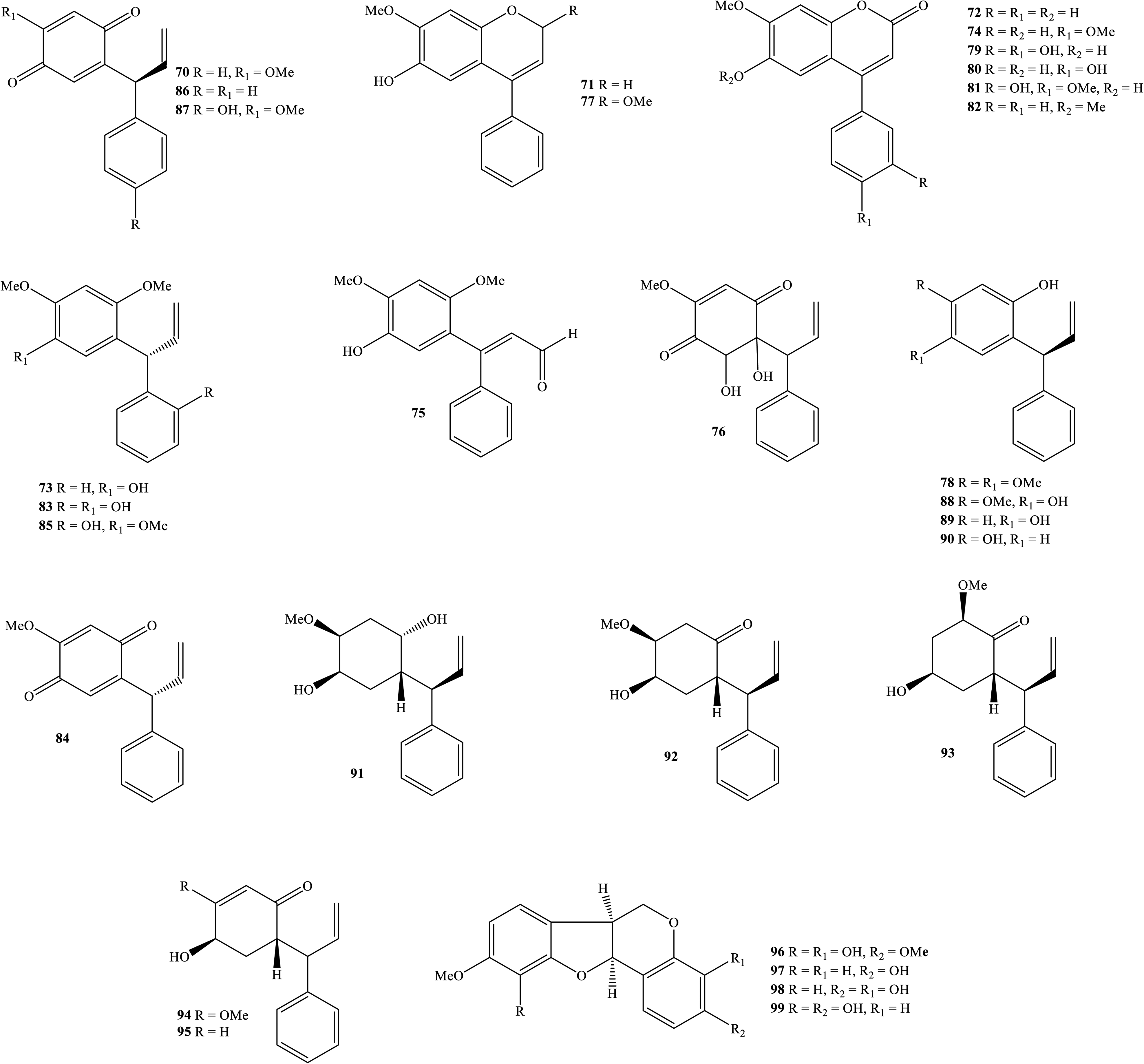
Neoflavonoids and pterocarpans from D cochinchinensis, D sissoo, and D nigra.
Chemical Constituents of D cochinchinensis, D sissoo, and D nigra.
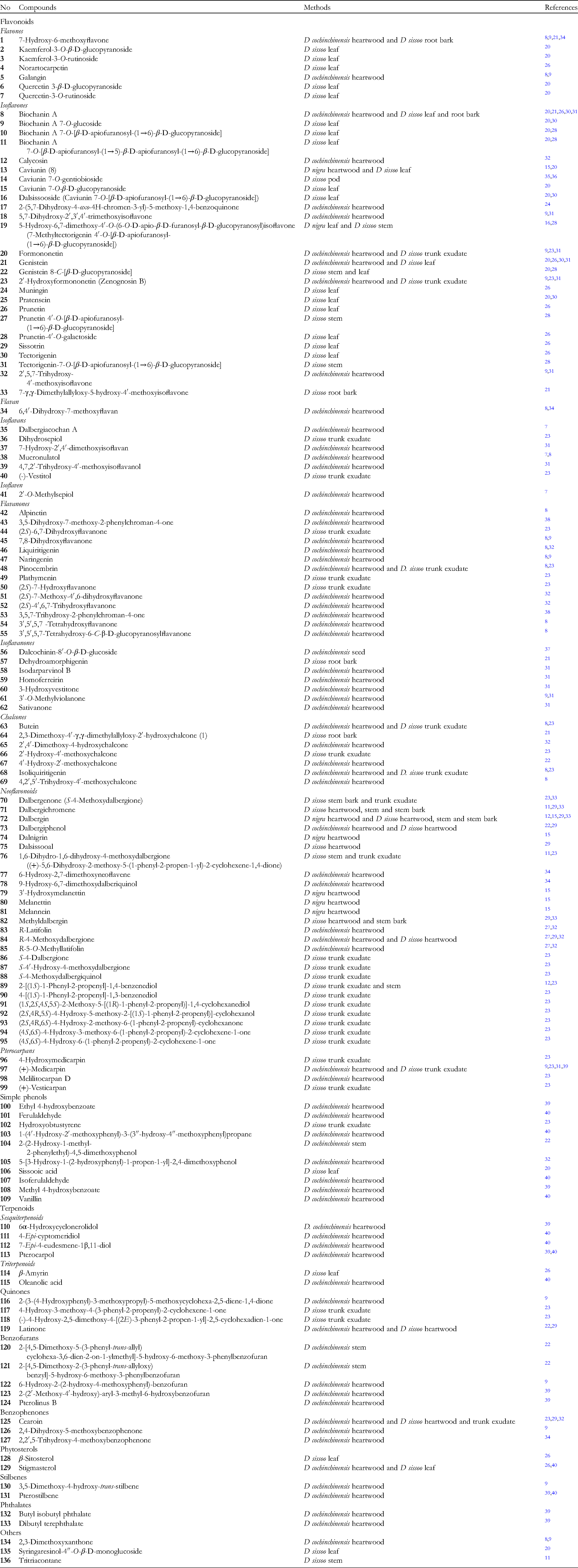
In detail, 7-hydroxy-6-methoxyflavone (1) was observed in both D cochinchinensis heartwood and D sissoo root bark, but galangin (
Regarding isoflavones
Phytochemical and NMR structural outcomes have further identified the presence of one new flavan, 6,4′-dihydroxy-7-methoxyflavan (
In Table 1, a list of 14 flavanones (
Isoflavanones are also characteristic of these Dalbergia plants. Svasti et al (1999) revealed that the EtOH extract of D cochinchinensis seed contained one new isoflavanone, dalcochinin-8′-O-β-D-glucoside (
Seven metabolites, encompassing compounds
Pharmacological Activities of D cochinchinensis, D sissoo, and D nigra.

Flavonoids derived from D cochinchinensis, D sissoo, and D nigra can be divided into various subgroups. On the basis of structural features, compounds
Four pterocarpans are covered in this review, of which 4-hydroxymedicarpin (
Ten compounds (

Simple phenols and terpenoids from D cochinchinensis and D sissoo.
Minor Components
Apart from flavonoids and phenolics, other chemical classes of compound have been found in D cochinchinensis and D sissoo. Six terpenoids, including 4 sesquiterpenoids (
Chromatographic separation of the 70% EtOH extract of D cochinchinensis heartwood led to the separation and determination of a new quinone, 2-(3-(4-hydroxyphenyl)-3-methoxypropyl)-5-methoxycyclohexa-2,5-diene-1,4-dione (
Benzofurans

Quinones, benzofurans, benzophenones, phytosterols, stilbenes, phthalates, and other types from D cochinchinensis and D sissoo.
Three compounds,
GC-MS Identification and Other Products
Siamese and Indian rosewoods were also used as raw materials in phytochemical studies using GC-MS (gas chromatography-mass spectrometry). A recent GC-MS analysis revealed that the petroleum extract of D cochinchinensis dried heartwood contained 2,6-dimethoxyphenyl 3-phenylpropanoate (43.8%), 1,1-diphenyl-2-propanol (10.3%), naringenin (8.8%), [2-hydroxy-4-(2-hydroxyethoxy)phenyl]phenyl-methanone (5.6%), triphenylmethane (5.2%), and 5-methoxy-6-[1-[4-methoxyphenyl]ethyl]-1,3-benzodioxole (3.1%). 38 The benzene-ethanol (1:2, v/v) extract of D cochinchinensis heartwood was associated with the presence of 6-iodo-2-methylquinazolin-4(3H)-one (54.43%), 4-cyclohexanedicarboxylic acid, 2,5-dioxo-diethyl ester (15.9%), 1-(3-aminopropyl)-azacyclotridecan-2-one (4.0%), naringenin (3.9%), and liquiritigenin (2.8%). 42 GC × GC-MS study of the volatile components of D cochinchinensis heartwood showed that aldehydes and ketones such as benzaldehyde, cinnamaldehyde, 4-chromanone, acetophenone, and 1-(2-hydroxyphenyl)ethanone are the main components. 43 Fatty acids are the major constituents of the oils of D sissoo fresh pod, some of which reached significant amounts, such as linoleic acid (22.3%), oleic acid (10.2%), palmitic acid (10.1%), behenic acid (9.3%), lauric acid (5.7%), myristic acid (4.9%), palmitoleic acid (2.2%), and stearic acid (2.9%). 44
Srisomsap et al (1996) successfully isolated and purified a glycosidase enzyme with both β-glucosidase and β-fucosidase activities from the seed of D cochinchinensis by ammonium sulfate fractionation, focusing-isoelectric preparation, and Sephadex G-150 column chromatography.
19
The β-glucosidase showed a high effect in hydrolyzing isoflavonoid glycosides to increase free isoflavones in soybean products.
45
The enzyme was also able to catalyze the break in the bond between aglycone and glycone of dalcochinin-8′-O-β-D-glucoside (
D cochinchinensis heartwood extracts, as natural dyes, have been effective in the staining of wood veneers with anti-UV capacity. 10 In the same manner, the meta-mordant technique for wool dyeing using D sissoo leaf dye and mordant ferrous sulfate caused the highest shade depth value of 17. 46 D sissoo SSD673 (sawdust charred at 673 K) has potential for removal of phenol from contaminated water, with a maximal adsorption capacity of 344.83 mg phenol/g SSD673 at 45 °C. 47
Mucilaginous polysaccharide derived from D sissoo leaf exhibited many potential pharmacological uses, thereby elucidating the structure and ratio of monosaccharides in the polysaccharide to help highlight the structure-activity relationship. Chemical engineering studies conducted by Rana et al showed that D sissoo leaf contained about 14.0% of a pure polysaccharide (molecule weight of 1.5 × 10⁵ Da, 15.7% of glucuronic acid).48–50 Monosaccharides in this saccharide were α-L-rhamnose, β-D-glucuronic acid, β-D-galactose, and β-D-glucose in 1:1:2:2.33 molar ratio, as well as these units linked to each other by 1→2, 1→3, and 1→4 linkages.48–50
Pharmacological Activities
Table 2 outlines the pharmacological results using the 3 Dalbergia plant extracts and their isolated compounds, comprising sexual,22,26,34,51–53 anti-osteoporosis,20,29,30,54–56 anti-inflammatory,14,23,26,57,58 anti-oxidative,59,60 anti-aging, 60 anti-bacterial,61–63 anti-nociceptive,13,64,65 anti-diarrheal,66,67 anti-pyretic,26,64 gastrointestinal, 68 biocontrol,18,69–72 and other activities.60,73
Sexual Activity
Testosterone has been known for a long time as a crucial hormone in driving male sexual function. It is completely converted to 5α-dihydrotestosterone (DHT) by 5α-reductase. The DHT-receptor complex, which causes diseases, is formed when DHT binds to an androgen receptor.
34
Five phytochemicals derived from D cochinchinensis, flavone (
In an anti-spermatogenic assay, the EtOH extract of D sissoo stem bark (20 mg/mL) caused immobilization of sperm of fertile men aged 25 to 35 years within 3 min. 51 This extract, at a concentration of 200 mg/kg, also decreased the weight of testis and epididymis of Swiss male albino mice in an in vivo anti-spermatogenic model. 51 D sissoo aqueous leaf extract at doses of 50 and 100 mg/kg significantly reduced epididymal sperm motility, viability and number during 35 days. 52 The anti-spermatogenic mechanism involved decreased StAR protein, P450scc enzyme expression, and 3β and 17β-hydroxysteroid dehydrogenase (HSD) enzyme activity, and induced oxidative stresses in the testis of Park male mice, and increased germ cell apoptosis and caspase-3 expression (Figure 6). 53

The plausible mechanism of action of D sissoo aqueous leaf extract on spermatogenic suppression in Parke male mice.
Anti-Osteoporosis Activity
Osteoporosis is mainly caused by low bone and micro-architectural deterioration of the trabecular and cortical bone.20,29,30,54–56 Naturally occurring flavonoids without adverse effects are now potential dietary agents to decrease the risk of this disease.
6
Five isoflavones (
The EtOH extract of D sissoo leaf (250 and 500 mg/kg, p.o.) prevented joint cartilage damage and deterioration in subchondral mice bone in vivo, while at a dose of 250 mg/kg remarkably increased bone volume fraction, trabecular thickness and number, and connective density, reduced trabecular separation, and promoted osteogenic genes expression of BMP-2, BMP-4, RunX-2, and COL-1.30,55
Anti-Inflammatory Activity
In an anti-inflammatory assay against NO (nitric oxide) production in LPS (lipopolysaccharide) stimulated J774.1 macrophage cells, the IC50 values were found to run in the consistent order of neoflavonoid
The 90% EtOH extract of D sissoo leaf was safe for mice at a dose of 10.125 g/kg, p.o., and demonstrated remarkably suppression of carrageenan, kaolin, and nystatin induced paw edema at doses of 100-300 mg/kg. 57 Similarly, the 90% EtOH extract of D sissoo bark (safe dose 3000 mg/kg, p.o.) at a concentration of 1000 mg/kg had a more potent anti-inflammation effect than doses of 300 and 500 mg/kg against carrageenan stimulated paw edema in rats. 14 In the same model, the MeOH extract of D sissoo root at a dose of 1000 mg/kg was better than that at doses of 100 and 500 mg/kg. 58
Injection of Brewer's yeast (Saccharomyces cerevisiae) leads to lethargy, fever, and anorexia because it causes the release of pro-inflammatory cytokines in the brain and blood. 6 The 70% EtOH extract of D sissoo bark (80 mg/100 g) helped to reduce paw thickness by up to 0.58 and 0.44 cm after injection of Brewer's yeast in mice at 3.0 and 6.0 h post treatment, as compared with those of the non-treated group (0.72 and 0.68 cm). 26
Anti-Oxidant and Anti-Aging Activities
The DPPH• (2,2-diphenyl-1-picrylhydrazyl) radical scavenging activity of the aqueous extract of D sissoo stem bark was comparable with the positive control gallic acid (IC50 = 12.14 μg/mL), and better than that of the MeOH extract (IC50 = 12.14 μg/mL). 59 It was further observed that the aqueous extract, with an EC50 value of 327.8 μg/mL in the FRAP (ferric reducing antioxidative power) assay, is less than that of the MeOH extract (EC50 = 754.9 μg/mL). 59
The aqueous extract of D sissoo bark, with better antioxidant activity index (AAI), IC50, and FRAP values, has greater antioxidant activity than the aqueous extracts of either the leaf or fruit in the DPPH• and ABTS•+(2,2′-azino-bis(3-ethylbenzothiazoline-6-sulfonic acid)) radical scavenging, and FRAP assays (Table 2). 60 The bark aqueous extract showed the best AAI of 2.73 in the DPPH• assay, the best IC50 value of 10.02 μg/mL in the ABTS+• assay, and the best FRAP value of 135.0 mg TE (trolox equivalent)/g dry extract. 60
For anti-aging activity, the SI values (selectivity index = IC50 for mouse melanoma B16 skin cancer cells/IC50 for non-cancerous HaCaT skin cells) run in the order of aqueous extract of D sissoo leaf (SI = 8.69) > the fruit aqueous extract (SI = 5.79) > the bark aqueous extract (SI = 1.89) > the positive control paclitaxel (SI = 1.33). 60 It is safe to conclude that D sissoo aqueous extracts show cytotoxicity toward B16 cells. Furthermore, the absorption coefficients KUV−B (300 nm) and KUV−A (365 nm) of the aqueous bark extract are always better than those of the aqueous extracts of the leaf and fruit (Table 2). 60
Anti-Bacterial Activity
The MeOH extract of D nigra leaf induced an inhibitory zone diameter (IZD) of 2 mm against Pseudomonas aeruginosa and Staphylococcus aureus, and an IZD value of 3 mm against Bacillus cereus and Escherichia coli. 61 The MeOH extract of D sisoo fruit inhibited the growth of S aureus and P aeruginosa with minimum inhibitory concentration values of 0.386 and 0.05 mg/mL, respectively. 62 A herbal drug formulation containing D sisso bark (100 g) and Datura stramonium (100 g) in cow urine (200 mL) inhibited the growth of S aureus SR, S aureus CI, Streptococcus pnuemonae CI, E coli SR, E coli CI, Klebsiella pneumonae, P aeruginosa SR, and P aeruginosa CI with IZD values of 5.55 to 27.53 mm, as compared with those of the positive control, chloramphenicol (IZD = 11.23-21.33 mm). 63
Anti-Nociceptive Activity
Anti-nociceptive action is involved in blocking the detection of a painful stimulus by sensory neurons. In the tail-flick model, the EtOH extract of D sissoo bark at a dose of 1000 mg/kg reduced the pain at 1 h (mean response time 29.42 s, compared to 30.85 s of the positive control aspirin), but the doses of 300 and 500 mg/kg failed to do so. 13 The MeOH extract of D sissoo leaf at doses of 100, 200, and 400 mg/kg showed anti-nociceptive activity in both heat and chemical stimulated pain models such as hot plate and acetic acid-induced nociception in mice via the cGMP pathway and ATP sensitive K+ channel opening and the subsequent efflux of K+ ions and membrane depolarization or hyperpolarization. 65 The 90% EtOH extract of D sissoo leaf, at doses of 100, 300, and 1000 mg/kg, p.o., showed analgesic activity since the writhing number (TWN) caused by acetic acid induced pain in mice decreased from 32.33 to 26.17/per 20 min. 64
Anti-Diarrheal Activity
In traditional uses of the Indian community, D sissoo parts are the best selection to treat infectious diarrhea. The decoction of D sissoo leaf (1%-10%) reduced colonization (adherence and invasion) of E coli B170, E coli E134, and S flexneri in Hep-2 cells. 66 The EtOH extract of D sissoo leaf has an LD50 value of more than 2000 mg/kg for mice, p.o. 67 In the models of castor oil and MgSO4 induced diarrheal disease (Table 2), a dose increase from 1000 to 4000 mg/kg was responsible for a decrease in the EI (evacuation index), as compared with the non-treated group (EI > 56.83). 67 This increase in dose also promoted the reduction of peristalsis activity of barium sulfate milk and charcoal meal in mice. 67
Anti-Pyretic and Gastrointestinal Activities
The 70% EtOH extract of D sissoo bark (80 mg/100 g, i.p.) also reduced the body temperature of mice by about 1.0 °C for 1-3 h treatment in the Brewer's yeast stimulated pyrexia model. 26 The 90% EtOH extract of D sissoo leaf, at doses of 100, 300, and 1000 mg/kg, p.o., produced a slight decrease in rectal temperature of mice after 1-6 h treatment. 64
Oral administration of the EtOH extract of D sissoo stem bark (200 and 400 mg/kg) resulted in a gastrointestinal protective effect. 68 This was evidenced by the extract remarkably reducing the ulcer index, TBARSs (thiobarbituric acid reactive substances), H2O2, and MPO (myeloperoxidase) activity in the gastric mucosa of the ulcerated mice, but increasing the contents of the enzymatic antioxidants CAT (catalase), SOD (superoxide dismutase), GSH-Px (glutathione peroxidase), GST (glutathione-S-transferase), GSH (reduced glutathione), and NP-SHs (nonprotein sulfhydryls) in the gastric mucosa of diclofenac-induced mice. 68
Biocontrol Activity
The EtOH extract of D sissoo fruit and root gave an LC90 value of less than 100 mg/L for molluscicidal activity against Biomphalaria pfeifferi adult, with additional toxicity toward its 0-24 h-old egg masses. 69 The bark, sapwood, and heartwood (2.0 g powder, each) of this plant also caused respective mortality rates of 85.2%, 47.61%, and 100% to Heterotermes indicola termite within 6 days. 18 In another report, the ethanol-toluene extract (2:1, v/v) of D sissoo heartwood controlled H indicola and Reticulitermes flavipes, with respective LC50 values of 5.54 and 3.89 mg/mL, and induced the respective highest mortalities of 73.3% and 62.7% at the concentration of 10 mg/mL. 71 The pure oil of D sissoo wood at a dose of 4 mL/m2 produced death percentages of 100%, 90%, and 60% to Anopheles stephensi, Aedes aegypti, and Culex quinquefasciatus immature mosquitoes within 24 h of treatment. 70 Additionally, as shown in Table 2, its protective effect against mosquito bites during 8 to 11 h was comparable with the commercial product mylol oil (93.8%). 70 The aqueous extract of D sissoo leaf, with an LC50 value of 1.58%, showed acaricidal activity against Rhipicephalus microplus tick, better than that of its EtOH extract (LC50 = 5.25%). 72
Other Activities
Another point is that, in Pakistan, parts of D sissoo are used for the treatment of epilepsy. A pharmacological study conducted by Majeed et al revealed that the alcoholic extracts of bark and leaf have non-toxic and non-mutagenic effects. 73 From in vivo experimental results, both of these 2 extracts also reduced seizure intensity, and convulsive duration when pilocarpine was used to induce seizures in albino Wistar rats. 73 Especially, at the dose of 500 mg/kg, p.o., D sissoo leaf extract impeded seizure onset against the control pilocarpine. 73
The aqueous extract of D sissoo fruit (10, 50, and 250 μg) showed plasmid DNA protection against H2O2 stress, whereas the aqueous bark extract (50 μg) had non-covalent interaction with ct DNA complex [λmax at 210 nm (the aqueous bark extract, only) shifted to 220 nm (the aqueous bark extract-ct DNA complex]. 60
Conclusion
For the first time, the current review gives an insight into the phytochemistry, applications, and pharmacological aspects relating to 3 well-known Dalbergia species, Siamese rosewood, Indian rosewood, and Brazilian rosewood. The studies focus on 2 main species, D cochinchinensis and D sissoo. More than 130 secondary metabolites have been completely isolated and structurally elucidated, to date. Dalbergia constituents appear in a wide variety of chemical classes, such as simple phenols, sesquiterpenoids, benzofurans, and benzophenones, but phenolics, especially flavonoids, are major compounds. Flavonoids
Footnotes
Abbreviations
Declaration of Conflicting Interests
The authors declared no potential conflicts of interest with respect to the research, authorship, and/or publication of this article.
Funding
The authors received no financial support for the research, authorship, and/or publication of this article.
