



Abstract
Introduction
Balsamorhiza sagittata (Pursh) Nutt. (Family Asteraceae, Heliantheae tribe, Engelmanniinae subtribe) (Figure 1) occurs throughout western North America from Alberta and British Columbia, east to the Dakotas, and south to Southern California, Nevada, Colorado, and Arizona (Figure 2). The preferred habitats for B. sagittata are open hillsides and prairies at mid to upper elevations in the Intermountain West and Rocky Mountain regions and is most common in upland rangeland shrubland types dominated by antelope bitterbrush (Purshia tridentata), basin big sagebrush (Artemisia tridentata subsp. tridentata), Wyoming big sagebrush (A. t. subsp. wyomingensis), and mountain big sagebrush (A. t. subsp. vaseyana).1,2

Balsamorhiza sagittata. (A) Photograph of plant (by K. Swor). (B) Scan of pressed plant (by W.N. Setzer).
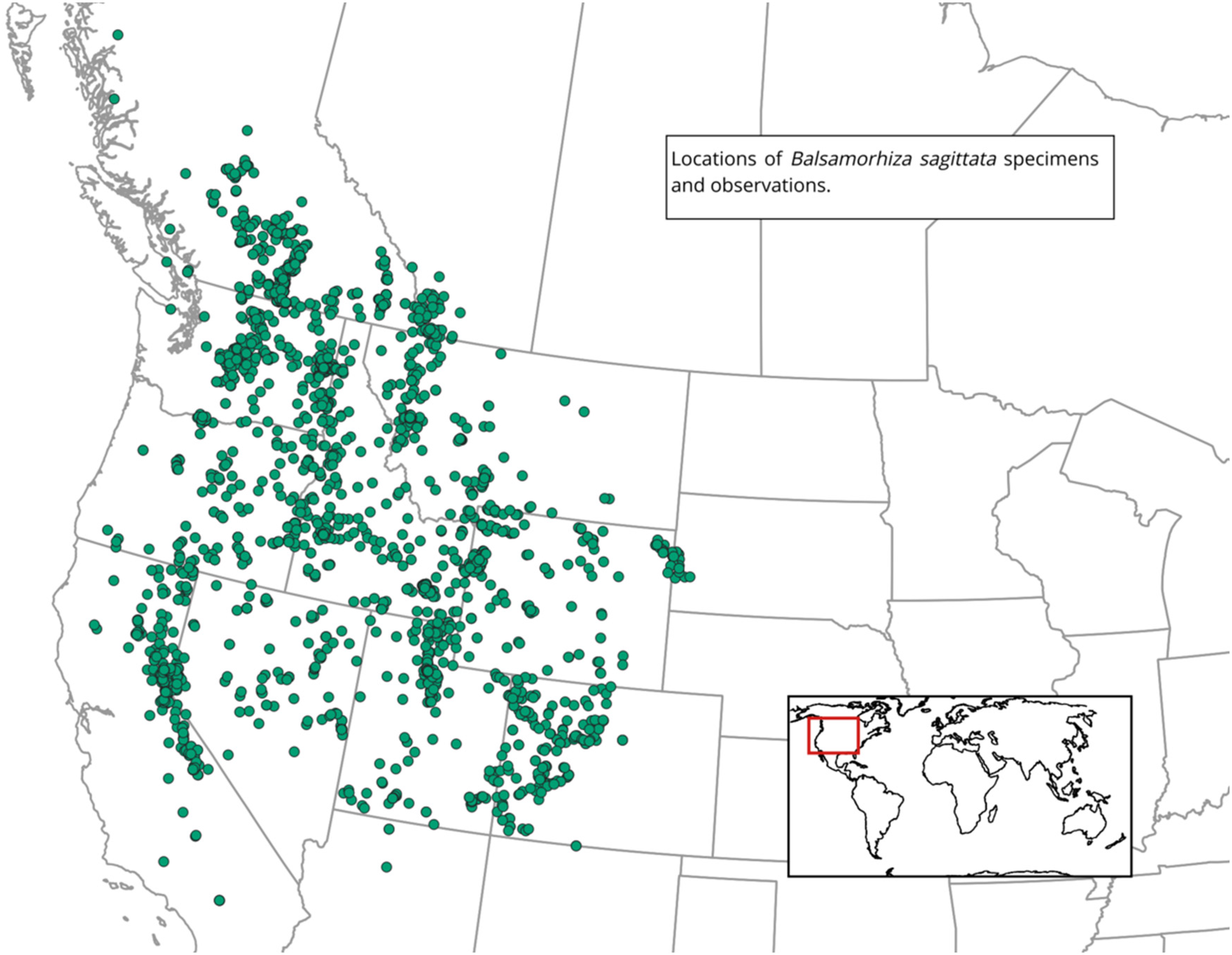
Range of Balsamorhiza sagittata in North America (by Looncreek—Own work, CC BY-SA 4.0, https://commons.wikimedia.org/w/index.php?curid=98731965). 24
B. sagittata was important in the ethnobotanical traditions of Native American cultures. 3 For example, the Cheyenne used a decoction of the plant to treat colds and stomach pains; the Flathead used a poultice of the leaves on burns; the Shuswap used an infusion of the leaves as a wash for poison ivy and running sores.
Leaves of B. sagittata were found to contain a single major flavonoid, 6-hydroxy-kaempferol 7-methyl ether. 4 From the aerial parts of B. sagittata, several sesquiterpene lactones, guaianolides, heliangolides, germacranolides, eudesmane acids, and geranylnerol derivatives were isolated and characterized.5,6 As part of our interest in characterizing the volatile phytochemistry of Great Basin aromatic plants, the focus of this study was to obtain and analyze the leaf essential oil of B. sagittata; as far as we are aware, there have been no reports on the essential oil of B. sagittata or any other Balsamorhiza species.
Results and Discussion
Essential Oil Composition
The leaves of B. sagittata were hydrodistilled to give pale blue essential oils in yields ranging from 0.069% to 0.917% (w/w). Gas chromatographic analysis of the nine essential oil samples led to identification of a total of 184 compounds (Supplemental Table 1). The major components are summarized in Table 1.
Major Components (%) of the Leaf Essential Oils of Balsamorhiza sagittata.

In order to compare the chemical compositions of B. sagittata leaf essential oils, an agglomerative hierarchical cluster (AHC) analysis was carried out (Figure 3). The AHC analysis revealed eight of the nine samples show at least 48% similarity in composition. However, one sample (#3) was very different. Samples #1, #2, and #4 through #9 were rich in germacrene D (10.8-34.5%), β-phellandrene (6.4-19.4%), (E)-β-caryophyllene (1.4-15.0%), and (E)-β-ocimene (3.1-8.4%). In contrast, limonene (13.7%), spathulenol (6.0%), p-cymene (5.5%), cryptone (5.4%), and β-phellandrene (4.9%) were the major components in sample #3, while germacrene D was not observed. A principal component analysis (PCA) was also carried out to verify the results of the AHC analysis (Figure 4). The PCA corroborates the AHC analysis; samples #1, #2, and #4 through #9 all show positive correlations with germacrene D, β-phellandrene, (E)-β-caryophyllene, and (E)-β-ocimene. Sample #3, on the other hand, positively correlates with limonene, spathulenol, p-cymene, and cryptone. It is not at all obvious why the chemical composition of sample #3 is so different from the other samples. It was collected on the same day from the same location as sample #2. Sample #1 was collected in May 2022 from one location and samples #2 and #3 were collected in May 2022 from a different location. On the other hand, samples #4 through #9 were collected in May 2023, from two different locations. The chemical compositions of #1, #2, and #4 through #9 are similar regardless of their different collection years, geographical locations, and elevations; sample #3 is just an outlier. The dendrogram (Figure 3) indicates 95% similarity between essential oil samples #2 and #6. Likewise, there is 94% similarity between essential oils #5 and #8. These four essential oil samples were all rich in germacrene D, but the #2/#6 subcluster had overall lower concentrations of monoterpene hydrocarbons than the #5/#8 subcluster.

Dendrogram obtained by cluster analysis of the major components of Balsamorhiza sagittata leaf essential oils based on Pearson similarity correlation and using the unweighted pair-group method with arithmetic average (UPGMA).

Principal component analysis of the leaf essential oils of Balsamorhiza sagittata in this study.
There have been no previous reports on essential oils of Balsamorhiza species for comparison. However, several members of the Heliantheae tribe, Engelmanniinae subtribe of the Asteraceae have been published, and a comparison with the major components of B. sagittata is presented in Table 2.
Comparison of Percentages of Key Essential Oil Components in Members of the Heliantheae Tribe, Engelmanniinae subtribe of the Asteraceae.

Abbreviation: nd, not detected.
Both germacrene D and (E)-β-caryophyllene seem to be major components in the Engelmanniinae subtribe of the Asteraceae, but those two sesquiterpenes are common components of many essential oils and may not, therefore, define this subtribe of the Asteraceae.
Terpenoid Enantiomeric Distributions
As a further characterization of the essential oil of B. sagittata, chiral GC/MS was carried out (see Table 3). Both α-pinene and β-pinene were virtually racemic in B. sagittata essential oils. The (−)-enantiomers were the dominant stereoisomers, when observed, for camphene, limonene, borneol, (E)-β-caryophyllene, and germacrene D, while (+)-sabinene, (+)-α-phellandrene, (+)-β-phellandrene, (+)-δ-cadinene, and (+)-(E)-nerolidol were dominant. There seems to be little consistency in enantiomeric distributions of monoterpenoids in the Asteraceae. For example, several Gnoxys species have been examined. Gnoxys miniphylla Cuatrec. showed 98.2% ee (−)-α-pinene, 100% ee (−)-α-phellandrene and (−)-β-phellandrene, but nearly racemic β-pinene and sabinene. 11 Likewise, Gnoxys laurifolia (Kunth.) Cass. had 100% (−)-α-phellandrene and (−)-β-phellandrene, nearly racemic sabinene, but 100% (−)-β-pinene. 12 Gnoxys rugulosa Muschl., on the other hand, showed 100% ee (+)-β-pinene and (+)-β-phellandrene and nearly racemic terpinen-4-ol and α-terpineol. 13 In contrast, Gnoxys buxifolia (Kunth.) Cass. had 100% ee for (−)-α-pinene, (−)-β-pinene, (+)-β-phellandrene, and (−)-terpinen-4-ol. 14 In a comparison with enantiomeric distributions in sagebrush (A. tridentata Nutt.), 15 there are some similarities with B. sagittata. Both α- and β-pinene were variable in distribution, (−)-limonene was dominant is sagebrush as was (−)-borneol. Apparently only (−)-(E)-β caryophyllene is seen in higher plants, but (+)-(E)-β caryophyllene has been found in some liverworts. 16 Camphene did show variation in enantiomeric distribution in sagebrush, depending on the subspecies.
Enantiomeric Distribution of Chiral Terpenoid Components (Percentage of Each Enantiomer) in Balsamorhiza sagittata Essential Oils.

Abbreviations: RIdb, retention index from our in-house database; RIcalc, calculated retention index based on a homologous series of n-alkanes on a Restek B-Dex 325 capillary column; —, compound not detected.
Conclusions
This work is the first presentation of the leaf essential oil composition of B. sagittata. Nine samples were collected from various locations in southwestern Idaho. Ignoring the composition of the outlier, sample #3, the leaf essential oil of B. sagittata can be summarized as containing (−)-germacrene D (10.8-34.5%), (+)-β-phellandrene (6.4-19.4%), (−)-(E)-β-caryophyllene (1.4-15.0%), and (E)-β-ocimene (3.1-8.4%) as major components. Furthermore, there was modest variation in composition or with respect to geographical location or elevation. A limitation of this study is the relatively narrow geographical range of the collections and likely does not adequately describe the essential oil composition of the species. It would be interesting to compare B. sagittata essential oils from geographical locations outside of Idaho to more definitively describe the volatile phytochemistry of this plant species. Likewise, comparison with essential oils of other Balsamorhiza species would be appealing.
Materials and Methods
Plant Material
Leaves of nine individuals of B. sagittata were collected during the flowering stage from the hills near Boise, Idaho. Plants were identified in the field by K. Swor by consulting the botanical descriptions,17,18 and by comparison with samples from the New York Botanical Garden Virtual Herbarium (https://sweetgum.nybg.org/science/vh/, accessed on 28 May 2022). A voucher specimen (KS-Bs-5316) has been deposited in the University of Alabama in Huntsville herbarium. The aerial parts were fresh frozen and stored at −20°C until distilled.
Essential Oil Isolation
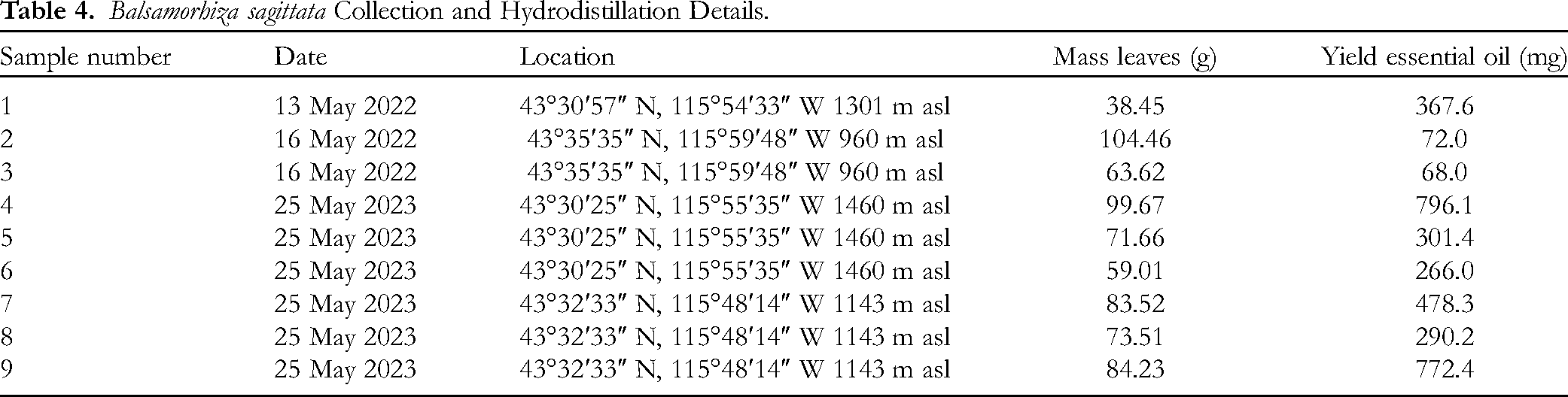
Each sample of plant material was hydrodistilled using a Likens-Nickerson apparatus for 3 h to give the essential oils (Table 4). Yields were calculated as 100% × essential oil mass/leaf mass.
Balsamorhiza sagittata Collection and Hydrodistillation Details.
GC-FID, GC/MS, and Chiral GC/MS Analyses
The essential oils of B. sagittata were analyzed by gas chromatography coupled with flame ionization detection (GC-FID), gas chromatography-mass spectrometry (GC/MS), and chiral GC/MS as previously described. 19 The essential oil components were identified by comparison of the mass spectral (MS) fragmentation patterns (>80% similarity match) and by comparison of retention index (RI) values (within 5 RI units) available in the Adams, 20 FFNSC 3, 21 NIST20, 22 and our own in-house database. 23 The identification of enantiomers was determined by comparison of retention indices with authentic samples obtained from Sigma-Aldrich (Milwaukee, WI, USA).
Multivariate Analysis
The agglomerative hierarchical cluster (AHC) analysis was carried out to assess the similarity of the essential oil samples using the distribution of the main essential oil constituents (Table 1). The nine B. sagittata samples were treated as operational taxonomic units (OTUs). Pearson correlation was selected as a measure of similarity, and the unweighted pair group method with arithmetic average (UPGMA) was used for cluster definition. PCA was carried out to verify the previous AHC analysis using the 20 main essential oil components (Table 1). The AHC and PCA analyses were performed using XLSTAT v. 018.1.1.62926 (Addinsoft, Paris, France).
Supplemental Material
sj-docx-1-npx-10.1177_1934578X231225842 - Supplemental material for The Essential Oil of Balsamorhiza sagittata from Southwestern Idaho: Chemical Composition and Enantiomeric Distribution
Supplemental material, sj-docx-1-npx-10.1177_1934578X231225842 for The Essential Oil of Balsamorhiza sagittata from Southwestern Idaho: Chemical Composition and Enantiomeric Distribution by Kathy Swor, Prabodh Satyal, Ambika Poudel and William N. Setzer in Natural Product Communications
Footnotes
Acknowledgments

Data Availability Statement
The data presented in this study are available upon reasonable request from the corresponding author.
Declaration of Conflicting Interests
The author(s) declared no potential conflicts of interest with respect to the research, authorship, and/or publication of this article.
Funding
The author(s) received no financial support for the research, authorship, and/or publication of this article.
Ethical Approval
Ethical approval is not applicable for this article.
Statement of Human and Animal Rights
This article does not contain any studies with human or animal subjects.
Statement of Informed Consent
There are no human subjects in this article and informed consent is not applicable.
Supplemental Material
Supplemental material for this article is available online.
References
Supplementary Material
Please find the following supplemental material available below.
For Open Access articles published under a Creative Commons License, all supplemental material carries the same license as the article it is associated with.
For non-Open Access articles published, all supplemental material carries a non-exclusive license, and permission requests for re-use of supplemental material or any part of supplemental material shall be sent directly to the copyright owner as specified in the copyright notice associated with the article.
