



Abstract
Background
The dried and ripe pulp of Cornus officinalis Sieb.et Zucc., a plant of the Cornaceae family, is mainly produced in Henan, Zhejiang, Shanxi, Sichuan, and other provinces. It nourishes the liver and kidney and tightens astringency.1–4 It is often used for dizziness, tinnitus, soreness in the waist and knees, impotence and nocturnal emission, enuresis, frequent urination, metrorrhagia, profuse sweating, and diabetes, among others. The decoction of Corni Fructus is recorded in the 2020 edition of the Chinese Pharmacopoeia. 5 After processing, wine-steamed Corni Fructus can warm the body by virtue of the wine, help the drug potential, reduce its acidity, and enhance its function of tonifying liver and kidney, immune regulation, and anti-aging. The main clinical application in Chinese medicine is wine-steamed Corni Fructus. The Chinese Pharmacopoeia records the processing technology of the plant material in wine as follows: clean shanyurou is taken, stewed with wine, steamed with wine, or steamed until the wine is exhausted. Generally, it lacks clear process parameters. There are also big variations in the process,6–9 and there is a lack of specific regulations for parameters such as immersion time, steaming time, and the amount of rice wine. It can be seen from the above that the jiuyurou processing technology is not uniform, and there are no specific processing parameters. Chinese herbal decoction pieces are directly used in the formulation of traditional Chinese medicine (TCM) clinical prescriptions and the raw materials of Chinese patent medicines. Therefore, the quality of Chinese herbs and preparations is directly related to their clinical efficacy. The processing technology largely determines the quality of the Chinese herbal. This study compares crude and wine-steamed Corni Fructus based on the ultra-performance liquid chromatography-quadrupole time of flight-tandem mass spectrometry (UPLC-Q-TOF-MS) combined with pharmacodynamics, which can provide evidence of processing time for jiuyurou.10–13 The results will determine how different processing times affect the constituents of jiuyurou and its medicinal effects (immunity, liver protection, and kidney-nourishing effects). Our results will provide the basis for the processing technology of decoction pieces.
Materials and Methods
Plant Material and Processing Technology With Different Wine Steaming Times
The Corni Fructus decoction pieces were collected from Xishan city, Henan Province and the batch number was G2101667. The samples were identified by Mei Wei (the corresponding author).
The 27 batches of Corni Fructus decoction pieces were soaked in wine (the amount of wine was 20% of the decoction pieces’ weight) for 2 h until the wine was completely absorbed. They were then steamed for 0, 1, 2, 4, 6, 8, 10, 12, and 14 h, respectively.
Chemicals and Reagents
Yellow rice wine (Lot No: FF2012005) was purchased from Shaoxing County No. 3 Distillery. The content of alcohol was 14.5% v/v, and the main components were water, rice, and wheat. Standard compounds, including β-maltose, citric acid, uridine, adenosine, guanosine, 5-hydroxymethyl-2-furaldehyde, 3, 4-dihydroxybenzoic acid, geniposidic acid, loganic acid, morroniside, cynaroside, alyposide, caffeic acid, rhoifolin, loganin, genistein, ferulic acid, rutin, hyperoside, isoquercitrin, quercetin, apigenin, ligustilide, and ursolic acid were purchased from National Institutes for Food and Drug Control. L-proline, pantothenate, ethyl gallate, and myricetin-3-galactoside were obtained from Sichuan Weikeqi Biological Technology Co., Ltd. L-pyroglutamic acid, p-hydroxybenzaldehyde, cryptochlorogenic acid, and sweroside were from Shanghai Standard Technology Co Ltd. p-Hydroxy-cinnamic acid and 1-caffeoylquinic acid were purchased from Chengdu Pufeide Biotechnology Co Ltd. (-)-Epiafzelechin was obtained from Chengdu Lemeitian Pharmaceutical Technology Co Ltd.
HPLC-grade acetonitrile was supplied by Merck, and formic acid by Tianjin Comeo Chemical Reagent Co. Ltd. Distilled water was used in all the experiments. All other reagent solutions were of analytical grade.
Chromatographic Conditions for UPLC-MS Analysis
Mass spectrometric analysis was performed on a UPLC-MS Thermo Vanquish Flex. Chromatographic separations were carried out on a Waters HSS T3 C18 column (210 mm × 100 mm, 1.8 μm). The mobile phase consisted of acetonitrile (A) and 0.1% formic acid aqueous solution (B) with a linear gradient: 0 to 3 min, 2% to 8% A; 3 to 9 min, 8% to 15% A; 9 to 13 min, 15% to 25% A; 13 to 16 min, 25% to 100% A; 16 to 19 min, 100% A; 19 to 22 min, 100% to 2%; 22 to 30 min, 2% A. The flow rate was 0.3 mL/min, the sample injection volume was 1.0 μL, the column temperature was 35 °C, and the detection wavelength was 260 nm. The mass spectrometer was an electrospray ion source (HESI). The spray voltage was set to 3.80 kV, the heating and capillary temperature to 350 °C, the sheath gas flow to 35 arb, and the auxiliary gas flow rate to 10 arb; the data were collected in positive and negative ion modes; the scanning mass range was 100 to 1200 Da, the S-lens voltage 50 V, and the secondary collision energies 40 eV.
Animals and Their Care
Kunming mice, 18 to 22 g in weight, were provided by the Guangdong Medical Laboratory Animal Center, and their certificate number was 44007200099222. They were acclimatized in an air-conditioned room at 22 ± 2 °C for 3 days with a 12-h light and 12-h darkness cycle. All animals were fed with standard laboratory chow and tap water before the experiment. The Animal Ethics Committee of Guangdong Province Hospital of Traditional Chinese Medicine approved the studies.
Wine-Steamed Corni Fructus Extract for the Animal Experiments
Three 100 g samples of Corni Fructus were soaked in 20 g wine for 2 h, then steamed for 1, 4, and 12 h, respectively. The samples were soaked 8 times in water for 0.5 h, and subsequently boiled for 1 h and filtered. The residues were extracted 8 times in water for 0.5 h and filtered. The filtrate was combined and condensed to 100 mL at 60 °C under reduced pressure.
Induction of Immunocompromised Mouse Model and Biochemical Assays
Kunming mice were randomly divided into groups: a blank group, cyclophosphamide (CTX) model group, ubenimex group, Corni Fructus group, and wine-steamed (1, 4, and 12 h) Corni Fructus groups, with 10 mice in each group. Except for the blank group, the other groups were given 80 mg/kg of CTX by intraperitoneal injection to establish an immunosuppressed mouse model. The blank group was given the same dose of normal saline for 3 days. After successful induction, each group was given the corresponding drugs by gavage, and the blank group and model group were given the same volume of distilled water for 7 days.
Twenty-four hours after the last administration, blood was collected. The thymus and spleen were separated and weighed, and the organ index was determined. After collection, the blood was left to stand for 15 min and centrifuged for 10 min (3000 rev/min). The supernatant was taken, and the content of IgG and IgM in serum was detected by ELISA.
Construction of a Mouse Model of Drug-Induced Liver Injury and Biochemical Assays
Kunming mice were taken, and, after adaptive rearing, they were randomly divided into groups, namely the blank group, the acetaminophen (APAP) model group, the bicyclol group, the Corni Fructus group, and the wine-steamed (1, 4, and 12 h) Corni Fructus groups, with 10 mice in each group. Ten mL/kg body weight of the corresponding drug was administered by intragastric administration once. Ten mL/kg body weight of distilled water was administered to the blank and APAP model groups every day for 7 days.
On the seventh day of administration, the mice fasted without food and water, and 12 h after the last administration, the mice in the blank group were intraperitoneally injected with saline (200 mg/kg). The other groups were intraperitoneally injected with APAP (200 mg/kg) to establish a liver injury model. After 12 h of modeling, the mice were removed to obtain blood, and the serum was separated for serum index determination. Alanine amino transferase (ALT), aspartate transaminase (AST), and malondialdehyde (MDA) (Tianjin Annorikang Biotechnology Co Ltd) were measured in the serum according to the kit instructions. Parts of the liver were sampled and were cut into pieces. Nine volumes of normal saline were added, and an electric glass homogenizer was used to homogenize a 10% liver homogenate in an ice bath. This was centrifuged at 3500 rev/min for 15 min, and the supernatant was collected. The superoxide dismutase (SOD) and seleno-dependent glutathione peroxidase (GSH-Px) (Tianjin Annorikang Biotechnology Co Ltd) contents in liver tissue were determined according to the kit instructions.
Induction of Kidney yin Deficiency in the Mice Model and Biochemical Assays
Kunming mice were taken and randomly divided into blank group, model group, Liuwei Dihuang Pills group, Corni Fructus group, and wine-steamed (1, 4, and 12 h) Corni Fructus groups, with 10 mice in each group. The mice in the blank and the model group were given distilled water by gavage, and the administration group was given 0.1 mL per 10 g body weight for 14 days. Except for the blank group, the mice in each group were given a thyroid tablet solution (160 mg/kg), once a day for 14 days.
Twenty-four hours after the last administration, the blood was collected and centrifuged for 10 min (3000 rev/min). The supernatant was aspirated, and the serum cyclic adenosine monophosphate (cAMP), cyclic guanosine monophosphate (cGMP), triiodothyronine (T3), and thyroxine (T4) were determined by ELISA. The thymus and spleen were separated and weighed, and the organ index was determined.
Statistical Analysis
The SIMCA-P (version 14.1, Umetrics) statistical program was used for principal component analysis (PCA). Data analysis was performed using GraphPad Prism 9. All data were expressed as mean ± SD. One-way ANOVA tests were applied when the homogeneity of variance assumptions were satisfied. Otherwise, the equivalent nonparametric test was used. P < .05 was considered significant.
Results
Effects of Different Steaming Times on Wine-Steamed Corni Fructus
With an increase in steaming time, the color of wine-steamed Corni Fructus gradually deepened from purplish red to black.
To analyze the overall trends in composition changes during processing, 10 batches of Corni Fructus and wine products with different processing degrees were analyzed. The relative peak areas of common peaks in mass spectrometry data were imported into SIMCA14.1 statistical software for unsupervised PCA modeling and analysis. The results are shown in Figures 1 and 2. The positive and negative ion model results indicated that the PCA score maps of different processed wines moved counterclockwise with the increasing processing degree. Although the changing trend in the chemical composition of each treatment was different and reflected a certain complexity, PCA could reduce this complexity and visually reflect the overall changes in the chemical composition.

Principal component analysis (PCA) score plot of raw and processed Corni Fructus at different processing stages: (A) positive mode and (B) negative mode.

Ultra-performance liquid chromatography (UPLC) chromatograms of Corni Fructus and 4-h wine-steamed Corni Fructus: (A) Corni Fructus and (B) 4-h wine-steamed Corni Fructus.
Mass Spectrometric Analysis
Compound Discover 3.3 software was used to analyze the MS and MS2 of the extracted chromatographic peaks. The precise molecular weight, mass number deviation, and admixture ion information of the target compounds were determined and then compared with the mzCloud database and MS OTCML database of traditional Chinese medicine components.
A total of 132 compounds were identified in both positive and negative ion models, including 34 organic acids, 16 glycosides, 19 flavonoids, 15 terpenoids, 13 alkaloids, 3 phenylpropanoids, 3 sugars, 1 steroid, 1 tannin, and 27 compounds belonging to other classes. The compounds are listed in Table 1. With the increase in processing time, the content of 19 compounds increased gradually, 67 compounds decreased, and 6 compounds increased initially and then decreased. The changes in the compounds quantified are shown in Figure 3. The peak with a retention time of 5.50 was distinctly different from the crude Corni Fructus. According to the analysis, the component is 5-hydroxymethyl-2-furaldehyde, which is produced during processing. Processing could reduce the acidity of Corni Fructus and enhance its liver and kidney toning effect, immune regulation, and anti-aging.

Heat map of changes in the concentration of compounds during processing (the number of Y-axis corresponds to Table 1).
Chemical Constituents of Shanyurou and Jiuyurou (Positive Ion Mode and Negative Ion Mode).
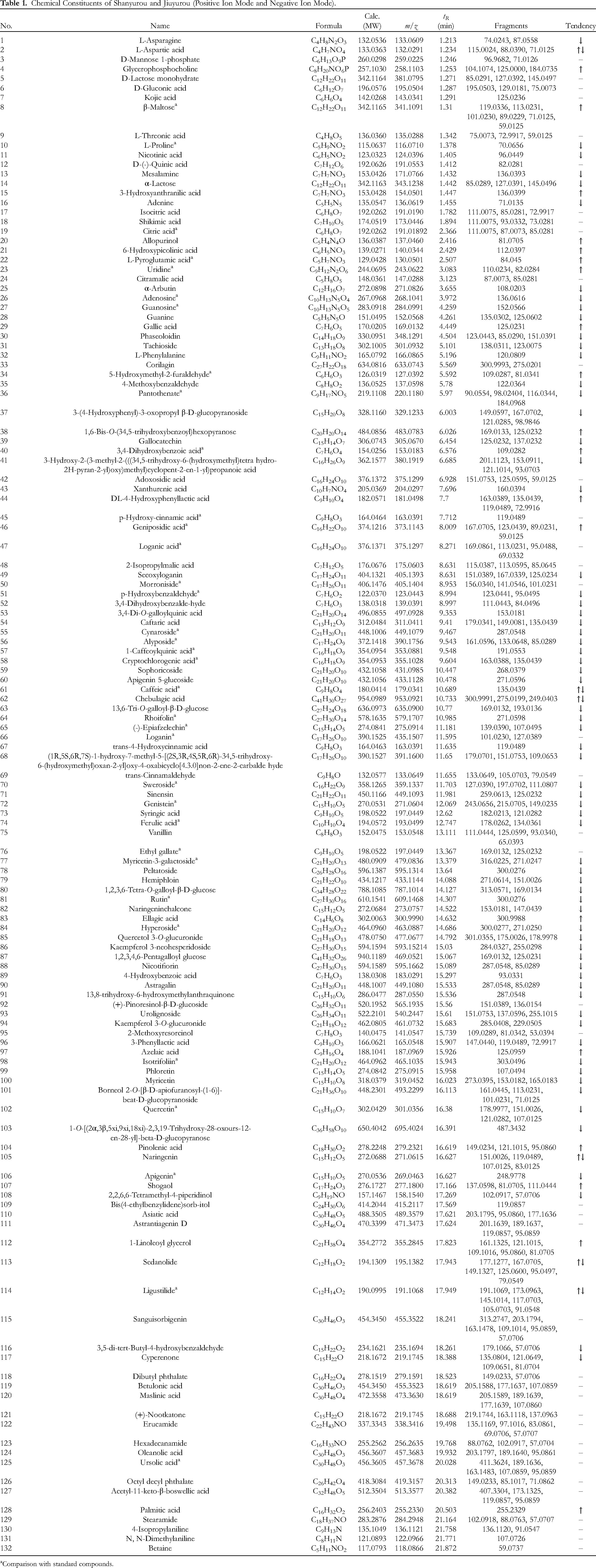
Comparison with standard compounds.
Effect of Immunocompromised Mouse Model Induction
The mice in the blank group had flexible movements, bright coat colors, and normal eating. On the other hand, mice in the other groups were slightly sluggish, their coats were slightly gray, dry, and messy, and their food intake was reduced. Compared with the blank group, the spleen index of mice in the CTX group was significantly decreased (P<.01). In contrast, the other groups tended to increase, but there were no significant differences (P > .05).
Compared with the blank group, the thymus index of mice in the CTX group significantly decreased (P<.01). In the other groups, the thymus index tended to increase, but there were no significant differences (P > .05, Figure 4).

Effects on spleen index and thymus index in immunocompromised mice (**P < .01 compared with blank group; #P < .05 compared with model group).
The serum IgG and IgM content of the mice in the CTX group was significantly decreased compared with the blank group (P < .01). When compared with the CTX group, the serum IgG and IgM levels in the ubenimex tablet group and wine-steamed (1, 4, and 12 h) Corni Fructus groups were significantly increased (P<.05 or P<.01). The serum IgG content of the Corni Fructus group had a tendency to increase, but no significant differences were identified (P > .05, Figure 5).
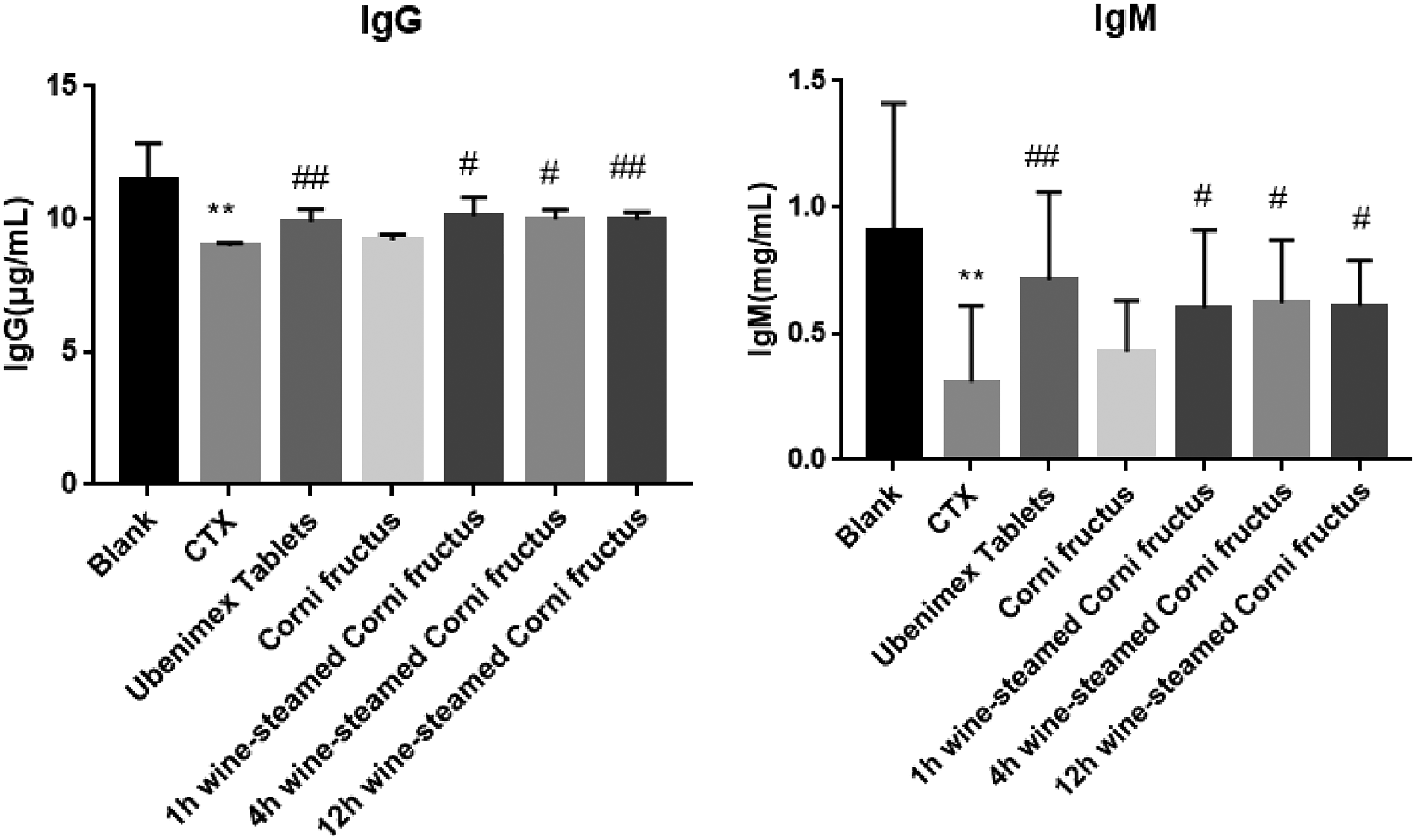
Effects on IgG and IgM in immunocompromised mice (**P < .01 compared with blank group; #P < .05, ##P < .01 compared with model group).
Effect on a Mouse Model of Drug-Induced Liver Injury
The APAP model group's serum ALT, AST, and MDA contents were significantly higher than the blank group (P < .01). Compared with the APAP model group, the serum ALT, AST, and MDA of the bicyclol group, Corni Fructus group, and wine-steamed (1, 4, and 12 h) Corni Fructus groups were significantly decreased (P<.05 or P<.01, Figure 6).

Effects on ALT, AST, and MDA in mice with liver injury (**P < .01 compared with the blank group; #P<.05, ##P<.01 compared with the model group).
Compared with the blank group, the SOD in the liver of the APAP model group was significantly decreased (P < .01). When compared with the APAP model group, the liver SOD in the bicyclol, Corni Fructus group, and wine-steamed (4 and 12 h) Corni Fructus groups were significantly increased (P < .05 or P < .01). The liver SOD in the 1 h wine-steamed Corni Fructus group appeared to be increased, but there was no statistical significance (P > .05).
Compared with the blank group, the liver GSH-Px content in the APAP model group was significantly decreased (P < .01). On the other hand, the GSH-Px contents of the liver of the wine-steamed (1, 4, and 12 h) Corni Fructus groups were significantly increased (P < .05 or P < .01) when compared with the APAP model group. The content of GSH-Px in the liver of the bicyclol and Corni Fructus groups appeared to increase, but no statistical significance was observed (P > .05, Figure 7).

Effects on SOD and GSH-PX in the liver of mice with liver injury (**P < .01 compared with the blank group; #P < .05, ##P < .01 compared with the model group).
Effect on Kidney Yin Deficiency Animal Model
Compared with the blank group, the cAMP of mice in the model group was significantly increased (P < .01). On the other hand, when compared with the model group, the cAMP content of mice in the Liuwei Dihuang Pills group, and wine-steamed (1, 4, and 12 h) Corni Fructus groups decreased significantly (P<.01). Similarly, the cGMP content of mice in the model group was significantly decreased (P > .05) when compared with the blank group. On the other hand, when compared with the model group, the cGMP content of the mice in the Liuwei Dihuang Pills group, Corni Fructus group, and wine-steamed (1, 4, and 12 h) Corni Fructus groups showed an increasing trend, but there was no statistical significance (P > .05, Figure 8).

Effects on cAMP and cGMP in mice with yin deficiency syndrome (*P < .05, **P < .01 compared with the blank group; ##P < .01 compared with the model group).
In terms of the effects on T3 and T4 in mice with yin deficiency syndrome, the T3 content of mice in the model group was significantly increased (P < .01) when compared with the blank group. Compared with the model group, the T3 content of the mice in the Liuwei Dihuang Pills group and the 12 h wine-steamed Corni Fructus group decreased significantly (P < .05 or P < .01). On the other hand, when compared with the blank group, the T4 content of mice in the model group was significantly increased (P < .01). Finally, the T4 content of the mice in the Liuwei Dihuang Pills group, Corni Fructus group, and wine-steamed (1, 4, and 12 h) Corni Fructus groups decreased significantly (P < .01) when compared with the model group. The results are presented in Figure 9.

Effects on T3 and T4 in mice with yin deficiency syndrome (*P<.05, **P < .01 compared with the blank group; ##P < .01 compared with the model group).
Discussion
When Corni Fructus is steamed with wine, high temperature causes tannin hydrolysis, increasing gallic acid content. Gallic acid can have anti-inflammatory and antioxidant properties and has protective effects on the liver.14,15 The Corni Fructus medicinal effect after processing is enhanced. 16 The iridoid glycosides have various pharmacological activities such as anti-tumor, anti-inflammatory, neuroprotection, among others. 17 The iridoid glycoside content can be reduced after corn liquor is steamed. Flavonoids have antibacterial and antioxidant effects.18,19 With the increase in processing time, some flavonoids gradually decreased and disappeared in Corni Fructus. In conclusion, a series of chemical composition changes during the processing process resulted in different pharmacodynamics of Corni Fructus and wine-steamed Corni Fructus. The Corni Fructus, after processing, can promote the body's immune function and enhance liver and kidney functions. From the UPLC-Q-TOF-MS results, combined with the pharmacodynamics results, we chose 4 h wine-steam Corni Fructus for the later study.
Immunoglobulin is an important compound with immune functions in blood and tissue fluid. IgG is the most functionally significant antibody, while IgM is the largest and earliest-antibody in the circulatory system, with roles in removing pathogenic bacteria, activating complement, and regulating immune functions. 20 In mice with low immunity caused by cyclophosphamide, processed Corni Fructus can enhance their immune function.
The liver protective effect of processed Corni Fructus was improved. APAP can induce the production of a large number of reactive oxygen species (ROS). It can lead to the consumption of SOD, GSH-Px, and other antioxidants, resulting in the imbalance of the antioxidant system in the human body, triggering the release of inflammatory cytokines in the intracellular inflammatory signaling pathway, and eventually leading to hepatocyte injury, and in severe cases, hepatocyte necrosis. ALT, AST, and MDA are commonly used to evaluate the degree of drug-induced liver injury. 21 When hepatocyte injury occurs, the MDA level increases, and ALT and AST in the cells will be released into the serum, resulting in increased activity of ALT and AST in the serum.
cAMP and cGMP, important substances involved in regulating metabolism and biological function in cells, antagonize and coordinate with each other to maintain vital cellular processes. 22 Research has shown that patients with renal yin deficiency present with increased plasma cAMP levels, decreased cGMP levels, and a significantly increased ratio of cAMP to cGMP. Thyroid hormone is an important substance regulating the body's energy metabolism. Hyperthyroidism can lead to an increase in serum T3 and T4 contents. Processed Corni Fructus enhances liver and kidney functions.
This study compared crude and wine-steamed Corni Fructus based on UPLC-Q-TOF-MS combined with pharmacodynamics. Our results provide a scientific basis for the subsequent use of wine-steamed Corni Fructus.
Footnotes
Acknowledgments
This work was supported by the Quality and Technical Service Platform for Traditional-Chinese-Medicine Whole Industry Chain (2022-230-221).
Data Availability
The datasets generated and analyzed during the current study are not publicly available due to the confidentiality of our project, but are available from the corresponding author on reasonable request.
Declaration of Conflicting Interests
The author(s) declared no potential conflicts of interest with respect to the research, authorship, and/or publication of this article.
Ethical Approval and Consent to Participate
The studies were approved by the Animal Ethics Committee of Guangdong Second Traditional Chinese Medicine Hospital.
Funding
The author(s) disclosed receipt of the following financial support for the research, authorship, and/or publication of this article: This work was supported by the Quality and technical service platform for traditional-Chinese-medicine whole industry chain (grant number 2022-230-221).

Statement of Informed Consent
There are no human subjects in this article and informed consent is not applicable.