



Abstract
Introduction
Oxidative stress occurs when there is an imbalance between the production of reactive oxygen species in the body and the ability of the body's antioxidant defense system to neutralize their harmful effects. 1 During oxidative stress, free radicals can cause cell and tissue injury by oxidizing lipids, nucleic acids, proteins, and carbohydrates. This process is recognized as a significant factor contributing to aging and disease. 2 Disorders of the human immune system can lead to various diseases, and there is a known connection between oxidative stress and immunity. Phagocytes produce reactive oxygen species and reactive nitrogen species to combat invading organisms, playing a crucial role in host defense. However, when these reactive substances are overproduced and beyond the scavenging capacity of the antioxidant defense system, they may cause oxidative damage. The immune system plays a key role in defending against foreign antigens and microbes. Oxidative damage can lead to a decline in immune system function, reducing the body's resistance to pathogens such as viruses and bacteria. 3
Reactive substances can affect the immune system, and antioxidants can delay the harm caused by oxidative stress. Some natural products have been found to have strong antioxidant capacity, which can enhance the antioxidant defense system and immune activity of organisms. 4 Many plants have been proven to have antibacterial, antioxidant, and immune-enhancing activity. 5 Basil (Ocimum Basicum), belonging to the Lamiaceae family, is a medicinal and edible herbaceous plant. Basil has also been evaluated to have various health benefits, including antioxidant, improving immunity, anti-inflammatory, anti-allergic, antiviral, and sedative effects. 6 As a commercial condiment, it has special flavor characteristics and is widely used in cooking. 1 The widespread application of basil is mainly due to the presence of various secondary metabolites, such as phenolic and aromatic compounds. 7
Previous studies have employed various techniques to extract compounds from different parts of basil. Basil seed gum, for instance, can be extracted using methods such as water extraction followed by alcohol precipitation, microwave-assisted extraction, or ultrasound-assisted extraction. 8 Basil essential oil can be extracted by steam or hydro distillation, supercritical extraction, organic solvent extraction, and Soxhlet extraction. 9 These extraction methods exhibit various effects on the effectiveness, cost, and chemical composition of extracted compounds.10,11 The differences in the chemical composition of extracts lead to discrepancies in their biological activities. The fractions obtained from sweet basil essential oil exhibit different antioxidant activities. 1 The antioxidant activity of basil seed extract extracted with 2-methyl tetrahydrofuran, considered as a green solvent, is higher than that of extract extracted with hexane, and their anti-inflammatory activities were similar. 12 Therefore, it is important to identify the bioactive substances responsible for each biological activity for studying abundantly the biological activity of basil. However, basil extracts have not been fully explored. Research has shown that ethanol and water extracts from basil can effectively enhance the growth and immune response of Oreochromis niloticus,13,14 while the active substances strengthening immunity response in basil have not been extensively explored. Systematic research on the biological activity of different basil extracts and clarification of active substances that exert biological activity is of great significance for fully utilizing basil and developing related basil products.
In this study, the secondary metabolites from basil were extracted and the crude extract (CE) was divided into four fractions using different organic solvents according to the polarity of the compounds. The substances in CE and its fractions were identified using mass spectra. In vitro antioxidant activity and in vivo immune-enhancing activity of basil fractionated extracts were analyzed to search for the compounds corresponding to the polar part with the strongest antioxidant activity and immune-enhancing activity. This study explored the antioxidant and immunity-enhancing activities of basil extract, which contributed to the development of basil products with antioxidant and immunomodulatory activities.
Materials and Methods
Materials
Dry basil was bought from the medicinal herbs market in Bozhou, Anhui, China. 1,1-Diphenyl-2-picrylhydrazyl (DPPH) and 2, 2'-azino-bis (3-ethylbenzothiazoline-6-sulfonic acid) (ABTS) were purchased from Sigma-Aldrich (St. Louis, MO, USA). Cyclophosphamide (CTX) was provided by Macklin Biochemical Technology Ltd (Shanghai, China). Lentinan was supplied by Luye Pharma Group (Yantai, Shandong, China). Pepsin and trypsin were obtained from Novozymes (Tianjin, China). Hank's solution, RPMI-1640, and concanavalin A (ConA) were provided by Biyuntian Biotech Co., Ltd (Shanghai, China). All kits used in this study were purchased from Nanjing Jiancheng Bioengineering Institute (Nanjing, Jiangsu, China), including 3-(4,5-dimethylthiazol-2-yl)-2,5-diphenyltetrazolium bromide (MTT), lactic dehydrogenase (LDH), immunoglobulin G (IgG), immunoglobulin A (IgA), and immunoglobulin M (IgM), tumor necrosis factor (TNF-α), interleukin 2 (IL-2), interferon-γ (IFN-γ), interleukin 4 (IL-4), and interleukin 10 (IL-10) kits. Eighty male ICR mice (6 weeks old, 18-22 g) were supplied by Sibeifu Biotechnology Co., Ltd. (Suzhou, Jiangsu, China) (Animal license number: SCXK(Su)2022-0006).
Fractional Extraction of Basil
The dry basil was crushed and filtered by 80 mesh. The basil powder (70 g) and 70% ethanol solution were mixed in the solid-liquid ratio of 1:15 (g/mL). The basil was extracted by ultrasound (120 W, 40 kHz) at 80 °C for 1 h. The supernatant was collected through vacuum suction filtration, and the residue was extracted again under the above conditions. The supernatant obtained from two rounds of filtration was combined. After concentrating the combined supernatant under the condition of reduced pressure, the CE of basil was obtained by drying the concentration to a constant weight.
The CE (10 g) was dissolved in water (100 mL) to form a suspension. Petroleum ether, ethyl acetate, and n-butanol were orderly used to extract suspension in equal proportion. The extraction solutions with different polar compounds and the remaining water solution were treated with rotary evaporation and dried to obtain petroleum ether extract (PE), ethyl acetate extract (EE), n-butanol extract (BE), and water extract (WE).
Determination of Total Phenolic (TP) and Total Flavonoid (TF) Content in Different Extracts
The Folin-Ciocalteu method was used to determine the TP content according to the study of Prado et al, 15 and the results were expressed in gallic acid equivalent (GAE).
The determination of TF content in different extracts was referred to the method of Chu et al, 16 and the results were represented in rutin equivalent (RE).
Identification of the Main Components of Fractionated Extracts
Different basil extracts (5 mg) were dissolved in 10 mL methanol. After filtering, the main compounds of extracts were identified using ACQUITY UPLC I-Class plus + Synapt XS (Waters, Milford, MA, USA) equipped with an ACQUITY UPLC® BEH C18 Column (1.7 μm, 2.1 × 100 mm). The chromatographic conditions were shown as follows: Mobile phase, acetonitrile (A) and 125 mM formic acid (B); Procedure of elution gradient, 0.00∼0.50 min: 98% B, 0.50∼10.00 min: 80% B, 10.00∼18.00 min: 0% B, 18.00∼21.00 min: 0% B, 21.00∼21.50 min: 98% B; Flow rate, 0.3 mL/min; Temperature of column, 40 °C; Injection volume, 1 μL. Mass spectrometry conditions were shown as follows: mass range: 20–1200 m/z; gas flow rate, 6.5 Bar; collision gas flow rate; 2 mL/min; capillary voltage, 2.5 kV; desolvation gas flow, 800 L/h; desolvation temperature, 400 °C; source block temperature, 100 °C.
Evaluation of in Vitro Antioxidant Capacity of Fractionated Extracts
DPPH Radical Scavenging Ability
The DPPH radical scavenging ability was determined using previously reported methods. 17
ABTS Radical Scavenging Ability
The ABTS radical scavenging abilities of different extracts were also determined using previously reported methods. 17
Evaluation of Fractionated Extracts Enhancing in Vivo Immunological Activity
Experimental Design
Eighty mice (6 weeks old, 18-22 g) were divided into 8 groups on average, including intervention groups (positive control (PC) group, CE group, PE group, EE group, BE group, and WE group), blank control (BC) group, and model (Model) group. The mice can eat and drink ad libitum, and the standard food was provided by Jiangsu Collaborative Medical Biotechnology Co., Ltd and mainly composed of crude protein, fat, carbohydrates, fiber, vitamins, and minerals. The immunosuppressed mice model in the intervention groups and the model group was established by intraperitoneal injection with CTX (100 mg/kg) for three consecutive days. The BC group was injected with physiological saline. From the fourth day, the mice in the intervention groups were intragastrically administered 100 μL, 250 mg/(kg·d) of fractionated extracts of basil, the mice in the PC group were intragastrically administered 100 μL, 250 mg/(kg·d) of lentinan, and the BC and model groups were intragastrically administered 100 μL of physiological saline once daily for 14 days. After the last gavage, fasting for 24 h, the blood of the mice was drawn from eyeball blood, and then the mouse was killed using cervical dislocation. The Institutional Animal Care and Use Committee of Jiangnan University approved all animal experiments (ethics certificate no. JN.No20240229S0240430[053]).
Effect of Fractionated Extracts on the Immune Organ index of Mice
The thymus and spleen were quickly removed, cleaned, and weighed. The thymus and spleen indexes were evaluated by the following equation:

Transformation and proliferation of splenic lymphocytes
After killing the mouse in the sterile environment, the spleen was removed and washed in Hank's solution. Next, the spleen was cut into small pieces and grinded into homogenate. The homogenate was diluted with Hank's solution and washed in a 75 μm cell sieve. The filtrate-containing cells were collected. The filtrate was repeatedly centrifuged for 3 times and the cells were resuspended with 1 mL of RPMI-1640 nutrient solution. Then, the spleen cells were seeded in 96 well plates at the density of 1 × 10⁵ cells/mL. After incubation in the incubator for 4 h, the cells were cultured in a nutrient solution containing ConA for 8 h. MTT kit was used to detect the cell proliferation of splenic lymphocytes in each group after ConA treatment. The RPMI-1640 culture medium without spleen cells was used as a BC. The proliferation rate of splenic lymphocytes is calculated using the following equation:

Effect of Fractionated Extracts on the Activity of Natural Killer (NK) Cells
The activity of NK cells was evaluated by detecting LDH released by NK cells of mice. The splenic lymphocytes of the mouse were prepared using the preparation method of mouse splenic lymphocytes. Target cell YAC-1 and splenic lymphocytes were cultured at an appropriate density. In experimental groups, YAC-1 cells and splenic lymphocytes were cocultured at a cell ratio of 1:50. In natural release groups, the target cells were incubated in a complete culture medium, and in the maximum release groups, the target cells were incubated in a complete culture medium containing LDH release agent. After culturing for 4 h, the cells were centrifuged for 10 min, and the supernatant was taken. The release of LDH was detected according to the LDH assay kit method. The OD values of the supernatants in each group were detected at 490 nm using a microplate reader. The activity of NK cells can be calculated using the following equation:

Effect of Fractionated Extracts on Immunoglobulin and Cytokine in Mouse serum
Clean centrifuge tubes were used to contain the eyeball blood of the mouse, and centrifuged for 15 min at 3000 r/min to obtain the serum. The serum was stored at −20 °C. The contents of IgG, IgA, and IgM, cytokine Th1 including TNF-α, iIL-2, and IFN-γ, and cytokine Th2 IL-4 and IL-10 in serum were determined using the kit methods.
Statistical Analysis
All results in this study were analyzed using IBM SPSS Statistics 21.0 (SPSS Inc., Chicago, IL, USA) and Microsoft Excel, and shown as the mean ± standard deviation (SD). The differences of P < 0.05 were considered significant.
Results
Contents of TP and TF and Antioxidant Activities of Different Basil Extract Extracts
Bioactive substances with similar physicochemical properties are more likely to dissolve in solvents of comparable polarity. 18 Therefore, employing solvents of varying polarities can effectively extract and separate compounds with diverse polarities and physicochemical characteristics. Basil contains various bioactive substances. Four solvents with different polarities and physicochemical properties were used to extract the substances in the CE of basil. The contents of TP and TF in CE, PE, EE, BE, and WE were determined and the results are shown in Table 1. The contents of TP and TF in extracts from different solvents vary significantly. The contents of TP and TF in the BE are the highest reaching 313.14 ± 4.45 mg GAE/g and 192.01 ± 2.48 mg rutin/g, followed by EE. Both have higher contents of TP and TF than CE, WE, and PE. The lower TP and TF contents in CE compared to BE and EE can be attributed to the presence of numerous other compounds in CE. Ethyl acetate and n-butanol can enrich the flavonoids and polyphenols, causing the increase of the TP and TF contents in BE and EE. The TP and TF contents in PE are much smaller than those in other extracts. This is because the hydroxyl structure in flavonoids and polyphenols makes most of them unfavorable for hydrophobicity, while petroleum ether is a non-polar solvent. Therefore, PE contains minimal TP and TF contents.
Total Flavonoid (TF) Content, Total Phenolic (TP) Content, and Antioxidant Activity of Different Extracts.
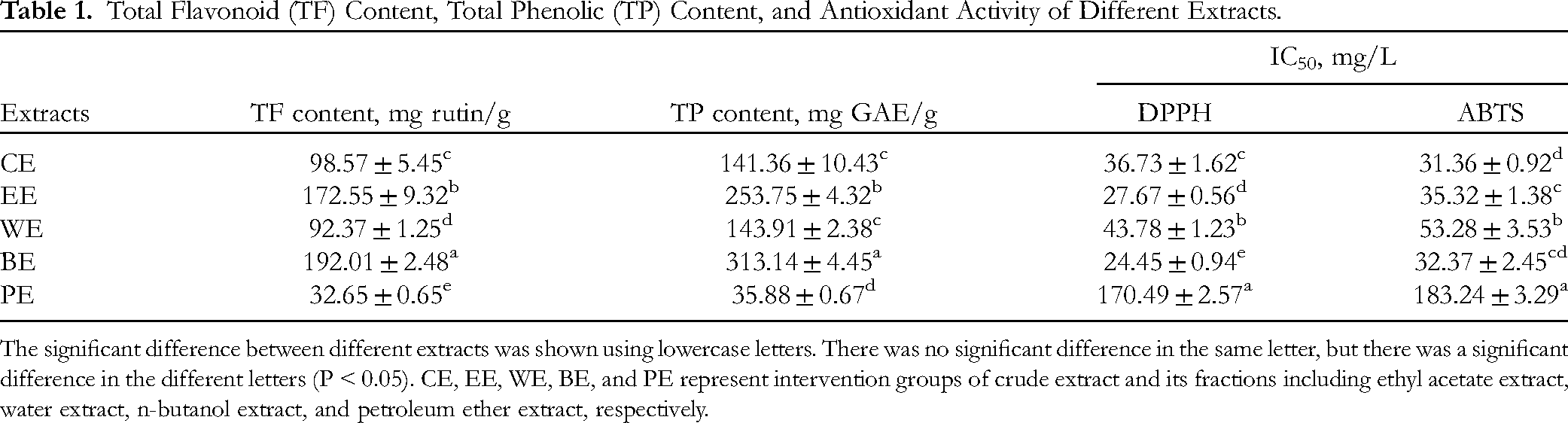
The significant difference between different extracts was shown using lowercase letters. There was no significant difference in the same letter, but there was a significant difference in the different letters (P < 0.05). CE, EE, WE, BE, and PE represent intervention groups of crude extract and its fractions including ethyl acetate extract, water extract, n-butanol extract, and petroleum ether extract, respectively.
The antioxidant activities of these five extracts of basil were analyzed using DPPH and ABTS radical scavenging experiments. According to the IC50 values (Table 1), the DPPH radical scavenging abilities of extracts in basil followed the order: BE (24.45 ± 0.94 mg/L) > EE (27.67 ± 0.56 mg/L) > CE (36.73 ± 1.62 mg/L) > WE (43.78 ± 1.23 mg/L) > PE (170.49 ± 2.57 mg/L). It can be observed that the order in the DPPH radical scavenging ability of fractionated extracts is almost consistent with the contents of TP and TF in the extracts because the DPPH free radical scavenging activity is related to the content of antioxidants in extracts. 19 However, the results of the ABTS free radical scavenging test showed that there is no good linear relationship between the contents of TP and TF in basil extracts and the ABTS free radical scavenging ability.20,21 The TP contents in BE and EE are about 1.8 and 2.2 times that of CE, respectively, and the TF contents in BE and EE are about 1.9 and 1.8 times that of CE, respectively. However, according to the IC50 values, the ABTS radical scavenging activity of CE is greater than that of BE and EE, which is related to the type and properties of free radicals and compounds in the extract.
Identification of Compounds in Fractionated Extracts of Basil
The compounds in CE, EE, WE, BE, and PE were identified using high-performance liquid chromatography-tandem mass spectrometry (LC-MS/MS). Thirteen compounds were identified and shown in Table 2. Among these compounds, The CE and its fractions contain maltol and arbutin. From Table 2, it can be found that BE and EE contain more polyphenols and flavonoids than CE, WE, and PE, including quercetin-3′,4′,7-trimethyl ether, arbutin, caffeic acid, and so on. This result is consistent with the content of TP and TF and indicates that ethyl acetate with medium polarity and n-butanol with larger polarity can enrich more polyphenols and flavonoids in the CE. The types of compounds identified in WE and PE are few. Except for maltol and arbutin, two glycoside compounds and one phenolic acid compound were identified in WE. However, only linoleic acid was found in PE, which may be because the hydrophobicity of linoleic acid makes it more soluble in non-polar petroleum ether. The differences in the types of substances in each basil extract are attributed to the differences in the solubility of compounds in solvents with different polarities. 22
Compounds Identified in Different Extracts from Basil.

“+” and “-” represent the presence or absence of the compound in different extracts. CE, EE, WE, BE, and PE represent intervention groups of crude extract and its fractions including ethyl acetate extract, water extract, n-butanol extract, and petroleum ether extract, respectively.
Effects of Fractionated Extracts on Immune Organ index in Mice
The spleen and thymus are important immune organs in the body, have abundant lymphocytes and macrophages, and participate in the immune response. 24 The changes in the index of immune organs such as the spleen and thymus directly reflected the changes in the immune function of an organism. The mouse immune organ index is shown in Figure 1. The spleen and thymus indexes in the Model group were significantly lower than those in the BC group due to the atrophy induced by CTX, 25 which also confirms the successful establishment of the immunosuppressive mouse model. The spleen and thymus index of intervention groups were lower than that of the BC group, but significantly higher than that of the Model group (P < 0.05). Compared with the Model group, the thymus index of CE, EE, WE, and BE groups increased by 19.30%, 21.93%, 10.53%, and 30.70%, respectively (Figure 1A), and the spleen index increased by 43.71%, 34.73%, 32.93%, and 46.11%, respectively (Figure 1B). However, there was no significant difference between the PE and Model group (P > 0.05). These results suggested that CE, EE, WE, and BE can all enhance the immunity of immunosuppressive mice.

Effect of different extracts on the immune organ index of the mouse. (A) Thymus index of mice in different treatment groups; (B) Spleen index of mice in different treatment groups. BC is the blank control group. Model represents the model group. CE, EE, WE, BE, and PE represent intervention groups of crude extract and its fractions including ethyl acetate extract, water extract, n-butanol extract, and petroleum ether extract, respectively. A significant difference between the intervention groups and the blank control group was shown using lowercase letters. A significant difference between the intervention groups and the model group was shown using capital letters. There was no significant difference in the same letter, but there was a significant difference in the different letters (P < 0.05).
Effects of Basil Fractionated Extracts on Splenic Lymphocytes
The spleen, being the largest peripheral lymphoid organ in humans and mammals, is densely populated with lymphocytes and serves as a primary site for specific immunity in the body. 26 The effects of basil extracts extracted with different solvents on the proliferation of splenic lymphocytes in immunosuppressed mice are shown in Figure 2(A). The proliferation of lymphocytes in the Model group mice was significantly reduced, only to 43.54 ± 6.13% (P < 0.05). Because the immunosuppressive effect of CTX can damage the spleen of the mouse and reduce the vitality of lymphocytes. Compared with the Model group, the proliferation rate of splenic lymphocytes in immunosuppressed mice in CE, EE, WE, BE, and PE groups was promoted. However, the proliferation rate of splenic lymphocytes can significantly increase only in the BE and EE groups (P < 0.05) and is still lower than that of the PC group. The increase in the proliferation rate of splenic lymphocytes in CE, WE, and PE groups was not significant (P > 0.05).

Effect of different extracts on the proliferation rate of splenic leukomonocyte and activity of nk cells. (A) The proliferation rate of splenic leukomonocyte of the mice in different treatment groups; (B) NK cell activity of mice in different treatment groups. BC is the blank control group. Model represents the model group. CE, EE, WE, BE, and PE represent intervention groups of crude extract and its fractions including ethyl acetate extract, water extract, n-butanol extract, and petroleum ether extract, respectively. A significant difference between the intervention groups and the blank control group was shown using lowercase letters. A significant difference between the intervention groups and the model group was shown using capital letters. There was no significant difference in the same letter, but there was a significant difference in the different letters (P < 0.05).
Effects of Basil Fractionated Extracts on NK Cells
The effects of basil fractionated extracts on NK cell activity are shown in Figure 2(B). The activity of NK cells in the BC group was 63.09 ± 3.50%, and the activity of NK cells in the Model group was obviously inhibited to 42.41 ± 2.72%. Except for the PE group, the activity of NK cells in the other basil extract intervention groups was significantly improved compared to the Model group. Both BE and EE exhibit the most significant impact on NK cell activity, with no significant difference observed between their effects (P > 0.05).
Effects of Basil Fractionated Extracts on Immunoglobulins in serum
The effects of different basil extracts on immunoglobulins (IgG, IgA, and IgM) in serum are shown in Figures 3A, B, and C, respectively. Compared to the BC group, the concentrations of IgG, IgA, and IgM in the Model group were significantly reduced due to the action of CTX. Under the intervention of CE, EE, WE, BE, and PE, the concentrations of IgG, IgA, and IgM in the serum of immunosuppressed mice increased. The concentrations of IgG, IgA, and IgM in CE, EE, WE, and BE groups are significantly higher than that of the Model group (P < 0.05), which suggests that CE, EE, WE, and BE can significantly reduce the decrease in the immunoglobulin levels and improve the humoral immune function of immunosuppressed mice.

Effect of different extracts on immunoglobulins in serum. (A) Content of IgG in mice serum in different treatment groups; (B) Content of IgA in mice serum in different treatment groups; (C) Content of IgM in mice serum in different treatment groups. BC is the blank control group. Model represents the model group. CE, EE, WE, BE, and PE represent intervention groups of crude extract and its fractions including ethyl acetate extract, water extract, n-butanol extract, and petroleum ether extract, respectively. A significant difference between the intervention groups and the blank control group was shown using lowercase letters. A significant difference between the intervention groups and the model group was shown using capital letters. There was no significant difference in the same letter, but there was a significant difference in the different letters (P < 0.05).
Effect of Basil Fractionated Extracts on Cytokines in serum
The effects of basil extracts on cytokine contents in the serum of immunosuppressive mice are shown in Figure 4. The contents of TNF-α (Figure 4A), IL-2 (Figure 4B), IFN-γ (Figure 4C), IL-4 (Figure 4D), and IL-10 (Figure 4E) in the Model group were significantly lower than that in the BC group. Compared with the Model group, basil extracts can significantly increase the concentration of cytokines in serum. Among them, the concentrations of TNF-α, IL-2, IFN-γ, IL-4, and IL-10 in BE and EE groups have the largest increase and the best immune-enhancing effects. In addition, the impacts of BE and EE on TNF-α and IL-4 show no significant difference (P < 0.05). The concentration of IL-4 in the BE and EE groups was similar to that in the PC group.

Effect of different extracts on cytokines in serum. (A) Content of TNF-α in mice serum in different treatment groups; (B) Content of IL-2 in mice serum in different treatment groups; (C) Content of IFN-γ in mice serum in different treatment groups; (D) Content of IL-4 in mice serum in different treatment groups; (E) Content of IL-10 in mice serum in different treatment groups. BC is the blank control group. Model represents the model group. CE, EE, WE, BE, and PE represent intervention groups of crude extract and its fractions including ethyl acetate extract, water extract, n-butanol extract, and petroleum ether extract, respectively. A significant difference between the intervention groups and the blank control group was shown using lowercase letters. A significant difference between the intervention groups and model group was shown using capital letters. There was no significant difference in the same letter, but there was a significant difference in the different letters (P < 0.05).
Discussion
There are significant differences in the content of TP and TF in CE, EE, WE, BE, and PE, mainly because the solubility of polyphenols and flavonoids in solvents with different polarities have great discrepancies. Variations in the content and types of polyphenols and flavonoids contribute to the diverse DPPH and ABTS free radical scavenging activities observed in basil extracts. It is reported that the effectiveness of antioxidants mainly depends on their structure, hydrophobicity, and cellular absorption. 27 The benzothiazole structure of ABTS free radicals is amphiphilic, while the aromatic ring structure of DPPH free radicals is hydrophobic. 28 The polarities of n-butanol and ethyl acetate are lower than that of 70% ethanol. Therefore, the polyphenols and flavonoids in BE and EE are more hydrophobic than those in CE, which is not conducive to scavenging ABTS free radicals, and higher TP and TF contents are also more conducive to scavenging DPPH free radicals. 28 Besides, CE contains many non-phenolic substances which may also exhibit better ABTS free radicals scavenging ability. The lowest DPPH and ABTS radical scavenging ability of PE can be attributed to the lowest TP and TF contents, as well as the stronger hydrophobicity of its compounds.
CTX can damage the gastrointestinal mucosal and result in immunodeficiency. Immunomodulator contributes to reducing the side effects of CTX. 29 The immunosuppressive mouse model induced by CTX has been widely used to evaluate the immunomodulatory effects of substances. Lentinan which has been widely used as an immune-enhanced drug in clinical treatment of tumors was used as a PC. 30 The results of the immunosuppressive mouse model showed that CE, EE, WE, and BE can enhance the immunity of immunosuppressive mice, except PE. Among these extracts, BE exhibits the best effect, which can be owning to the highest contents of TP and TF contents. BE can significantly increase the thymus and spleen indices. Caffeic acid, identified only in BE, has been proven to promote the proliferation of splenic cells and increase the immune organ index. The immunomodulatory effect of caffeic acid may be attributed to its cytoprotection through antioxidant capacity to some extent. 31 In the proliferation experiment of splenic lymphocytes, BE has the greatest effect on the proliferation rate of splenic lymphocytes, followed by EE. It is easy to conclude that the effect of basil extract on the proliferation of splenic lymphocytes in immunosuppressed mice is positively correlated with the TP and TF contents.
NK cells play an important role in innate immunity and have a broader reactivity towards tumors. It is reported that NK cells play a key role in eliminating tumors at an earlier stage and inhibiting neoplasm metastasis. 32 NK cells can produce many cytokines and affect both innate and adaptive immune responses. The NK cells activity in the BE group is the greatest and shows no significant difference compared to the EE group, while the contents of TP and TF in the BE are significantly higher than those in the EE. In the previous report, quercetin has been proven to regulate immune responses, stimulate the phagocytosis of phagocytes, and promote the activity of NK cells. 33 Although quercetin was not detected in basil extract, quercetin-3′,4′,7-trimethyl ether with the same skeletal structure as quercetin was determined in EE, which may also favor the activity of NK cells. These results indicate that CE, EE, WE, and BE can significantly repair the activity of NK cells damaged by CTX, and strengthen the innate immunity by activating NK cells, thereby enhancing the ability to antitumor and antiviral infection.
Immunoglobulin, as an immune-active molecule, is a biomarker of humoral immunity, including IgG, IgA, and IgM. 34 The heavy chain structure of different immunoglobulins varies and plays distinct roles in humoral immunity. IgG, the most abundant and longest half-life immunoglobulin in serum, is closely related to the phagocytosis of monocytes and can improve the activity of immune cells. IgA plays an important role in preventing bacterial or viral infection and can protect the mucosa from damage by directly neutralizing or preventing the binding between bacteria, viruses, or toxins with the mucosal surface. 35 The high affinity of IgM enables it to bind with various low-level and non-protein antigens effectively, and IgM is the first line of defense against invading microorganisms and abnormal human cells. 36 The changes in concentration of IgG, IgA, and IgM are closely connected to the immune function of the body. The BE and EE with high TP and TF contents showed the best improvement effect on immunoglobulin. The phenomenon that the concentrations of IgG and IgA in the BE group were higher than that in the EE group, while the concentration of IgM in the EE group was higher than that in the BE group may be caused by the different types of polyphenols and flavonoids in the BE and EE.
Cytokines are important immune mediators in immune activity and are secreted by lymphocytes, macrophages, and NK cells in the immune system. The contents of cytokines in serum were measured to reflect the humoral and cellular immune status of the body. IL-2 can promote the differentiation and proliferation of T lymphocytes. TNF-α is one of the main cytokines secreted by macrophages and can induce necrosis of some tumors. 37 IFN-γ also has antitumor effects and is the uppermost cytokine related to antitumor immunity. 38 IL-2 and IFN-γ can also directly activate NK cells, thereby eliminating tumor cells in the body. IL-10 can induce the growth, differentiation, and secretion of IgG in B cells. 37 Therefore, cytokines in serum, including TNF-α, IL-2, and IFN-γ secreted by Th1 cell subpopulation and IL-4 and IL-10 secreted by Th2 cell subpopulation, were determined. Among these basil extracts, BE and EE are more conducive to increasing the concentrations of TNF-α, IL-2, IFN-γ, IL-4, and IL-10 and exhibit better immune-enhanced effects. However, the concentration of IL-4 in BE and EE groups was similar to that in the PC group, indicating that the substances in PE can effectively increase the expression of IL-4, and the expression level of IL-4 is not positively correlated with the content of TP and TF. The effects of BE on the other three cytokines are significantly higher than that of EE, which may lead to higher TP and TF content in BE. The increase in expression of TNF-α, IL-2, IFN-γ, IL-4, and IL-10 indicates that basil extracts can enhance the repair capacity of damaged immune cells and play a good immune-enhanced activity.
Conclusion
Basil contains abundant secondary metabolites and has various biological activities. The CE of basil was further extracted using different polar solvents to obtain the CE and its fractions including EE, WE, BE, and PE. The TP and TF contents in these five extracts are different. The lower contents of TP and TF in CE than those in BE and EE indicate the presence of other non-phenolic substances in CE, and solvents with different polarities can further purify and separate polyphenols and flavonoids in CE. The MS results showed that the polyphenols and flavonoids identified in CE were less than those in BE and EE, but both compounds, maltol, and arbutin, were found in all five extracts. BE and EE with higher TP and TF contents exhibit strong antioxidant activity and immune-enhanced effects in immunosuppressive mice, followed by CE and WE. The content of TP and TF in PE is the lowest, and its antioxidant and immune-enhanced effects on immunosuppressive mice are also the worst.
The diverse array of substances found in basil extracts contributes to their varied effects in antioxidant and immune-enhancement assays. The phenolic content particularly plays a crucial role in these activities. Further extraction of basil CE allows for the identification of key active substances. Further extraction of basil CE helps to identify the main substances exerting active effects in basil, n-butanol, and ethyl acetate can further enrich bioactive substances in basil, making it have better antioxidant and immune-enhancing activities. BE and EE can be developed as deep-processing products of basil with antioxidant and immune-enhancing activities used in food and cosmetics. However, the specific forms and optimal applications of BE and EE products require further investigation. Additionally, the main substances and mechanisms of BE and EE exerting immune-enhancing activity need to be further explored.
Footnotes
Acknowledgments
We thank all the people who have given us guidance.
CRediT Author Statement
Data Availability Statement
The data presented in this study are available on request from the corresponding author. The data are not publicly available due to being used in other future works.
Declaration of Conflicting Interests
The authors declared no potential conflicts of interest with respect to the research, authorship, and/or publication of this article.
Ethical Approval
This study was approved by the Institutional Animal Care and Use Committee of Jiangnan University (ethics certificate no. JN.No20240229S0240430[053]).
Funding
The authors disclosed receipt of the following financial support for the research, authorship, and/or publication of this article: This work was supported by the University Natural Science research project of Anhui province (grant numbers KJ2020A0775, KJ2019A1301, KJ2019A1304).
Human and Animal Rights
All procedures in this study were conducted in accordance with the protocols approved by the Institutional Animal Care and Use Committee of Jiangnan University (ethics certificate no. JN.No20240229S0240430[053]).
Informed Consent
This article does not involve any studies with human subjects
