



Abstract
Background
Scopoletin (Sco) is a botanical acaricidal compound isolated and purified from Artemisia annua. Self-assembled nanostructured materials with tailored properties could aid efficient acaricide delivery.
Methods
The botanical natural product Sco was coated on the surface of cellulose nanocrystals (CNCs) and polydopamine (PDA) to enhance its acaricidal bioactivity. Sco@PDA-CNCs, a new biological base acaricidal agent, were prepared through hydrogen bonding and van der Waals forces.
Result
Sco@PDA-CNCs exhibited a stronger acaricidal effect than pure Sco. At 48 h after treatment, the median lethal concentration of Sco@PDA-CNCs against carmine spider mites was 24.36 mg/L and that of pure Sco was 92.21 mg/L. The toxicity value of Sco@PDA-CNCs had increased by 3.8-fold relative to that of pure Sco. Sco@PDA-CNCs exhibited sustained release characteristics and continued to release Sco even at 7 days after application.
Conclusion
Results revealed that Sco@PDA-CNCs not only have good slow-release properties, but they can also improve acaricidal efficiency well.
Introduction
Phytophagous mites damage crops either through direct feeding or by transmitting plant pathogens, including viruses. They are difficult to control effectively by using standard pest management strategies because of their short life cycle and rapid propagation. Therefore, the development of new effective chemical agents for preventing and controlling phytophagous mites is highly desirable. Rod-like nanoparticles exhibit powerful shape-dependent mutual effects with cell membranes and can be used in targeted intracellular drug delivery. 1 In recent years, cellulose nanocrystals (CNCs) have attracted scientific attention in the fabrication of hybrid smart materials due to their natural abundance, biodegradability, and biocompatibility.2-5 CNCs, a common type of biomass-based rod-like nanoparticles, have beneficial properties because they have higher biocompatibility and biodegradability and lower toxicity than inorganic nanoparticles. CNCs with a length of 100 to 2000 nm and diameter of 20 to 40 nm usually show a high aspect ratio.6,7 Pesticides can be applied at nanodosages to improve pest control effects. The mutual effect of rod-like nanoparticles and the cell membrane is closely related to the particles’ aspect ratio. Specifically, when rod-like nanoparticles interact with the cell membrane, their high aspect ratio can cause changes in the cell membrane structure. These changes can lead to altered cell signaling pathways and cellular responses. CNCs could display great penetration capacity and may thus potentially serve as ideal biological carriers. 8
The carmine spider mite (CSM), Tetranychus cinnabarinus (Bois.), is an important phytophagous mite that attacks more than 110 agricultural crops or plants, such as fruits, cotton, beans, peppers, tomatoes, and cucurbits.9-11 However, due to its short life cycle, high reproductive capacity, and strong adaptability, CSM could develop high resistance to chemical acaricides rapidly. 12 Therefore, mite population control represents a great challenge. 13
Scopoletin (7-hydroxy-6-methoxychromen-2-one, abbreviated as Sco), an important coumarin phytoalexin, has been found in numerous herbaceous plants, including Nicotiana tabacum, 9 Morinda citrifolia,14,15 Argyreia speciosa, 16 and Arabidopsis thaliana. 17 It exhibits various pharmacological bioactivities, such as anticholinesterasic, 18 anti-inflammatory, and antitumorigenesis effects. 19 In agricultural applications, Sco presents insecticidal activity, antibacterial sterilization action, nematicidal bioactivity, and allelopathy.20,21 In our previous study, we found that Sco extracted from Artemisia annua exhibits strong acaricidal activity against CSM. 11 However, Sco is difficult to use commercially because it has poor water solubility and is strongly susceptible to photolysis. Given these shortcomings, finding a new way for the utilization of Sco is an urgent issue.
Dopamine is a neurotransmitter, which is a chemical substance that transmits signals among neurons. Polydopamine (PDA) is a synthetic material. Its synthesis is inspired by the natural polymerization of dopamine. The adhesive proteins of mussels, which contain high concentrations of catechol and amine functional groups, generate a range of PDA-coated planar substrates and can change a hydrophobic surface into a hydrophilic one. 22 Previous studies demonstrated that the wall thickness of PDA can be readily controlled through repeated deposition cycles, through which we successfully prepared a PDA-coated controlled-release fertilizer. 23 PDA has unique properties that make it attractive for various applications, including biomedical engineering, surface modification, and nanotechnology.24,25 Moreover, dopamine can polymerize in an aqueous solution without any organic solvents. 26 Furthermore, PDA exists in the form of a black precipitate that can absorb ultraviolet light. 27 Thus, a PDA layer can be reasonably predicted to absorb or block ultraviolet light to prevent pesticide photodegradation. To our knowledge, the use of PDA with well-defined surface properties as a photoprotective agent for Sco has not been investigated yet. PDA has great potential in pesticide applications. In the present study, we prepared a PDA-coated pesticide with controlled-release and ultraviolet-shielding properties.
Results
Preparation of Sco@PDA-CNC Micelles
Sco@PDA-CNCs were connected mainly via hydrogen bonds, these hydrogen bonds play a crucial role in anchoring the Sco molecules onto the surface of CNCs, leading to the formation of a stable complex. The negative charge of Sco was conducive to bonding with PDA and improving loading efficiency. CNCs could be used as a supporting material to form a coating layer on the surface of CNCs, and the microspheres formed by Sco@PDA could bond to the outside of CNCs. The dosage of the active drug was substantially reduced. Sodium hydroxide (NaOH), having an identical molar mass to Sco, facilitates the conversion of the hydroxyl group in Sco to its ionic state. The negatively charged modified Sco was likely to bond with the PDA. This characteristic improved the loading efficiency. However, in consideration of the final effective ingredient content of Sco and the cost of CNC and PDA, a loading efficiency of 78.3% was used for the optimal Sco@PDA-CNC formulation (w/w/w = 1:6:6) (Table 1).
Preparation Process of the Best Loading Efficiency of Sco@PDA-CNC Formulations.

Abbreviations: Sco, scopoletin; CNC, cellulose nanocrystals; PDA, polydopamine; LE, loading efficiency.
LE refers to the extent to which a substance, such as a drug or a molecule, is successfully incorporated or loaded into a carrier system, such as nanoparticles, micelles, or other delivery vehicles. It is a measure of how effectively the carrier system can encapsulate or bind the substance of interest.
Acaricidal Bioactivities of Sco@PDA-CNCs
The acaricidal activity of the modified Sco was not remarkably different from that of pure Sco with Tween 80 as a solubilizer. The median lethal concentration (LC50) values of different components against CSM are summarized in Figure 1 and Table 2. The toxicity ratio of the Sco@PDA-CNC preparation (LC50 = 24.36 mg/L) for CSM was stronger than that of the control Sco (LC50 = 92.21 mg/L) (Table 2).

Acaricidal effect of various components against carmine spider mite (CSM).
Toxicity Regression Analysis of Different Components Against CSM at 48 h After Treatment.

Abbreviations: CSM, carmine spider mite; Sco, scopoletin; CNC, cellulose nanocrystals; PDA, polydopamine; LC, lethal concentration.
Median LC, the concentration of pesticides that causes 50% mortality of individuals in a group of test female adults.
Confidence interval, the interval estimation of a population parameter of this sample.
Structural Characteristics of Sco@PDA-CNCs
Fourier transform infrared (FTIR) spectroscopy is often employed to identify the chemical functional groups of various samples directly. The FTIR spectra of Sco, PDA, CNCs, and Sco@PDA-CNCs are shown in Figure 2. In the PDA and CNC spectra, the absorption peaks of –COOH were observed at 1708 cm−1. The –COOH functional group was unique to Sco. The FTIR spectrum of Sco@PDA-CNCs showed peaks typical for CNCs, PDA, and pristine Sco, indicating that Sco was successfully coated with PDA.
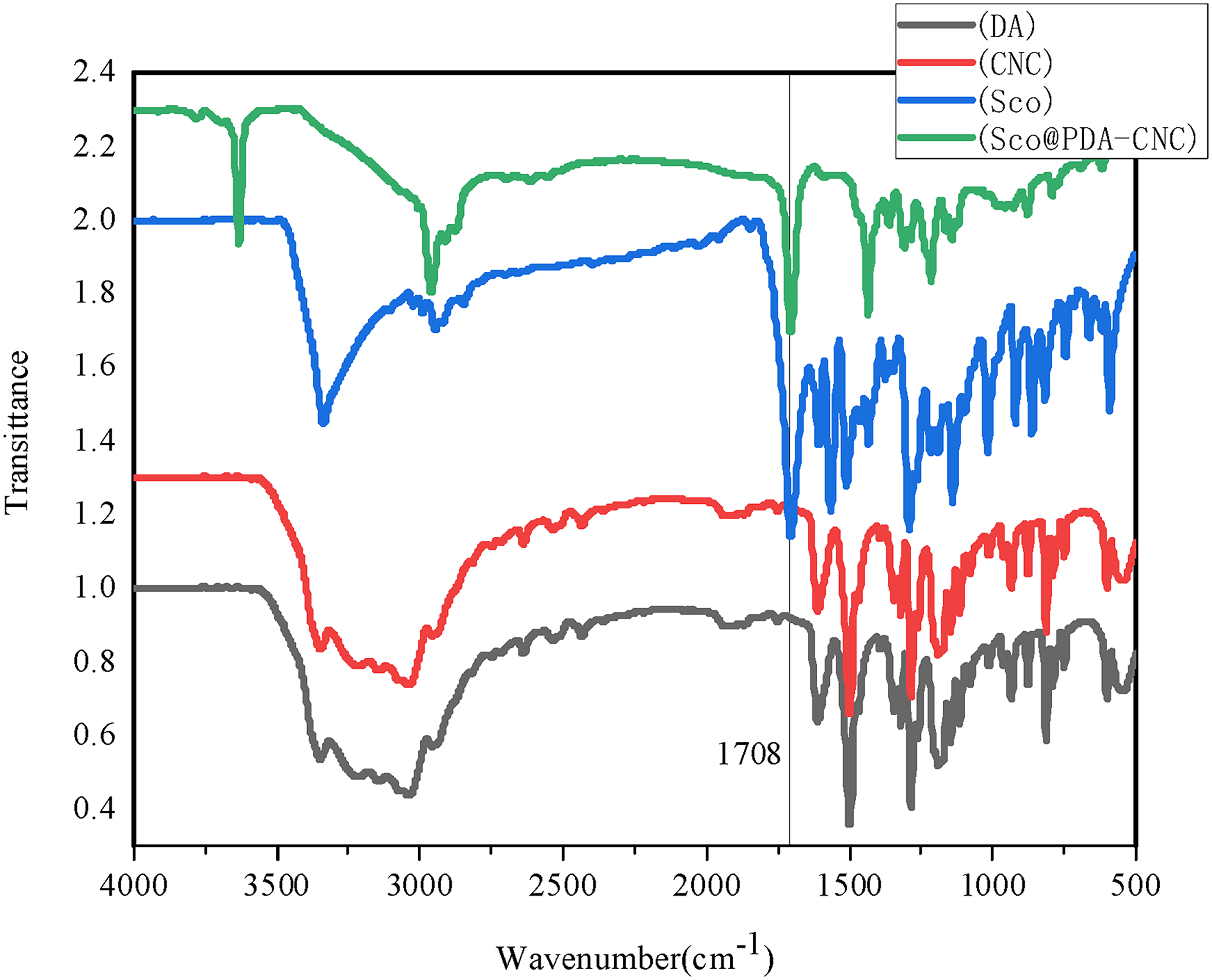
FTIR spectra of pristine Sco, CNCs, PDA, and Sco@PDA-CNCs. Abbreviations: Sco, scopoletin; CNC, cellulose nanocrystals; PDA, polydopamine; FTIR, Fourier transform infrared.
Transmission electron microscopy revealed the presence of numerous CNCs with a length of approximately 150 nm and a diameter of approximately 25 nm (Figure 3). In the scanning image (Figure 4), the surface of CNCs appeared to be very rough, indicating that it had been coated with Sco@PDA-CNCs. Sco can be coated in two ways. Sco on the CNC surface could be easily released. By contrast, Sco could be slowly released from microspheres over a long period.

Transmission electron microscopy of Sco@PDA-CNCs. Abbreviations: Sco, scopoletin; CNC, cellulose nanocrystals; PDA, polydopamine.
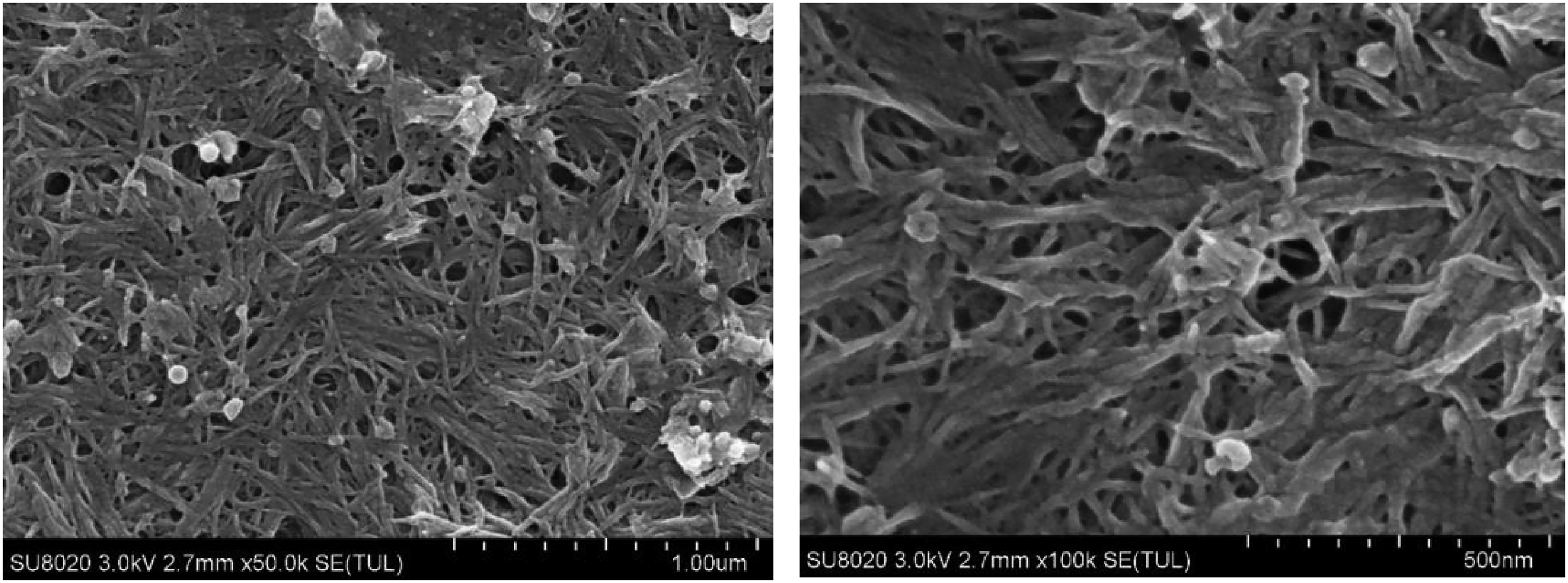
Scanning electron microscopy of Sco@PDA-CNCs. Abbreviations: Sco, scopoletin; CNC, cellulose nanocrystals; PDA, polydopamine.
Sco samples coated with CNCs, PDA, CNCs, and PDA or uncoated Sco samples were immersed in a 70% ethanol–water mixture at room temperature (25 °C) at regular intervals to investigate their controlled-release behaviors. Afterward, the absorbance of the solutions containing the Sco samples was measured via high-performance liquid chromatography (HPLC) (Figure 5). A total of 20 mL of the Sco@PDA-CNC solution was placed into a dialysis bag with a molecular weight of 3000 for the controlled-release behavior test. Release rates were expressed as a percentage of the total amount of a substance released over a given period of time. As shown in Figure 5, Sco@PDA-CNCs exhibited a release rate of 29.73% within 7 days after treatment.

Controlled-release behaviors of the samples with Sco@PDA-CNCs. Abbreviations: Sco, scopoletin; CNC, cellulose nanocrystals; PDA, polydopamine.
Discussion
CSM is a small invertebrate animal that is difficult to control due to its severe resistance to chemical acaricides. It first damages the leaves on the lower parts of plants then moves upward. It mainly accumulates on the undersides of the leaves and the sides of the veins. Adult and larval mites pierce the epidermis to absorb nutrients. The piercing of the epidermis by mites produces chlorotic spots, causing the leaves of the plant to yellow and drop and often causing the entire plant to die. Therefore, the control of phytophagous mites must be comprehensive and multispatial. The action of acaricides should have a long duration and a certain timeliness. Sco has numerous pharmacological activities. For example, 5.0 μM Sco functionally reduced the proliferation of immature bone marrow dendritic cells by more than 50% relative to the vehicle. 28 Sco can prevent the oxidative stress-mediated loss of dopaminergic neurons and at the same time enhance the efficacy of dopamine-recharging regimens. 29 It is a biological acaricide that can kill CSM by blocking the Ca2+ signaling pathway in the cell membrane. 30 Nanosheet/silver nanoparticles/screen-printed electrode also showed excellent reproducibility and anti-interference properties. The response of the proposed electrochemical sensing platform was linear over a wide detection range of 2 μM to 0.45 mM with a low limit of detection of 0.89 μM. 31 We speculate that the addition of nanomaterials, such as CNCs, increases the effective dosage of Sco that reaches the calcium channel and related target sites, finally elevating acaricidal bioactivity.
We found that the acaricidal effect could be improved by attaching Sco to CNCs and PDA. This finding indicated that CNCs and PDA are suitable as wall materials for the preparation of Sco and that the acaricidal effect of Sco has significantly improved.
Conclusions
Our work showed the acaricidal effects of a natural product obtained by adding PDA and CNCs to nanopesticide preparations. When used as supporting materials, CNCs can aggregate pesticides for rapid pest control. Moreover, CNCs can be easily prepared because they are a ubiquitous material. Nanopesticide preparations can improve the inhibition of pest activity and minimize the pollution of cultivated plants. We demonstrated that PDA can alleviate ultraviolet radiation, while CNCs can aggregate. These characteristics improve the acaricidal effects of Sco and reduce the environmental pollution caused by Sco. Our results showed that the slow release of Sco@PDA-CNCs can prolong CSM control. The acaricidal effects of Sco@PDA-CNCs were better than those of pure Sco because the latter lacks special transmission ability to plants and mites. We demonstrated that the effects of pesticides can be improved and that their action time can be extended via nanotechnology.
Materials and Methods
Materials
Sco (extracted in our laboratory), CNCs, H2SO4, and NaOH were supplied by Hebei Veyong Bio-chemical Co., Ltd, China. Dopamine hydrochloride (Dopa-HCl) was purchased from Sigma-Aldrich Company. Tris (hydroxymethyl) aminomethane (Tris) and hydrochloric acid were purchased from Beijing Chemical Reagents Company, China. Analytical grade ethanol was bought from Tianjin Zhiyuan Chemical Reagent Co., Ltd, China. Deionized water was prepared by using an ion-exchange system.
Mite Strains
CSM populations were first collected from the leaf surface of cowpea cultivated in Beibei, Chongqing, P.R. China, in 2000. The populations were kept indoors on potted fresh cowpea leaf seedlings for >22 years and have not been exposed to any medicine/pesticide throughout the entire period. The indoor populations were fed under the conditions of 25 °C ± 2 °C, 60% to 80% relative humidity, and light/dark (L/D) cycle of 14:10 h.
Sulfuric Acid Extraction of CNCs
NaOH (20 g) was dissolved in 1000 mL of distilled water to prepare 2% NaOH solution. Subsequently, 50 g of cotton fibers were added to the NaOH solution, which was then stirred at 25 °C for 12 h. The cotton fibers pretreated through saturation with the NaOH solution were washed until their pH became neutral then dried. Afterward, 126 mL of 90% concentrated sulfuric acid was added to 124 mL of cold distilled water to prepare 65% sulfuric acid solution. The temperature was reduced to room temperature (approximately 25 °C). Then, 12.5 g of dry alkali-treated cotton fibers were placed into the sulfuric acid solution and stirred for 1 h at 45 °C. 32 The cotton fibers were centrifuged for 7 days, and the suspension was collected for analysis.
Synthesis of PDA from Dopa-HCl
PDA nanospheres were synthesized via the spontaneous oxidative polymerization of Dopa-HCl in a mixed solvent of deionized water–ethanol (v:v = 1:1) at room temperature and atmospheric air under alkaline conditions (pH 8.5) (Figure 6).

Scheme of synthesis of PDA from Dopa-HCl. Abbreviations: Dopa-HCl, dopamine hydrochloride; PDA, polydopamine.
Synthesis of Sco@PDA-CNCs
A total of 1 mg of Sco was dissolved in 500 μL of methanol and then added 50 μL of 2% NaOH solution. Sco was encapsulated by PDA mainly through viscosity and hydrogen bond interactions to form Sco@PDA microspheres. The microspheres then adsorbed on CNCs primarily via viscosity and hydrogen bond interactions to form Sco@PDA-CNCs. Sco@PDA microspheres adsorbed on the surfaces of CNCs.
The modified Sco with NaOH was characterized via the dip-dyeing method. Sco solution dissolved in methanol was added to the CNC aqueous solution. The mixed solution was then stirred for 1 h at 500r/min by a magnetic stirrer. The pH of the solution was adjusted to 8.5 with Tris solution. Next, dopamine with the same mass as CNCs was dissolved in deionized water and then dripped into the CNC and Sco solution. The masses of dopamine and Sco were 6 and 1 mg, respectively. The reaction was adjusted to pH 8.5 after 24 h then centrifuged at 12 000r/min after 48 h. Uncoated drugs were removed through repeated flushing with deionized water. A total of 200 μL of the centrifuged supernatant was collected to measure the loading efficiency (Figure 7).

Diagram of Sco@PDA-CNC synthesis. Abbreviations: Sco, scopoletin; CNC, cellulose nanocrystals; PDA, polydopamine.
Acaricidal Activity Assay
The acaricidal bioactivities of different Sco formulations were determined via the glass slide-dipping method recommended by the FAO. Female CSM adults were affixed on a double-sided adhesive tape that was preattached to one end of a 10 cm × 2 cm glass slide carefully. The mites were then soaked in different formulations and dilutions for 5 s. The slide was removed, and any excess solution was absorbed with filter paper under a biological binocular. All treated mites were cultured in a controlled-climate box under the conditions of 27 °C ± 2 °C 60% relative humidity, and 16:8 h L/D cycle. Mortality rate was monitored every 24 h. A mite was considered dead if it did not move when lightly touched with a fine brush. All treatments were repeated three times.
Footnotes
Acknowledgements
The authors acknowledge the Youyang Branch of Chongqing Branch of China National Tobacco Corporation Project (202050024221028), Chongqing Innovation Team of Characteristic Benefit Grain and Oil Industry Technology System (Laboratory of Green Prevention and Control of Disease and Insect Pests-003), and the Mission Statement of Key Special Projects of Science and Technology Help Economy 2020 (SQ2020YFF0405970).
Author Contributions
K.W., S.Z., J.L., and Y.Z.contributed to the data collection, methodology, formal analysis, and writing—original draft preparation. K.W. and J.L. contributed to manuscript writing. J.H. and Y.Z. contributed to conceptualization, methodology, validation, supervision, funding acquisition, and writing—review and editing. All authors discussed the results and contributed to the final manuscript. All authors have read and agreed to the published version of the manuscript.
Data Availability Statement
The data sources presented in this study are available when requested.
Declaration of Conflicting Interests
The authors declared no potential conflicts of interest with respect to the research, authorship, and/or publication of this article.
Funding
The authors disclosed receipt of the following financial support for the research, authorship, and/or publication of this article: This work was supported by the Mission Statement of Key Special Projects of “Science and Technology Help Economy 2020,” (grant number SQ2020YFF0405970).
