



Abstract
Literature data suggest that apple-derived products, including phenol-enriched extracts, may reduce food intake in rodent models of diet-induced obesity. With the intent of further expanding this research issue, the present study investigated the effect of an apple branch extract (ABE)—standardized for the polyphenol, phlorizin (22.93%)—on regular food intake in healthy, nonobese Wistar rats. Rats were given unlimited access to standard food pellets and water in the homecage. Acute, intragastric treatment with ABE (0, 300, and 900 mg/kg) effectively and selectively reduced food intake. The effect of 900 mg/kg ABE was closely replicated by acute treatment with 200 mg/kg pure phlorizin, suggesting that this was the likely active ingredient underlying the effect of ABE on food intake. These results further strengthen the hypothesis that apple-derived products may represent a promising option for novel pharmacotherapies for eating disorders and overweight.
Introduction
Recent literature data suggest that treatment with polyphenol-enriched extracts of the apple tree (Malus domestica) effectively reduces food intake and body weight in laboratory rodents.1-3 More specifically, apple plant extracts containing approximately 80% polyphenols prevented fat mass increase, ameliorated insulin resistance, reduced hyperglycemia and hyperleptinemia, stimulated glucagon-like peptide-1 secretion, and altered the composition of gut microbiota, ultimately causing satiety and delay of body weight gain in rats and mice exposed to obesity-inducing, high fat and/or carbohydrate diets.1-3 Taken together, these data make polyphenol-rich, apple-based preparations promising nutritional agents for use in controlling appetite, food consumption, and body weight. 3
In line with this hypothesis, the present study investigated whether a standardized extract of apple branches (apple branch extract [ABE])—characterized by a high content (∼23%) of the polyphenol, phlorizin—reduced regular food intake in healthy, nonobese rats. Phlorizin is the main apple phenol, abundant in roots, barks (from which it was first isolated in 1835), leaves, and fruit peels.4,5 It produces a variety of central and peripheral effects, including improvement of memory functions and inhibition of intestinal glucose absorption.4,5 For the sake of completeness, the present study also included a separate experiment testing pure phlorizin under experimental conditions identical to those used to test ABE.
Results and Discussion
Experiment 1 investigated the effect of acute treatment with ABE on food intake. Analysis of variance indicated that treatment with ABE reduced food intake from the second time interval (“0-4 h”). Statistical significance at post hoc analysis (Tukey's test) was reached by treatment with 300 mg/kg ABE at “0-4 h” and “0-24 h” time intervals (P < .05) and by treatment with 900 mg/kg ABE at all time intervals of the test day (P < .05) (Figure 1). Maximal reduction averaged 22% at the 300 mg/kg ABE dose (“0-4 h” time interval) and 35% at the 900 mg/kg ABE dose (“0-8 h” time interval). Food intake did not differ among the rat groups on the posttreatment day (Day + 1) (Figure 1). Finally, acute treatment with ABE did not alter water intake at any time interval (Table 1). These results indicate that acute treatment with ABE, a standardized extract of apple branches containing a high content (∼23%) of the polyphenol, phlorizin, effectively reduced food intake in healthy, nonobese rats. ABE-induced reduction of food intake was relatively long-lasting, with ongoing evidence at the “24-h” time point. Notably, the reducing effect of ABE was selective for food intake, as ABE treatment did not alter water intake at any time interval; these data suggest that the anorectic effect of ABE was secondary to an action on the mechanisms regulating appetite and satiety rather than any possible unspecific, adverse-like effect.

Effect of acute treatment with a standardized apple branch extract (ABE) on food intake in adult male Wistar rats. Regular food pellets and water were always available in the homecage. ABE was administered intragastrically 30 min before lights off. Food intake was recorded 2, 4, 6, 8, and 24 h after lights off. The recording was repeated the day after (Day + 1). Bars are the mean ± SEM of n = 8−10 rats. Results of one-way analysis of variance calculated at each time interval are reported behind the corresponding graph. *: P < .05 in comparison to 0 mg/kg ABE-treated rat group (Tukey's test).
Effect of Acute Treatment With a Standardized Apple Branch Extract (ABE) on Water Intake in Adult Male Wistar Rats.

Water and regular food pellets were always available in the homecage. ABE was administered intragastrically 30 min before lights off. Water intake was recorded 2, 4, 6, 8, and 24 h after the lights off. The recording was repeated the day after (Day + 1). Values are the mean ± SEM of n = 8−10 rats.
The results of Experiment 1 are consistent with literature data demonstrating that apple-derived products, including phenol-enriched extracts and juice vinegar, reduced food intake in different rodent models of diet-induced obesity.1-3,6 Together, these data make apple-based preparations an intriguing research issue in the potential discovery of new and safe natural remedies for use in the treatment of eating disorders, overweight, and obesity. This scenario acquires additional relevance when considering the limited, current availability of effective pharmacotherapies to control appetite and overeating7,8 as well as the high acceptance and preference that most subjects display for herbal remedies over conventional, synthetic chemical entities to cure a number of different diseases, 9 including eating disorders and obesity. 10 In this particular case of ABE, its possible development as a novel pharmacotherapy would theoretically also entail the economic and ecological advantage of using a raw material (plant branches) that is otherwise discarded.
Experiment 2 investigated the effect of a dose (200 mg/kg) of pure phlorizin selected to match the phlorizin content in the 900 mg/kg dose of ABE. To facilitate the comparison, the design of Experiment 2 was identical to that of Experiment 1, with the sole exception of the administered product (phlorizin instead of ABE). The Mann–Whitney test indicated that acute treatment with phlorizin reduced food intake from the second (“0-4 h”) to the last (“0-24 h”) time interval of the test day (P < .05) (Figure 2). Maximal reduction averaged 33% (“0-8 h” time interval). Food intake did not differ between the rat groups on posttreatment day (Day + 1) (Figure 2). Finally, acute treatment with phlorizin did not alter water intake at any time interval (Table 2).

Effect of acute treatment with phlorizin on food intake in adult male Wistar rats. Regular food pellets and water were always available in the homecage. Phlorizin was administered intragastrically 30 min before lights off. The phlorizin dose was selected to equate phlorizin content in the 900 mg/kg ABE dose. Food intake was recorded 2, 4, 6, 8, and 24 h after lights off. The recording was repeated the day after (Day + 1). Bars are the mean ± SEM of n = 6 rats. + : P < .05 in comparison to 0 mg/kg phlorizin-treated rat group (Mann–Whitney test).
Effect of Acute Treatment With Phlorizin on Water Intake in Adult Male Wistar Rats.
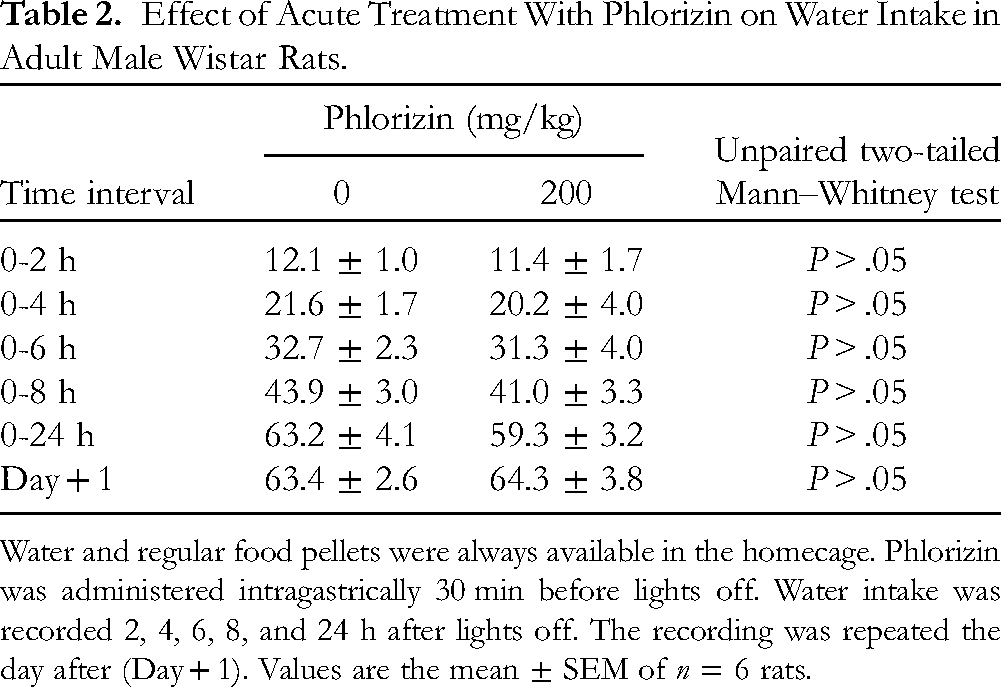
Water and regular food pellets were always available in the homecage. Phlorizin was administered intragastrically 30 min before lights off. Water intake was recorded 2, 4, 6, 8, and 24 h after lights off. The recording was repeated the day after (Day + 1). Values are the mean ± SEM of n = 6 rats.
The results of Experiment 2 indicated that magnitude, onset, duration, and selectivity of the reducing effect of phlorizin on food intake were virtually identical to those of the reducing effect of 900 mg/kg ABE. These results are highly congruent with previous experimental data demonstrating that acute treatment with phlorizin reduced food intake in rats 11 ; they are also in favor of the hypothesis that phlorizin is the major active ingredient responsible for the anorectic effect of ABE. In keeping with this hypothesis, the well-known ability of phlorizin to affect glucose metabolism—via inhibition of sodium/glucose cotransporters in gut and kidney 4 —constitutes the likely mechanism of ABE action on food intake.
Conclusions
The results of the present study indicate that acute treatment with ABE effectively and selectively reduced food intake in healthy, nonobese rats. These results are in line with previous data suggesting that apple-derived products decreased food intake in obese rats and mice.1-3,6 The polyphenol, phlorizin, was the likely active ingredient responsible for the ABE effect.
The results of the present study pose new, relevant research questions, that will need to be addressed by future experimental studies. To mention a few examples: Is the reducing effect of ABE on food intake maintained after repeated treatment? Is ABE differently effective in female rats? Does the reducing effect of ABE extend to the intake of high-fat and/or carbohydrate food or even highly palatable food known to promote addictive-like behaviors? The results of these additional studies will better define the translational potential of the anorectic properties of ABE.
Materials and Methods
Experimental procedures adhered to the European Communities Council Directive (86/609/EEC) and Italian Law on the “Protection of animals used for experimental and other scientific reasons” (D.Lgs. no. 116/1992).
Animals
Adult male Wistar rats (Harlan) were used. Rat age and body weight averaged approximately 60 days and 250 g, respectively, at the start of each experiment. In both experiments, rats were housed individually in plastic cages provided with wood chip bedding. Environmental conditions of the animal vivarium were: inverted 12:12 h light-dark cycle (lights off at 11:00 a.m.
ABE and Phlorizin Preparation and Administration
ABE was prepared at Indena according to the following procedure. Twigs were initially ground on a 6 mm grid and then extracted in a percolator with 80% (v/v) ethanol at 70 °C until exhaustion, keeping each extraction in contact for at least 4 h. The leachates were filtered, pooled, and then concentrated until soft (dry residue of 50-60%, w/w). This soft material was poured into a steel container and dried in an oven at 50 °C under vacuum overnight. Phytochemical analysis was performed in duplicate according to the following procedure. Twenty (± 2) mg Malus domestica extract was poured into two 100-mL volumetric flasks, dissolved in an ultrasonic bath, diluted with methanol 50% (v/v) (test solution), and filtered through a 0.45-µm polytetrafluoroethylene filter before injection into a high-pressure liquid chromatography (HPLC) pump. The HPLC chromatogram of the test solution is reported in Figure S1. Quantification was obtained using phloridzin as external standard, with ultraviolet detection at 285 nm. The final extract had a standardized HPLC content of 22.93% phlorizin. Phlorizin was purchased from Biovectra.
For in vivo testing, both ABE and phlorizin were suspended in distilled water containing 0.5% (w/v) methylcellulose and administered intragastrically (administration volume: 4 mL/kg) 30 min before lights off. Intragastric administrations were performed by means of a flexible, plastic feeding tube (Instech Laboratories).
Experimental Procedure
In both experiments, test sessions were conducted after approximately 30 days of single housing. In Experiment 1, rats were divided into three groups of n = 8−10, with comparable body weight and daily food and water intake, and treated acutely with 0, 300, and 900 mg/kg ABE. ABE doses were selected on the basis of preliminary results (this laboratory, unpublished data). In Experiment 2, rats were divided into two groups of n = 6, with comparable body weight and daily food and water intake, and treated acutely with 0 and 200 mg/kg phlorizin. The phlorizin dose was selected to equate with the phlorizin content in the 900 mg/kg ABE dose.
In both experiments, food (g/kg) and water (mL/kg) intake was monitored by weighing food pellets and water bottles (0.01 g accuracy) 2, 4, 6, 8, and 24 h after lights off. The recording was repeated the day after (Day + 1). In Experiment 1, data from each time interval were analyzed by one-way analysis of variance, followed by Tukey's test for post hoc comparisons. In Experiment 2, data from each time interval were analyzed by unpaired two-tailed Mann–Whitney test.
Supplemental Material
sj-docx-1-npx-10.1177_1934578X231174312 - Supplemental material for Reducing Effect of a Standardized Extract of Apple Branches on Food Intake in Healthy, Nonobese Rats
Supplemental material, sj-docx-1-npx-10.1177_1934578X231174312 for Reducing Effect of a Standardized Extract of Apple Branches on Food Intake in Healthy, Nonobese Rats by Mauro A.M. Carai, Erika Sitzia, and Giancarlo Colombo in Natural Product Communications
Footnotes
Acknowledgments
The Authors are grateful to Ms. Anne Farmer for the language editing of the article.
Declaration of Conflicting Interests
The author(s) declared no potential conflicts of interest with respect to the research, authorship, and/or publication of this article.
Funding
The author(s) received no financial support for the research, authorship, and/or publication of this article.

Supplemental Material
Supplemental material for this article is available online.
References
Supplementary Material
Please find the following supplemental material available below.
For Open Access articles published under a Creative Commons License, all supplemental material carries the same license as the article it is associated with.
For non-Open Access articles published, all supplemental material carries a non-exclusive license, and permission requests for re-use of supplemental material or any part of supplemental material shall be sent directly to the copyright owner as specified in the copyright notice associated with the article.
