



Abstract
Senna alata L. was reported to exhibit significant bioactivities and health effects.
Introduction
The bioactive compounds derived from plants have long been esteemed for their remarkable health benefits and versatile applications across the pharmaceutical, cosmetic, and food industries. Among these, polyphenols and flavonoids stand out due to their potent antioxidant, anti-inflammatory, and antimicrobial properties. Senna alata L. (Leguminosae family), commonly referred to as candle bush, is a widely distributed herbaceous plant in tropical regions of Asia and Africa. Its rich reservoir of bioactive compounds has been traditionally used in folk medicine to treat microbial infections, skin disorders, and inflammatory conditions. This plant is well-recognized for its diverse range of bioactive compounds. It contains an assortment of phenolics, including rhein, chrysaphanol, kaempferol, aloe-emodin, and their glycosides. The plant is also rich in anthraquinones such as alatonal, aloe-emodin, chrysophanol, and features steroids like stigmasterol, β-sitosterol, and daucosterol. Additionally, it contains flavonoids such as kaempferol and luteolin, and other compounds like benzoquinone, coumarin (dalbergin), ellagitannin, and xanthone (cassiaxanthone). The plant's leaves, flowers, seeds, roots, and bark exhibit a multitude of biological effects, including antimicrobial, antifungal, antibacterial, antitumor, anti-inflammatory, antidiabetic, antioxidant, antihelmintic properties, and dermatophytic activities. Given the rising challenges posed by drug-resistant diseases, current research is increasingly focused on leveraging these natural compounds for developing potent and safe new therapeutic agents.1–3
Senna alata has drawn significant attention due to its diverse bioactivities. making it a compelling subject for this study. One of its most notable attributes is its potent antioxidant activity, with extracts displaying significant free radical scavenging ability across various assays. Studies have reported IC50 values of 71.35 ± 0.32 μg/mL for DPPH, 38.17 ± 1.2 μg/mL for lipid peroxidation, and 95.46 ± 0.79 μg/mL for hydroxyl radicals, highlighting its broad-spectrum antioxidant capabilities. 4 The acetone extract further exhibited 37.02 ± 0.45% inhibition in antioxidant assays, correlating with a total phenolic content of 23.29 ± 0.89 mg/g. 5 These findings emphasize its potential as a natural alternative to synthetic antioxidants, with promising applications in mitigating oxidative stress and enhancing product stability.
Additionally, research has revealed its choleretic, antidiabetic, anti-inflammatory, analgesic, and anticancer potential, further broadening its therapeutic applications.6–8 The diverse bioactivities of S. alata, supported by robust quantitative evidence, underscore its immense pharmacological value, solidifying its position as a promising source of bioactive compounds for medicinal and industrial applications.
Polyphenols and flavonoids in S. alata exhibit a wide range of beneficial health effects, making them significant in both traditional and modern medicine. These bioactive compounds are renowned for their potent antioxidant properties, which play a crucial role in neutralizing harmful free radicals and reducing oxidative stress, thereby reducing the risk of chronic diseases. 9 Additionally, the anti-inflammatory properties of these compounds contribute to the reduction of inflammation-related conditions, including arthritis and inflammatory bowel disease. 10 S. alata contain several polyphenols (eg rhein, chrysophanol, and gallic acid), and flavonoids (eg quercetin, naringenin, and kaempferol glycosides), 3 which demonstrates significant antimicrobial, antifungal, antidiabetic activities and other advantages for human health, including cardiovascular health, enhanced endothelial function, reduced blood pressure, neuroprotective effects, liver health and detoxification, anti-obesity properties, etc These properties not only validate its traditional medicinal uses but also highlight its potential as a source of natural therapeutic agents in the development of novel pharmaceutical products.
Various extraction techniques have been employed to isolate bioactive compounds from Senna alata leaves, each with distinct advantages and applications. Conventional maceration has been widely used to extract total phenolic content (TPC) and total flavonoid content (TFC), as well as to evaluate antioxidant properties.4,11 Soxhlet extraction with methanol has also been utilized to assess the plant's antioxidant potential. 12 In recent years, advanced extraction techniques have been explored to enhance the yield and efficacy of bioactive compounds. Ultrasonic-assisted extraction (UAE) and microwave-assisted extraction (MAE) have been applied to improve the recovery of polyphenols and kaempferol from S. alata leaves by optimizing extraction efficiency through microstructure analysis. 11 Additionally, supercritical fluid extraction (SFE) has been investigated as a green extraction approach to evaluate the biological activity of S. alata extracts, offering a solvent-free alternative with high selectivity. 13 These diverse methodologies highlight the importance of optimizing extraction conditions to maximize the yield and bioactivity of S. alata-derived compounds for pharmaceutical and cosmetic applications. Further, Aung et al (2023) employed ultrasonic-assisted extraction combined with Response Surface Methodology to develop a rhein-rich, dechlorophyllated extract from S. alata, achieving high rhein yield (10.44 mg/g extract) and strong bioactivity, particularly antioxidant and antimicrobial potential. 14 Notably, this study also explored extract color improvement through dechlorophyllization, demonstrating the importance of purification steps in extract standardization for topical or ingestible applications. In addition, another study by Aung et al (2024) utilized S. alata extract in the fabrication of electrospun shellac nanofibers for controlled drug delivery and wound healing, showing enhanced antimicrobial properties and structural integrity of the fibers. 15 These modern approaches demonstrate the versatility and adaptability of S. alata extracts in both extraction innovation and formulation development.
Despite its therapeutic potential, systematic optimization of its bioactive compound extraction remains underexplored. Optimization of bioactive extraction processes is crucial to leverage the full potential of plant-derived compounds. By refining extraction parameters, it becomes possible to maximize yields, enhance compound purity, and improve the cost-efficiency of downstream applications. Response Surface Methodology (RSM) is a particularly effective approach for this purpose, allowing researchers to evaluate and optimize the interplay of multiple variables simultaneously.
Response Surface Methodology (RSM) is a powerful statistical and mathematical approach used to design, enhance, and optimize processes. Originally described by Box and Wilson in 1951, RSM has become essential in evaluating the effects of multiple process variables and their interactions on response variables. This technique is particularly useful in optimizing complex processes, including extraction technology, as it reduces the number of experimental trials needed while providing precise and effective results. RSM involves designing experiments, building predictive models, and determining optimal conditions, making it a valuable approach for studying relationships between dependent and independent variables. By focusing on the most significant variables, RSM enhances the efficiency and accuracy of the optimization process, making it less laborious and time-consuming compared to traditional methods. This methodology has proven effective and versatile across numerous fields, showcasing its capability to optimize various processes. In several studies, RSM was applied to optimize polyphenols and flavonoids extraction from various sources such as Compositae, 16 alfalfa, 17 white turmeric, 18 apple, 19 tamarillo fruit, 20 and stinging nettle. 21
The extraction of bioactive compounds such as polyphenols and flavonoids from plant matrices is a widely researched area due to their significant medicinal and cosmetic applications. Senna alata L. is a medicinal plant known for its antimicrobial, anti-inflammatory, and antioxidant properties. However, its potential as a source of bioactive compounds has been underexplored, particularly in optimizing the extraction process to maximize yield and efficacy. For Senna alata, parameters such as extraction temperature, solvent-to-solid ratio, and solvent composition critically influence the recovery of polyphenols and flavonoids.
This study employs Response Surface Methodology (RSM), a robust statistical tool for process optimization, to extract polyphenols and flavonoids from Senna alata L. leaves. While RSM is an established technique, its application in this context brings unique insights, particularly concerning the quadratic and linear effects as well as the interaction between extraction parameters. Unlike previous studies that largely focused on extraction efficiency, this research emphasizes understanding the interplay between temperature, solvent-to-solid ratio, and solvent composition, thereby introducing a novel dimension to the optimization process. Additionally, this work addresses the lack of comprehensive analysis in the existing literature by validating the optimized model and proposing pathways for medicinal and cosmetic applications of the extracts. The objective of this paper is to apply Response Surface Methodology (RSM) to optimize the extraction process of polyphenols and flavonoids from Senna alata. By fine-tuning extraction parameters such as liquid-to-solid ratio, extraction temperature, extraction duration, and extraction solvent composition, this study attempted to achieve maximal yields of these bioactive compounds. The insights from this research elucidated the optimal extraction conditions as an essential platform for future investigations and potential therapeutic applications of Senna alata extracts in advanced health and medical sciences.
Materials and Methods
Materials
Healthy green S. alata leaves without signs of diseases and nutrient deficiency were provided by a local pharmaceutical company in Ho Chi Minh City, Vietnam. Gallic acid standard, quercetin standard, sodium bicarbonate (NaHCO3), aluminum chloride (AlCl3), potassium acetate (CH3CO2K), Folin-Ciocalteu reagent, and Ethanol 98% were purchased from Sigma Aldrich, St. Louis, MO, USA. All chemicals employed in this study were of analytical grade.
Extraction of Polyphenols and Flavonoids
The collected S. alata leaves were ground into fine powder and stored in a container with silica gel desiccant packs in darkness at room temperature to prevent moisture and sunlight. The extraction was carried out under reflux water cooling condenser conditions in which extraction parameters were changed according to design models. Liquid extracts were filtrated through vacuum filtration and their volume was measured meticulously.
Analytical Methods
Analysis of Total Phenolics
Total phenolic content (TPC) was determined following the ISO 14502-1:2005 method using the Folin-Ciocalteu reagent, with minor modifications. Gallic acid was the standard chemical for phenolic compounds to make the calibration curve. Specifically, 2.5 mL of daily prepared Folin-Ciocalteu reagent (diluted ten-fold with distilled water) was added to 1 mL of the liquid sample. The mixture was then placed in an ultrasonic bath at room temperature for 2 min, followed by the addition of 2 mL of 7.5% (w/w) sodium bicarbonate. After incubating for 60 min, the absorbance was measured at 765 nm using a Jenway 7305 UV/Visible Spectrophotometer. The results were expressed as gallic acid equivalents (GAE) per gram of dry weight (DW).

Analysis of Total Flavonoids
Total flavonoid content (TFC) was assessed using the aluminum chloride colorimetric method
22
with slight adjustments. Quercetin served as the standard for the calibration curve. In this procedure, 0.5 mL of the liquid sample was mixed with 0.1 mL of 10% aluminum chloride, 3 mL of 98% ethanol, and 1.5 mL of 1 M potassium acetate. The mixture was then incubated at 45 °C for 45 min. Following incubation, the absorbance was recorded at 410 nm using a Jenway 7305 UV/Visible Spectrophotometer. The results were reported as quercetin equivalents (QE) per gram of dry weight (DW).

Experimental Design and Statistical Analysis
RSM was used to determine the optimum condition for polyphenols and flavonoids extraction of S. alata leaves. The experimental design and statistical analysis were performed using Stat-Ease software (Design-Expert 13.0.5.0). The experimental data were modeled using a second-order polynomial equation, and the corresponding regression coefficients were calculated. The response surface analysis utilized the following generalized quadratic polynomial model:

Here,
To determine the statistical significance and the initial range of the extraction variables, a Regular Two-Level Factorial Design (2n−1) was employed with four factors: extraction temperature, extraction duration, solvent-solid ratio, and solvent composition. Subsequently, a three-level, three-factor Box–Behnken design was chosen to evaluate the combined effects of three independent variables: extraction temperature (X1), solvent-solid ratio (X2), and solvent composition (X3). The range and levels of the independent variables, as determined through preliminary experiments (screening process), are detailed in Table 1. The experiments were randomized to minimize the influence of unexplained variability in the observed responses due to extraneous factors. The experimental design included star points and six center points to assess the method's repeatability (Table 2). The response functions (Y) were total phenolic content (mg GAE/g dry weight) and total flavonoid content (mg QE/g dry weight).
Independent Variables and their Coded and Actual Values used for Optimization.

The Box–Behnken Design and Experiment Data for Polyphenols and Flavonoids Extraction from S. alata Leaves.

Results
Preliminary Experiments
The results from the (2n−1) fractional factorial design revealed that extraction temperature, solvent-solid ratio, and solvent composition are statistically significant parameters based on their evaluated levels. Following preliminary experiments, extraction duration was deemed statistically insignificant and thus excluded from further analysis. Additionally, to enhance the experimental design, the range of the low and high values for the parameters was expanded, leading to the implementation of a more refined Box-Behnken design using RSM.
Statistical Analysis
In this study, the RSM was applied to optimize the extraction conditions for TPC and TFC from Senna alata extracts. The analysis of variance (ANOVA) and regression analysis confirmed the significance and reliability of the models for both TPC and TFC. Specifically, the RSM model for TPC demonstrated an R² value of 0.9478, with an adjusted R² of 0.8892 (Table 3). This indicates that approximately 94.78% of the variability in TPC is explained by the independent variables, reflecting a strong correlation between the predicted and observed values. The closer the R² value is to one, the better the empirical model aligns with the actual data.
ANOVA Table Showing the Variables as Linear, Interaction, and Quadratic Terms on TPC Response and Coefficients for the Prediction Models.

Similarly, the model for TFC exhibited an R² value of 0.9854 and an adjusted R² of 0.9691, suggesting that 98.54% of the variation in TFC is attributable to the experimental factors, thereby showcasing an excellent fit between the model and the actual data (Table 4). The comparison of R² and adjusted R² values for the models showed minimal variation, indicating that non-significant terms were successfully excluded from the model. This consistency suggests that the final models are well-calibrated and only include significant factors.
ANOVA Table Showing the Variables as Linear, Interaction, and Quadratic Terms on TFC Response and Coefficients for the Prediction Models.

F-value and p-value served as a tool to assess the significance of each coefficient. Variables become more significant as the absolute F-value increases and the p-value decreases. The significance of the models was further supported by the p-values and F-values obtained from the ANOVA. The model for TPC showed a p-value of 0.0003 and an F-value of 16.16, indicating that the model is statistically significant and that the independent variables have a substantial impact on the TPC response. For TFC, the model exhibited an even higher level of significance, with a p-value of less than 0.0001 and an F-value of 60.16. These results highlight the robustness of the regression equations and their ability to predict the outcomes effectively.
After excluding the influence of non-significant factors related to the process variables, the equations for the fitted models are presented in Table 5.
Response Surface Models after Eliminating Non-Significant Variables.

Total Phenolic Content
Figure 1 depicts the changes in TPC in relation to extraction temperature, solid-to-solvent ratio, and solvent composition.
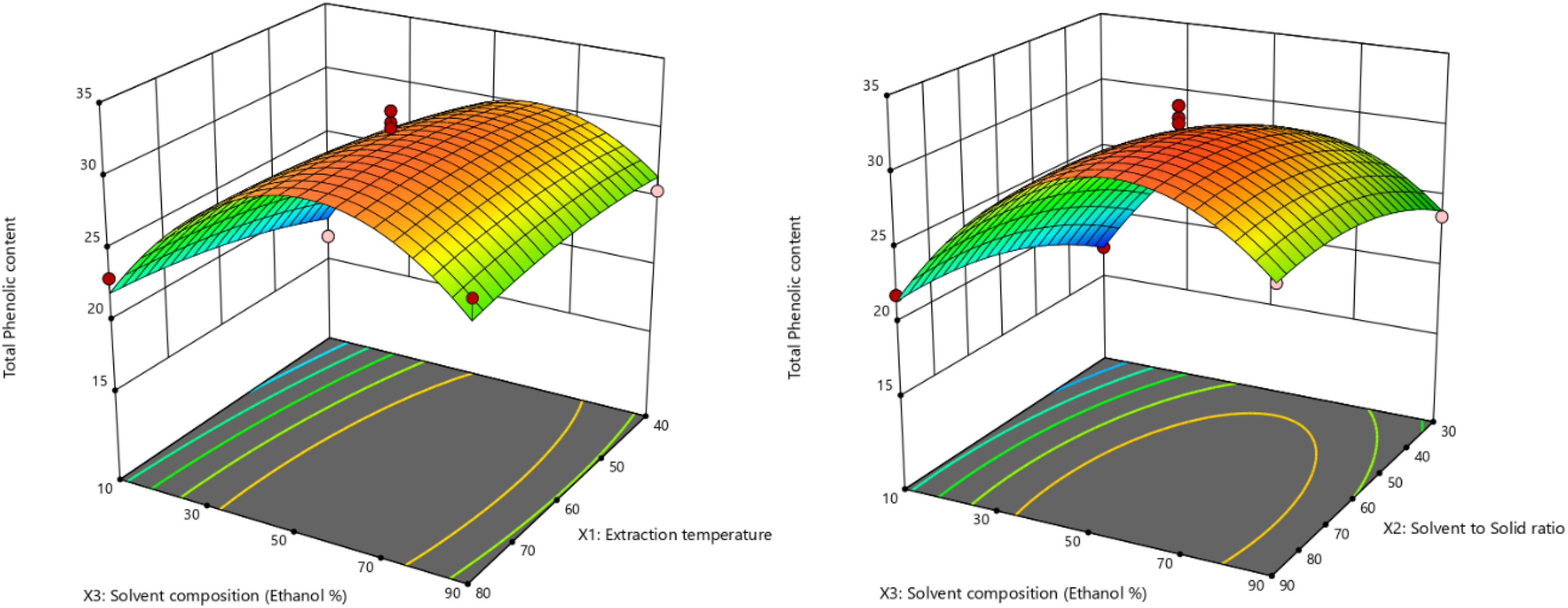
Response surface for the effect of extraction temperature and solvent composition at solvent to solid ratio = 60 mL/g (left) and solvent to solid ratio and solvent composition at extraction temperature = 60 °C (right) on TPC.
The ANOVA results for TPC indicate that among the three factors studied—extraction temperature (X1), solvent to solid ratio (X2), and solvent composition (X3)—the solvent composition had the most significant impact on TPC, with a p-value of 0.0006. This is consistent with the fundamental principles of solvent extraction, where the polarity of the solvent plays a crucial role in determining the solubility and subsequent extraction efficiency of phenolic compounds.
The solvent to solid ratio was also a critical factor, with a significant p-value of 0.0121. The quadratic effect of solvent composition (X32) on TPC is highly significant (p < 0.0001), indicating a non-linear relationship between solvent concentration and phenolic extraction. In contrast, the quadratic effects of extraction temperature (X12) and solid-to-solvent ratio (X22) are not significant for TPC (p = 0.3912 and p = 0.0893, respectively).
Total Flavonoid Content
Similarly, for TFC, the ANOVA results also highlighted the solvent composition (X3) as the most significant factor, with an extremely low p-value (<0.0001) (Figure 2).

Response surface for the effect of extraction temperature and solvent composition at solvent to solid ratio = 60 mL/g (left) and solvent to solid ratio and solvent composition at extraction temperature = 60 °C (right) on TFC.
The solvent to solid ratio (X2) was also a significant factor (p-value = 0.0039), underscoring its importance in the extraction process. The extraction temperature (X1) also did not significantly influence TFC (p-value = 0.2092). Regarding quadratic effects, none of the quadratic terms—extraction temperature (X12), solid-to-solvent ratio (X22), and solvent composition (X32)—showed significant p-values for TFC (p = 0.6783, p = 0.0618, and p = 0.1640, respectively).
Optimization and Verification
Through comprehensive numerical and graphical optimization using the Design-Expert software, the ideal conditions for maximizing TPC and TFC were determined. The optimal extraction parameters for achieving peak TPC and TFC are extraction temperature of 56 °C, solvent-to-solid ratio of 90 mL/g, and solvent composition of 75% ethanol. Under these conditions, the highest TPC and TFC values were recorded at 30.6117 mg GAE/g DW and 47.9087 mg QE/g DW, respectively. The optimal extraction region is visually represented in Figure 3, illustrating the efficacy of these parameters in maximizing both TPC and TFC.
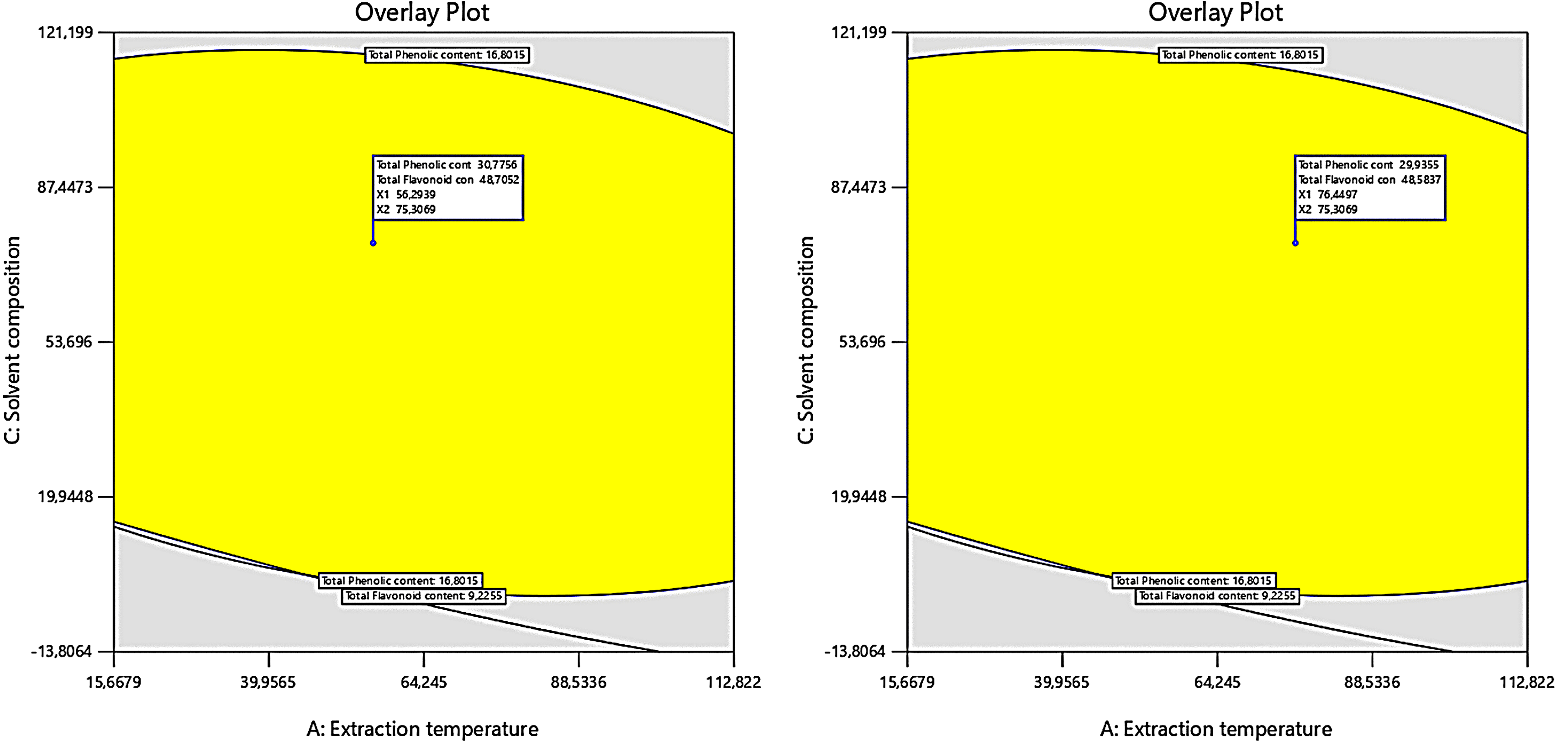
Response surface for the optimum region, obtained by overlaying contour plots of TPC and TFC.
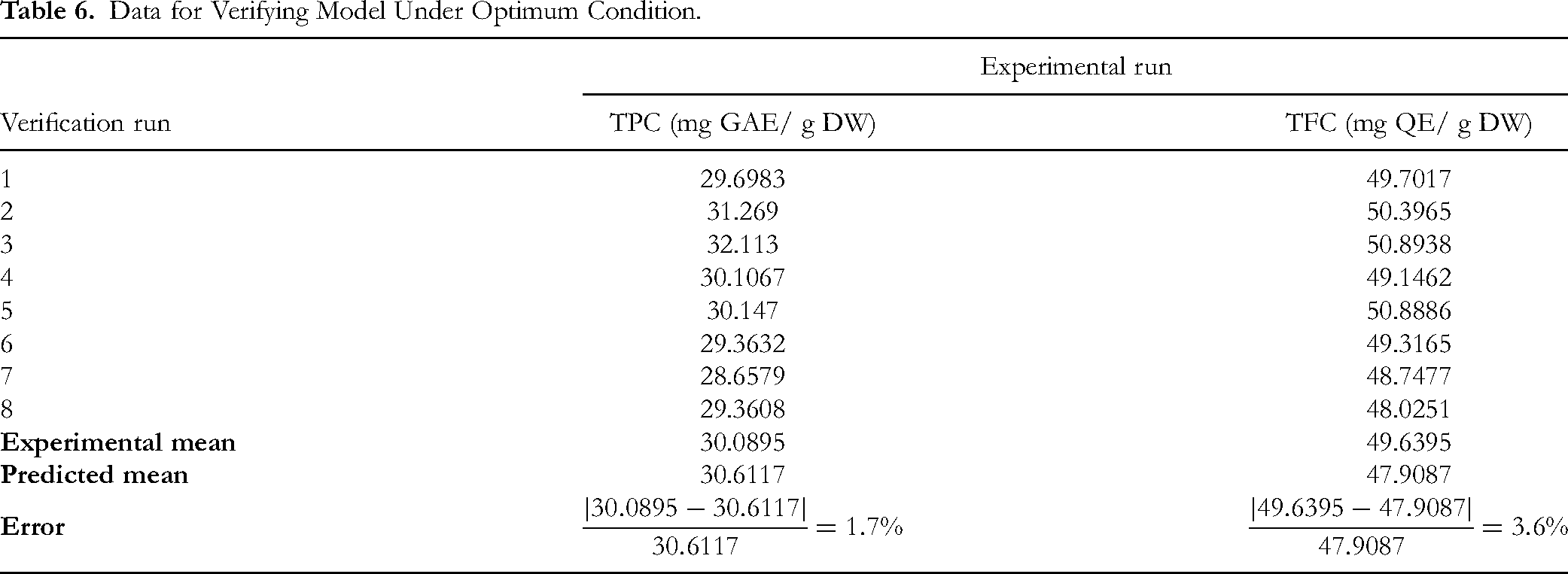
The efficacy of the models in predicting the optimal response values was assessed through the extraction of polyphenols and flavonoids under the conditions determined by the RSM optimization, including extraction temperature of 56 °C, solvent-to-solid ratio of 90 mL/g, and solvent composition of 75% ethanol. As shown in Table 6, the observed values for TPC and TFC are closely aligned with the predicted values, with no significant differences at the 5% significance level. These findings confirm a high degree of concordance between experimental and predicted results, demonstrating that the models used are both accurate and reliable.
Data for Verifying Model Under Optimum Condition.
Discussion
Examining the lack of fit is essential for assessing the adequacy and reliability of the models. A significant lack of fit typically indicates that the model fails to accurately represent the data within the experimental domain, particularly at points not included in the regression analysis. However, in this study, the lack of fit was not significant for any of the variables (p > 0.05), implying that the proposed models accurately predicted the related responses. This non-significant lack of fit confirms that the models provide a reliable representation of the experimental data, ensuring that the response surface models can be effectively used for optimization purposes.
Additionally, the coefficient of variation (CV) was calculated to assess the precision and reliability of the experimental data. The coefficient of variation (CV) measures the extent of variability relative to the mean of the data set. Generally, a low CV signifies minimal variation around the mean, which contributes to the development of a robust and reliable response model. The low CV values observed in the proposed models suggest that the experiments were conducted with high precision and consistency. The CV for TPC was 6.01%, indicating low variability and high precision in the measurements. For TFC, the CV was slightly higher at 7.39%, but still within an acceptable range, suggesting that the experimental results are consistent and reproducible.
Overall, the high R² values, significant p-values and F-values, and low CV percentages underscore the efficacy of RSM in optimizing extraction conditions. These findings are consistent with other studies that have utilized RSM to maximize the recovery of bioactive compounds, thereby enhancing the potential health benefits of plant extracts like those from S. alata.
Total Phenolic Content
An optimal solvent to solid ratio is essential for maximizing TPC, as it ensures that there is sufficient solvent available to dissolve the phenolic compounds released during extraction. The outcome is rooted in mass transfer principles, where the concentration gradient between the solid and the solvent is regarded as the primary driving force for mass transfer. A lower solvent-to-solid ratio can lead to a more concentrated extract, but it also risks insufficient solvent availability and can limit extraction efficiency. Conversely, a higher ratio might result in a diluted extract, where the phenolic compounds are not fully utilized. Therefore, finding the right balance in the solvent-to-solid ratio is key to maximizing TPC. Belwal et al 23 also reported that increasing the ratio of extraction solvent to solid resulted in higher yields of phenolic compounds from Berberis asiatica fruits.
However, the extraction temperature did not show a significant effect on TPC (p-value = 0.1910), suggesting that within the studied range, temperature was not a limiting factor for phenolic extraction. This might be due to the thermal stability of the phenolic compounds in S. alata, which allows for efficient extraction across a range of temperatures. Although temperature did not show significant effects, it is a crucial parameter in extraction processes as it can affect the solvent's viscosity and diffusivity, as well as the overall extraction efficiency.
In terms of interactions, TPC is not significant, indicating that the relationship between these factors and TPC is primarily linear within the studied range. This suggests that the optimization of TPC in Senna alata extraction can be effectively managed by adjusting the linear terms of solvent to solid ratio, with less concern for temperature or potential interactive effects.
The quadratic effect of solvent composition on TPC indicates a non-linear relationship between solvent concentration and phenolic extraction. This suggests that moderate solvent concentrations are optimal for maximizing TPC, while both very low and very high concentrations may be less effective. Interestingly, it was observed that a 50% ethanol concentration resulted in higher TPC compared to a 90% ethanol concentration. This is attributed to the intermediate solvent polarity, such as 50% ethanol, which is more effective in solubilizing a broader range of phenolic compounds, which are not as efficiently extracted by either highly polar (water) or less polar (90% ethanol) solvents. The quadratic effect indicates that the solvent's polarity must be finely tuned to achieve maximum phenolic extraction. However, when the ethanol concentration was further increased to 70%, the yield began to decline. In the research of Ciric et al, 24 polyphenols were extracted from gallic and the quadratic effects of methanol concentration were also presented as the TPC was at optimum at around 70% methanol. Their study revealed a negative quadratic impact of ethanol concentration on TPC, with the optimal solvent mixture identified as 63% ethanol in water.
In contrast, the quadratic effects of extraction temperature and solid-to-solvent ratio are not significant for TPC, which points to a more straightforward linear relationship between these factors and TPC, with the primary focus on optimizing solvent composition.
Overall, the significant quadratic effect of solvent composition highlights the sensitivity of phenolic compounds to changes in solvent polarity. Achieving the highest TPC requires precise adjustment of solvent composition to balance the solubility and stability of phenolic compounds, while the solid-to-solvent ratio plays a secondary but still important role.
Total Flavonoid Content
The influence of solvent polarity is particularly important for flavonoid extraction, as flavonoids are often polar compounds that require a solvent of matching polarity for efficient extraction. Polar solvents are generally more effective in dissolving flavonoid compounds due to their ability to interact with the hydroxyl groups present in these compounds. This interaction facilitates the breakdown of plant cell walls, thereby enhancing the release and solubilization of flavonoid compounds into the solvent and maximizing the yield of flavonoids in the extraction process from S. alata. The behavior of TFC in response to varying ethanol concentrations exhibited a distinct linear trend, progressively increasing as the solvent composition approached pure ethanol. This contrasts sharply with the TPC, which demonstrated a quadratic relationship with ethanol concentration. Unlike TFC, TPC peaked at ethanol concentration of around 70%, beyond which its yield declined. This divergence in response underscores the complex interplay between solvent composition and the extraction efficiency of different phytochemicals, reflecting the distinct solubility characteristics and affinities of flavonoids and phenolics within the solvent matrix. Their findings align with the linear trend seen in our study, where increasing ethanol concentration led to a steady enhancement in total flavonoid content.
The solvent to solid ratio was a significant factor in the extraction process. This observation supports the idea that a higher solvent-to-solid ratio improves extraction efficiency by offering a greater volume of solvent relative to the solid material. This larger solvent volume enhances the dissolution and extraction of flavonoids, leading to an increased flavonoid content in the final extracts. A well-balanced solvent to solid ratio ensures that there is enough solvent to interact with and extract the flavonoids from the plant material. As with TPC, this ratio needs to be optimized to avoid either solvent saturation or dilution, both of which can reduce extraction efficiency.
The extraction temperature also did not significantly influence TFC. This indicates that similar to phenolics, the flavonoid compounds in S. alata may also be stable across the range of temperatures tested. This stability suggests that other factors, such as solvent composition and solvent to solid ratio, are more critical in optimizing TFC than the extraction temperature within the studied parameters. However, a positive regression coefficient for temperature was observed, indicating that the total flavonoid content (TFC) increased with rising temperature up to a certain point. Elevated temperatures lead to the softening of plant tissues, which disrupts the interactions between flavonoid compounds and proteins or polysaccharides. This disruption enhances the solubility of flavonoid compounds, thereby improving their diffusion rate and increasing extraction efficiency. Nevertheless, it is crucial to avoid excessively high temperatures, as some flavonoids are thermo-sensitive and can degrade under extreme heat, potentially reducing the overall yield of flavonoids.
The interaction effects between the variables did not significantly affect TFC, with all interaction terms showing non-significant p-values. Similarly, the quadratic effects of the factors were not significant, except for the solvent composition's quadratic term in TPC, which suggests that the primary effects of these factors are linear. This reinforces the idea that the extraction of flavonoids from Senna alata is primarily dependent on the linear adjustments of solvent composition and solvent to solid ratio.
The extraction temperature, solid-to-solvent ratio, and solvent composition showed significant p-values for TFC. This suggests that TFC extraction is primarily influenced by the linear effects of the factors, with no significant non-linear behavior observed in the response surface. Nevertheless, other studies have highlighted that solvent composition (ethanol or methanol concentration) can exert a negative quadratic effect on TFC, similar to the pattern observed for TPC. Researchers, such as, Amina et al 25 and Daghaghele et al 26 indicated that beyond a certain concentration, increases in ethanol or methanol can lead to a decrease in TFC, reflecting a complex interplay between solvent polarity and flavonoid solubility. This observed difference may be attributed to the varying chemical structures and compositions of flavonoid compounds from different sources, which can influence their solubility and extraction dynamics in different solvent environments.
In summary, for TFC, the linear effects of solvent composition and solid-to-solvent ratio are the most significant, with solvent composition being the predominant factor. The lack of significant interaction and quadratic effects implies that the optimization of flavonoid extraction can be achieved through a focus on these linear factors, without the need for complex interactions or non-linear adjustments.
Optimization and Verification
The findings of this study demonstrate the critical influence of extraction parameters on the yield of polyphenols and flavonoids from Senna alata L. leaves. The quadratic effect of solvent composition on TPC aligns with the hypothesis that intermediate solvent polarity maximizes phenolic compound solubility, consistent with prior findings in similar plant matrices. However, this study uniquely integrates these effects into a comprehensive RSM model, providing a deeper understanding of parameter interactions and their implications for extraction efficiency.
The present study is critically compared with those reported by Subuki et al 13 and Yeong et al, 27 which also employed advanced optimization techniques for the extraction of bioactive compounds from Senna alata. Subuki et al investigated the use of supercritical fluid extraction (SFE) for extracting flavonoids and evaluating hyaluronidase inhibition activity, employing RSM to optimize pressure and temperature conditions. Their study emphasized the environmental benefits and high selectivity of SFE but noted challenges in scalability due to the high-pressure systems required. Meanwhile, Yeong et al applied microwave-assisted extraction (MAE) to enhance the recovery of anthraquinones and flavonoids. Their work focused on process kinetics and the structural impacts of microwave power, showcasing the efficiency of MAE but also highlighting the need for specialized microwave equipment.
In contrast, the novelty of this study lies in its application of RSM to optimize solvent-based extraction parameters, providing a balance between yield, process simplicity, and industrial scalability. Unlike SFE, which requires high-pressure systems, or MAE, which necessitates specialized microwave equipment, the methodology employed here offers a cost-effective and accessible alternative. Furthermore, this work highlights the interaction effects of key variables such as solvent composition and temperature, offering deeper insights into the optimization process. This level of detail is absent in both Subuki et al and Yeong et al, where the studies focused more narrowly on specific technological advantages rather than a holistic optimization framework.
This study contributes to the broader field of natural product extraction by demonstrating that solvent-based methods, when optimized using RSM, can achieve comparable or superior yields to advanced techniques like SFE and MAE. By providing a comprehensive understanding of the interplay between extraction parameters, this work lays a foundation for further research into efficient extraction methods for S. alata.
These findings indicate that the condensed extract, rich in polyphenols and flavonoids, holds significant potential for various industries, particularly cosmetics, pharmaceuticals, and functional skincare formulations. The extract can be incorporated into cosmetic bases such as creams, lotions, or serums, where its antioxidant, anti-inflammatory, and antimicrobial properties may contribute to skin health, aiding in the treatment of conditions such as eczema, fungal infections, and inflammation. Additionally, its potential antimicrobial activity suggests applications in natural preservative systems, offering a sustainable alternative to synthetic preservatives. These industrial applications highlight the broader relevance of Senna alata extracts beyond extraction optimization, paving the way for future formulation studies to enhance product stability, efficacy, and regulatory compliance.
While this study provides valuable insights into the optimization of polyphenol and flavonoid extraction from Senna alata leaves, several limitations must be acknowledged. Firstly, due to time constraints, the model was restricted to a limited selection of solvents. If additional time were available, the inclusion of a wider range of solvents could have offered a more comprehensive understanding of their influence on extraction efficiency. Additionally, the analytical instrumentation available limited the scope of this research to phenolic and flavonoid compounds as the primary responses, despite the presence of other bioactive compounds such as anthraquinones, which are known for their significant therapeutic properties. These compounds could not be evaluated due to these constraints. Furthermore, while antioxidant capacity is a critical indicator of the health benefits of plant extracts, incorporating it into the model proved challenging, as the variability in antioxidant results made it difficult to achieve statistically meaningful conclusions. Expanding the model to include these factors would likely enhance the depth and applicability of the findings.
Conclusions
This study demonstrates the effectiveness of RSM in optimizing the extraction conditions for polyphenols and flavonoids from S. alata L., a plant with considerable medicinal value. The findings underscore the critical role of solvent composition in maximizing the extraction of TPC and TFC, with an optimal ethanol concentration of 75% proving to be highly effective. The high R² values achieved for the predictive models confirm the accuracy of the optimized conditions. This study successfully optimized the extraction parameters for total phenolic content (TPC) and total flavonoid content (TFC) from Senna alata (L.) leaves using Response Surface Methodology (RSM). The optimal conditions—56 °C extraction temperature, 90 mL/g solvent-to-solid ratio, and 75% ethanol composition—resulted in yields of 30.61 mg GAE/g DW for TPC and 47.91 mg QE/g DW for TFC. The high concordance between predicted and experimental values underscores the reliability and robustness of the model.
Results from the present study highlighted the importance of precise parameter control in the extraction process to achieve optimal yields of bioactive compounds, which are pivotal for their therapeutic applications. Furthermore, the observed quadratic effect of solvent composition on TPC and the linear effect on TFC provides critical insights into the interaction of extraction variables and their impact on the efficacy of the extraction process. Additionally, the solvent-to-solid ratio also a critical factor in the extraction process that affects the yield of both polyphenols and flavonoids.
This research not only contributes to the understanding of optimal extraction techniques for Senna alata but also supports the broader application of RSM in enhancing the extraction processes of natural products for various medicinal purposes.
Footnotes
Acknowledgements
We acknowledge the support from Ho Chi Minh City University of Technology and Nguyen Tat Thanh University for this study.

Consent to Participate
There are no human participants in this article and informed consent is not required.
Funding
The authors received no financial support for the research, authorship, and/or publication of this article.
Declaration of Conflicting Interests
The authors declared no potential conflicts of interest with respect to the research, authorship, and/or publication of this article.
Data Availability Statement
Data sharing not applicable to this article as no datasets were generated or analyzed during the current study.