



Abstract
This study examined the chemical composition and antimicrobial activities of essential oils isolated from the leaves, twigs, and fruits of Neolitsea sericea var. aurata from Taiwan. The major compounds responsible for antimicrobial activity were isolated and identified. The leaf, twig, and fruit essential oils were obtained through hydrodistillation in a Clevenger-type apparatus and were characterized through gas chromatography (GC) with flame ionization detection (GC/FID) and GC/mass spectrometry (GC/MS). The major compounds were (E)-β-ocimene (49.3%) and sericenine (31.6%) in the leaf oil; (E)-β-ocimene (73.7%), α-cadinol (6.8%), and α-muurolol (4.0%) in the twig oil; and (E)-β-ocimene (84.7%) in the fruit oil. The twig oil exhibited the strongest antibacterial and antifungal activities. We isolated α-cadinol and α-muurolol, the main components of NTO4 fraction, and used them in antimicrobial tests; the two compounds exhibited excellent antimicrobial activities. The twig essential oil contains α-cadinol and α-muurolol and exhibited excellent antimicrobial activities against food-borne pathogens; thus, they are worthy of further research and development.
Introduction
Microorganisms play a vital role in the daily life of humans. For example, microorganisms are used to brew wine and prepare soy sauce and fermented food. However, not all microorganisms are beneficial to humans. Some microorganisms can cause food-borne diseases. Food poisoning resulting from the consumption of pathogen-contaminated food has become a public health problem. 1 Therefore, controlling pathogen growth can reduce the incidence of food-borne illness and ensure the supply of safe, healthy, and nutritious food. Various methods have been developed to control microbial growth, and the use of synthetic antimicrobials can reduce the incidence of food poisoning. 2 However, synthetic antimicrobials lead to microbial resistance and adverse effects. Therefore, the use of antimicrobial compounds derived from plants as natural antimicrobials has become a crucial research direction. 3 Our previous studies have demonstrated the strong antimicrobial activity of the essential oil isolated from the heartwood of Cunninghamia lanceolata var. konishii 4 and that isolated from the leaves of Litsea kostermansii. 5
Neolitsea is one of the main genera of Lauraceae family, its morphology as shrub or evergreen trees, including about 100 species, mainly distributed in tropical Asia. Neolitsea sericea var. aurata (Lauraceae), an evergreen large tree, is endemic to Taiwan. The leaves are known to be ovate to elliptic, with acuminate to at the apex, and beneath covered with yellowish-golden pilose. 6 No study has examined the chemical composition and biological activity of essential oils isolated from this species. Therefore, we extracted leaf, twig, and fruit oils from this tree through hydrodistillation and analyzed these isolated oils through gas chromatography (GC) with flame ionization detection (GC/FID) and GC/mass spectrometry (GC/MS). In addition, we investigated the activities of the leaf, twig, and fruit oils against food-borne bacterial and fungal pathogens and isolated and identified antimicrobial compounds. The findings of this study can provide a chemical basis for the effective multipurpose utilization of N. sericea var. aurata.
Results and Discussion
The hydrodistillation of the leaves, twigs, and fruits of N. sericea var. aurata produced yellow essential oils with yields of 0.92 ± 0.03, 0.14 ± 0.01, and 0.17 ± 0.01 mL/100 g of the dry weight, respectively. Table 1 lists the identified compounds, percentages, and linear retention index (LRI) values in the order of elution from the DB-5 capillary column. A total of 29 compounds were identified in the leaf oil. The essential oils were characterized on the basis of the presence of monoterpene hydrocarbons, oxygenated monoterpenes, sesquiterpene hydrocarbons, oxygenated sesquiterpenes, and other compounds. The leaf oil consisted of 51.2% monoterpene hydrocarbons, 37.3% oxygenated sesquiterpenes, 11.0% sesquiterpene hydrocarbons, 0.3% oxygenated monoterpenes, and 0.2% other compounds. The main monoterpene hydrocarbon was (E)-β-ocimene (49.3%), and the main oxygenated sesquiterpene was sericenine (31.6%).
Chemical Composition of the Leaf, Twig, and Fruit Essential Oils of Neolitsea sericea var. aurata.
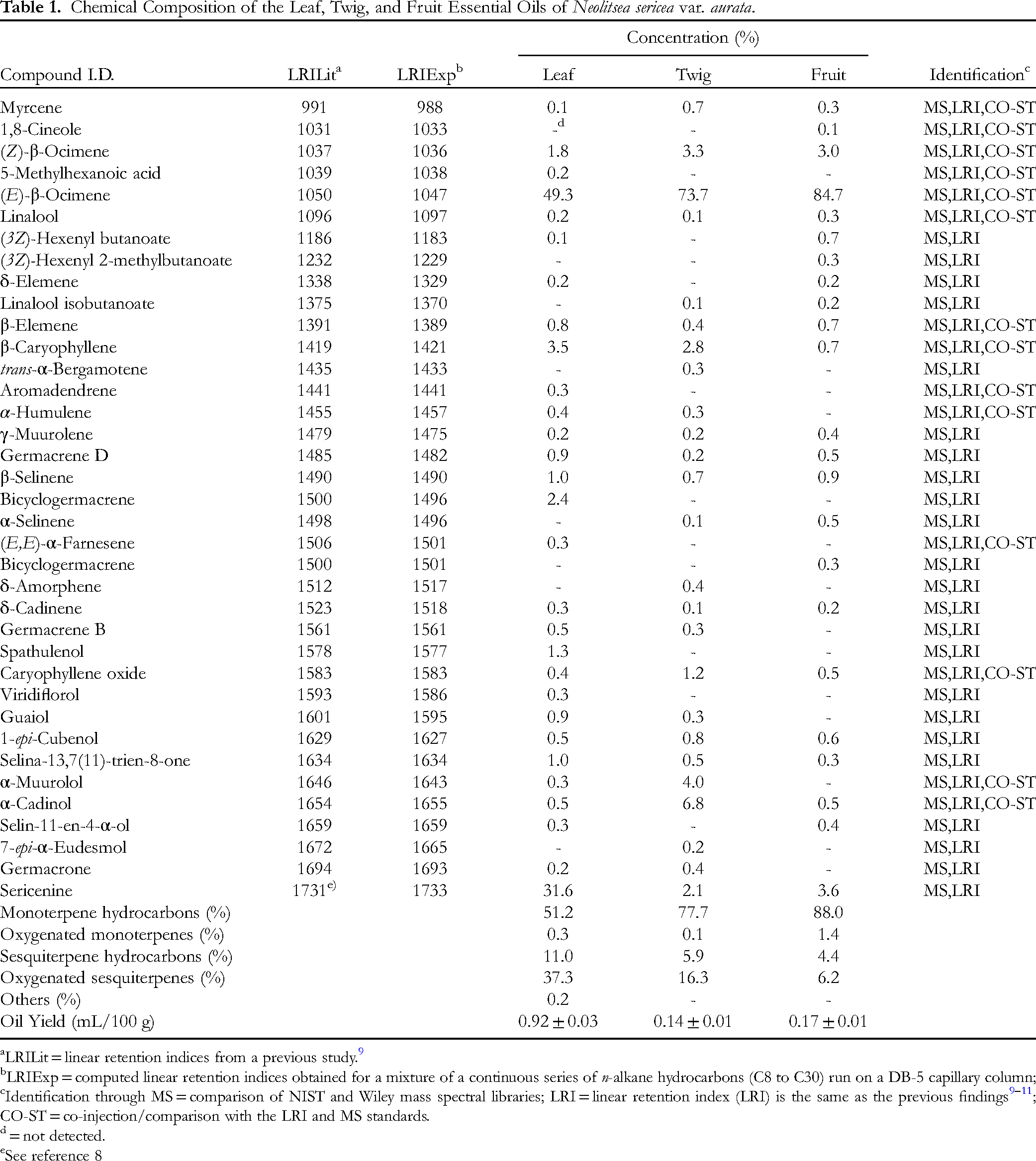
LRILit = linear retention indices from a previous study. 9
LRIExp = computed linear retention indices obtained for a mixture of a continuous series of n-alkane hydrocarbons (C8 to C30) run on a DB-5 capillary column;
Identification through MS = comparison of NIST and Wiley mass spectral libraries; LRI = linear retention index (LRI) is the same as the previous findings9–11; CO-ST = co-injection/comparison with the LRI and MS standards.
= not detected.
See reference 8
A total of 25 compounds were identified in the twig oil. The twig oil contained 77.7% monoterpene hydrocarbons, 16.3% oxygenated sesquiterpenes, 5.9% sesquiterpene hydrocarbons, and 0.1% oxygenated monoterpenes. Among sesquiterpene hydrocarbons, the most abundant compound was (E)-β-ocimene (73.7%). Among oxygenated sesquiterpenes, the main compounds were α-cadinol (6.8%) and α-muurolol (4.0%).
A total of 23 compounds were identified in the fruit oil. The fruit oil contained 88.0% monoterpene hydrocarbons, 6.2% oxygenated sesquiterpenes, 4.4% sesquiterpene hydrocarbons, and 1.4% oxygenated monoterpenes. Among monoterpene hydrocarbons, (E)-β-ocimene (84.7%) was the most abundant component.
Few studies have examined the chemical composition of the essential oil of N. sericea var. aurata. However, we identified two studies reporting the composition of the leaf oil7,8 and one study reporting the composition of the fruit oil 7 of N. sericea. Nii et al 7 reported that the main ingredients of the leaf essential oil were isosericenine (43.9%), trans-β-ocimene (13.6%), caryophyllene (7.6%), and sabinene (6.1%). Yoon et al. 8 indicated that the leaf essential oil contained sericenine (32.3%), sabinene (21.0%), trans-β-ocimene (13.3%), β-caryophyllene (4.8%), and 4-terpineol (4.2%). These components are different from the ones we identified in the leaf oil of N. sericea var. aurata in this study. Nii et al 7 reported that the main components in the fruit oil of N. sericea were isosericenine (56.0%–69.9%) and trans-β-ocimene (4.8%–17.5%). These compounds are different from the ones we identified in the fruit essential oil of N. sericea var. aurata in this study. Therefore, this is the first study to report the composition of the leaf, twig, and fruit oils of N. sericea var. aurata.
We examined the antibacterial activity of the leaf, twig, and fruit oils of N. sericea var. aurata against food-borne pathogenic bacteria by using disk diffusion method and serial dilution method, respectively. Six strains of food-borne pathogenic bacteria were selected: three Gram-positive bacterial strains, namely Bacillus cereus, Staphylococcus aureus, and S. epidermidis, and three Gram-negative bacterial strains, namely Escherichia coli, Enterobacter aerogenes, and Vibrio parahaemolyticus. Table 2 lists the inhibition zone (IZ), minimum inhibitory concentration (MIC), and minimum bactericidal concentration (MBC) values of the leaf, twig, and fruit essential oils. The antibacterial activity of the twig oil was higher than that of the leaf and fruit oils (Table 2). The twig oil exhibited moderate to strong antibacterial activity against all the six food-borne pathogenic bacteria. The strongest inhibition was observed against B. cereus, S. aureus, and S. epidermidis, with their inhibition zones ranging from 28 to 34 mm, their MIC values ranging from 128 to 256 μg/mL, and their MBC values ranging from 256 to 512 μg/mL. However, the three essential oils exerted a stronger bacteriostatic effect on the Gram-positive bacteria than on the Gram-negative bacteria.
Antibacterial Activity of the Leaf, Twig, and Fruit Essential Oils of Neolitsea sericea var. aurata.

I. B. cereus, II. S. cereus. III. S. epidermidis, IV. E. coli, V. E. aerogenes, VI. V. parahaemolyticus.
Inhibition zone diameter (mm), including the diameter of the sterile disk (6 mm); values are presented as the mean ± SD.
The minimum inhibitory concentration is presented as μg/mL.
The minimum bactericidal concentration is presented as μg/mL.
α-Cadinol (100%) and α-Muurolol (100%) were isolated in this study.
Positive control: Amoxicillin (25 μg/disk).
Previous studies have reported that essential oils or antibacterial compounds are more effective against Gram-positive bacteria than against Gram-negative bacteria12–15; this finding is in accordance with that of the present study. The penetration of hydrophobic compounds in Gram-negative microorganisms is more difficult because of the presence of a second physical barrier formed by the outer membrane.15,16 Thus, the hydrophobicity of essential oils enables them to disrupt the lipid layer of bacterial cell membranes and mitochondria, thereby making the bacterial structure more permeable. This results in the leakage of ions and other cellular contents, 17 leading to lysis and death when limits are exceeded. 18 This mechanism interferes with the cytoplasmic membrane, enzyme activity, and electron flow, disrupting the proton motive force, active transport, ADP phosphorylation, and coagulation of cellular contents.17–20
In the anti-food-borne fungal pathogen experiment, we selected five fungi, namely Aspergillus flavus, A. niger, Chaetomium globosum, Penicillium citrinum, and Trichoderma viride. These fungi cause food spoilage and poisoning. Table 3 lists the MIC and IC50 values of the three essential oils derived from N. sericea var. aurata against the food-borne pathogenic fungi. The results revealed that the twig essential oil exhibited the highest inhibitory activity against the food-borne pathogenic fungi. The concentrations of the twig essential oil that completely inhibited the growth of A. flavus, A. niger, C. globosum, P. citrinum, and T. viride were 256, 256, 128, 512, and 256 μg/mL, respectively.
MIC and IC50 Values (μg/mL) of the Leaf, Twig, and Fruit Essential Oils of Neolitsea sericea var. aurata. Against Five Food-Borne Pathogenic Fungi.

The aforementioned results indicate that the twig essential oil of N. sericea var. aurata exhibited the highest antibacterial and antifungal activities. Therefore, to determine the antimicrobial active components of the twig essential oil, we performed silica gel column chromatography of the twig oil, and the eluent consisted of n-hexane (n-hex) and ethyl acetate (EA) mixed in different ratios (n-hexane/EA = 100/0 to 0/100). The eluents were divided into seven fractions (NTO1 to NTO7). Then, we used the seven fractions to conduct antibacterial and antifungal tests separately. The results are presented in Figures 1 and 2.

Inhibitory effects of the seven fractions of the twig essential oil against six food-borne pathogenic bacteria. Each experiment was performed five times, and the data were averaged (n = 5).

Inhibitory effects of the seven fractions of the twig essential oil against five food-borne pathogenic fungi. Each experiment was performed five times, and the data were averaged (n = 5).
As illustrated in Figure 1, the seven fractions were used for the antibacterial test, and the concentration of each fraction was 10 μL/disc. The NTO4 fraction exhibited the largest inhibition zones against the six food-borne pathogenic bacteria. In the antifungal test, the seven fractions were used, and the concentration of each fraction was 100 μg/mL. The results are presented in Figure 2. The NTO4 fraction exhibited the strongest inhibitory activity and the highest antifungal index against the five food-borne pathogenic fungi. Among the food-borne pathogenic fungi, the NTO4 fraction completely inhibited the growth of A. niger and C. globosum.
The aforementioned findings indicated that the NTO4 fraction displayed excellent inhibitory activity against food-borne pathogens. Therefore, we performed GC and GC/MS to identify the components of the NTO4 fraction. We identified 13 compounds in the NTO4 fraction, and its main components were α-muurolol (33.5%) and α-cadinol (46.2%) (Table 4).
Composition of the NTO4 Fraction Isolated from the Twig Essential oil of Neolitsea sericea var. aurata.

LRILit = linear retention indices from a previous study. 9
LRIExp = computed linear retention indices obtained against a mixture of a continuous series of n-alkane hydrocarbons (C8 to C30) run on a DB-5 capillary column;
We used the isolated and purified α-muurolol and α-cadinol to conduct antibacterial and antifungal tests against the six bacterial strains and five fungal strains separately. We used the disc diffusion method (a concentration of 10 μL/disc) to examine antibacterial activity. The two compounds inhibited the six bacterial strains, with their inhibition zones ranging from 23.8 to 56.8 mm (Table 2). Furthermore, both the compounds exhibited strong antifungal activity (Figure 3). At a concentration of 50 μg/mL, the two compounds completely inhibited A. flavus, A. niger, and C. globosum. Previous studies have indicated that these two compounds strongly inhibit the growth of bacteria and fungi.16,21

Antifungal index (%) of two compounds (50 μg/mL) from the Neolitsea sericea var. aurata twig oil against five food-borne fungal pathogens. Each experiment was performed five times, and the data were averaged (n = 5).
Conclusion
This study investigated the leaf, twig, and fruit oils of N. sericea var. aurata. The major components of the leaf oil were (E)-β-ocimene (49.3%) and sericenine (31.6%). The major components of the twig oil were (E)-β-ocimene (73.7%), α-cadinol (6.8%), and α-muurolol (4.0%). The major component of the fruit oil was (E)-β-ocimene (84.7%). The twig oil exhibited the strongest inhibitory activity against the food-borne bacterial and fungal pathogens. The twig oil was purified through fractionation. Among the seven fractions, NTO4 fraction displayed the strongest inhibitory activity against the pathogens. The main components of the NTO4 fraction were α-muurolol (33.5%) and α-cadinol (46.2%). These two compounds displayed excellent antibacterial and antifungal activities. The findings of this study can facilitate the development of diverse natural anti-food-borne pathogen products.
Experimental
Plant Materials
We collected the fresh leaves, twigs, and fruits of N. sericea var. aurata in March 2022 from Taimalee Research Center, Taiwan Forestry Research Institute (TFRI; Taitung County, Taiwan, elevation: 250 m, 22°35′59.2′′N, 120°58′48.9′′E). The plant was identified by Dr Hsu Chun-Kai from TFRI. A voucher specimen (HCCLH-093) was deposited at the Division of Wood Cellulose, TFRI, Taiwan.
Isolation of Leaf, Twig, and Fruit Essential Oils
We performed the hydrodistillation of 10 kg each of the leaves, twigs, and fruits by using a Clevenger-type apparatus for 3 h. Essential oils derived from the leaves, twigs, and fruits were dried using anhydrous sodium sulfate and stored in a specimen bottle at 4 °C until their use. The essential oil yield and all experimental data are expressed as the mean ± standard deviation of triplicate analyses.
Essential Oil Analysis
The N. sericea var. aurata leaf, twig, and fruit oils were analyzed through GC/FID and GC/MS. GC/FID was performed using a Hewlett–Packard 6890 gas chromatograph with FID fitted with a DB-5 fused silica capillary column (5% phenyl, 95% methylpolysiloxane, length: 30 m, inner diameter: 0.25 mm, film thickness: 0.25 μm). The oven temperature was maintained at 50 °C for 2 min and then gradually increased to 250 °C at a rate of 5 °C/min. The injector temperature was 270 °C, and the detector temperature was 250 °C. Hydrogen was used as a carrier gas at a rate of 1.0 mL/min and a split ratio of 1:60. The injection volume was 1 μL (1/100, v/v, in EA). LRI values of all compounds were calculated using the homologous series of n-alkanes (C8 to C30) as reference.9,10 The relative proportions of essential oil compositions were calculated using the peak normalization method. The results are summarized in Table 1 and listed in the order in which compounds were eluted from the DB-5 capillary column.
GC/MS was performed using a Hewlett-Packard 6890/5973 GG–MS system equipped with a DB-5 fused silica capillary column. Helium (1 mL/min, 99.995% purity) was used as the carrier gas. The parameters were identical to those used in GC/FID. The MS conditions were as follows: full scan mode (scan time: 0.3 s) and mass range = m/z 30–500 at 70 eV in the electrospray ionization mode.
Component Identification
Essential oils components were identified by comparing LRIs, retention time, and mass spectra with those obtained from authentic standards, NIST and Wiley mass spectral libraries, and previous studies.8,10,11
Isolation and Purification of Twig Oil Components
The twig oil of N. sericea var. aurata (20 g) mixed with silica gel (60 g) (Merck 7734, Merck Co., Germany) was analyzed using a silica gel column (600 g) and eluted with n-hex/EA. Gradient elution was performed by changing the ratio from 100/0 to 0/100. Then, each collected fraction was examined through thin-layer chromatography (TLC), and fractions with similar profiles were combined to generate seven subfractions (NTO1 to NTO7). The yield of each fraction was 18.5% (NTO1), 29.3% (NTO2), 20.8% (NTO3), 15.5% (NTO4), 10.5% (NTO5), 3.1% (NTO6), and 2.3% (NTO7). According to the antimicrobial activity assay, the NTO4 fraction exhibited the strongest antibacterial and antifungal activities. Next, we isolated and purified α-muurolol and α-cadinol from the NTO4 fraction through HPLC. The conditions were as follows: semipreparative HPLC Si-60 column, mobile phase: EtOAc:n-C6H14 = 30:70, and flow rate: 1 mL/min. α-Muurolol was isolated at retention time (R.t.) = 23.2 min, and α-cadinol was isolated at R.t. = 31.6 min. The chemical structures of the isolated compounds were determined by through MS, and 1H NMR spectroscopy. Two sesquiterpenoids, α-muurolol and α-cadinol, were isolated and identified through spectral analysis.16,22,23 α-Cadinol: Colorless needle crystal, m.p. 74 °C to 75 °C, EI-MS for C15H26O (EI-MS: 222), 1H NMR (in CDCl3): δ (ppm) 0.75 (3H, d, J = 7.0 Hz, H-12), 0.88 (3H, d, J = 7.0 Hz, H-13), 1.06 (3H, s, H-14), 1.63 (3H, s, H-15), 2.14 (1H, m, H-11), 5.46 (1H, br s, H-14). α-Muurolol: White solid, m.p. 137 to 138.5 °C, EI-MS for C15H26O (EI-MS: 222), 1H-NMR (in CDCl3): δ (ppm) 0.81 (3H, d, J = 6.9 Hz, H-14), 0.88 (3H, d, J = 6.9 Hz, H-13), 1.29 (3H, s, H-15), 1.65 (3H, s, H-11), 1.97 (1H, m, H-12), 5.51 (1H, m, H-5).
Antibacterial Activity
The following food-borne pathogenic bacteria were used in this study: three Gram-positive bacteria, namely B. cereus (ATCC 11778), S. aureus (ATCC 6538P), and S. epidermidis (ATCC 12228), and three Gram-negative bacteria, namely E. coli (IFO 3301), E. aerogenes (ATCC 13048), and V. parahaemolyticus (ATCC 17803). The bacterial strains were obtained from the Culture Collection and Research Center of the Food Industry Research and Development Institute, Hsinchu City, Taiwan.
The antibacterial activities of the leaf, twig, and fruit oils of N. sericea var. aurata were evaluated using the paper disc diffusion method, and their MIC and MBC were determined. In addition, the antibacterial activities of the main compounds obtained after the isolation of the twig essential oil were analyzed using the paper disc diffusion method, which was reported by Bauer et al. 24 In brief, the bacterial inoculum was seeded on solidified Mueller Hinton agar (MHA) in a Petri dish to produce uniform growth throughout the dish. After preparing the dishes, 6-mm-diameter discs of the filter paper containing 10 μL of the undiluted oil were placed on the plates inoculated with the test microorganisms. The zone of growth inhibition (including a disc diameter of 6 mm) was measured after 24 h incubation at 37 °C. Amoxicillin was used as the positive control. Each test was conducted with three replicates.
The MIC values were determined by performing a microdilution susceptibility test, which was conducted in accordance with the National Committee of Clinical Laboratory Standards, 25 as reported previously. 26 The essential oils were diluted to 10.24 mg/mL in dimethyl sulfoxide. A series of 2-fold dilutions of each individual essential oil, ranging from 1024 to 16 μg/mL, was tested.
The MBC was determined using the method reported by Chikezie. 27 Aliquots (100 μL) of each dilution without visible growth were spread on MHA. The inoculated Petri dishes and controls were incubated at 37 °C for 24 h. The number of colonies was counted and compared with those on control dishes. The MBC was defined as the lowest concentration that killed >99.9% of the initial inoculum. Data are expressed as the mean ± standard deviation of three independent experiments.
Anti-Food-Borne Fungal Pathogen Assays
The antifungal assay method reported by Su et al. 28 was adopted. The food-borne pathogenic fungi were obtained from the Culture Collection and Research Center of the Food Industry Research and Development Institute, Hsinchu City, Taiwan. The fungi used were A. clavatus (ATCC 1007), A. niger (ATCC 6275), C. globosum (ATCC 6205), P. citrinum (ATCC 9849), and T. viride (ATCC8678). The assays were performed in triplicate, and the data were averaged. Different concentrations of the essential oils and main constituents of the twigs oil (16 to 1024 μg/mL) were added to sterilized potato dextrose agar (PDA). The test Petri dishes were incubated at 27 °C. When the mycelium of the fungi reached the edge of the control plate, the anti-food-borne fungal pathogen index (%) was calculated as (1 − Da/Db) × 100, where Da is the mycelium diameter (cm) of the experimental groups, and Db is the mycelium diameter (cm) of the control group. Nystatin was used as the positive control. Each test was repeated five times, and the data were averaged. The concentration that inhibited 50% of mycelial growth (IC50) was calculated in probit analysis.
Footnotes
Declaration of Conflicting Interests
The author(s) declared no potential conflicts of interest with respect to the research, authorship, and/or publication of this article.
Ethical Approval
Ethical approval is not applicable for this article.
Funding
The author(s) received no financial support for the research, authorship, and/or publication of this article.
Statement of Human and Animal Rights
This article does not contain any studies with human or animal subjects.
Statement of Informed Consent
There are no human subjects in this article and informed consent is not applicable.
