



Abstract
Introduction
Rauvolfia cambodiana Pierre ex Pit. (family Apocynaceae) is a shrub, up to 1.5 m tall and distributed in the wild in central Vietnam, such as Quang Tri, Thua Thien Hue, Quang Nam, Quang Ngai, Kon Tum, Gia Lai, and Dak Lak provinces.
1
In Vietnamese traditional medicine, the stems, roots, and leaves of this plant are used to treat some diseases such as high blood pressure, sedation, and memory loss.
2
The stem bark of this plant contains alkaloids (2.95%-6.40% of the dry weight), including isoreserpiline, reserpine, and ajmaline.3‐5 However, to date, there have been few studies on the chemical constituents and biological activity of R cambodiana. This paper reports the isolation, structure determination, and acetylcholinesterase inhibition activity of one new (
Results and Discussion
Compound

Chemical structures of
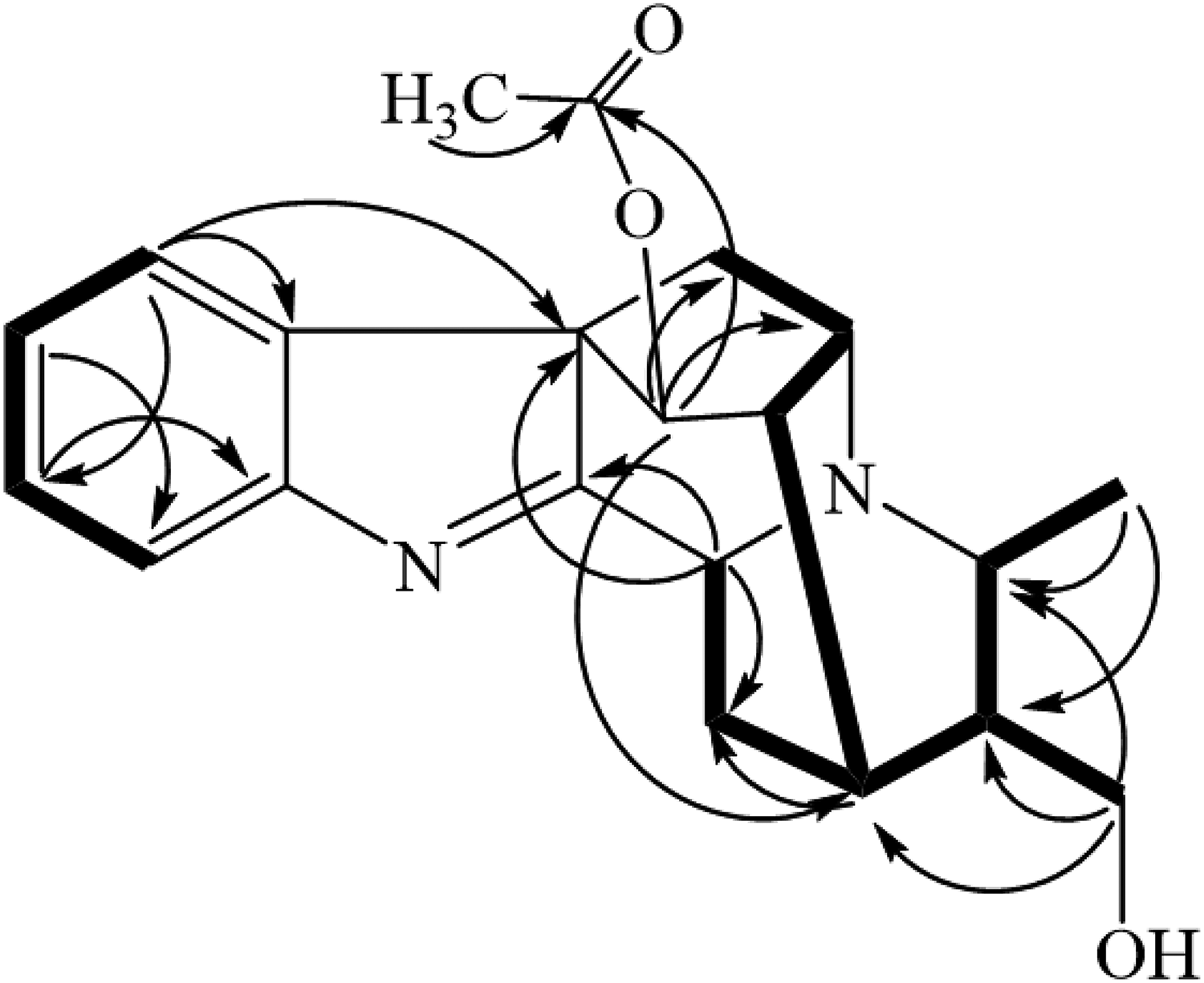
Key 1H-1H COSY and HMBC correlations of

Key NOESY correlations of

Comparison between experimental and td-DFT calculated ECD spectra of
1H NMR and 13C NMR Spectroscopic Data for

Measured in CDCl3.
150 MHz.
600 MHz.
All the NMR data assignments were made from 1H NMR, 13C NMR, HSQC, HMBC, COSY, and NOESY spectra.
Compounds
The HR-ESI-MS, IR, CD, and NMR spectra of compounds
The aerial parts of R cambodiana are used in Vietnamese folk medicine to enhance memory. In addition, some monoterpene indole alkaloids from the genus Rauvolfia have been reported to exhibit acetylcholinesterase inhibitory activity.
14
Therefore, compounds
Materials and Methods
General Experimental Procedures
The used characterization equipment is the same as that described in our previous work.15,16
Refer to Supplemental Material.
Plant Materials
The aerial parts of R cambodiana were collected from Dakrong Nature Reserve, Quang Tri Province, Vietnam, and identified by Dr Bui Van Thanh, Institute of Ecology and Biological Resources, VAST. The voucher specimen (NCCT-P141) has been deposited at IMBC, VAST.
Extraction and Isolation
Refer to Supplemental Material.
Rauvolcambonine (1 )
Pale yellow solid,
Acetylcholinesterase Inhibitory Assay
Refer to Supplemental Material.
Theoretical Calculation of ECD Spectra for Compound 1 16
Refer to Supplemental Material.
Conclusions
In this study, one new alkaloid named rauvolcambonine (
Supplemental Material
sj-docx-1-npx-10.1177_1934578X231153732 - Supplemental material for Alkaloids and Iridoids From the Aerial Parts of Rauvolfia cambodiana Pierre ex Pit. and Their Acetylcholinesterase Inhibitory Activity
Supplemental material, sj-docx-1-npx-10.1177_1934578X231153732 for Alkaloids and Iridoids From the Aerial Parts of Rauvolfia cambodiana Pierre ex Pit. and Their Acetylcholinesterase Inhibitory Activity by Ninh Khac Thanh Tung, Nguyen Chi Mai, Duong Thi Hai Yen, Bui Huu Tai, Ninh Khac Ban, Jong Seong Kang and Phan Van Kiem in Natural Product Communications
Footnotes
Acknowledgments
The authors would like to thank Dr Bui Van Thanh at the Institute of Ecology and Biological Resources, VAST for the plant identification.
Author Contribution
Research idea: NKB, PVK, and JSK; Isolation: DTHY, NKTT, and NCM; Structure elucidation and writing: NKB, PVK, and BHT.
Declaration of Conflicting Interests
The author(s) declared no potential conflicts of interest with respect to the research, authorship, and/or publication of this article.
Funding
The author(s) disclosed receipt of the following financial support for the research, authorship, and/or publication of this article: This work was supported by the Vietnam Academy of Science and Technology (VAST) (grant number NVCC38.01/22-23).

Supplemental Material
Supplemental material for this article is available online.
References
Supplementary Material
Please find the following supplemental material available below.
For Open Access articles published under a Creative Commons License, all supplemental material carries the same license as the article it is associated with.
For non-Open Access articles published, all supplemental material carries a non-exclusive license, and permission requests for re-use of supplemental material or any part of supplemental material shall be sent directly to the copyright owner as specified in the copyright notice associated with the article.
