



Abstract
Since the recent coronavirus disease 2019 pandemic and the lifestyle changes it necessitated, the demand for mental health treatment has skyrocketed, with long wait lists for both psychological and psychiatric care. Over-the-counter supplements and home remedies are increasingly sought. In this study, we screened natural materials and blended supplements from Asia that may improve the mood and mental health of humans by testing cell viability and expression of the proopiomelanocortin gene as a marker of β-endorphin production in rat hypothalamus neuron cells. Among 23 tested samples, 3 samples produced significantly higher cell viability in R-HTH-507 cells than the control treatment. In a real-time-polymerase chain reaction (RT-PCR) experiment, 7 samples showed significant β-endorphin synthesis activity. This is the first report that the Asian natural materials Areca catechu, Moringa oleifera, Lignosis rhinocerus, and Aegle marmelos promote β-endorphin synthesis; further investigation will identify the active ingredients in the blended samples. These results suggested that these Asian natural materials have great potential to expand the range of treatments for mental health.
Introduction
Due to the spread of the coronavirus, people are often unable to go out and spend their time at home for more than 2 years. Because of this restricted life style, people are concerned about the effects on their mental health, such as stress build up, anxiety and depression-like symptoms. World Health Organization (WHO) reported that, global prevalence of anxiety and depression increased by 25% In the first year of the coronavirus disease 2019 (COVID-19) pandemic. Many studies investigated the psychological effects of COVID-19 on health care workers and the general public, and reported high levels of problems in these aspects. A study reported the prevalence of 28% for anxiety, 32% for depression, and 31% for stress in the student population during the pandemic. 1 Irfan et al 2 examined university students’ anxiety level in Malaysia and found that only 12.3% of students were unaffected, whereas 30.5% were experiencing mild anxiety, 31.1% moderate anxiety, and 26.1% severe anxiety. In a similar experiment conducted in Thailand, the COVID-19 pandemic had a negative influence on anxiety symptoms of health professional students in Thailand. 3 Healthcare professionals also have mental illness because of excessive stress and mental stress, long working hours, being away from the family, lacking proper protective equipment in the working environment, and no effective treatment. Burnout levels and factors associated with the risk of psychological distress among healthcare workers engaged in the management of COVID 19 in India was reported. 4
In Asia, there have been unique drugs different from Western medicine, such as Chinese herbs, Yunani and Ayurveda were used to improve physical and mental illness. These medicines have been used over century in Asian countries, however the scientific evidence of these traditional medicines is mainly empirical, and require further experimental research. In this study, we chose 23 natural materials or supplements containing several herbs from throughout Asia (India, Malaysia, Thailand, and Philippine). These products were chosen because they have been used as folk remedies for decades and were easily obtained from a single source.
β-endorphin is one of the peptide hormones known to be related with pain, mental illness, stress reduction, homeostasis, and reward cognition. 5 It is derived from β-lipotropin, which is produced from a precursor, proopiomelanocortin (POMC). POMC expressed in the pituitary gland and arcuate nucleus of the hypothalamus is cleaved into β-lipotropin and adrenocorticotropic hormone by endoproteinase. Thus, promote POMC gene expression will increase β-lipotropin production which reads to yielding β-endorphin.
In this study, we carried out a screening using rat hypothalamus neuron cells to evaluate POMC gene expression as a β-endorphin synthesis marker to find candidate drugs able to reduce stress and anxiety and increase users’ sense of well-being.
Result and Discussion
First Screening
To investigate antistress activity from Asian natural remedies and supplements, activation of rat hypothalamus neuron cells (R-HTH-507) was examined. Any samples showing significantly less cell growth than controls were considered toxic. As the result of the cytotoxicity experiment, 13 of the 23 water-extracted samples showed significant cytotoxicity to R-HTH-507 cells compared to water-treated controls (Figure 1). Only 1 sample (No. 7) showed more than 100% cell viability compared to controls. This plant material, Areca catechu, also known as betel tree, is widely used as chewable tobacco. Betel nut chewing is known for mental stimulation effects such as reducing stress and a sense of wellbeing or even euphoria. Our result also supported that A catechu can change people's moods. Unfortunately, some studies have shown that chewing betel nuts increases the risk of oral and pharyngeal cancers.6,7
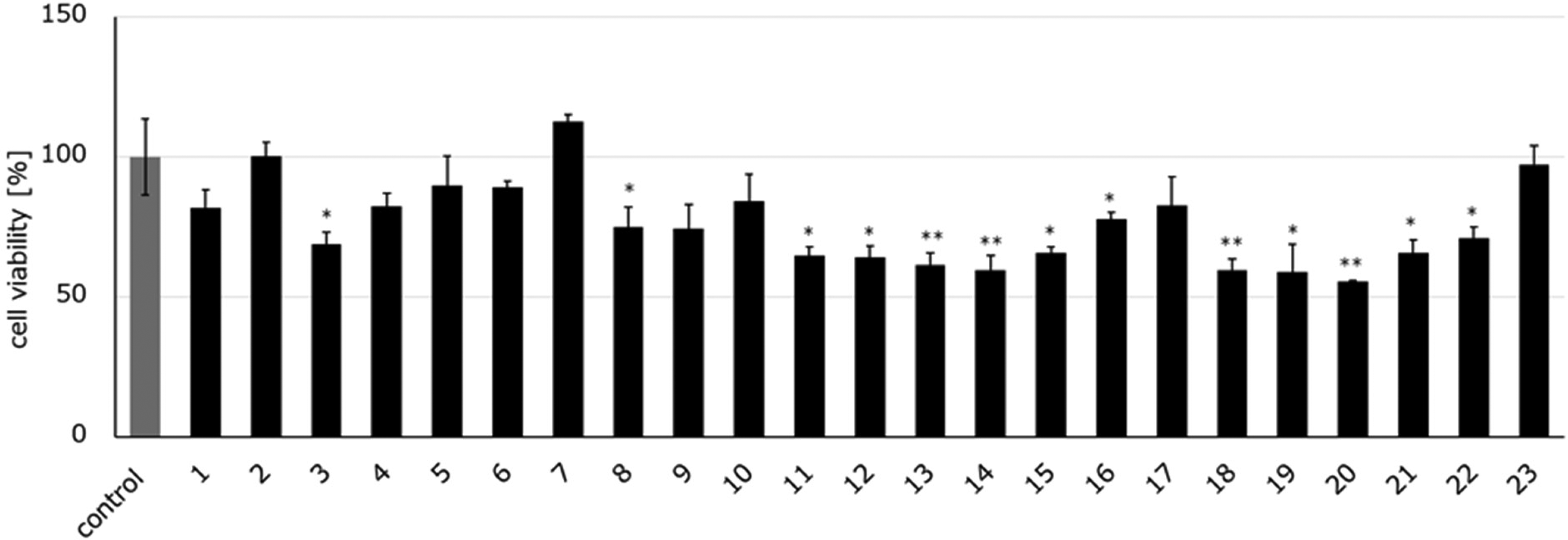
Cell viability of R-HTH-507 cells at first screening. R-HTH-507 cells were treated with 50 μg/mL water extract of each sample. The cell viability after 24 h of treatment was measured by 3-(4,5-dimethylthiazol-2-yl)-2,5-diphynyltrazoliumbromide (MTT) assay. Control; MQ, *; P < .05, **; P < .01. average ± SD, n = 3.
We considered that the high rate of R-HTH-507 cell deaths may have occurred because of the high concentration of each sample. People tend to believe that natural products are at least as safe if not safer than pharmaceutical drugs, and this is true in many cases. However, care should be taken not to make assumptions that natural plants having some positive effects on humans are safe at any concentration. It is important to identify the appropriate concentration of natural material to elicit the functional effect of the material while reducing the risk of side effects.
Second Screening
Therefore, in a second screening experiment, the concentrations of water extracts of samples were adjusted as shown in Table 1, based on the results of first screening (Table 1). This time, sample 6 and 10 showed significantly higher cell survival rate of the R-HTH-507 cells than the cells treated with MQ (Figure 2). In addition, the average cell viabilities of sample 4, 5, 7 and 9 were slightly higher than the water control. Sample 6 is a blended supplement containing Asparagus adscendens, Mucuna pruriens, Withania somnifera, Curculigo orchiodis, Pausinystalia yohimbe and Shilajeet (Supplemental table S1). It has been reported that A adscendens has an antidepressant-like effect 8 in an in vivo experiment. Furthermore, ashwagandha (W somnifera) has been used in Ayurveda and other medicines for over 3000 years in India and is known to reduce anxiety and stress.9,10 These materials in sample 6 might explain its high stimulatory activity in R-HTH-507 cells. Moringa oleifera Lam. (sample 10) has been previously shown to have neuroprotective effects11,12; because the cells used in this study were rat hypothalamus neurons, the high cell viability of sample 10 against R-HTH-507 is consistent with these previous studies.

Cell viability of R-HTH-507 cells in the second screening. R-HTH-507 cells were treated with adjusted concentrations of the water extract of each sample. The cell viabilities after 24 h of treatment were measured by 3-(4,5-dimethylthiazol-2-yl)-2,5-diphynyltrazoliumbromide (MTT) assay. Control; MQ, *; P < .05, **; P < .01. average ± SD, n = 3.
Natural Materials.
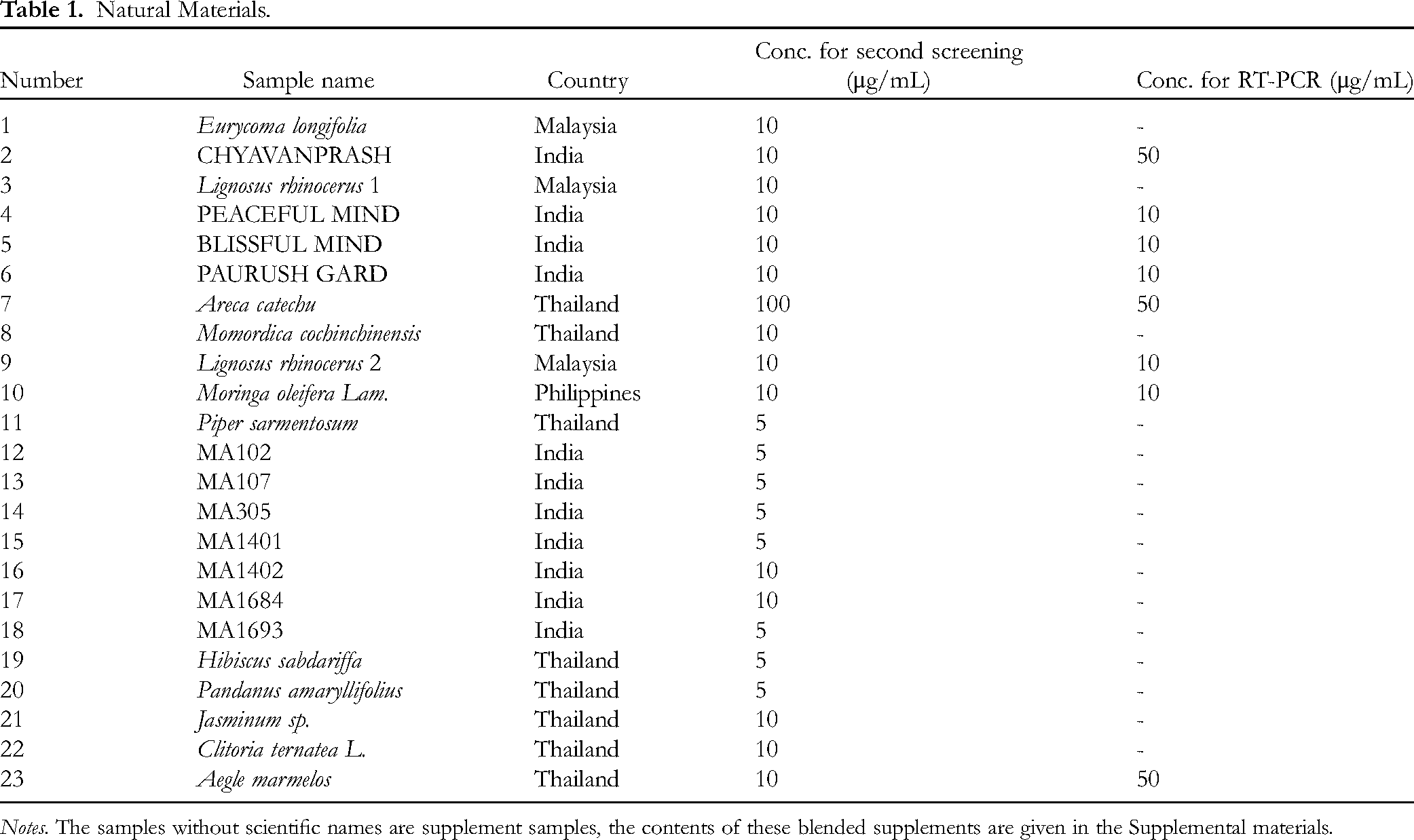
Notes. The samples without scientific names are supplement samples, the contents of these blended supplements are given in the Supplemental materials.
Eight samples continued to show cytotoxicity against hypothalamus neurons. Considering of the result of 2 3-(4,5-dimethylthiazol-2-yl)-2,5-diphynyltrazoliumbromide (MTT) assay and also the characteristics of the sample, 8 samples (No. 2, 4, 5, 6, 7, 9, 10 and 23) were chosen to be subjected to real-time polymerase chain reaction (PCR) examination of POMC gene expression.
Real-Time PCR
The gene expression of POMC involved in β-endorphin synthesis was investigated by real-time PCR. The sample concentration (Table 1) for this experiment was decided based on the results of first and second screening experiments. After being synthesized in the brain, POMC is broken down into enrhdorphins and corticosteroids by the action of enzymes. Therefore, it is considered that increased expression of the POMC gene indicates increased production of endorphins.
As a result, it was confirmed that the expression of the POMC gene was increased compared with the control by adding all 8 of the plant water extracts, with the exception of sample 2 (Figure 3). Samples 5 and 7 showed more than 3 times higher POMC gene expression than water-treated cells. Sample 5 (BLISSFUL MIND) mainly contains Centella asiatica, W somnifera, Convolvulus pluricaulis, and 5 other Ayurveda herbs. Water extract of C asiatica has previously been found to have cognitive-enhancing effects in animal models of ageing and Alzheimer's disease. The mechanisms of the cognitive-enhancing effect of C asiatica have been identified as upregulation of nicotinamide adenine dinucleotide in the brain and the modulation of brain-derived neurotrophic factor. 13 The cell used in the present study was a type of neuron cells, R-HTH-507, which presumably the modulation of neurotrophic factor would affect. C pluricaulis is reported to have an antidepressant-like effect against neuroinflammation-associated depressive behavior induced by chronic, unpredictable mild stress in rats. 14 The 3 main ingredients in sample 5 are well studied and proven to have nerve protection effects, and our result supports these previous studies. Sample 4 (PEACEFUL MIND) is also an Ayurvedic medicine that promotes calmness and stress/anger reduction. Bacopa monnieri, a component of PEACEFUL MIND, is known to have a neuroprotective effect.15,16

Expression levels of the proopiomelanocortin gene in R-HTH-507 cells. Relative value of POMC gene expression was estimated by real-time PCR. Control; MQ, *; P < .05, **; P < .01. average ± SD, n = 3. Abbreviations: POMC, proopiomelanocortin; PCR, polymerase chain reaction.
According to a previous study, Terminalia arjuna bark extract attenuates picrotoxin-induced anxiety in mice. 17 The positive result of sample 4 in this study might be due to the synergistic effect of these ingredients.
Sample 9 was Lignosus rhinocerus, commonly known as tiger milk mushroom, and also showed a high POMC gene expression effect. L rhinocerus has the known functional activities of antioxidation, neuroprotection, immunomodulating effect and skin conditioning.18,20 To the best of our knowledge this is the first report that L rhinocerus may also affect mental health. Sample 23 (Aegle marmelos) and sample 10 (M oleifera Lam) activated the POMC gene about 2 times the control activation. Raheja et al reported that A marmelos leaf extract showed cognitive impairment and oxidative stress improvement in rats. 21 In this study, A marmelos also exhibited a positive effect on rat neuron cells. M oleifera Lam is known to contain polyphenol; thus, this plant has anti-oxidative and anti-inflammatory activities as well as a protective effect against neurons. 12 De Barros et al 22 examined the acute and repeated-dose toxicity and genotoxicity of M oleifera leaves, and found that extract doses above 2000 mg/kg and powder doses at 500 and 1000 mg/kg are harmful to humans. The POMC gene expression activity of M oleifera was observed at 10 μg/mL, a concentration is far below the toxic concentration reported; nonetheless, it is important to consider the high-dose toxicity of this potential medicinal/nutraceutical extract.
Endorphins are central neurotransmitters thought to be involved in the endogenous analgesic system. A catechu, L rhinocerus II, M oleifera Lam, and A marmelos water extracts can be expected to increase the production of β-endorphins. Among these natural materials, A catechu and L rhinocerus showed higher POMC gene expression than the others; supplement material PEACEFUL MIND and BLISSFUL MIND also stimulate POMC gene expression. C asiatica, a common component in these 2 supplements, is known to contain triterpene. 23 A catechu (sample 7) and L rhinocerus (sample 9) are also reported to have triterpene24,25; thus, we expect that triterpene may be one of the active compounds in these natural blended supplements that promote POMC gene expression.
β-endorphin synthesis has been reported to have stress-reducing effects in humans. 5 This is the first report to reveal that A catechu, M oleifera, L rhinocerus and A marmelos promote β-endorphin synthesis. Although some of the samples used in this study showed likely production β-endorphin, this experiment was a preliminary screening of an endorphin precursor gene. The endorphin expression level needs to be examined in the next study, in which we will also explore the active compounds in these Asian plants.
Conclusion
Twenty-three natural herbs and supplements used in traditional medicine in 4 Asian countries to promote a sense of well-being were obtained. These herbs and supplements were tested on rat neuronal cells to investigate their potential as anxiolytic and/or antidepressant drugs. Seven herbs and supplements exhibited positive effects on the target cells; ie, of increased viability. According to the RT-PCR experiment results, the mechanism of antistress might be related to the increase of POMC gene expression and the promotion of β-endorphin synthesis. This result suggested that traditional Asian plant-based medicines may be a good resource for psychotropic medicine.
Materials and Methods
Sample Preparation
Twenty-three natural materials and blended supplements were provided by Delightex (Singapore) (Table 1). The samples were ground to a powder and dissolved in MQ water at concentration of 50 μg/mL for first screening. The dissolved samples were mixed well by vortex and sonicated for 5 min. This step was repeated 6 times. We used these sonicated samples as water extract of each material. In the second screening and real-time PCR experiment, the concentration of the water-extracted sample was adjusted as indicated in Table 1.
Cell Culture
Rat hypothalamus neurons (R-HTH-507) were purchased from Lonza Bioscience and cultured in primary neuron growth medium (PNGM) supplemented with PNGM Singlequots, which contains all growth factors and supplements required for successful culture of rat and mouse neurons.
Cell Viability Assay
The cytotoxicity of R-HTH-507 was measured in vitro by a colorimetric method that measures the reaction of MTT purchased from Tokyo Chemical Industry with mitochondria. Generally, reduction of MTT occurs in metabolically active cells. The level of activity is thus measured from the viability of the cell, which is proportional. Cells were cultured in a 96-well plate at a density of 1 × 10⁵ cells/mL for 24 h. Then, R-HTH-507 cells were treated with samples, dissolved in MQ. After 24 h, cell viability was determined using MTT reagent as follows: 10 μL of MTT solution (5 mg/mL PBS) was added to each well, followed by a 4 h incubation at 37 °C in 5% CO2. The supernatant was discarded, and 40 mM HCl-isopropanol (100 μL) was added to dissolve the formazan crystals. The absorbance was measured at 570 nm using a Microplate Reader 310-Lab (Corona Electric Company).
Real-Time PCR
R-HTH-507 cells were seeded in 24-well plate at 0.5 × 10⁵ cells per dish. After 24 h of incubation, water extracted samples or MQ as a control was added to the R-HTH-507 cells. The R-HTH-507 cells were then cultured for an additional 24 h. Total RNA was purified from the cultured R-HTH-507 cells using PureLink RNA Mini kit (Thermo Fisher Scientific). The cDNA strand was synthesized from 400 ng of total RNA using ReverTra Ace qPCR RT Master Mix with gDNA Remover (TOYOBO). Quantitative real-time PCR was performed in a total reaction volume of 20 µL using THUNDERBIRD SYBR qPCR Mix (TaKaRa Bio) and 20 ng cDNA per reaction. Real-time PCR was performed using an Agilent AriaMX Real-Time PCR system (Agilent Technologies) under the following conditions: 3 min at 95 °C, followed by 40 cycles each of 95 °C for 3 s and 60 °C for 30 s Primers used for amplification were CCTCACCACGGAAAGCA and TCAAGGGCTGTTCATCTCC for POMC, or TTGTGCAGTGCCAGCCTC and CCAA-TACGGCCAAATCCG for GAPDH. The expression level of the POMC gene was analyzed using ΔΔCt analysis mode with AriMx Real-Time PCR software.
Statistical Analysis
Cell viability is expressed as means ± SD values. The statistical significance of differences was evaluated using the Student's t test.
Supplemental Material
sj-docx-1-npx-10.1177_1934578X231152964 - Supplemental material for Screening of Asian Natural Materials to Promote β-Endorphin Synthesis
Supplemental material, sj-docx-1-npx-10.1177_1934578X231152964 for Screening of Asian Natural Materials to Promote β-Endorphin Synthesis by Masako Matsumoto, Maki Nagata, Yutaka Kuroki and Kuniyoshi Shimizu in Natural Product Communications
Footnotes
Declaration of Conflicting Interests
The author(s) declared no potential conflicts of interest with respect to the research, authorship, and/or publication of this article.
Funding
The author(s) received no financial support for the research, authorship, and/or publication of this article.

Supplemental Material
Supplemental material for this article is available online.
References
Supplementary Material
Please find the following supplemental material available below.
For Open Access articles published under a Creative Commons License, all supplemental material carries the same license as the article it is associated with.
For non-Open Access articles published, all supplemental material carries a non-exclusive license, and permission requests for re-use of supplemental material or any part of supplemental material shall be sent directly to the copyright owner as specified in the copyright notice associated with the article.
