



Abstract
Introduction
The genus Vitex (Lamiaceae) is made up of 233 recognized species, 1 dominated by trees and shrubs, found in tropical and sub-tropical regions.2,3 Common species used in ethnobotanical medicine include V. agnus-castus L., 4 V. negundo L., 5 V. rotundifolia L., 6 and V. trifolia L. 7
Vitex doniana Sweet (black plum) is a deciduous flowering tree growing up to 20 m height in the forests of coastal tropical west Africa. It is recognized with long-stalked leaves rounded at the apex with a glabrous leaflet and edible fruits. 8 V. doniana is known locally as “Oori nla” in Yoruba, “Dinya” in Hausa and “Ucha Koro” in Igbo. In folk medicine, V. doniana is used for treatment of several ailments, for example conjunctivitis, skin rashes due to measles or chickenpox, respiratory infections, and abdominal disorder and diarrhea.9–11 Antimicrobial potency of V. doniana has been reported against several bacteria, including methicillin resistant Staphylococcus aureus, Bacillus subtilis, Escherichia coli, Shigella dysenteriae, Pseudomonas aeruginosa, and Salmonella typhi among others.12–17 Hydroxycinnamic acid, saponins, allicins, flavonoids, and terpenoids have been identified in leaf extracts of V. doniana. 18 This present report is aimed at the characterization of the components of the essential oil of V. doniana and its antimicrobial activity for future exploitation in pharmaceutical applications.
Results and Discussion
Essential Oil Composition
Hydrodistillation of V. doniana leaves gave a pale-yellow essential oil in 0.65% (v/w) yield. The essential oil was analyzed by gas chromatography-mass spectrometry (GC-MS). A total of 21 compounds were identified in the essential oil (Table 1), which was predominantly (46.75%) oxygenated diterpenoids with phytol (16.87%) and incensyl acetate (23.57%) as the dominant components. Sesquiterpene hydrocarbons (20.31%) also made up a large percentage of the composition with (E)-caryophyllene (12.34%), α-humulene (3.71%), and ar-curcumene (3.22%). Notably, monoterpene hydrocarbons were not observed and linalool was the only oxygenated monoterpenoid in only 2.92%. Other constituents in high concentration were phytone (9.73%) and p-vinylanisole (5.82%).
Chemical Composition of the Leaf Essential Oil of Vitex doniana From Southwestern Nigeria.

RIcalc, retention index calculated with respect to a homologous series of n-alkanes on a ZB-5 ms column; RIdb, reference retention index from the databases.19–22
Three measurements.
A previous report on V. doniana essential oil also showed phytol and (E)-β-caryophyllene to be major components. 23 In contrast, however, β-phellandrene (31.3%) was the dominant component in the previous study, but this compound was not detected in the present study. Likewise, incensyl acetate (23.57%) and phytone (9.73%) were major components in the present study, but were not observed in the previous work. Variation in the composition of the present and the previous study may be attributed to climatic, geographical, and environmental factors.24,25 Interestingly, Vitex ajugifolia and Vitex pinnata leaf essential oils also showed a paucity of monoterpenoids, while Vitex trifolia essential oils were dominated by monoterpenoids. 26 Furthermore, Vitex negundo essential oils from Vietnam have shown large variations in chemical composition depending on geographical location. 27
Antibacterial and Antifungal Activity
The V. doniana essential oil and 3 essential oil components were assayed for antibacterial and antifungal activity using the microbroth dilution technique against a panel of pathogenic bacteria, namely Bacillus cereus, Staphylococcus aureus, Staphylococcus epidermidis, and Streptococcus pyogenes; and pathogenic fungi Aspergillus fumigatus, Aspergillus niger, Cryptococcus neoformans, Microsporum canis, Microsporum gypseum, Trichophyton mentagrophytes, Trichophyton rubrum, and Candida albicans (see Table 2).
Antibacterial and Antifungal Activities (MIC, μg/mL) of Vitex doniana Leaf Essential Oil From Southwestern Nigeria.
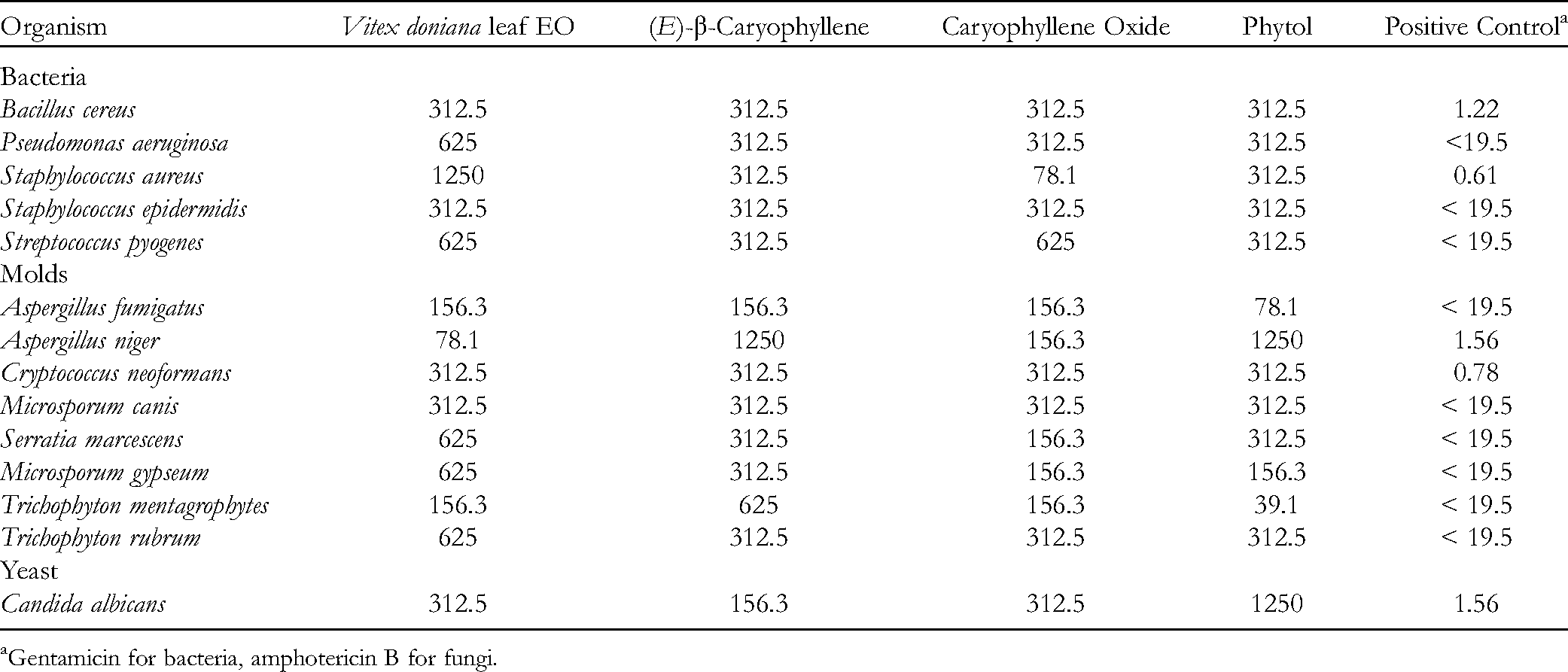
Gentamicin for bacteria, amphotericin B for fungi.
The antimicrobial screening of V. doniana leaf essential oil revealed a broad range of activities and inhibited 14 microorganisms with minimum inhibitory concentration (MIC) ranging from 78.1 to 1250 μg/mL. Holetz and co-workers have defined antimicrobial activities of botanicals as good activity (MIC < 100 μg/mL), moderate activity (MIC 100-500 μg/mL), weak activity (MIC 500-1000 μg/mL), and inactive (MIC > 1000 μg/mL). 28 Thus, V. doniana essential oil was strongly active against A. niger (MIC = 78.1 μg/mL), moderately active against T. mentagrophytes and A. fumigatus (MIC = 156.3 μg/mL), and moderately active against B. cereus, S. epidermidis, C. neoformans, M. canis, and C. albicans (MIC = 312.5 μg/mL). The antimicrobial activities reported herein complement those reported previously by Sonibare and co-workers who found good activity against Proteus mirabilis (agar diffusion assay). 23 It is tenuous to speculate as to what components may be responsible for the antimicrobial activities; there does not seem to be any correlation between the activities of (E)-β-caryophyllene, caryophyllene oxide, or phytol and the activities of the essential oil. Incensyl acetate may also be responsible for the antimicrobial activities; incensyl acetate-rich frankincense has shown antimicrobial activities. 29 Synergistic effects likely play a role in the activities.30–32
Conclusions
In conclusion, this report complements the previous investigation of Sonibare and co-workers 23 and demonstrates the wide variation in essential oil composition of V. doniana leaf essential oil. It also adds to our knowledge of the antifungal properties of this essential oil; V. doniana should be considered as an alternative or complementary antifungal therapy option.
Materials and Methods
Plant Material
V. doniana Sweet leaves (2.5 kg) were collected from mature trees in the month of August, 2019, from Ile-Igbon Village, Lagelu, Oyo State, Nigeria at (7°28′59″ N, 4°4′59″ E). Botanical identification was done by Mr. S. A. Odewo at the Herbarium, Forest Research Institute of Nigeria (FRIN), Jericho, Ibadan, Nigeria, where a voucher specimen (Voucher Number FHI 112549) was deposited. Hydrodistillation of 3 samples of leaves, 450 g each, were carried out using all-glass Clevenger-type apparatus. For each distillation, a ratio of 2:6 V. doniana leaves and water were mixed and hydrodistilled for 3 to 4 h until no additional oil was observed to be distilled. The essential oils were combined, dried over anhydrous sodium sulfate to eliminate traces of water, and stored in a sealed vial under refrigeration (4 °C) prior to analysis.
GC-MS Analysis
The leaf essential oil from V. doniana was subjected to GC-MS analysis as previously reported 26 : the sample was injected 3 times. Identification of the individual components of the essential oils was prepared by injection of pure samples when available and determined by comparison of the retention index values, which were determined by calibration using a series of n-alkanes, 33 in addition to MS fragmentation comparisons with those found in the databases.19–22
Antibacterial and Antifungal Assays
The essential oil and 3 different components, (E)-β-caryophyllene, caryophyllene oxide, and phytol (Sigma-Aldrich, St. Louis, MO), were screened for antimicrobial activity against bacteria (Bacillus cereus [ATCC No. 14579], Staphylococcus aureus [ATCC No. 29213], Staphylococcus epidermidis [ATCC No. 12228], and Streptococcus pyogenes [ATCC No. 19615]); antifungal activity against the molds (Aspergillus fumigatus [ATCC No. 96918], Aspergillus niger [ATCC No. 16888], Cryptococcus neoformans [ATCC No. 32045], Microsporum canis [ATCC No. 11621], Microsporum gypseum [ATCC No. 24102], Trichophyton mentagrophytes [ATCC No. 18748], and Trichophyton rubrum [ATCC No. 28188]), along with one yeast (Candida albicans [ATCC No. 18804]) using the microbroth dilution technique as previously described.34,35
Footnotes
Acknowledgements

Data Availability Statement
Data from this investigation are available in the manuscript.
Declaration of Conflicting Interests
The author(s) declared no potential conflicts of interest with respect to the research, authorship, and/or publication of this article.
Funding
The author(s) received no financial support for the research, authorship, and/or publication of this article.
Ethical Approval
Ethical approval is not applicable for this article.
Statement of Human and Animal Rights
This article does not contain any studies with human or animal subjects.
Statement of Informed Consent
There are no human subjects in this article and informed consent is not applicable.