



Abstract
Fullerene has attracted much attention for applications in biomaterials because of its high antioxidant activity. In this study, C60 and C70 fullerenes were mixed with a commercially available anionic phospholipid mixture, Technol PG, and sodium cholate, resulting in effective dispersion of the fullerenes to give small-sized fullerene nanoparticles.
Introduction
Recently, a variety of nanoparticles containing of bioactive organic molecules, proteins, and even cells have been designed.1–4 Among them, fullerenes are large carbon cage molecules regarded as 3D benzene analogues. Fullerene with 60 (Figure 1a) and 70 (Figure 1b) carbon atoms in the spherical structure is most abundant form of fullerenes. Their unique chemical and physical features have recently paid particular attention as biomaterials. Because of this, a variety of fullerene-based compounds having attractive biological activities have been synthesized for anticancer or antimicrobial therapy, enzyme inhibition, cytoprotection, controlled drug delivery, and radioactivity-based diagnosis.5–11 One promising research in this field is how to make fullerene soluble not only in chemical solvents but also in water. However, it is still challenging to disperse fullerenes because of its high crystallinity. Phospholipids, surfactants derived from biomolecules, are promising as dispersants, and thus preparations of fullerene nanoparticles using a neutral phospholipid such as 1,2-dipalmitoyl-sn-glycero-3-phosphocholine have been reported. 3 In view of practical applications of fullerene nanoparticles, creation of smaller sized particles using commercially available phospholipids, is often necessary. In this study, we report that C60 and C70 fullerenes can be effectively dispersed with Technol PG a mixture of anionic phospholipid (Figure 1c), and sodium cholate (SC) (Figure 1d) as a dispersant, which resulted in small-sized fullerene nanoparticles.

Molecular structures of C60 fullerene (a), C70 fullerene (b), phosphatidyl glycerol (c), sodium cholate (d). (e) Microscopic image of Technol PG vesicles. Scale bar 10 μm.
Materials and Methods
We focused Technol PG for designing practical fullerene nanoparticles. Technol PG is provided from YOKOZEKI cheaply as compared with typical anionic phosphatidyl glycerol such as 1,2-dipalmitoyl-sn-glycero-3-phosphocholine (≒ 1000$/g from Avanti). Previously, it was reported that Technol PG mixed with SC (Figure 1d) can be utilized for the creation of small-sized nanoparticles encapsulating bioactive molecules such as resveratrol. 12 For extension of these studies, Technol PG was utilized to disperse fullerene (Figure 2a). Since Technol PG alone formed large vesicles (Figure 1e), we prepared fullerene nanoparticles by mixing with Technol PG and SC in water and sonicating them. Typically, Technol PG powder (5.0 wt%), SC (2.0 wt%), and C60 fullerene powder (0.1 wt%) were dispersed in water, and sonicated at 100 W for 2 min, and then cooled to room temperature.
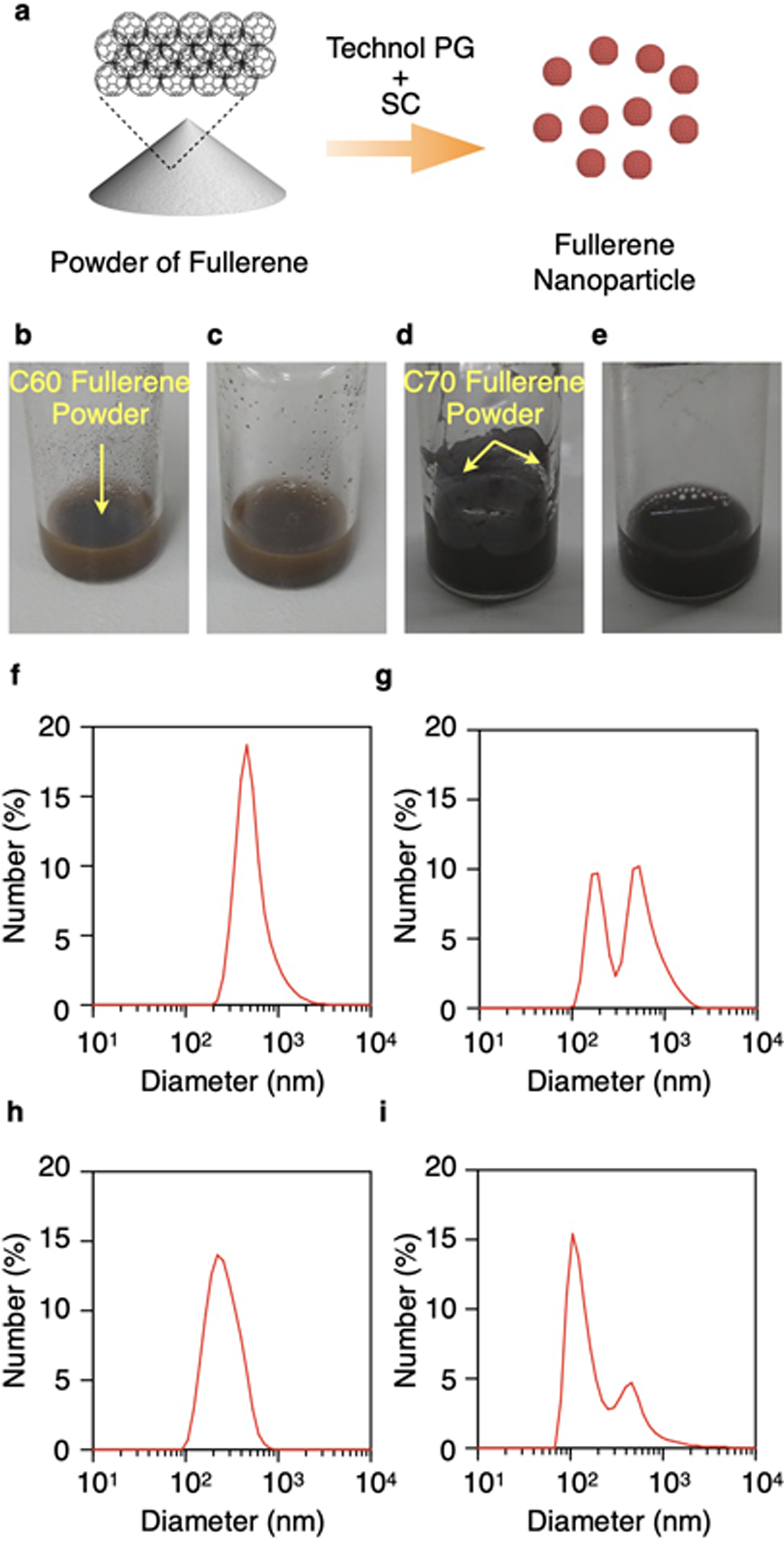
(a) Synthetic illustrations for the preparation of fullerene nanoparticles. Photograph of the dispersions of C60 fullerene (b) without and (c) with Technol PG (5.0 wt%) and SC (2.0 wt%), and C70 fullerene (d) without and (e) with Technol PG (5.0 wt%) and SC (2.0 wt%). DLS profiles of the dispersions of C60 fullerene (f) with-out and (g) with Technol PG (5.0 wt%) and SC (2.0 wt%), and C70 fullerene (h) without and (i) with Technol PG (5.0 wt%) and SC (2.0 wt%).
Result and Discussion
Visual observation of the prepared sample showed a floating of C60 fullerene powder (Figure 2b), but it turned into a brown transparent aqueous solution after the mixing with Technol PG and SC (Figure 2c). Interestingly, when C70 fullerene was dispersed in the same way, C70 fullerene could also be dispersed (Figure 2d and e). Then, the particle size of the particles by dynamic light scattering analysis was evaluated. C60 fullerene showed a peak around 459 nm without additive (Figure 2f). However, it showed a peak around 190 nm after the dispersion with Technol PG and SC (Figure 2g), confirming the creation of small fullerene nanoparticles. In addition, after dispersing with the mixture of Technol PG and SC, the sample of C70 fullerene also showed a peak around 106 nm (Figure 2i) which is smaller than untreated C70 fullerene with a size around 220 nm (Figure 2h). Microscopy of the samples revealed that both C60 fullerene (Figure 3a) and C70 fullerene (Figure 3c) which formed micrometer particles were dispersed to form smaller particles (Figure 3b and d) after the mixing with Technol PG and SC.

Microscopic observation of C60 fullerene (a) without and (b) with Technol PG (5.0 wt%) and sodium cholate (SC) (2.0 wt%), and C70 fullerene (c) without and (d) with Tech-nol PG (5.0 wt%) and SC (2.0 wt%). Scale bar 5 μm.
Conclusion
Here, fullerene nanoparticles using Technol PG were successfully prepared. Since fullerenes are promising materials for ultraviolet absorbers taking into account its high antioxidant activity, the small-sized fullerene nanoparticles prepared using cheaply available phospholipids in this study, is applicable to skin care materials with efficient permeability across the barrier function in the stratum corneum in future.
Experimental
Footnotes
Declaration of Conflicting Interests
The author(s) declared no potential conflicts of interest with respect to the research, authorship, and/or publication of this article.
Funding
The author(s) received no financial support for the research, authorship, and/or publication of this article.
