



Abstract
In this work, the dispersibility of Technol PG, composed of anionic phospholipids, was investigated in the presence of cholic acid-based surfactants.
With the recent diversification of drug discovery, nanometer-sized particles containing hydrophobic drugs play a crucial role.1,2 For example, properly size-controlled nanoparticles can target cancer tissue in blood administration due to enhanced permeability and retention effect. 3 Furthermore, it is also known that small particles can be used as carriers for transdermal drug delivery with high skin permeability. 4 Recently, we have studied nanoformulations of drug molecules using naturally occurring anionic phospholipids. For example, small-sized resveratrol (Res) nanoparticles dispersed with an anionic phospholipid of 1,2-dipalmitoyl-sn-glycero-3-phosphorylglycerol (DPPG) have been reported to exhibit high skin permeability. 5 We herein focused on Technol PG (Figure 1), which is available from YOKOZEKI for practical applications of anionic phospholipid-based nanoformulations. Technol PG consists of a mixture of phosphatidylglycerol having fatty acids which contain C16 and C18 with 0 (C18-0), 1 (C18-1), 2 (C18-2), and 3 (C18-3) of double bonds. The percentage of each component (C16, C18-0, C18-1, C18-2, C18-3) is 14.4%, 4.7%, 13.5%, 61.0%, and 6.0%, respectively. Since Technol PG is less expensive than DPPG, nanoformulation with Technol PG could be more practical. However, the utility of Technol PG has been not well explored. In this study, we prepared Technol PG-based nanoparticles using easily accessible cholic acid-derived surfactants (Figure 1). 6 Dispersion of Technol PG with sodium cholate (SC) enabled the encapsulation of hydrophobic molecules Res.
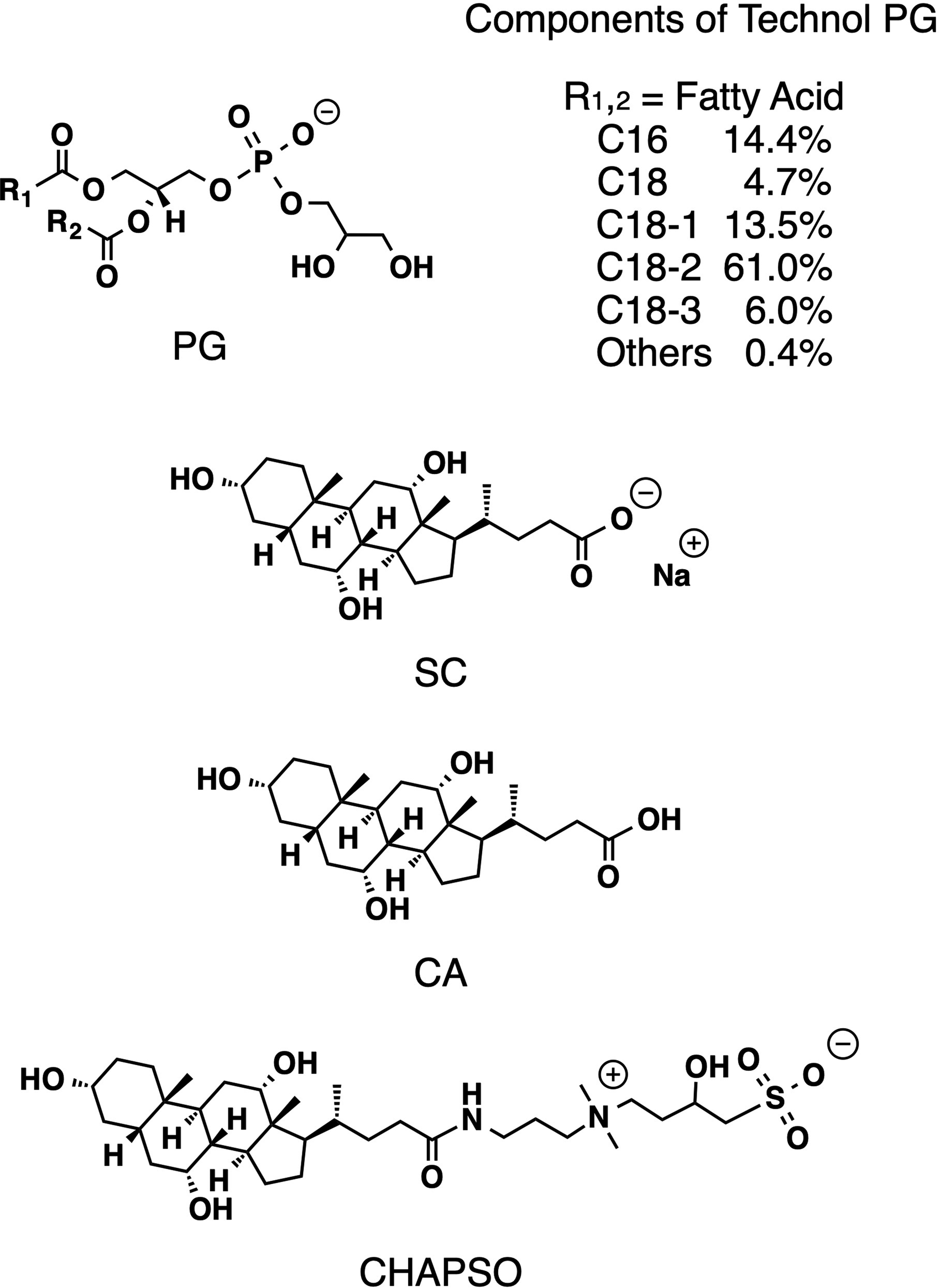
Molecular structure of PG and components of Technol PG, and molecular structure of SC, CA, and CHAPSO.
As a typical method, Technol PG powder (5 wt%) was dispersed in water, mixed with SC (0.5-5 wt%), and sonicated for 2 min. When 0.5 wt% of SC was mixed with Technol PG, a cloudy dispersion was observed (Figure 2b), similar to Technol PG before the addition of SC (Figure 2a). However, when SC was added at 2 wt% (Figure 2c) and 5 wt% (Figure 2d), the Technol PG dispersion became transparent. We performed a dynamic light scattering (DLS) analysis to investigate how the SC surfactant affected the size of Technol PG particles. The hydrodynamic diameter of Technol PG, around 0.1 to 10 μm (Figure 2e), decreased slightly after the addition of 0.5 wt% of SC (Figure 2f). Interestingly, the addition of 2 wt% (Figure 2g) and 5 wt% (Figure 2h) of SC resulted in Technol PG particles with 1 to 5 nm size as observed by DLS. To clarify the effects of molecular structure of the surfactants on the dispersibility of Technol PG, we next mixed Technol PG with noncharged cholic acid (CA) and 3-[(3-cholamidopropyl)dimethylammonio]-2-hydroxy-1-propanesulfonate (CHAPSO) having a zwitterionic group. As a result, a cloudy dispersion was observed when CA was added (Figure 2i), while a clear dispersion was observed when CHAPSO was mixed (Figure 2j), suggesting that the ionic groups in the surfactants were important for the dispersion of Technol PG. In good agreement with the DLS result, microscopic observation of Technol PG (5 wt%) with 2 wt% of SC revealed that Technol PG was well dispersed in the solution (Figure 3b), while it showed large aggregates before the addition of SC (Figure 3a).

Photograph of Technol PG (5 wt%) before (a) and after mixing with 0.5 wt% (b), 2 wt% (c), and 5 wt% (d) of SC. DLS profiles of Technol PG (5 wt%) before (e) and after mixing with 0.5 wt% (f), 2 wt% (g), and 5 wt% (h) of SC. Photograph of Technol PG (5 wt%) after mixing with 5 wt% of CA (i), and CHAPSO (j).

Microscopic observation of Technol PG (5 wt%) without (a) and with (b) sodium cholate (SC) (2 wt%). Scale bar 10 μm.
Interestingly, when Res (0.2 wt%) was added to the SC-dispersed Technol PG sample and sonicated for 1 min, a clear aqueous solution was observed, suggesting an encapsulation of Res into the Technol PG nanoparticles (Figure 4a). In fact, DLS analysis of the sample showed a hydrodynamic diameter of 1 to 5 nm, and no peak derived from an aggregate of Res was observed (Figure 4b).
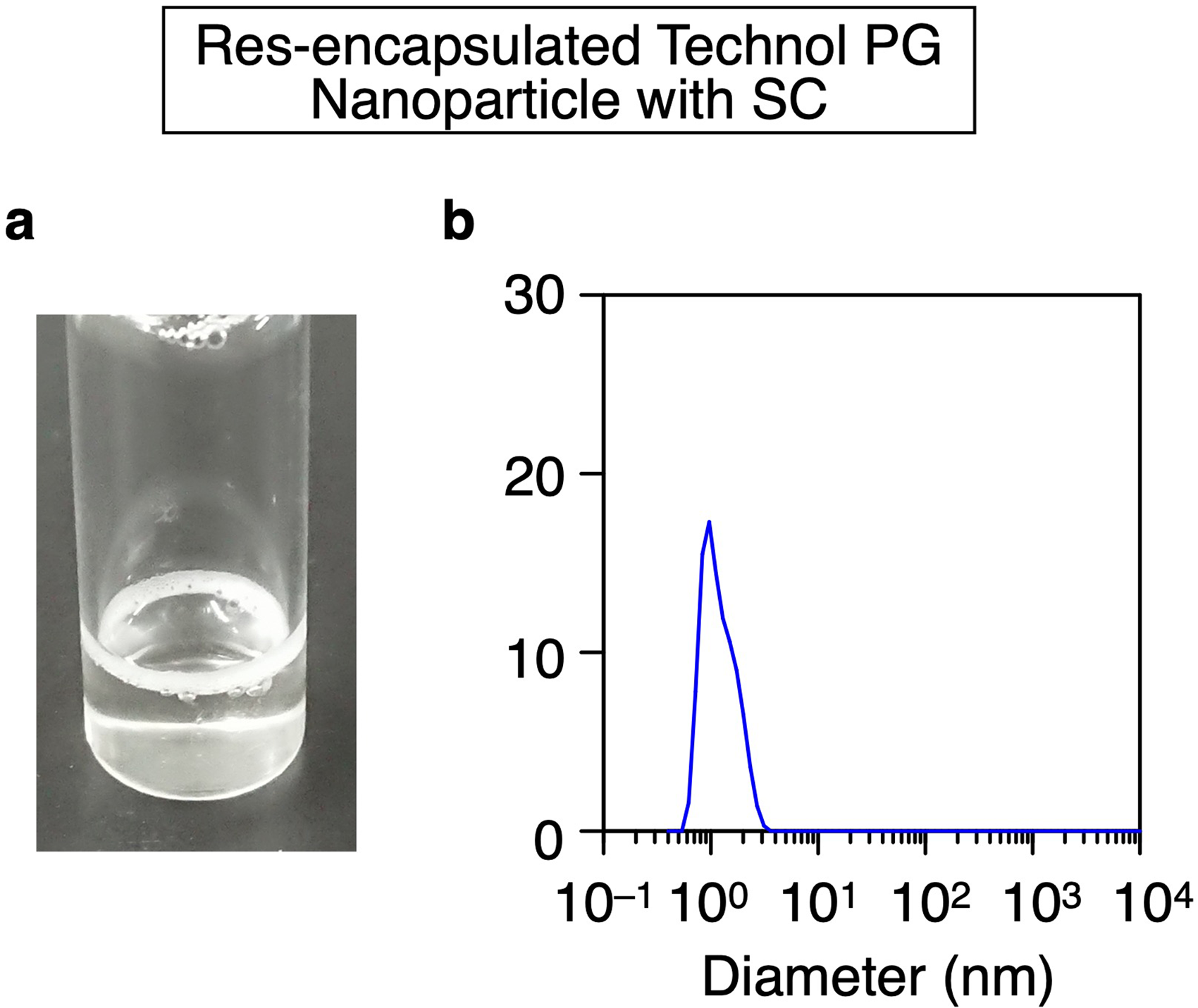
Photograph (a) and DLS profile (b) of the SC (5 wt%)-dispersed Technol PG (5 wt%) encapsulating Res (0.2 wt%).
In this study, we successfully prepared Technol PG nanoparticles by dispersing Technol PG powder with cholic acid-based surfactants such as SC. Since Res is known to exhibit antioxidant properties such as suppressing the effects of ultraviolet rays on skin tissue, Technol PG-based nanoparticles in this study could be applicable to skincare materials by evaluating its skin permeability in the future.
Experimental
General
Technol PG was provided by YOKOZEKI. CHAPSO, SC, and Res were purchased from TCI and CA from Nacalai Tesque.
Preparation of Technol PG Nanoparticles
For the preparation of Technol PG nanoparticle, Technol PG (5 wt%) was mixed with cholic acid-based surfactants of SC (0.5-5 wt%), CA (5 wt%), or CHAPSO (5 wt%) in water and sonicated for 2 min.
Footnotes
Declaration of Conflicting Interests
The authors declared no potential conflicts of interest with respect to the research, authorship, and/or publication of this article.
Funding
The authors received no financial support for the research, authorship, and/or publication of this article.
Ethical Approval
Not applicable, because this article does not contain any studies with human or animal subjects.
Informed Consent
Not applicable, because this article does not contain any studies with human or animal subjects.

Trial Registration
Not applicable, because this article does not contain any clinical trials.