



Abstract
This work explored the compositions of a crude extract of peels of Citrus x aurantium using a gas chromatography-mass spectrometry (GC-MS) technique. The crude extract of peels of C. × aurantium was analyzed by GC-MS revealing the presence of limonene as the major compound, accounting for 93.7% of the total. Virucidal activity of the oil of C. x aurantium peels against influenza A virus H1N1 was evaluated by the ASTM E1053-20 method. Moreover, the virucidal activity was also investigated of D-limonene, the major terpene in essential oils of C. x aurantium, and its enantiomer L-limonene. The essential oil of the C. x aurantium peels produced a log reduction of 1.9 to 2.0, accounting for 99% reduction of the virus, while D- and L-limonene exhibited virucidal activity with a log reduction of 3.70 to 4.32 at concentrations of 125 and 250.0 µg/mL, thus reducing the virus by 99.99%. Previous work found that D-limonene exhibited antiviral activity against herpes simplex virus, but L-limonene, an enantiomer of D-limonene, has never been reported for antiviral activity. This work demonstrates the antiviral activity of L-limonene for the first time. Moreover, this work suggests that concentrations of 0.0125% to 0.025% of either D- or L-limonene can possibly be used as a disinfectant against viruses, probably in the form of essential oil sprays, which may be useful disinfectants against the airborne transmission of viruses, such as influenza and COVID-19.
Introduction
Viral infections have become a global health concern by reason of the pathological consequences of the viral diseases and the high contagiousness of the viruses. Although scientists have been paying attention to viral infections for a long time ago, interest towards the infections has recently been increased noticeably due to the current global pandemic of coronavirus disease 2019 (COVID-19) which first emerged in Wuhan City, China in 2019. COVID-19 disease is caused by a highly contagious coronavirus, namely severe acute respiratory syndrome coronavirus 2 (SARS-CoV-2). 1 As of December 10, 2021, there were approximately 267 865 289 COVID-19 cases with 5 285 888 deaths worldwide. 2 Even though vaccines and antiviral agents have been developed recently, the efficacy and safety of these preventive and curative measures are controversial. However, viral infections caused by other viruses, such as human immunodeficiency virus, 3 dengue virus, 4 rabies, 5 enterovirus,6–8 and influenza viruses9–11 are undeniable. Diseases caused by viruses have been public health problems worldwide, and, therefore, effective and safe antiviral drugs are needed to fight against these viruses.
Influenza virus has been a serious public health problem worldwide, and has seasonal epidemics and periodic pandemics. 12 However, nowadays, the most serious virus infection is SARS-CoV-2 or COVID-19, which has been a critical problem throughout the world, significantly disrupting human daily life. In 2020 to 2021, there have been 2 main drugs, remdesivir and favipiravir, used for the treatment of COVID-19.13,14 However, these were originally not designed for the treatment of COVID-19. Remdesivir was previously designed to treat hepatitis C and Ebola virus, while favipiravir was formerly used for the treatment of influenza virus. Recently, most drug designs for the treatment of COVID-19 employed structures of antiviral drugs originally designed to treat other viral diseases. For example, 2 new drug candidates for the treatment of COVID-19 were designed from boceprevir or telaprevir, which are known protease inhibitors, and they are commonly used for the treatment of hepatitis C virus. 15 Therefore, information on antiviral activity, regardless of its efficacy against COVID-19 virus, is crucially important for the development of antiviral drugs. The examples of anti-COVID-19 drugs (remdesivir and favipiravir) 13,14 and drug candidates 15 originally designed for the treatment of other viruses, and not COVID-19 virus, underscore the importance of the findings of new antiviral compounds, which may be useful for anti-COVID-19 drug development. The present work has demonstrated an antiviral activity of essential oils from bitter orange, Citrus x aurantium L., as well as limonene.
Plant-based natural products have widely been using to treat both infectious and noninfectious diseases in traditional medicines as well as in Western medicine heretofore. Plant essential oils have broad biological activities against pathogens including antibacterial, antifungal, and antiviral activities.16–23 Essential oils also provide various benefits, for example, relieving migraine, 24 having antioxidant activity and tyrosinase inhibitory activity, 25 being used as nutraceuticals, 26 and for the treatment of Alzheimer's disease. 27 Recently, essential oils have been widely used as food preservatives or additives, replacing chemical additives, that is, nitrate and nitrite.28–33 Essential oils could give effects at the cellular levels, that is, activating GABA and olfactory receptors, and transient receptor potential channels, and thus transferring signals to the olfactory bulb and the brain. 34 Since the outbreak of COVID-19 has spread worldwide, a few reports recently proposed that essential oils could be potential agents for the treatment of this deadly virus.35–42 Recent evidence revealed that essential oils could be used for the management of upper respiratory tract symptoms in patients with COVID-19. 43 Inhalation of steam with essential oils released from boiling water containing herbs is widely used in Thailand for home remedies of COVID-19 patients; this method can relieve breathing difficulties of patients with severe acute respiratory illness and lung injury.
Citrus has complex taxonomy. Bitter orange has many names, for example, Citrus x aurantium L., Citrus aurantium L. var. amara, and Citrus aurantium var. myrtifolia. A spiny evergreen tree, Citrus x aurantium L., is native to Southeast Asia. While bitter orange (C. aurantium) has been widely studied for its chemical constituents, biologically active compounds of the variety Citrus x aurantium native to Southeast Asia have rarely been chemically explored. GC-MS analysis of the volatile chemical constituents in peels of Iranian C. aurantium revealed 4 major terpenes, limonene, β-myrcene, α-pinene, and β-pinene, 44 while the essential oil of leaves from Indian C. aurantium contained 3 major compounds, 2-β pinene, δ-3 carene, and limonene (28%). 45 Crude extract of C. aurantium peels showed a protective effect against cisplatin-incited renal damage in rats. 46 Synephrine alkaloids in C. aurantium were used for the treatment of overweight and obesity, 47 while essential oils from C. aurantium were able to prevent/control oral infections caused by bacteria. 48 It is known that essential oils of citrus plants have various biological activities and applications, that is, antimutagenic, antioxidant, 49 and antimicrobial activities, 50 applications in food,51,52 and anti-inflammatory and analgesic activities. 53 Citrus essential oils were reported to have antiviral activity, for example, against hepatitis A virus, 54 and recently they have received attention because of their potential use for the treatment of COVID-19 virus.23,55,56 Moreover, flavonoids from citrus could prevent Zika virus infection in human cells, 57 and they might have potential for COVID-19 treatment.58–60 Herein, we report the essential oil compositions of peels of C. x aurantium and their antiviral activity against influenza A virus H1N1, as well as virucidal activity of limonene, the major terpene in essential oils of C. x aurantium.
Results and Discussion
Peels of C. x aurantium were extracted with dichloromethane to give an extract, which is an essential oil. GC-MS analysis of the oil was performed, which revealed D-limonene as the major compound. D-Limonene and L-limonene, as well as an extract of C. x aurantium peels, were evaluated for virucidal activity.
Identification and Quantification of the Chemical Constituents of the Essential Oil of C x aurantium Peels
In Thailand, C. x aurantium is locally known as “Som Za,” which has a distinct orange odor, different from that of Citrus aurantium. In the present work, peels from fruits of C. x aurantium were extracted with dichloromethane to give an essential oil extract. GC-MS analysis was used to analyze its components (Table 1). Limonene was the major component (93.7%). Recent work reported that essential oils from leaves of C. x aurantium had linalyl acetate as the major compound (63.4%), but D-limonene formed only 1.57%. 61 The commercial essential oils of C. x aurantium had 94.7% of D-limonene, but this previous report did not indicate the plant part, that is, leaves or peels, from which the essential oils were obtained. 62 It is worth mentioning that essential oils obtained using different extraction methods, that is, hydrodistillation, solvent extraction, and supercritical fluid extraction, may have different percentages of compounds, and thus having different chemical compositions. 63
Chemical Composition of Essential Oil of Citrus x aurantium Peels.

Calculated retention indices.
Retention indices on DB-5 columns from Adams library (2017). 64
Virucidal Activity and Cytotoxicity of Essential Oils, D
-
Limonene, and L
-
Limonene
We evaluated the virucidal activity of the essential oil from peels of C. x aurantium. Since GC-MS analysis indicated that limonene was the major compound in the essential oil, we propose that limonene may be responsible for the biological activity. Therefore, we also investigated the activity of limonene, both D-limonene or (R)-(+)-limonene (1) and its enantiomer, L-limonene or (S)-(−)-limonene (2) (Figure 1). D-Limonene is commonly found in citrus plants, while L-limonene is found in pine needles and mint oils.
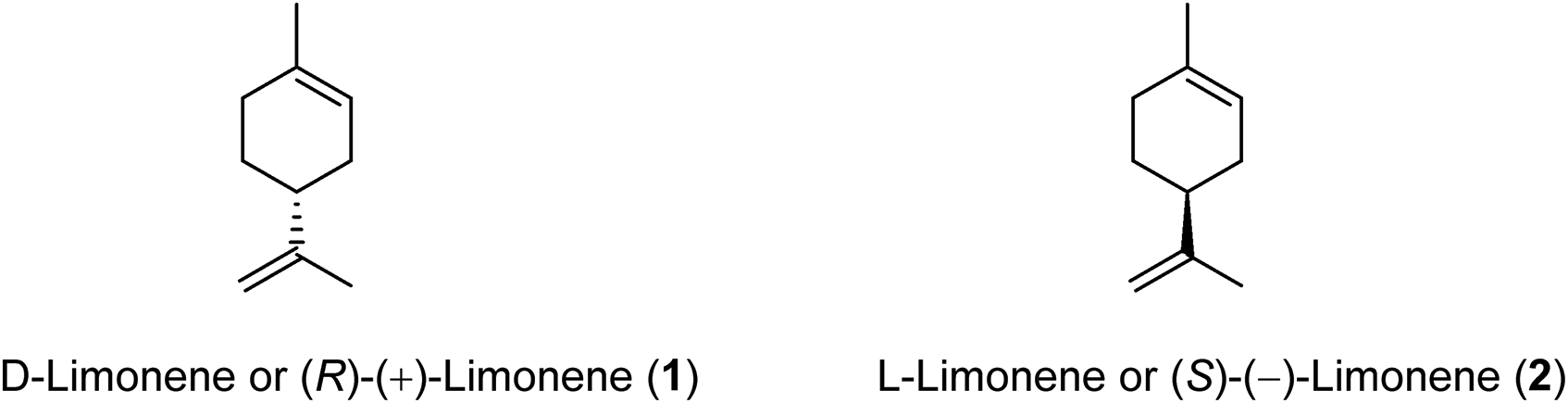
Structures of D-limonene or (R)-(+)-limonene (
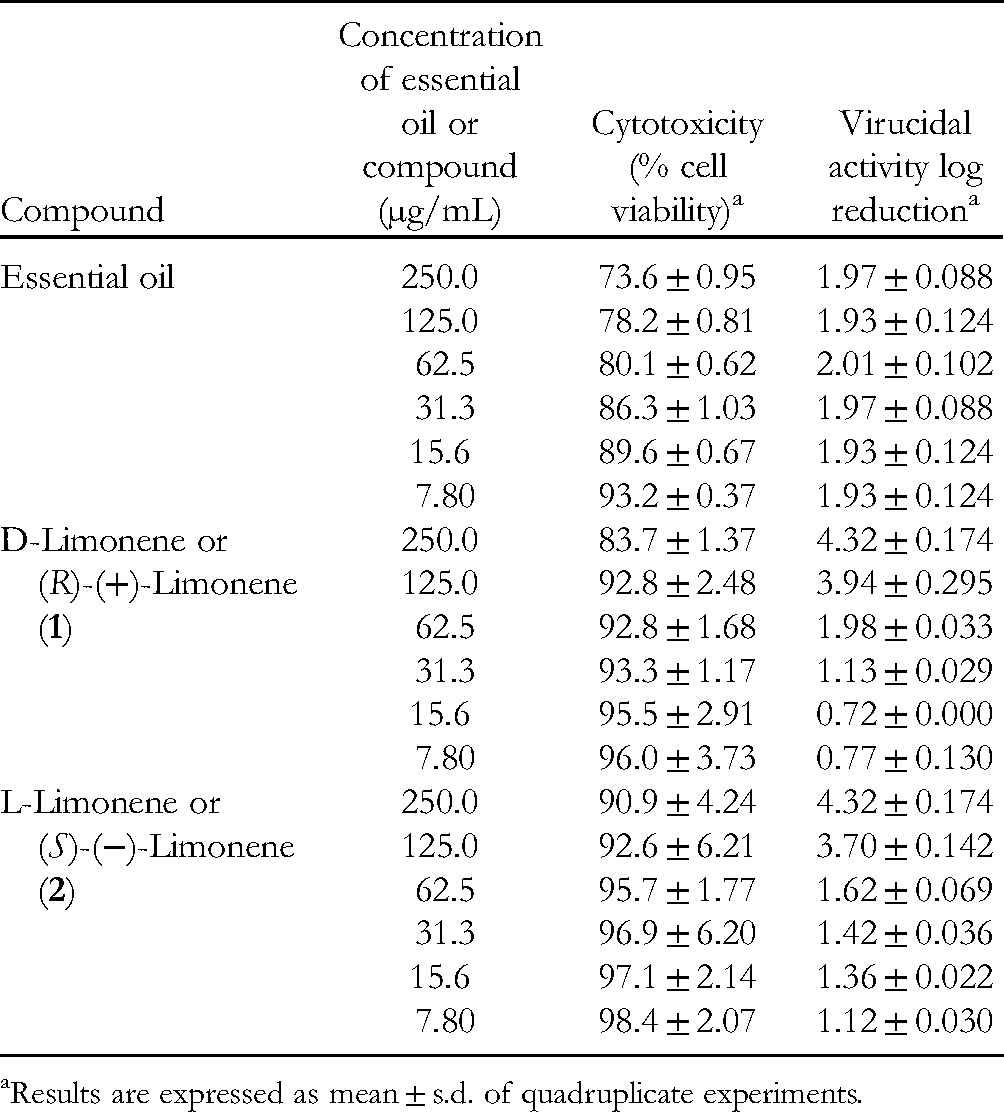
Prior to virucidal activity testing, we investigated cytotoxicity against Madin-Darby Canine Kidney (MDCK) cell lines of essential oils and limonene at concentrations of 250.0, 125.0, 62.5, 31.3, 15.6, and 7.80 µg/mL. As shown in Table 2, at the highest concentration, 250.0 µg/mL, the essential oil of Citrus x aurantium peels had 73.6% cell viability, which is less than that of D-limonene (83.7%) and L-limonene (90.9%). Therefore, the essential oils are slightly more cytotoxic than either D- or L-limonene. This could be because the essential oil has other compounds, which might contribute towards the cytotoxic effects. However, the essential oil at a concentration of 62.5 µg/mL or less had at least 80% cell viability, suggesting that they were not toxic at 62.5 µg/mL or at lower concentrations (Table 2). In general, both D- and L-limonene were not cytotoxic to MDCK cells, and they had more than 80% cell viability at all concentrations tested (Table 2).
Virucidal Activity and Cytotoxicity of Essential Oil from Peels of Citrus x aurantium
Results are expressed as mean ± s.d. of quadruplicate experiments.
The virucidal activity of the essential oil and limonene is shown in Table 2. The essential oil showed a log reduction of ca 1.9 to 2.0, accounting for 99% reduction of virus at every concentration tested (Table 2). D-limonene had virucidal activity with a log reduction of 4.32 and 3.94 at respective concentrations of 250.0 and 125.0 µg/mL (Table 2), which indicated that D-limonene can kill 99.99% of virus at these concentrations. L-Limonene also showed similar values of log reduction to that of the D-form, showing a log reduction of 4.32 and 3.70 at concentrations of 250.0 and 125.0 µg/mL (Table 2), and thus reducing 99.99% of virus at these concentrations. This is the first report on the virucidal activity of both forms of limonene. Both D- and L-limonene are natural products. D-Limonene is found in citrus plants, while L-limonene is found in the oils of pine needles, mint oils, lemongrass (Cymbopogan citratus), and citronella (Cymbopogan nardus). 65 The present work demonstrated that the configuration of limonene does not effect the virucidal activity because both D- and L-limonene exhibited similar activity. It is worth mentioning that D-and L-limonene could reduce 99.99% of the virus, which was comparable to the positive control, 0.21% sodium hypochlorite, which showed a log reduction of >4.4, accounting for 99.99% of virus.
Previous work on the antiviral action of some disinfectants against murine hepatitis virus, which has several structural and genetic similarities to SARS-CoV virus, revealed that common household disinfectants showed a log reduction of 3.0 to 4.5, 66 which are similar to those of D- and L-limonene. The household disinfectant, that is, 0.12% parachlorometaxylenol, 0.05% triclosan, 0.23% pine oil, 0.21% sodium hypochlorite, and 0.10% alkyl dimethyl benzyl ammonium saccharinate with 79% ethanol effectively inactivated murine hepatitis virus; therefore, these household disinfectants could be potential surrogates for SARS coronavirus. 66 In the present work, since D- and L-limonene displayed similar values of log reduction to those of household disinfectants, 66 they could be potential disinfectants against viruses. Previous work revealed log reduction of 4.17 to 4.50 for 0.23% pine oil, 66 which showed comparable efficacy to that of D- and L-limonene at the concentrations of 250.0 and 125.0 µg/mL, accounting for 0.025% and 0.0125%, respectively. Therefore, 0.0125% to 0.025% of either D- or L-limonene is recommended for use as a disinfectant against viruses. Although the antiviral mechanism of action of D- or L-limonene is not known, recent work revealed that limonene in lemon essential oils significantly downregulated angiotensin-converting enzyme 2 expression in epithelial cells, suggesting that lemon essential oils might be used to prevent the invasion of COVID-19 virus. 55 Previous work found that D-limonene exhibited antiviral activity against herpes simplex virus with an IC50 value of 5.9 µg/Ml. 67 However, L-limonene has never been reported for antiviral and virucidal activities. The present work demonstrates virucidal activity of L-limonene, an enantiomer of D-limonene, for the first time. A recent review hypothesizes that limonene might be a possible candidate for evaluation as an agent or adjuvant against COVID-19 virus, and plants containing limonene displayed antiviral activity against various viruses; 68 this suggests that limonene may also have activity against COVID-19 virus. The present work reveals the virucidal activity of D- and L-limonene for the first time, and these results suggest the potential use of limonene as a household disinfectant against viruses. Since limonene is widely used as a fragrance in the cosmetics industry, it may be used in the form of disinfectant sprays against airborne transmission of virus, that is, influenza and COVID-19 viruses.
Materials and Methods
Plant Material and Extraction of Essential Oil
Fruits of Citrus x aurantium L., collected from Pathum Thani Province, Thailand, was identified by Dr Panarat Thongpoem, and a voucher specimen, number CRI781, was deposited at Chulabhorn Research Institute, Thailand. Fresh peels of C. x aurantium were cut into small pieces and extracted with dichloromethane (AR grade). Peels (400 g) were macerated in dichloromethane (2 × 1.0 L) for 3 days, and then the extraction solvent was separated from the peels by filtration using a filter paper. The solvent was evaporated in a rotary evaporator, giving 18.35 g of a crude extract, which is the essential oil.
Analysis of Essential Oils by GC
-
MS
Essential oil (300 µL) from peels of C. x aurantium was dissolved in 1 mL of n-hexane. One μL of solution was injected into the gas chromatography-mass spectrometry (GC-MS) machine containing an Agilent 6890 N gas chromatograph (Agilent Technologies) equipped with an electron impact ionization and mass-selective detector (Agilent 5973, Agilent Technologies). A fused-silica capillary DB5-MS (30 m × 0.25 mm i.d., 0.25 μm) (J&W Scientific) was used with helium as carrier gas, with a rate of 1.0 mL/min. The injector temperature was set at 250 °C. The ionization energy was 70 eV in electron impact ionization mode with an ion source temperature of 250 °C and interface temperature of 250 °C. The oven temperature program was initiated at 60 °C and then increased to 240 °C at a rate of 3 °C/min. The acquisition was performed in scan mode (m/z 30-300).
Peak Identification
The volatile components were identified using the computer matching method and by comparing the mass spectra with the NIST17 (The National Institute of Standards and Technology) libraries. The Kovats retention indices were calculated using linear interpolation of the retention times of n-alkanes and were compared with the relevant literature reported by Adams (2017) library. 64
Reagents and Chemicals
Dichloromethane (AR grade) (purity, 99.8%) used for the extraction of essential oil was from RCI Labscan, D-limonene or (R)-(+)-limonene (purity 94%) from Merck, L-limonene or (S)-(−)-limonene (purity 96%) from Sigma Aldrich, and sodium hypochlorite from Sigma Aldrich.
Virucidal Activity and Cytotoxicity Testing
The method used for virucidal activity followed the American Society for Testing and Materials (ASTM) method No. ASTM E1053-20. 69 Cytotoxicity of the tested compound in Madin-Darby Canine Kidney (MDCK) cells was examined by 3-(4,5-Dimethylthiazol-2-yl)-2,5-diphenyl-2H-tetrazolium bromide (MTT) assay. MDCK cells were seeded in 96-well plates, and incubated for 24 h. MDCK cells were treated with media containing the test compounds and further incubated for 10 min. Then, the media in each well was replaced with media containing MTT (0.5 mg/mL), and incubated for 2 h. Subsequently, the media containing MTT was removed, and dimethyl sulfoxide was added (100 μL/well). An absorbance was measured at 550 nm and subtracted by the absorbance at 650 nm, using a microplate reader. Influenza A virus H1N1 was grown on MDCK host cells. Essential oils from C. x aurantium, D-limonene, and L-limonene were individually tested against influenza A virus H1N1. Essential oils or limonene were tested at concentrations of 250.0, 125.0, 62.5, 31.3, 15.6, and 7.80 µg/mL for virucidal activity. The assay was performed in quadruplicates. Titers of influenza A virus H1N1 were expressed as TCID50/mL, and 1 × 10 5 TCID50/mL influenza A virus H1N1 in 5% bovine serum albumin was used as organic soil load. 70 The medium was dried on nonporous surface. The test compounds were individually added and incubated for 10 min, then they were neutralized and filtered. The filtrate was subjected to serial 10-fold dilutions and applied to 96-well plates containing MDCK monolayer. After incubation at 37 °C in 5% CO2 for 4 days, an individual well was observed for cytopathic effects, which showed infectious virus. Infected plates were read until the endpoint was determined by the observation of signs of cytotoxicity and changes in cell morphology. The titer was calculated using the method of Muench and Reed. 71 0.21% sodium hypochlorite was used as a positive control.
Conclusions
The composition of the essential oil from peels of the bitter orange variety, Citrus x aurantium L., native to Southeast Asia, was chemically investigated by GC-MS analysis. Limonene was found as a major component. Virucidal activity against influenza A virus H1N1 of the essential oil of C. x aurantium peels and D-and L-limonene were evaluated. D-and L-limonene exhibited similar values of log reduction to those of common household disinfectants in a previous report. The present work suggests that concentrations of 0.0125% to 0.025% of either D- or L-limonene may be used as an effective disinfectant against viruses.
Footnotes
Acknowledgments
This work is supported by Thailand Science Research and Innovation (NRCT) (FFB640035 Project code 50169, a grant to Chulabhorn Graduate Institute, Chulabhorn Royal Academy. N.Q.F. acknowledges Chulabhorn Graduate Institute and ASEAN Foundation Joint Post-Graduate Scholarship supported by Thailand International Cooperation Agency (TICA). We acknowledge facilities of the Chulabhorn Research Institute (CRI) and Chulabhorn Graduate Institute through the grants from the National Research Council of Thailand (NRCT) and Thailand Science Research and Innovation (TSRI). We thank Dr Panarat Thongpoem for the plant identification.
Author Contributions
N.Q.F. contributed to investigation, formal analysis, writing-original draft; A.J. contributed to investigation, formal analysis; P.L. contributed to formal analysis; P.P. contributed to investigation, formal analysis; D.D. contributed to formal analysis, writing-original draft; C.M. contributed to supervision; S.R. contributed to supervision, funding acquisition; P.K. contributed to conceptualization, writing-original draft, writing-review & editing. All authors have read and agreed to the published version of the manuscript.
Declaration of Conflicting Interests
The authors declared no potential conflicts of interest with respect to the research, authorship, and/or publication of this article.
Funding
The authors disclosed receipt of the following financial support for the research, authorship, and/or publication of this article: This work is supported by Thailand Science Research and Innovation (NRCT) (FFB640035 Project code 50169, a grant to Chulabhorn Graduate Institute, Chulabhorn Royal Academy.
