



Abstract
In this study, we aimed at evaluating in vitro and in vivo anti-inflammatory activity of various extracts of the rhizomes of Globba pendula Roxb. Three extracts (n-hexane, ethyl acetate, and water) were screened for their inhibitory effect on NO production by lipopolysaccharide-stimulated RAW 264.7 macrophages. The ethyl acetate extract of G. pendula rhizomes (
Introduction
In folk medicine, the rhizomes of Globba pendula Roxb (Zingiberaceae family) have been used to treat many diseases, such as rheumatism and osteoarthritis in Vietnam.
1
In Malaysia and Indonesia, they have also been used as a decoction to treat flatulence in postpartum women.
2
Ten compounds have been reported from G. pendula, including a labdane diterpene, benzofuran, phenolics, and steroids.
3
The essential oil of this plant was found to possess moderate NO inhibitory effect, and significant cytotoxic activity against MCF7 and Hep3B cells.
4
We previously reported the isolation of one new polyoxygenated cyclohexene, globbanol A (
Results and Discussion
Effect on NO Production
Nitric oxide (NO) is a signaling molecule that plays a key role in the pathogenesis of inflammation. It produces an anti-inflammatory effect under normal physiological conditions. On the other hand, NO is considered as a pro-inflammatory mediator that in abnormal situations induces inflammation due to over production. The overproduction of NO as an inflammatory mediator can lead to tissue destruction such as in inflammatory autoimmune diseases. NO is not only a marker but also a pro-inflammatory mediator of arthritis. It is produced by nitric oxide synthase (NOS). An increased serum concentration of nitrate indicates enhanced NO production in serum and synovial fluid of the inflamed joints in patients with rheumatoid arthritis (RA), osteoarthritis (OA), and ankylosing spondylitis. For this reason, synthetic NOS inhibitors have been evaluated for clinical use. 6
N-hexane, ethyl acetate, and water extracts of the rhizomes of G. pendula were screened for their inhibitory activities on LPS-induced NO production using RAW 264.7 cells by the Griess reaction. L-NMMA (NG-methyl-L-arginine acetate) was used as a positive control (IC50 value 8.34 µg/mL). The ethyl acetate extract of
Effect on Arthritis Score
RA is a chronic systemic autoimmune disease that primarily affects the lining of the synovial joints and is associated with progressive disability, premature death, and socioeconomic burdens.
7
Collagen antibody-induced arthritis (CAIA) is a simple mouse model of rheumatoid arthritis that can be used to address questions of pathogenic mechanisms and to screen candidate therapeutic agents.
8
Based on the promising in vitro anti-inflammatory results, we decided to search for in vivo activity of
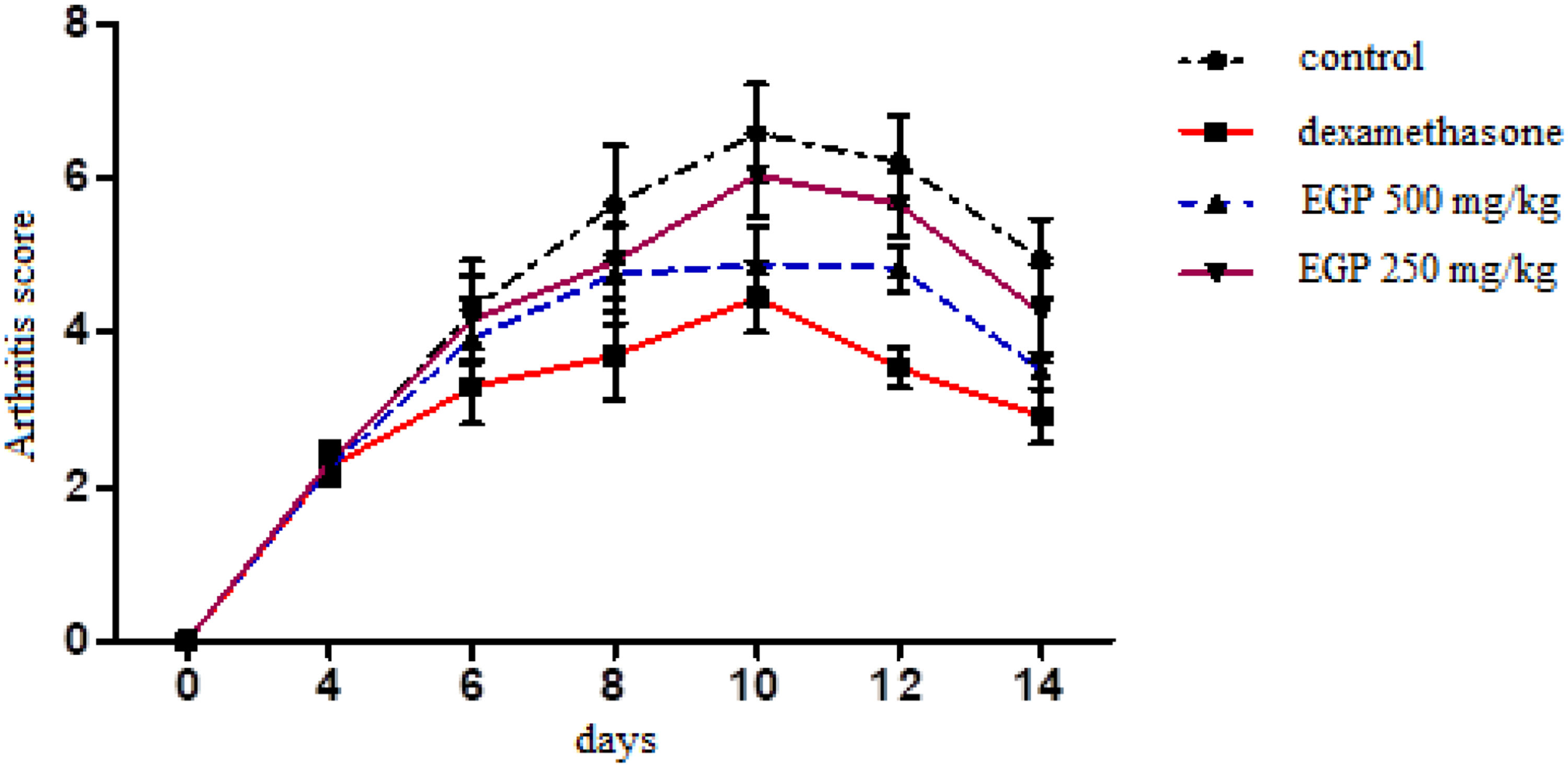
Effect of
Histopathological Results
The histopathology of the joints in the negative control group revealed strong edema, inflammatory leukocytes, macrophages, and synovial hyperplasia. Inflammatory cell infiltration and edema in the joints were reduced by administration of 500 mg/kg b.w. of

Histopathology of joint sections of experimental mice at 200 X magnification. (A) Normal mice; (B) negative control mice show remarkably increased fibrin and infiltration of leukocytes; (C) mice treated with
Effect on Cytokine Production
As an autoimmune disease, the pathology of RA is related to the presence of cytokines in the joints. Cytokines are involved in the development of the immune system and induce autoimmunity.
9
Cytokines play an important role in developing new therapeutic targets in pharmacology.
10
There are three groups of cytokines playing roles in the development of RA, pro-inflammatory (IL-1, IL-6, and TNF-α), anti-inflammatory (IL-4 and IL-10), and supplemental cytokines.
11
TNF-α is present in the joints and blood of RA patients. TNF-α is produced mainly by macrophages and induces the synthesis and secretion of matrix-degrading proteases, prostanoids, IL-6, IL-8, and granulocyte-macrophage colony stimulating factor by synovial fibroblasts.12,13 IL-6 is a multifunctional cytokine that not only promotes inflammation and articular joint destruction, but also induces systemic symptoms, including inflammatory anemia, coagulation, and thrombopoietin activation.
14
IL-10, a cytokine with anti-inflammatory properties, has a central role in infection by limiting the immune response to pathogens.
15
In inflammation, PGE2 is of particular interest because it is involved in all processes leading to the classic signs of inflammation: redness, swelling, and pain. Redness and edema result from increased blood flow into the inflamed tissue through PGE2 mediated augmentation of arterial dilatation and increased microvascular permeability. Pain results from the action of PGE2 on peripheral sensory neurons and on central sites within the spinal cord and the brain.
16
Therefore, PGE2 and other cytokines, such as IL-6 and TNF-α, and IL-10, were measured in the serum of mice treated with

The effects of
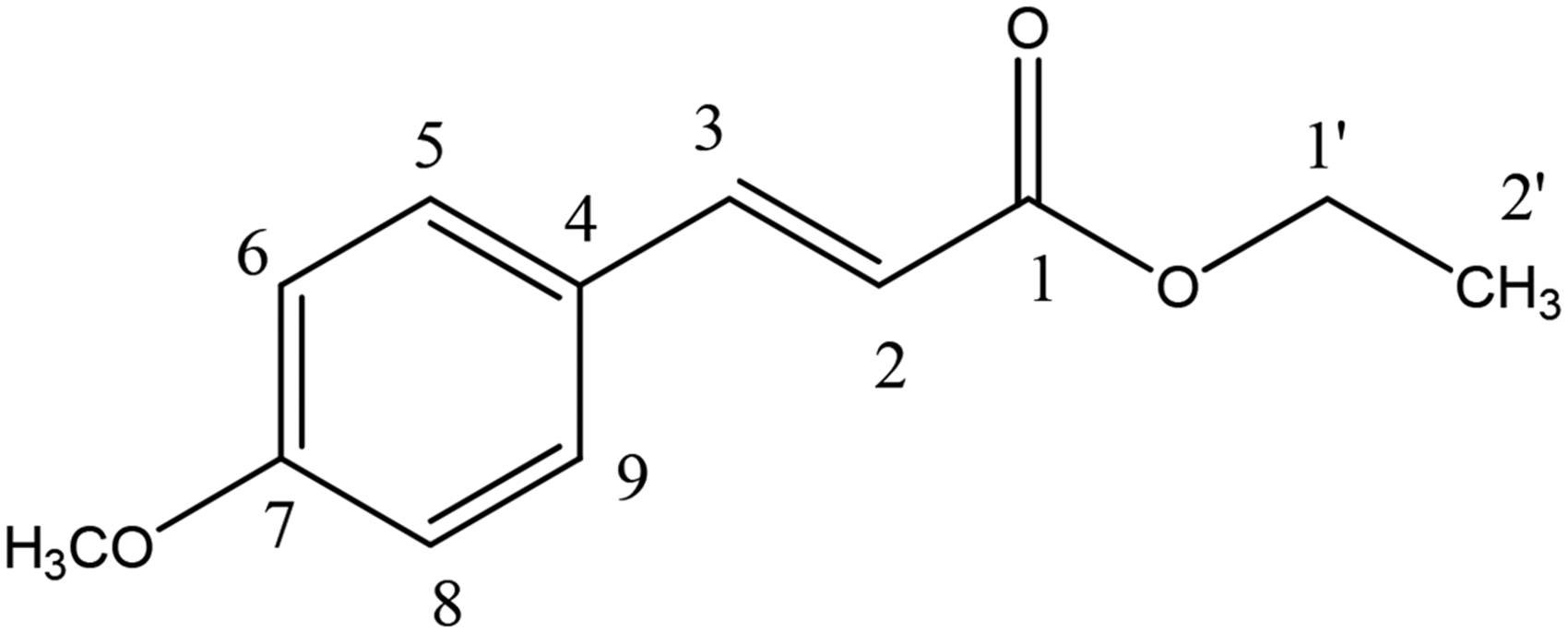
Chemical structure of ethyl p-methoxy cinnamate.
Acute Toxicity
After being treated with
Chemical Profile of EGP
Conclusions
In summary, our findings showed that the ethyl acetate extract of Globba pendula rhizomes (
Experimental
Plant Materials
The fresh rhizomes of Globba pendula Roxb. were collected in An Giang province, Vietnam in February 2019 and were identified by Dr Nguyen Van Du, Institute of Ecology and Biological Resources, Vietnam Academy of Science and Technology (VAST). The voucher specimens (NGM-02.2019) were deposited in the Pharmaceutical Chemistry Laboratory, Institute of Natural Product Chemistry, VAST.
General Experimental Procedures:
The 1H-NMR (500MHz) and 13C-NMR (125MHz) spectra were recorded on a Bruker AM500 FT-NMR spectrometer. Column chromatography (CC) was performed on silica gel (0.040-0.063 mm). Thin layer chromatography (TLC) was conducted on pre-coated silica gel 60 F254. Compounds were visualized by UV light at 254 and 365 nm, and by spraying with a solution of 10% H2SO4 in ethanol, followed by heating.
Lipopolysaccharides (LPS) from Escherichia coli were purchased from Sigma Chemical Co. (St. Louis, MO, USA), Dulbecco's Modified Eagle's Medium (DMEM) and fetal bovine serum (FBS) from Life Technologies, Inc., (Gaithersburg, MD, USA), and sodium nitrite, sulfanilamide, N-1-napthylethylenediamine dihydrochloride, and dimethyl sulfoxide (DMSO) from Sigma Chemical Co. (St. Louis, MO, USA). Other chemicals were purchased from Sigma, GIBCO, Invitrogen, and Promega. The murine macrophage cell line (RAW 264.7) was obtained from Prof. Domenico Delfino, Perugia University, Italy. TNF-alpha, IL-10 and IL-6, PGE2 ELISA kits were obtained from Biovision (Chester Springs, PA, USA). The mix of anti-collagen antibodies was provided by Modi Quest Research (Nijmegen, The Netherlands). Male albino BALB/c mice at a range of 8 to 10 weeks old were obtained from the Institute of Biotechnology, Vietnam Academy of Science and Technology (Hanoi, Vietnam).
Extraction and Isolation:
The fresh rhizomes of Globba pendula were washed, sliced, and dried in an oven at 50 °C. The dried rhizomes (1.5 kg) were powdered and extracted with methanol at 50 °C (3 times x 2 h per time) using a heated ultrasonic machine to give the total dry extract, which was then suspended in water and successively partitioned with n-hexane and ethyl acetate to give three corresponding extracts (n-hexane, ethyl acetate, water).
The EtOAc fraction (20.0 g) was separated by silica gel CC using a gradient of n-hexane-EtOAc (100:0, 75:25, 50:50, 25:75, 0:100, v:v) to obtain 5 fractions (E1→E5). Fraction E4 (6.5 g) was chromatographed on a silica gel column, eluting with n-hexane-acetone (20:1), to give 3 sub-fractions (E4.1-E4.3). Sub-fraction E4.2 (2.8 g) was further subjected to a silica gel column using n-hexane-acetone (15:1) as the mobile phase to produce 4 smaller sub-fractions (E4.2.1- E4.2.4). Sub-fraction E4.2.2 (1.5 g) was then recrystallized from n-hexane-acetone (2:1) to give ethyl p-methoxy cinnamate (0.9 g) as the main constituent of
Assay for Inhibition of NO Production:
RAW264.7 cells were initially grown in a 96-well plate (2 × 10⁵ cells/well) and incubated in a humidified atmosphere with 5% CO2 at 37 °C for 24 h. After that, the medium was removed and replaced by DMEM (free FBS) for 3 h. The cells were treated with a sample for 2 h followed by 1 µg/mL of LPS treatment for 24 h. The nitrite accumulated in the culture medium was measured as an indicator of NO production based on the Griess reaction. Briefly, 100 µL of culture medium was incubated with 100 µL of Griess reagent {50 μL of 1% (w/v) sulfanilamide in 5% (v/v) phosphoric acid and 50 μL of 0.1% (w/v) N-1-naphthylethylenediamine dihydrochloride in water} in a 96-well plate, and incubated at room temperature for 10 min. After incubation, the absorbance was determined using an ELISA reader at 540 nm. The DMEM (free FBS) medium was used for the blank-reading in all experiments, and the positive control was NG-methyl-L-arginine acetate (L-NMMA). The remaining cell solutions in cultured 96-well plates were used to evaluate cell viability by 3-(4,5-dimethylthiazole-2-yl)-2,5-diphenyl tetrazolium bromide (MTT) assay.
Anti-Inflammatory Evaluation Using Collagen Antibody-Induced Arthritic Mice (CAIA):
BALB/c male mice (24) were injected intraperitoneally (i.p.) with 3 mg of the cocktail of anti-collagen antibodies on day 0, followed by intravenous injection with 25 μg of LPS on day 3 and day 9 to boost arthritic development. Mice having initial symptoms of arthritis on day 4 were divided into 4 groups (6 mice/group). Group 1 received water daily for 10 days served as a negative control; Groups 2 and 3 were orally administered
Acute Toxicity Assay
The acute toxicity assay was conducted according to the Vietnam Ministry of Health
20
. Twenty-four healthy albino BALB/c mice were divided into 4 groups (6 mice/group). Group 1 receiving water daily for 10 days served as a negative control while groups 2, 3, and 4 were treated with
Statistical Analysis
The results are shown as mean ± SD. Data were analyzed by GraphPad Prism 4.0 (GraphPad Software, Inc., San Diego CA). Student's t-test was used for statistical comparison between the different groups. In all comparisons, P < .05 was considered statistically significant.
Footnotes
Acknowledgments
Ethical Approval
Our institution does not require ethical approval for reporting individual cases or case series.
Statement of Human and Animal Rights
The care and use of laboratory animals were executed in conformity with Vietnamese Ethical Laws, and European Communities Council Directives of November 24, 1986 (86/609/EEC).
Statement of Informed Consent
There are no human subjects in this article and informed consent is not applicable.
Author Contributions
LM Ha, DT Thao, PT Tam searched the literature and designed the study. Both NT Phuong and NTT Hien did experiment work. DTT Huyen, DT Thao, and LM Ha were responsible for data analysis. LM Ha, DT Thao, and PT Tam did preparation, editing, and review of the manuscript.
Declaration of Conflicting Interests
The author(s) declared no potential conflicts of interest with respect to the research, authorship, and/or publication of this article.
Funding
The author(s) disclosed receipt of the following financial support for the research, authorship, and/or publication of this article: The authors are grateful to Ministry of Education and Training for financial support (Grant No. B2021-MHN-04).
Trial Registration
Not applicable, because this article does not contain any clinical trials.
