



Abstract
Mentha arvensis L., M. citrata L., and M. spicata L. (family Lamiaceae) essential oils, and their characteristic constituent, menthol, were evaluated in vitro for angiotensin converting enzyme 2 (ACE2) and 5-lipoxygenase (5-LOX) enzyme inhibitory activity. The chemical compositions of M. arvensis, M. citrata, and M. spicata essential oils were analysed both by GC-FID, and GC/MS; 82.0%, 38.1%, and 0.4% menthol were identified, respectively. M. spicata essential oil contained 88.2% carvone as its major component.
The enzyme inhibitory activities of the essential oils were evaluated using a fluorometric multiplate based enzyme inhibition kit; the ACE2 inhibitions produced by M. arvensis, M. citrata, and M. spicata essential oils were 33%, 22%, and 73%, while the 5-LOX inhibitions were 84%, 79%, and 70%, respectively. In addition, menthol also showed remarkable ACE2 inhibition of 99.8%, whereas the 5-LOX inhibition was 79.9%. As a result, menthol and the three different mint essential oils may have antiviral potential applications against coronaviruses due to their ACE2 enzyme inhibition and anti-inflammatory features. However, further in vivo studies are needed to confirm the safety and efficacy.
Keywords
Introduction
Mentha species, commonly known as mints, are perennial herbaceous plants with creeping stems, mostly spreading in moist and wet places. 1 Mints, an important resource for essential oils, are distributed all over the world, except Antarctica. The plants have widespread usage due to their aromatic, and medical properties. 2
In a previous study conducted with Mentha citrata L. in Iran, menthone and menthol were found as major components of the essential oil and were evaluated in terms of antifungal activity. 3 In another study, more than 50% menthol was found in M. citrata essential oil and antibiofilm activity was reported. 4 The antiviral activity of M. citrata and M. spicata was also studied and remarkable results were obtained against Herpes simplex type-1 (HSV-1), and parainfluenza type-3 (PI-3). 5 In addition to the essential oil of M. citrata, the antiviral and anti-inflammatory effects of alcohol extracts were also determined. 6 Another study suggested that the carvone-rich essential oil of M. spicata L. has potential as a food preservative due to its antimicrobial properties. 7 M. arvensis L., another menthol rich species, is also remarkable for its antimicrobial activity. 8 Mint species are frequently used for the treatment of flu and colds, due to their broad antimicrobial potential.9,10
In this present study, the potential antiviral effects of three different Mentha essential oils were evaluated by in vitro ACE2 and 5-LOX enzyme assays. To the best of our knowledge, this study is the first comparative work with the three different Mentha essential oils, and menthol for in vitro ACE2, and 5-LOX enzyme inhibition potential.
Results and Discussion
Chemical Composition of Essential Oils
M. arvensis and M. citrata essential oil analyses showed a relatively high menthol percentage, while carvone was the major consituent of M. spicata. M. arvensis essential oil contained 82.0% menthol, 4.1% menthone, 3.5% isomenthone, and 2.7% menthyl acetate. The major components of M. citrata were menthol (38.1%), menthone (22.2%), neomenthol (8.5%), and isomenthone (7.8%), and of M. spicata, carvone (88.7%), limonene (3.5%), terpinolene (1.2%), and p-cymen-8-ol (0.8%). The percentage of menthol in M. spicata essential oil was found to be 0.4%, as shown in Table 1. In previous studies, it was observed that M. citrata and M. arvensis essential oils collected from different locations at different times were rich in menthol. Although the percentages of menthone and menthyl acetate are more variable, their presence as major components was determined for both essential oils. 11 On the other hand, M. spicata was found to be rich in carvone, but menthol could not be detected in some analyses.12,13
The Chemical Composition of Mint Essential Oils.

RRI Relative retention indices calculated against n-alkanes.
% calculated from FID data.
tr Trace (<0.1%).
Overall, the chemical analyses of the commercial oils were in accordance with the literature data and standards.
ACE2 Enzyme Inhibition
ACE2 enzyme inhibition assay was performed at concentrations of 20 μg/mL for essential oils, and 5 μg/mL for menthol. The essential oils were evaluated using a fluorometric multiplate based enzyme inhibition kit, where the in vitro ACE2 inhibition rates of M. arvensis, M. citrata, and M. spicata essential oils were 33.0 ± 0.13%, 22.1 ± 0.80%, and 73.2 ± 0.45%; whereas menthol inhibited the ACE2 enzyme by 99.8 ± 0.02% (Figure 1). Although the ACE2 enzyme inhibition of menthol is quite high, the fact that menthol-rich M. arvensis and M. citrata inhibited the enzyme at a lower rate than M. spicata may be due to the interaction with other substances present in the essential oils.

ACE II enzyme inhibition of Mentha essential oils (20 μg/mL), and menthol (5 μg/mL) (***P < 0.0001).
Mentha preparations are among the most frequently used in flu and cold infection cases.14,15 They have also been the subject of some studies due to their antimicrobial effect.16,17 Mentha species have antiviral potential, and successful results were obtained in studies with M. citrata essential oil against Type 1 and 2 Herpes simplex virus. 18
As is well known, the COVID-19 pandemic is an important health issue with limited therapeutic and protective approaches. Since interaction of the coronavirus spike protein and ACE2 is necessary for the virus to infect, any agent that interrupts their interaction has therapeutic potential. The receptor-binding domain-based human monoclonal antibody, and recombinant human ACE2 protein (rhuACE2) have been targetted and attracted attention.19,20 Therefore, as a result of the findings obtained in this study, especially based on the ACE2 enzyme inhibition values of M. spicata and menthol, it can be expressed that M. spicata and menthol may have potential in the prevention of coronaviruses, and antiviral effects.
5-LOX Enzyme Inhibition
The assay was performed at concentrations of 20 μg/mL for essential oils, and 5 μg/mL for menthol, as in the ACE2 assay. The 5-LOX inhibition results of M. arvensis, M. citrata, M. spicata essential oils, and menthol were 84.5 ± 0.14%, 79.0 ± 0.12%, 70.1 ± 0.34%, and 79.9 ± 0.43%, respectively as shown in Figure 2. Also NDGA was tested as a positive control, which showed 90.1 ± 0.02% 5-LOX enzyme inhibitory activity. In previous studies, essential oils of M. citrata subspecies and M. spicata were studied separately for their in vitro LOX enzyme inhibition; anti-inflammatory activity was demonstrated for both.21,22 Baylac and Racine tested M. citrata essential oil using the LOX method; effective results were reported. 23
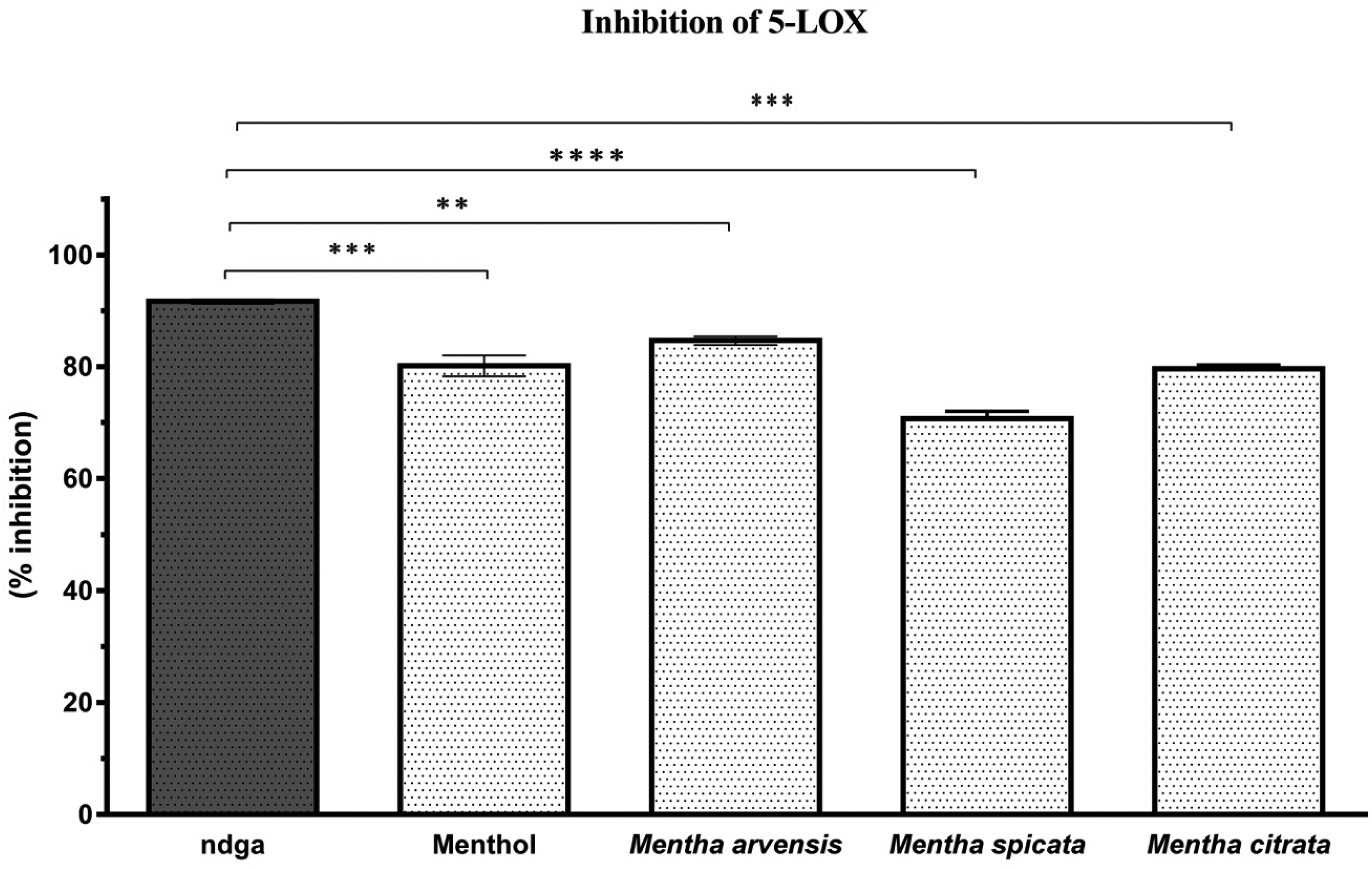
5-LOX Enzyme inhibition of Mentha essential oils (20 μg/mL), menthol and nordihydroguaiaretic acid (ndga) (5 μg/mL) (**P < 0.01, ***P < 0.001, ****P < 0.0001).
As is known, monocytes allow viruses to migrate to the tissues they infect and spread to all organs and tissues. Monocytes and macrophages infected with coronavirus can produce numerous proinflammatory cytokines and chemokines that contribute to tissue inflammation and a systemic inflammatory response called a cytokine storm. Both tissue inflammation and cytokine storm play a fundamental role in the development of COVID-19-related complications, such as acute respiratory distress syndrome (ARDS), which is the cause of death in coronavirus patients. Therefore, evaluation of anti-inflammatory parameters in terms of coronavirus studies may be an approach.20,24
Thus, in the present study, both ACE2 and the 5-LOX enzyme inhibitory potential of Mentha essential oils were evaluated; the results and outcome were rather promising.
Conclusion
In this present study, three different Mentha essential oils, and menthol, the major component of M. arvensis and M. spicata oils, were evaluated for their potential in vitro 5-LOX and ACE2 enzyme inhibitory activities. To the best of our knowledge, the Mentha essential oils, and menthol are reported comparatively, in terms of in vitro ACE2 enzyme inhibition, for the first time. In addition, promising results were observed for both enzyme inhibitions, and compared with the major compound menthol. Based on the first in vitro experimental results, it can be suggested that especially Mentha spicata essential oil may be further evaluated as a potential antiviral tools against coronaviruses.
Experimental
Materials
Commercial essential oils were aquired from Doalinn Ltd, Şti. İstanbul. Menthol, NDGA, and LOX enzyme kits were obtained from Sigma-Aldrich (Germany); Angiotensin II Converting Enzyme (ACE2) Inhibitor Screening Kit was from BioVision (U.S.A).
GC-FID and GC/MS Analysis
An Agilent 6890N GC system was used for the GC-FID analyses, and an Agilent 5975 GC-MSD system for GC/MS. The temperature of the FID detector was set to 300 °C. Concurrent auto-injection was performed in two identical columns using the same conditions in the GC/MS system. Relative percentages (%) were calculated using FID chromatograms. Relative retention indices (RRI) were used to characterize the essential oil components, either with authentic samples or by comparison with the relative retention index (RRI) of n-alkanes, with commercial GC/MS Libraries such as MassFinder 3 Library, and the in-house “Başer Library of Essential Oil Constituents”. 25
ACE2 Enzyme Inhibition Assay
The test samples were initially dissolved in DMSO <1% (v/v). Enzyme inhibitions were performed accordancing the the manufacturer's instructions for “Angiotensin II Converting Enzyme (ACE2) Inhibitor Screening Kit (BioVision, K310)”, and the enzyme inhibition of the samples was measured with Ex/Em = 320/420 nm wavelength in a multimode microplate reader (SpectraMax i3) in fluorescence mode. The enzyme inhibition of the test substances was calculated by comparing with standards provided in the kit. Inhibition % (%I) values were calculated for all samples resulting from triplicate data, as previously described. 26
5-LOX Enzyme Inhibition Assay
5-Lipoxygenase (5-LOX) was measured by modifying the spectrophotometric method of Baylac and Racine. 23 The reaction was initiated by the addition of linoleic acid solution; the change of absorbance at 234 nm was observed for 10 min. All the kinetic experiments were performed in triplicate. The concentration of the tested essential oils was 20 μg/mL, and of the pure compounds 5 μg/mL. All tests and control assays were corrected by blank experimental data for non-enzymatic hydrolysis. The percentage of inhibition (%I) was calculated as the absorbance change per minute in enzyme activity (without inhibitor) compared to absorbance change per minute of the test sample. Nordihydroguaiaretic acid (NDGA) was used as the positive control. Experiments were performed in triplicates, and results are given as a mean, as previously reported. 26
Footnotes
Acknowledgments
A part of this work will be presented at XIV International Symposium “Actual Problems of Chemistry, Biology and Technology of Natural Compounds” in Tashkent, Uzbekistan, 2021. Also the authors would like to dedicate this work to all colleagues from Tokushima Bunri University for their valuable collaboration since more than two decades.
Declaration of Conflicting Interests
The author(s) declared no potential conflicts of interest with respect to the research, authorship, and/or publication of this article.
Funding
The author(s) disclosed receipt of the following financial support for the research, authorship, and/or publication of this article: This work was supported by the Anadolu University Scientific Research Projects Commission (grant number 2005S058).
Ethical Approval
Not applicable, because this article does not contain any studies with human or animal subjects.
Informed Consent
Not applicable, because this article does not contain any studies with human or animal subjects.

Trial Registration
Not applicable, because this article does not contain any clinical trials.