



Abstract
Two new fucose containing spirostanol glycosides, (25R)-spirost-5-en-3β-yl O-β-D-glucopyranosyl-(1→4)-β-D-fucopyranoside (
Introduction
The phytochemistry of plants belonging the genus Disporopsis (Asparagaceae) is mainly characterized by steroidal saponins and phenolic compounds, which have showed antitumor, anti-inflammatory, anti-diabetes, and anti-microbial activities.1–6 Disporopsis longifolia Craib. is a herbaceous, perennial plant, which is distributed in Vietnam, Thailand, China, and Laos at a height about 400 to 1500 m. In Vietnam the rhizomes of this plant are used in folk medicine with effects of nourishing yin to lessen fire, and to invigorating liver and kidney.1,2 However, so far, there have been no publications on the chemical constituents and biological activities of this medicinal plant, thus prompting this study. This paper reports the isolation, structure determination of two new (
Results and Discussion
Compound
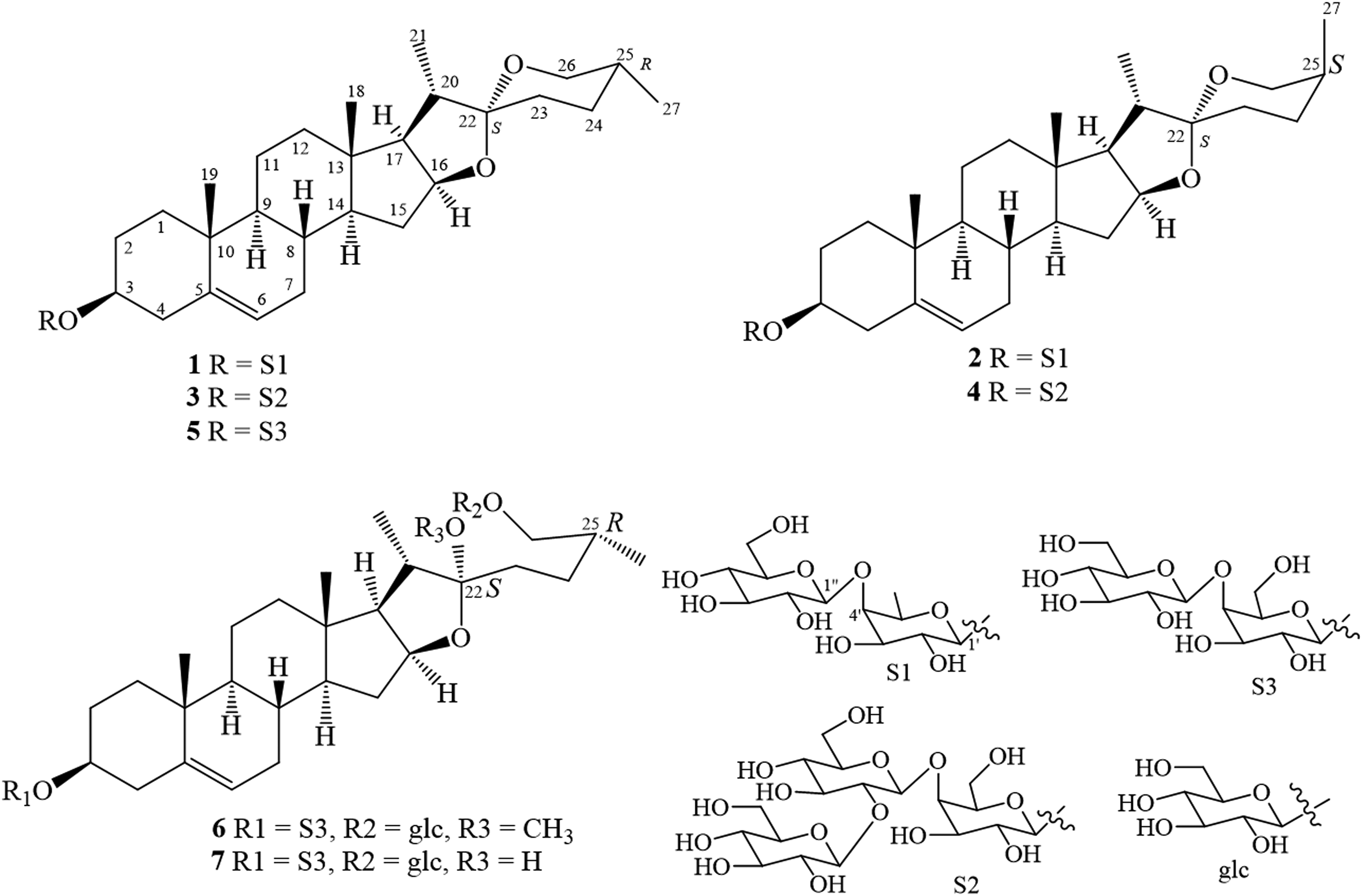
Chemical structure of compounds

The 1H-1H COSY and key HMBC correlations of compounds

The key NOESY correlations of compounds
Compound
NMR Spectroscopic Data for Compounds

The other compounds were identified to be (25R)-spirost-5-en-3β-yl O-β-D-glucopyranosyl-(1→2)-β-D-glucopyranosyl-(1→4)-β-D-galactopyranoside (
Inhibitory Activity of Compounds
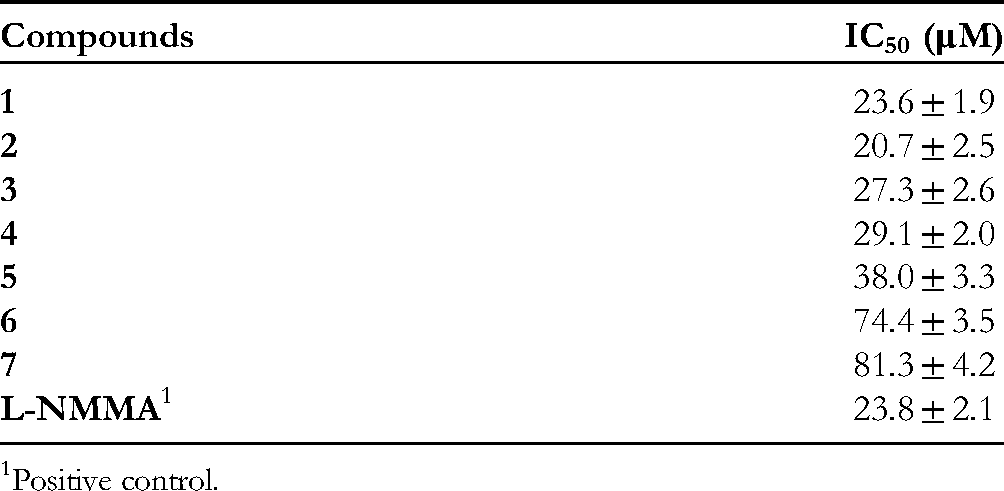
Positive control.
Materials and Methods
General Experimental Procedures
Optical rotation was measured on a Jasco P-2000 polarimeter, NMR spectra on a Bruker AvanceNEO 600 MHz spectrometer, and HRESIMS on a SCIEX X500 QTOF LC/MS. Flash column chromatography was performed using either silica gel or reversed phase (RP-18) resins as adsorbent. The ratio between the amount of silica gel and fraction was 20/1 (w/w). A fraction collector was set by volume per tube (15 mL/tube). Fractionation was monitored by thin layer chromatography (TLC) to combine test tubes showing similar TLC pattern. TLC was carried out on either pre-coated silica gel 60 F254 and/or RP-18 F254S plates. Compounds were visualized by UV irradiation (254 and 365 nm) and by spraying with H2SO4 solution (5%) followed by heating with a heat gun. HPLC was carried out using an AGILENT 1100 HPLC system.
Plant Material
The rhizomes of Disporopsis longifolia Craib (Asparagaceae) were collected in Hoang Su Phi District, Ha Giang Province, Vietnam, in September 2020, and identified by Dr Do Hoang Chung at the Institute of Forestry Research and Development, Thai Nguyen University of Agriculture and Forestry, Thai Nguyen City, Vietnam. A voucher specimen (NCCT-P129) is kept at the Institute of Forestry Research and Development.
Extraction and Isolation
Dried, powdered Disporopsis longifolia rhizomes (4.0 kg) were ultrasonically extracted with hot MeOH (45 °C), three times (each 15 L). The extracts were filtered through filter paper, and the filtrate was evaporated to dryness to yield 500 g of a dark solid extract. This was suspended in water (5.0 L) and successively partitioned with dichloromethane and ethyl acetate (each 5 L) giving the dichloromethane extract (IPL1, 20 g), ethyl acetate extract (IPL2, 1.2 g), and water layer (IPL1C). After removal of the solvent, the water layer was chromatographed on a Diaion HP-20 column eluting with water to remove sugar, then with increasing concentration of methanol in water (25, 50, 75, and 100%) to obtain four fractions, IPL3 (8.3 g), IPL4 (15.6 g), IPL5 (12.7 g) and IPL6 (0.7 g). Fraction IPL4 (15.6 g) was chromatographed on a silica gel column eluting with dichloromethane/methanol/water (5/1/0.1, v/v/v) to give five sub-fractions (IPL4A-IPL4E). IPL4D (4.3 g) was further chromatographed on a YMC column eluting with acetone/water (2/1, v/v) to give three sub-fractions (IPL4D1-IPL4D3). IPL4D3 (0.1 g) was further chromatographed by HPLC using a J'sphere ODS H-80, 250 mm × 20 mm column, acetonitrile in H2O (75%, v/v) and a flow rate of 3 mL/min to yield compounds
Dispolongioside A (1 )
Colorless amorphous powder,
Dispolongioside B (2 )
Colorless amorphous powder,
Acid Hydrolysis of Compounds 1 and 2
Compounds
Nitric Oxide Assay
Refer to Supplemental Material.
Conclusions
Five spirostan (
Supplemental Material
sj-docx-1-npx-10.1177_1934578X211055013 - Supplemental material for Dispolongiosides A and B, Two New Fucose Containing Spirostanol Glycosides From the Rhizomes of Disporopsis longifolia Craib., and Their Nitric Oxide Production Inhibitory Activities
Supplemental material, sj-docx-1-npx-10.1177_1934578X211055013 for Dispolongiosides A and B, Two New Fucose Containing Spirostanol Glycosides From the Rhizomes of Disporopsis longifolia Craib., and Their Nitric Oxide Production Inhibitory Activities by Tran Thi Thu Ha, Dang Kim Vui, Nguyen Huy Hoang, Bui Huu Tai and Phan Van Kiem in Natural Product Communications
Footnotes
Acknowledgments
We thank Dr Do Hoang Chung at The Institute of Forestry Research and Development, Thai Nguyen University of Agriculture and Forestry for the identification of the plant sample.
Conflict of Interest
The authors declare no conflict of interest.
Ethical Approval
Our institution does not require ethical approval for reporting individual cases or case series.
Statement of Human and Animal Rights
This article does not contain any studies with human or animal subjects.
Statement of Informed Consent
There are no human subjects in this article and informed consent is not applicable.
Declaration of Conflicting Interests
The author(s) declared no potential conflicts of interest with respect to the research, authorship, and/or publication of this article.
Funding
The author(s) disclosed receipt of the following financial support for the research, authorship, and/or publication of this article: The authors would like to express their sincere thanks to the Ministry of Education and Training for supporting research funding through the topic: “Research on conservation and development of genetic resources of Disporopsis longifolia Craib. in Ha Giang province”, code: CT-2018-TNA-01.
Trial Registration
Not applicable, because this article does not contain any clinical trials.

Supplemental material
Supplemental material for this article is available online.
References
Supplementary Material
Please find the following supplemental material available below.
For Open Access articles published under a Creative Commons License, all supplemental material carries the same license as the article it is associated with.
For non-Open Access articles published, all supplemental material carries a non-exclusive license, and permission requests for re-use of supplemental material or any part of supplemental material shall be sent directly to the copyright owner as specified in the copyright notice associated with the article.
