



Abstract
In our survey on the chemical composition of Chinese folk medicines, nine compounds were isolated from methanol extract of the leaves of Toricellia angulata Oliv. var. intermedia (Harms.) Hu (Corniaceae). The structures of these compounds were elucidated on the basis of NMR data analysis, which were identified as dimethyl 2-(hydroxymethyl)-5-oxocyclohexane-1,4-dicarboxylate (
Introduction
Chinese herbal medicine is a unique medicine, which has been used for thousands of years in China. Because plant medicine accounts for the majority of traditional Chinese medicine, traditional Chinese medicine is also called Chinese herbal medicine. At present, there are over 5000 kinds of traditional Chinese medicines used in various places, and there are countless prescriptions formed by the combination of various kinds of traditional Chinese medicines, which play an important role in the fight against various diseases, such as Corona Virus Disease 2019 (COVID-19).1,2 Chinese herbal medicine is an important part of medicine. Although herbal medicine plays an important role in the treatment of various diseases, it is difficult to widely accept Chinese herbal medicine because of its complex chemical composition, unclear pharmacodynamic components and mechanism. Thus, it is necessary to elucidate the chemical constituents and investigate action mechanism of Chinese herbal medicines.
Among numerous Chinese herbal medicines, Toricellia angulata Oliv. var. intermedia (Harms.) Hu is a traditionally folk medicine widely used in Guizhou province of China. T. angulata var. intermedia, a member of the Corniaceae plant family, is distributed in the Himalayas and Yunnan, Guizhou, and Sichuan provinces of China. 3 As a historically folk medicine, the leaves or roots (cortex) were documented to possess the functions of promoting blood circulation, removing blood stasis, and connecting bones and tendons, which has been used traditionally to treat various diseases such as rheumatoid arthritis pain, postpartum low back pain, chronic enteritis, diarrhea, according to the description in the book “Chinese Materia Medica”. 4 The extensive efficacy of T. angulata var. intermedia has evoked the attention on its chemical constituents. In the previous chemical studies, nearly 33 compounds have isolated and identified from the roots of this plant.5-8 The leaves of T. angulata Oliv. var. intermedia (Harms) Hu are also widely used for various medical indications in ethnic minority areas or National medical institutions. 9 However, there have been few reports on the chemical constituents of the leaves of T. angulata var. intermedia.
The current study aims to investigate the chemical constituents in the leaves of T. angulata var. intermedia. Herein, the isolation and structural identification of these chemical constituents are described.
Results and Discussion
After extraction, the petroleum ether- and ethyl acetate-soluble fractions of the methanol extract derived from the leaves of T. angulata var. intermedia were fractionated by column chromatography and MPLC, and purified further by HPLC to afford nine pure compounds. Using NMR experiments, the structures of isolated compounds were elucidated as follows.
Compound

1H-1H COSY and key HMBC and NOESY correlations of compound 1.

Structures for compounds 1–9.
The configuration of
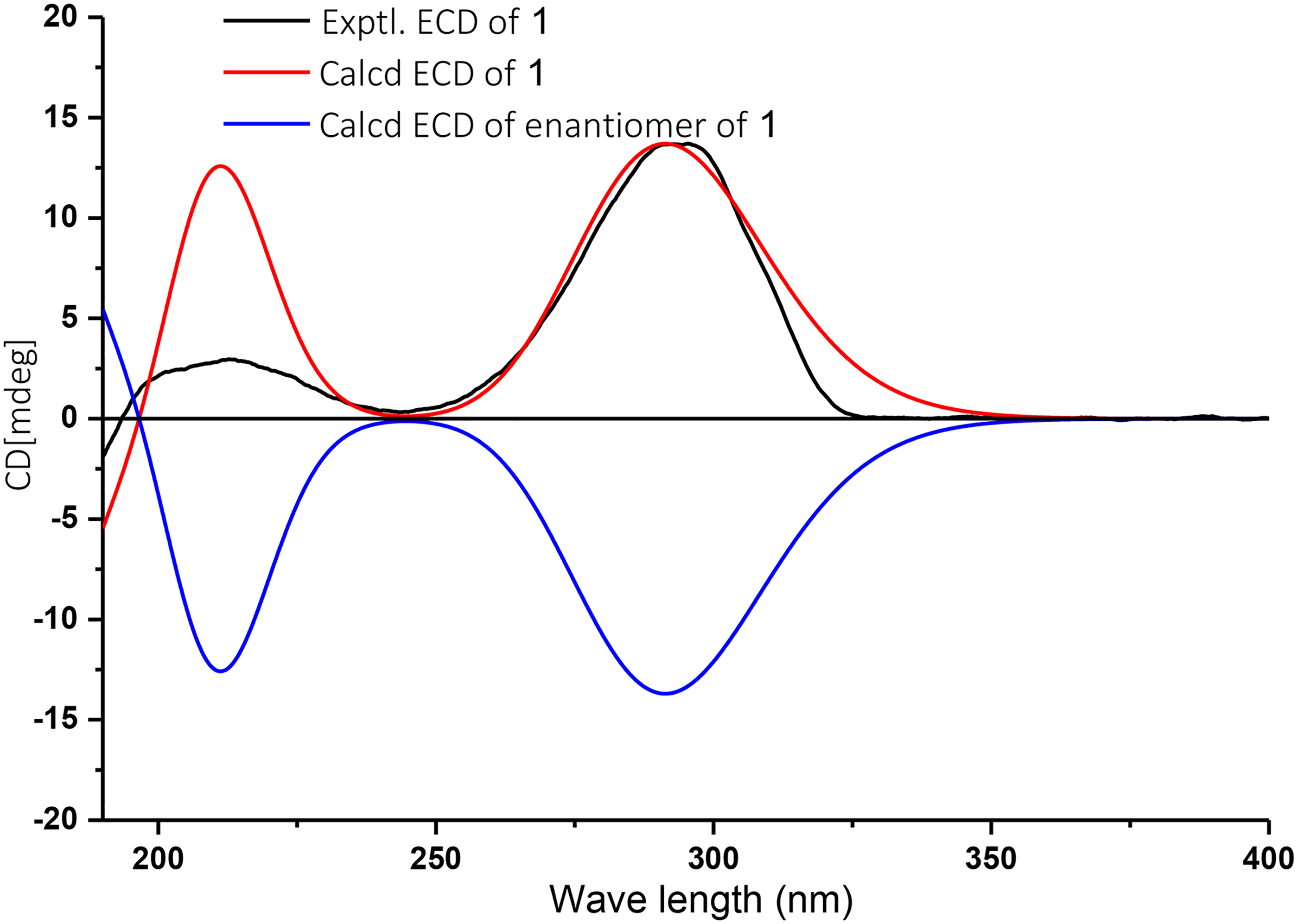
The ECD spectra of compound
In addition to a new compound, torriangulate A, eight known compounds were also isolated from the leaves of T. angulata var. intermedia. Using 1D (1H and 13C) and/or 2D NMR experiments and comparing their NMR data with the chemical shift data reported, the known compounds were identified as methyl succinate (
In conclusion, the current chemical composition survey on the traditionally folk medicine led to the isolation of nine chemical constituents from the leaves of T. angulata var. intermedia. Through NMR, HRESIMS data analysis, and ECD calculations, the structures of nine compounds were determined, which included one new compound and four ones isolated for the first time from this genus or species. The current investigation revealed the chemical composition of the leaves, which lays a foundation for the development of T. angulata var. intermedia used as a traditionally folk medicine.
Experimental
General
Optical rotations were measured by InsMark IP120 automatic optical rotator (InsMark Co.Ltd, Shanghai, China). ECD data were measured by JASCO J-715 CD spectrometer (JASCO Co.Ltd, Japan). IR spectrum was recorded on a Bruker Tensor 37 FT-IR spectrometer with KBr discs (Bruker Co. Ltd, Germany). All NMR tests were performed on a Bruker AV 400 instrument (Bruker Co. Ltd, Germany) with TMS as an internal standard at room temperature. High resolution spectra obtained on IonSpec 7.0T FTICR (IonSpec Co. Ltd, Canada) mass spectrometer. HPLC separations were conducted on a CXTH system, equipped with a Shodex RI-102 detector (Showa Denko Co., Ltd, Tokyo, Japan) and a YMC-pack ODS-AM (20 × 250 mm) column (YMC Co. Ltd, Kyoto, Japan). Medium pressure liquid chromatography (MPLC) was run on a P0100 pump with an ultraviolet (UV) detector (Huideyi Co., Beijing, People's Republic of China) and a column (40 × 400 mm) filled by octadecylsilyl (ODS, 50 μm, YMC Co., Ltd). Silica gel (200–300 mesh) used for column chromatography was purchased from Qingdao Haiyang Chemical Group Co., Ltd (Qingdao, People's Republic of China). Chemical reagents (analytical grade) for isolation were of analytical grade and were provided by Tianjin Chemical Reagent Co. (Tianjin, China) and Sigma Co., respectively.
Plant Material
The leaves of T. angulata var. intermedia were collected from Guizhou Province (N 26.262822°, E 107.514536°, altitude 807 m), China, in May 2020. The botanical identification was made by Zhongyao Han (Dept. of Pharmacy, Qiannan Medical College for Nationalities, China), and a voucher specimen (No.20200518) was deposited at the laboratory of the Research Department of Natural Medicine, College of Pharmacy, Nankai University, China.
Extraction and Isolation
The air-dried leaves (6.0 kg) of T. angulata var. intermedia were extracted with methanol under reflux for three times (2.5 h, 1.5 h, and 1.5 h, each time). The organic solvent was evaporated under vacuum to give a crude methanol extract (2.1 kg), which was suspended in H2O (2.1 L) and then partitioned successively with petroleum ether and ethyl acetate to give the petroleum ether-soluble portion (350 g) and ethyl acetate-soluble portion (80 g).
The ethyl acetate-soluble portion was fractionated by silica gel column chromatography (silica gel, 700 g; column, 7 × 50 cm), using a gradient solvent system of petroleum ether-acetone (100: 0, 100: 2, 100: 4, 100: 6, 100: 9, 100: 13, 100: 19, 100: 27, 100: 35, 21 L for each gradient elution), to afford nine fractions (F1−F9) according to the TLC analysis. F5, F6, and F7 were subjected to MPLC and eluted with a step gradient of 64 − 92% MeOH in H2O to give subfractions F5-1−F5-6, F6-1−F6-8, F7-1−F7-8. Subsequenly, HPLC separations were carried out for some of these subfractions. The purification of F6-1 (45% MeOH in H2O) led to the isolation of compounds
The petroleum ether-soluble portion was subjected to silica gel column chromatography (silica gel, 700 g; column, 7 × 50 cm), using ethyl acetate as eluent to give one fraction A1. Then, A1 was separated by MPLC to obtain nine subfractions A1-1−A1-9. The purification of A1-1 (70% MeOH in H2O) resulted in the obtainment of compounds
Dimethyl 2-(hydroxymethyl)-5-oxocyclohexane-1,4-dicarboxylate (
Methyl succinate (
5-Hydroxymethyl-2-furfuraldehyde (
7-Hydroxy-6-methoxycoumarin (
Loliolide (
(8S)-Deca-2-trans-2,9-diene-4,6-diyn-1,8-diol (
Methyl malate (
Griselinoside (
Methyl linoleate (
Footnotes
Declaration of Conflicting Interests
The author(s) declared no potential conflicts of interest with respect to the research, authorship, and/or publication of this article.
Funding
The project was supported by the Natural Science Foundation of Guizhou (No. QKHJC[2020]1Y390) and Qiannan Medical College for Nationalities Research Fund Project (No.qnyz202034), China.
Ethical Approval
Not applicable, because this article does not involve any animal experiments.
Statement of Human and Animal Rights
Not applicable, because this article does not involve any animal experiments.
Informed Consent
Not applicable, because this article does not contain any studies with human or animal subjects.
Trial Registration
Not applicable, because this article does not contain any clinical trials.
