



Abstract
A new arylnaphthalide lignan, corniculin (
Oxalis corniculata L. (Oxalidaceae) is a commonly used herb with a range of biological activities including the effects of anti-oxidation, antitumor, and anti-inflammation.
1
-5
The previous studies show that flavonoids, phenolic acids, and alkaloids were major constituents of O. corniculata.
6
-11
In our efforts toward the clarification of the chemical constituents of O. corniculata, a new arylnaphthalide lignan named corniculin (
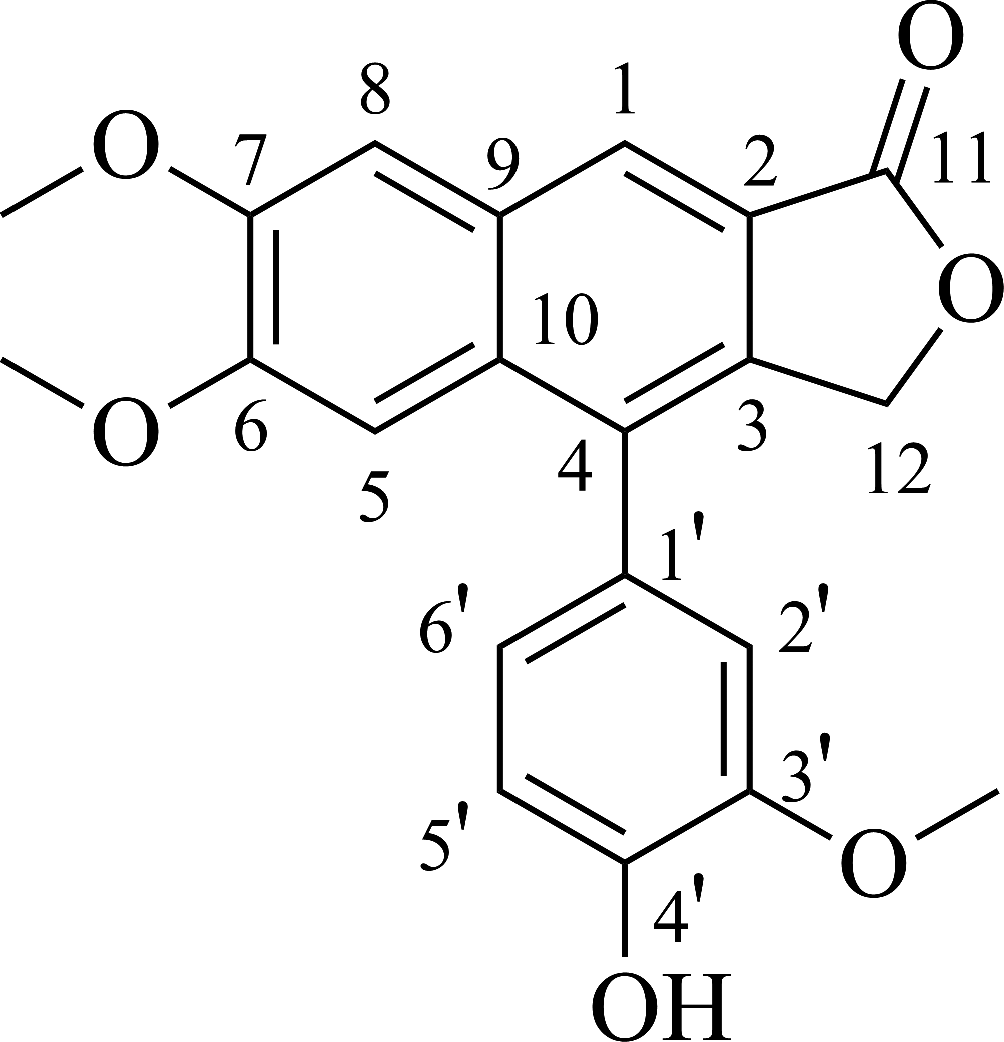
The structure of 1.
Corniculin (
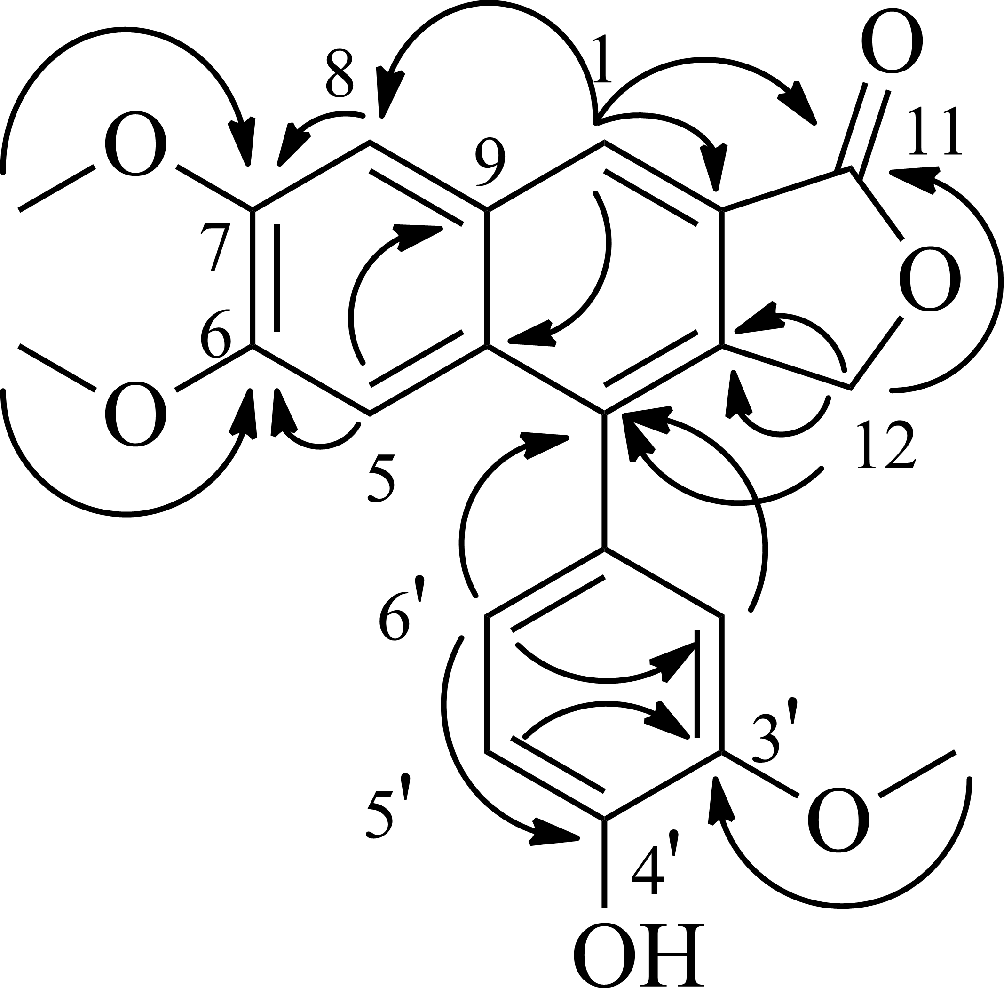
Key HMBC (H→C) correlations of 1.
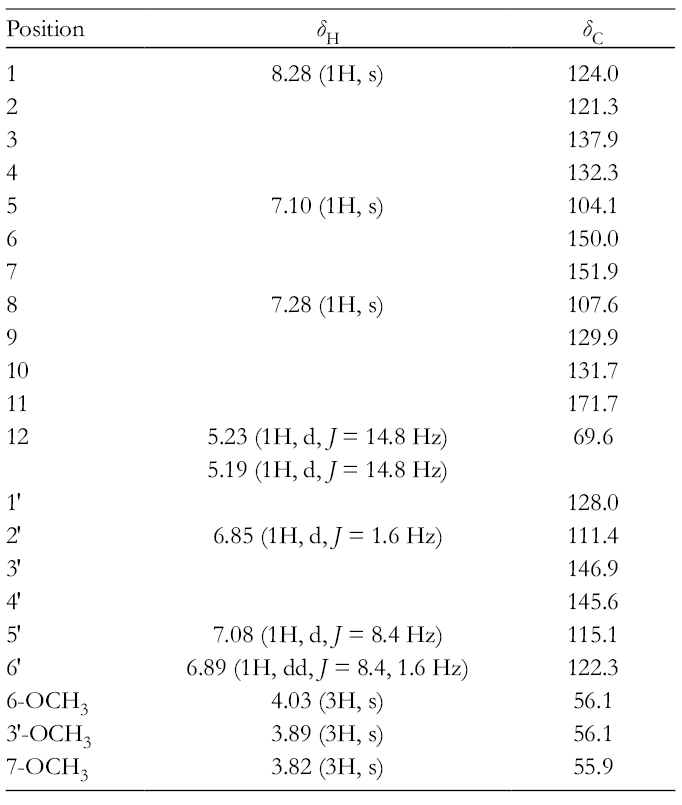
1H (400 MHz, CDCl3) and 13C (100 MHz, CDCl3) NMR Data for 1.
In vitro cytotoxicity of corniculin was then evaluated by the methy thiazolyl tetrazolium (MTT) assay against 4 cancer cell lines (SMMC-7721, A549, HCT-15, and MCF-7). The new compound exhibited moderate cytotoxicity against SMMC-7721, MCF-7, HCT-15, and A549 cell lines, with IC50 values of 29.0, 35.6, 31.3, and 25.7 µM, respectively, which were comparable to that of the positive control cisplatin (Table 2).
Comparison of IC50 Values of Compound 1 and Cisplatin on SMMC-7721, MCF-7, HCT-15, and A549.

Experimental
General
HR-ESI-MS was measured on a Bruker Daltonics microTOF-Q II mass spectrometer (Bruker Daltoniks GmbH, Germany). NMR was recorded on a JEOL ECS 400 NMR spectrometer, with δ in ppm and tetramethyl silane (TMS) and solvent residue (for CDCl3) as internal reference (JEOL, Japan). D-101 macroporous resin (Tianjin Haiguang Chemical Co., Ltd., China), normal-phase silica gel (200-300 and 300-400 mesh, Qingdao Haiyang Chemical Co., Ltd., China), and Sephadex LH-20 (Pharmacia Biotech, Switzerland) were used. Thin layer chromatography (TLC) was run on a prefabricated silica gel GF254 (Qingdao Haiyang Chemical Co., Ltd., China).
Plant Material
The whole plant of O. corniculata was collected in June and supplied by Guizhou Wei Kang Zi Fan Pharmaceutical Co., Ltd., which was identified by Professor Qing-De Long of Guizhou Medical University. A voucher specimen (No. 20170601) was stored in the Herbarium of the Department of Guizhou Provincial Key Laboratory of Pharmaceutics, Guizhou Medical University.
Extraction and Isolation
The air-dried whole plant of O. corniculata (15 kg) was chopped and refluxed with 75% EtOH (120 L, 1.5 hours × 3). The combined EtOH extract was concentrated to yield a residue (2.1 kg) under reduced pressure. The resulting residue was then subjected to D-101 macroporous resin column (22 × 80 cm) and eluted successively by H2O, 50% EtOH, and 95% EtOH. The 50% EtOH eluate and 95% EtOH eluate were concentrated to give a brown syrup, respectively. The combined brown syrup (130 g) was applied to a normal-phase silica gel column (10 × 80 cm, 200-300 mesh) and eluted accordingly with chloroform-methanol (50:1, 20:1, 15:1, 10:1, 8:1, 6:1, 4:1, 2:1, and 0:1, v/v) to give 12 fractions (Fr.1-12). Fr.9 was purified successively by the first normal-phase silica gel column (4 × 60 cm, 300-400 mesh, chloroform-methanol, 9:1-1:1, v/v), the secondary normal-phase silica gel column (3 × 40 cm, 300-400 mesh, petroleum ether-acetone, 8:2, v/v) and the final Sephadex LH-20 column (1.5 × 120 cm, methanol) to give
Corniculin (1)
Yellowish amorphous solid.
1H- and 13C-NMR (CDCl3): Table 1.
HR-ESI-MS m/z: [M+H]+ calcd. for C21H19O6: 367.1204; found: 367.1182.
Supplemental Material
Supplemental material - Supplemental material for A New Arylnaphthalide Lignan From Oxalis corniculata
Supplemental material, Supplemental material, for A New Arylnaphthalide Lignan From Oxalis corniculata by Bao Zhang, Li Jiang, Xue Ma, Ai-Min Wang, Ting Liu, Meng Zhou, Shang-Gao Liao, Yong-Lin Wang, Yong Huang and Yong-Jun Li in Natural Product Communications
Footnotes
Declaration of Conflicting Interests
The author(s) declared no potential conflicts of interest with respect to the research, authorship, and/or publication of this article.
Funding
The author(s) disclosed receipt of the following financial support for the research, authorship, and/or publication of this article: This research was financially supported by programs for the National Natural Science Foundation of China (U1812403), the Youth Science and Technology Talent Growth of the Education Department of Guizhou Province (No. (2018)179), the Academic New Seedlings Cultivation and Innovation Exploration Project in 2018 of Guizhou Medical University (No. (2018)5779-12), the Excellent Scientific and Technological Young Talents of Guizhou Province (No. (2015)11), the Central Government Guides Local Science and Technology Special Projects (No. (2018)4006), and the Scientific and Technological Innovation Team of the Education Department of Guizhou Province (No. (2016)5613/5677).
References
Supplementary Material
Please find the following supplemental material available below.
For Open Access articles published under a Creative Commons License, all supplemental material carries the same license as the article it is associated with.
For non-Open Access articles published, all supplemental material carries a non-exclusive license, and permission requests for re-use of supplemental material or any part of supplemental material shall be sent directly to the copyright owner as specified in the copyright notice associated with the article.
