



Abstract
In this study, response surface methodology (RSM) was used to optimize the ultrasonic-assisted extraction parameters of Sojae Semen Praeparatum polysaccharides (SSPP-80), the optimum conditions were determined as follows: ultrasonic frequency of 100 W, ultrasonic power of 80 Hz, ultrasonic temperature of 52℃, ultrasonic time of 23 minutes, and liquid to raw material ratio of 40 mL/g. Based on these conditions, polysaccharides extraction rate was 7.72% ± 0.26%. Then, 2 novel polysaccharides (SSPP-80‐1, SSPP-80‐2) were isolated from SSPP by DEAE-cellulose 52 chromatography. The chemical compositions, physicochemical properties, and structure of SSPPs were investigated by simultaneous thermal analyzer (TGA), scanning electron microscopy (SEM), fourier transform infrared spectroscopy (FI-IR), and high-performance liquid chromatography (HPLC). The results showed that SSPP-80 and 2 fractions were mainly composed of mannose (Man), glucose (Glc), galactose (Gal), xylose (Xyl), and arabinose (Ara). In addition, the antioxidant activities were evaluated against the DPPH and hydroxyl radical in vitro, the IC50 of SSPP-80, SSPP-80‐1 and SSPP-80‐2 against DPPH free radical were 4.407, 8.267, and 5.204 mg/mL, respectively, whereas the IC50values for removing hydroxyl groups were 5.318, 3.516, and 4.016 mg/mL, respectively. It demonstrated that SSPP-80 and 2 fractions had certain antioxidant activity. Theoretical basis for use of Sojae Semen Praeparatum polysaccharides was provided by this study.
Sojae Semen Praeparatum (Chinese herbal name is “dandouchi”), results from soybean fermentation, has been an important component of traditional diet and effective traditional Chinese medicine among Chinese communities worldwide. It has been reported to be rich in isoflavones, proteins, polysaccharides, fatty acids, mineral elements, and so on after fermentation, 1 and has tonify energy, invigorate the spleen, decrease myocardial oxygen consumption, improve microcirculation, and assist in the curing of tumors. 2 Previous studies have shown that polysaccharides is one of the main active ingredients of Sojae Semen Praeparatum, 3 possess many biological activities, including antimicrobial, antioxidant, and antitumor. 4,5 The biological activity of polysaccharides is related to the extraction method and structure, currently, polysaccharides extraction methods include hot water extraction, 6 ultrasonic extraction, 7 microwave extraction, 8 H2O2-assisted extraction, and supercritical fluid extraction, 9 and so on. However, each extraction method has its advantages and disadvantages. For example, hot water extraction requires high extraction temperatures and longer times. 10 New extraction methods have been developed to overcome the limitations of hot-water extraction. 11 Ultrasonic-assisted processing is a good example of novel methods.
Response surface methodology (RSM) is an effective statistical method, which has been used successfully to improve, and optimize biochemical processes in recent years. 12 It allows for more efficient and easier arrangement and interpretation of experiments compared to other methods. 13 Therefore, the RSM is used to optimize the polysaccharides extraction.
Polysaccharides have been reported to be potential antioxidants. However, till date, their few studies reported on the extraction, characterization, and antioxidant activities of Sojae Semen Praeparatum polysaccharides. Therefore, it is mainly included in our research as follows: (1) optimizing the ultrasonic assisted water extraction of SSPP-80 using single factor test and RSM; (2) characterizing the samples by TGA, SEM, FT-IR and HPLC; (3) testing the antioxidant activity of the samples in vitro.
Materials and Methods
Materials and Reagents
Sojae Semen Praeparatum (SSP) was provided by Anhui Bozhou Northwest Pharmaceutical Co., Ltd. (Anhui, China). 2,2-diphenyl-1-picryl-hydrazyl (DPPH) was purchased from Beijing ZhongshengRuitai Technology Co., Ltd. (Beijing, China). All other chemicals and solvents were analytical grade and obtained from Shanghai Chemical Reagents Company (China National Medicines Group) (Shanghai, China).
Extraction of Polysaccharides
Pretreatment of SSP
The dried SSP were pulverized and passed through a 40 mesh sieve to obtain the SSP powder, with 10-fold volume of 95% ethanol reflux extraction 3 times, each time for 1 hours, removed the lipids and monosaccharides, and the residue was dried at room temperature.
Extraction of crude SSPP-80
The ultrasonic-assisted extraction method was used to extract polysaccharides from SSP. The pretreated dried powder (10 g) was extracted with distilled water held in the ultrasonic extractor. Experimental conditions were shown in Table 2. At the end of the extraction time, the extract solution was centrifuged, filtered, concentrated, and then the crude extract was mixed with 4 volumes of ethanol and stored at 4℃ overnight. After filtration, the precipitate was washed with 3 times dehydrated alcohol and dried under reduced pressure to obtain the crude polysaccharides (SSPP-80).
The polysaccharides extraction rate (Y) was calculated as follows:

Where W SSPP was defined as weight of SSPP whereas Wsample was defined as weight of SSP (10 g).
Single Factor Experimental Design
To set the range of extraction variables for optimizing the extraction process using the response surface method, 4 factors were performed by changing one parameter at a time while setting the others constant. Ultrasonic temperature was designed from 40℃ to 80℃, ultrasonic time was set from 10 min to 50 min, number of ultrasonic extractions was 1 to 4 times and liquid to raw material ratio was from 10 mL/g to 50 mL/g. The first single factor test was performed with changing the ultrasonic temperature from 40℃ to 80℃, while setting other parameters at liquid to raw material ratio 20 mL/g, 30 minutes and extractions twice. The optimal results of the previous single factor test were selected to conduct a later single factor test.
Experimental Design
On the basis of a single-factor experiment for the rate of polysaccharides, proper ranges of ultrasonic temperature, ultrasonic time, and liquid to raw material ratio were preliminarily determined. RSM was applied to investigate the effect of 3 variables, including ultrasonic temperature (A), ultrasonic time (B), and liquid to raw material ratio (C) on the extraction rate of SSPP-80. The range of independent variables and the corresponding response values were shown in Table 1. A 17-run Box Behnken design (BBD) was applied to statistically optimize the extraction of SSPP-80 (Table 2).
Range and Corresponding Levels of Independent Variables.

Box-Behnken Design (BBD) Matrix of the 3 Variables in Coded Units and Response Values for the Extraction Rate of SSPP-80.

Purification of SSPP-80
The crude polysaccharide (SSPP-80) was extracted under the optimal conditions. A total of 200 mg of crude SSPP-80 was redissolved in 10 ml of distilled water, it was eluted in DEAE-cellulose 52 column (2.6 × 40 cm) for classification. SSPP-80 was eluted with distilled water and then with 0 to 1 M NaCl. The eluate was collected with a fully automatic collector, each collection of one tube/10 minutes. The polysaccharides content was determined by the phenol-sulfuric acid method. 14 The absorbance value was measured and the elution curve was drawn to determine the composition of SSPP-80. The distilled water eluate was concentrated and dried to prepare a purified polysaccharide. The NaCl eluate was concentrated to 20 ml, placed in a dialysis bag, dialyzed for 24 hours in water, and dialyzed against distilled water for 24 hours.
TGA Analysis
The samples were heated from 10℃ to 800℃ at a heating rate of 10 ℃/min under an atmosphere of nitrogen with simultaneous thermal analyzer (Q600).
UV-Vis Spectra Analysis
The solution of samples (0.1 mg/mL) were analyzed by UV-vis spectroscopy on a UV-vis spectrophotometer (Purkinje General Instrument Co., Ltd, Beijing, China) at wavelengths in the range of 200‐800 nm.
SEM Analysis
The samples were adhered to the sample stage, and the conductive layer was placed on the vacuum sprayer. The surface morphology was observed by scanning electron microscope (JSM-7610F). The acceleration voltage was 3.0 kV, the resolution was 7.2 mm, and the magnification was 6000 times.
FT-IR Analysis
The FT-IR was analyzed by a Fourier transform IR spectrophotometer (FT-IR, Vector 22 Bruker). The samples were ground with KBr powder and then pressed into pellets before being subjected to FT-IR measurement in the frequency range of 4000‐500 cm-1.
Monosaccharide Composition Analysis
HPLC was applied to determine the monosaccharide composition. Derivatization of monosaccharides were carried out according to the method of Chen et al. 15 HPLC analysis: Monosaccharide (10 mg) standards and the samples (20 mg) through a 0.45 µm membrane. Then the contents of monosaccharides were determined by HPLC with a UV detector at 245 nm on Agilent 1200 Infinity chromatograph. The mobile phase was 0.05 mol/mL phosphate buffer solution (pH = 6.8) (A) and acetonitrile (B) (A:B = 83:17, v/v). With 20 µL of injection volume, separation was performed on Eclipse XDB-C18 HPLC column (4.6 mm×250 mm, 5 µm) at 30 ℃ and 0.8 mL/min of flow rate.
Antioxidant Activity
DPPH scavenging activity of samples were carried out according to the method of Wu. 16 Hydroxyl radical scavenging activity was measured according to the method of Han et al. 17
Statistical Analysis
All experiments were performed in triplicate, and the results presented the average of 3 independent trials. Design-Expert (Version 8.0.6.1, State-Ease, Inc., Minneapolis, MN, USA) was applied for the statistical analysis of RSM.
Results and Discussion
Single-Factor Experiments Analysis
Effect of ultrasonic temperature
As shown in Figure 1(A), the extraction rate of the SSPP-80 presented an upward trend with the increasing ultrasonic temperature (40℃~50℃). However, when the ultrasonic temperature continued to increase, the rate of polysaccharides decreased. Therefore, ultrasonic temperature of 50℃ was considered to the optimal ultrasonic temperature in the BBD experiments, as higher temperatures resulted in wasted energy and increased costs for the extraction process. 18

Effects of ultrasonic temperature (
Effect of ultrasonic time
The effect of different ultrasonic time (10 minutes, 20 minutes, 30 minutes, 40 minutes, 50 minutes) on extraction rate of SSPP-80 were shown in Figure 1(B). The extraction rate of SSPP-80 increased as the time was increased from 10 to 20 minutes. Then, the SSPP-80 extraction rate began to decline as time extends. With the extension of ultrasonic time, the glycoside bonds of polysaccharides would be unstable and ease to break, and the decomposition of polysaccharides would lead to the decrease of extraction rate. 19 Therefore, 20 minutes was selected as the optimal ultrasonic time in the BBD experiments.
Effect of number of ultrasonic extractions
Figure 1(C) showed that the rate increased with an increase number of ultrasonic extractions from once to twice. However, after twice extraction, the rate declined. Therefore, number of ultrasonic extractions of twice was selected in the BBD experiments. 20
Effect of liquid to raw material ratio
Different liquid to raw material ratio could significantly affect the extraction rate. Figure 1(D) showed that liquid to raw material ratio was 40 mL/g, the extraction rate of polysaccharides reached the peak. However, the rate of SSPP-80 started to decrease after it exceeded 40 mL/g, this may be because as the ratio increased, more polysaccharides molecules dissolved in water. Therefore, liquid to raw material ratio was set at 40 mL/g in the BBD experiments. 21
Model Building and Statistical Analysis
Based on the single-factor experiment, BBD was used to optimize the extraction. Three independent variables, namely, ultrasonic temperature (A), ultrasonic time (B), and liquid to raw material ratio (C) were assessed. The results of 17 experiments in a random order were presented in Table 2. Based on the experimental data obtained from the multiple regression analysis method, the predicted response Y for the extraction rate of SSPP-80 can be fitted into the following second-order polynomial equation:

where Y was the extraction rate of SSPP-80, and A, B, and C were the coded values of the tested ultrasonic temperature, ultrasonic time, and liquid to raw material ratio, respectively.
The analysis of variance (ANOVA) results of the response surface quadratic model was summarized in Table 3.
Analysis of Variance of the BBD Experimental Results.
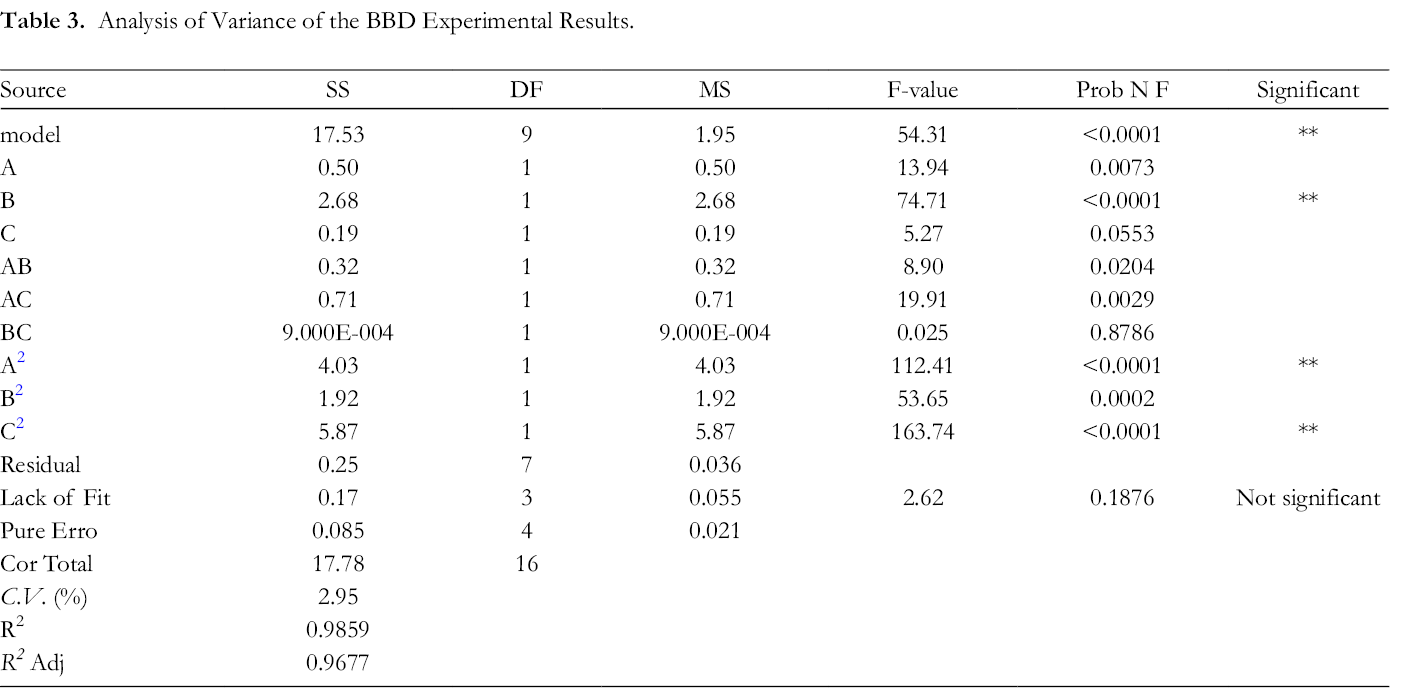
The p-values were used as a tool to check the significance of each coefficient, and the P value of the model was <0.0001, indicating that the fitness of the model was highly significant. The lack-of-fit value was 0.1876, indicating that it was insignificant relative to the pure error (P > 0.05). The values of R 2 (determination coefficient) and R Adj 2 (adjusted determination coefficient) were 0.9859 and 0.9677, respectively, indicating a high correlation degree between predicted and observed values. Additionally, a low coefficient of the variation (C.V.%2.95) showed a high degree of reliability and precision. Moreover, the order of factors influencing the response value of the extraction rate of SSPP-80 were as follows: ultrasonic time (B) > ultrasonic temperature (A) > liquid to raw material ratio (C). Therefore, ultrasonic time was the most important factors in the polysaccharides extraction process.
Optimization of the Procedure
Response surfaces were plotted using Design-Expert to study the effects of parameters and their interactions on polysaccharides rate. When the contours were circular, the interaction of the factors was not obvious. And the contours were elliptical, the interaction was obvious. 22 Figure 2(A, a) showed the effect of ultrasonic time and liquid to raw material ratio on extraction rate. The response surface was almost flat, indicating a non-significant mutual interaction between ultrasonic time and liquid to raw material ratio. Figure 2(B, b) showed ultrasonic temperature, ultrasonic time and their reciprocal impacts on extraction rate. The response surface was steep, indicating a significant interaction between ultrasonic time and ultrasonic temperature. A similar trend was observed for ultrasonic temperature, liquid to raw material ratio and their reciprocal impacts on extraction rate shown in Figure 2(C, c). Based on the above analyses of the response surface, the ultrasonic temperature and ultrasonic time were found to be the strongest reciprocal impacts during SSPP-80 extraction.

Response surface plots for the effects of ultrasonic time and liquid to raw material ratio (
The optimum extraction conditions (ultrasonic temperature 51.10℃, ultrasonic time 22.38 minutes and liquid to raw material ratio 40.54) for the polysaccharides extraction rate were estimated using the model equation by solving the regression equation and analyzing the response surface contour plots. The theoretical polysaccharides extraction rate that was predicted under the above conditions was 7.94%.
Validation of the Model
In order to validate the adequacy of the model equations, a verification experiment was conducted. Considering the practical operation of the extraction process, the optimal conditions were modified as follows: ultrasonic frequency of 100 W, ultrasonic power of 80 Hz, ultrasonic temperature 52℃, ultrasonic time 23 minutes and liquid to raw material ratio of 40 mL/g. Under these optimal conditions, the polysaccharides extraction rate was 7.72 ± 0.26% (n = 3), which closely agreed with the predicted value. This confirmed that the response model was adequate for the optimization of polysaccharides extraction.
Extraction, Isolation and Purification of Polysaccharides
The SSPP-80 purified by DEAE-cellulose 52 chromatography, and 2 fractions were obtained, SSPP-80‐1 and SSPP-80‐2 were eluted from distilled water and 1 M NaCl, respectively (Figure 3). The rate of SSPP-80‐1 was 50.5% whereas the SSPP-80‐2 was 18.3%.
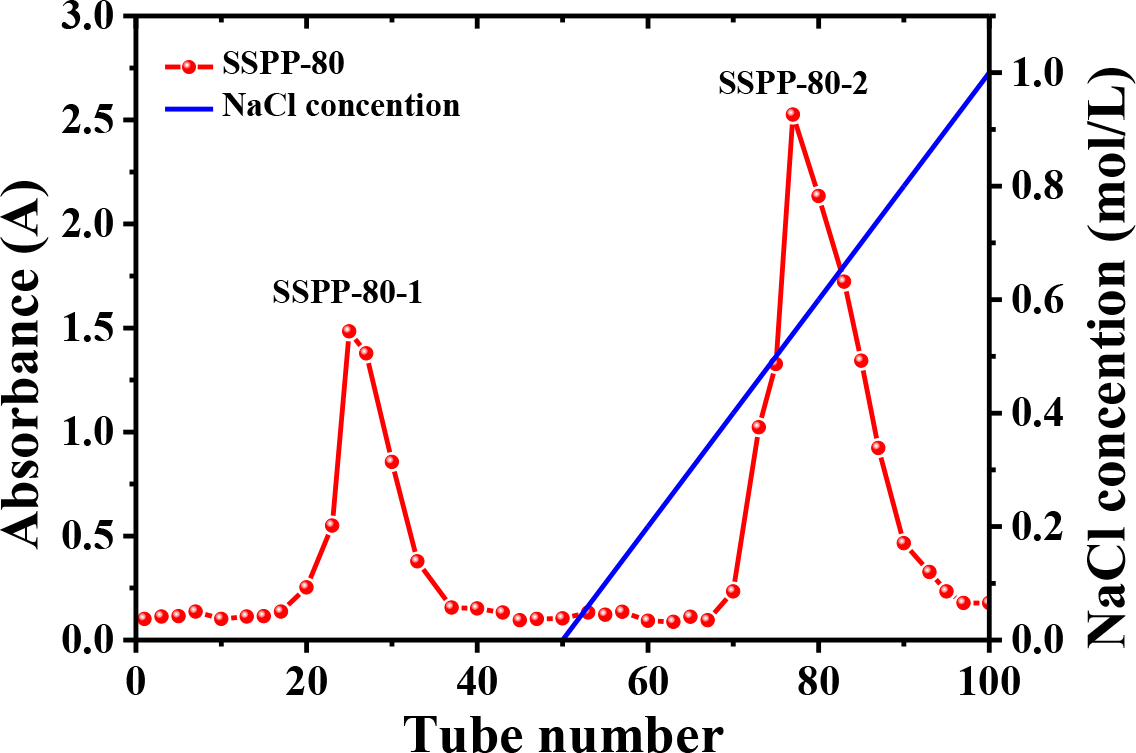
Elution profiles of SSPP-80 on DEAE-cellulose 52 chromatography with deionized water and NaCl.
Physical and Chemical Properties Analysis
TGAanalysis
The TGA analysis of SSPP-80, SSPP-80‐1, and SSPP-80‐2 were shown in Figure 4(A). It can be seen that the TGA of SSPP-80 and SSPP-80‐2 were divided into 3 stages. SSPP-80‐1 was 4 stages. The first stage was mainly the sublimation of adsorbed water, and the second stage was mainly due to evaporation of polysaccharides. In the third stage, the weight loss rate of polysaccharides decreased gradually. It showed that SSPP-80 and SSPP-80‐2 were basically completely degraded in the first 2 stages. The rapid weight loss of SSPP-80‐1 at 700℃ may be because the decomposition temperature of SSPP-80‐1 was not reached in the third stage, so it was not completely degraded. TGA analysis demonstrated that the thermal degradation temperature of SSPP-80 and SSPP-80‐2 was about 200 °C whereas SSPP-80‐1 was 100°C and 700 °C.The difference in TGA results may be due to different monosaccharide composition and content.

TGA curve of SSPP-80, SSPP-80‐1 and SSPP-80‐2 (
UV-vis analysis
The UV spectra of SSPP-80, SSPP-80‐1, and SSPP-80‐2 were shown in Figure 4(G). The UV-vis spectra of SSPP-80, SSPP-80‐1, and SSPP-80‐2 showed absorptions at 260‐280 nm indicating the presence of protein. 23
Morphological structure
The morphological property of SSPP-80SSPP-80, SSPP-80‐1 and SSPP-80‐2 were examined by SEM. As shown in Figure 4 (C, D and E), the surfaces of SSPP-80 and SSPP-80‐2 were uneven and show thin pieces. SSPP-80 had a larger gap, while SSPP-80‐2 had a smaller gap. The surface of SSPP-80‐1 was relatively smooth and flat, and the texture was compact, which may also be the reason why it was not easy to decompose during the thermal degradation process.
FT-IR analysis
The characteristic absorption spectra of SSPP-80, SSPP-80‐1 and SSPP-80‐2 were illustrated in Figure 4(F). SSPP-80, SSPP-80‐1 and SSPP-80‐2 had similar FT-IR absorption bands, indicating similarities in their structural features. The stretching vibration of O-H was observed between 3600 and 3200 cm-1, which was due to the glycosidic linkages of polysaccharides. 24 The bands at 1600 cm-1 and 1400 cm-1 were resulted from the presence of C = O stretching and C-H bending vibration, respectively. 25 The characteristic peak at around 870 cm-1 indicated the existence of β-glycoside bonds. 26 The structures of SSPP-80‐1 and SSPP-80‐2 were similar with SSPP-80, and they all contained the most basic group peaks and characteristic absorption peaks. They all had a typical polysaccharides characteristic absorption peak.
Monosaccharide composition analysis
By comparing with the retention time of the monosaccharide standards, the monosaccharide composition of SSPP-80, SSPP-80‐1 and SSPP-80‐2 were identified by HPLC in Figure 4(G). The SSPP-80 was primarily composed of Man, GalA, Glc, Gal, Xyl and Ara in a molar ratio (%) of 0.05:0.14:0.13:0.26:0.18:0.24, whereas SSPP-80‐1 mainly consisted of Man, Glc, GalA, Xyl and Ara in a ratio of 0.04: 0.24: 0.11: 0.15: 0.08: 0.39. It can be seen that SSPP-80 and SSPP-80‐2 had the same monosaccharide composition and different ratios. HPLC demonstrated that SSPP-80‐2 mainly consisted of Man, Glc, Gal and Ara in a ratio (%) of 0.05:0.71:0.08:0.16. The majority was Glc, which do not contain uronic acid.
Antioxidant Activity Analysis
DPPH radical scavenging activity was a widely applied test to assess the free radical scavenging activity of natural extracts. 27 As shown in Figure 5(A), DPPH radical scavenging activity of SSPP-80, SSPP-80‐1 and SSPP-80‐2 increased in a concentration-dependent manner. Within the concentration range, as the samples concentration increased, the ability to scavenge DPPH gradually increased. When the concentration was 4 mg/mL, the clearance rates of SSPP-80, SSPP-80‐1 and SSPP-80‐2 were 51.443 ± 0.012%, 29.347 ± 0.025% and 49.566 ± 0.009%, respectively. The IC50 of SSPP-80, SSPP-80‐1, SSPP-80‐2 and Vc were 4.407, 8.267, 5.204 and 0.005 mg/mL, respectively. Analyzed by IC50, the order of clearing capacity was Vc > SSPP-80 > SSPP-80‐2 > SSPP-80‐1.

The antioxidant activity of SSPPs (scavenging activity towards DPPH radicals (
Among the reactive oxygen species, hydroxyl radicals were regarded as the most harmful radicals, which can affect the biomacromolecules in living cells. 28 Thus, it is very important to remove hydroxyl radicals for the protection of living natural systems. As shown in Figure 5(B), The Hydroxyl radical scavenging activity of SSPP increased in a concentration-dependent manner. When the concentration was 8 mg/mL, the clearance rates of SSPP-80, SSPP-80‐1 and SSPP-80‐2 were 50.812 ± 0.471%, 94.142 ± 0.105% and 75.117 ± 0.029%, respectively. The IC50 of SSPP-80, SSPP-80‐1, SSPP-80‐2 and Vc were 5.318, 3.516, 4.016 and 0.072 mg/mL, respectively. Analyzed by IC50, the order of clearing capacity was Vc > SSPP-80‐1 > SSPP-80‐2 > SSPP-80.
Therefore, in different antioxidant systems, SSPPs exhibits different antioxidant activities, which may be caused by different antioxidant principles. There were many factors that affected the antioxidant activity of polysaccharides, such as molecular weight, monosaccharide composition, and type of glycosidic bonds. 29 According to reports, monosaccharide composition was one of the main factors affecting the antioxidant activity of polysaccharides. The higher the Gal and Ara content, the better the DPPH free radical scavenging activity. SSPP-80 contains the most Gal and Ara. From the principle of oxidation reaction, SSPP-80‐1 had good antioxidant activity, probably because it contained higher galacturonic acid. 30 At present, there are relatively few studies on the soybean polysaccharides. Liu et al. 31 studied the structure and antioxidant activity of the black soybean polysaccharide in vitro, and the results showed that the black soybean polysaccharide had antioxidant ability. At the concentration of 1 mg/mL, the scavenging activities were 72.22%, 30.11%, 50.46%, 66.67%, and 97.56% for crude BSPS, BSPS-1, BSPS-2, BSPS-3, and Vc, respectively. Hu et al. 32 studied the antioxidant activity of soybean extract, which had a certain antioxidant activity, the IC50 value of the DPPH free radical scavenging rate was 6.91 mg/mL, and the carbohydrate in the soybean extract accounts for the largest proportion of 17.6%. Combined with the results of this study, soybean polysaccharides have certain antioxidant activity.
Conclusions
In this study, the optimization of ultrasonic-assisted extraction of polysaccharides from Semen Sojae Praeparatum was conducted. The optimal conditions for polysaccharides were ultrasonic frequency of 100 W, ultrasonic power of 80 Hz, ultrasonic temperature of 52℃, ultrasonic time of 23 minutes and liquid to raw material ratio of 40 mL/g. Under these conditions, the extraction rate was 7.72 ± 0.26%. Then, SSPP were separated by DEAE-52 cellulose and 2 fractions (SSPP-80‐1 and SSPP-80‐2) were obtained. Furthermore, they were characterized by TGA, SEM, FT-IR, HPLC. They showed the similar FT-IR spectra and monosaccharide composition. In vitro antioxidant tests showed that SSPP and 2 fractions had certain antioxidant activity. Further studies on their other biological activities are currently underway.
Footnotes
Declaration of Conflicting Interests
The author(s) declared no potential conflicts of interest with respect to the research, authorship, and/or publication of this article.
Funding
The author(s) disclosed receipt of the following financial support for the research, authorship, and/or publication of this article: The present study was supported by the Fourth Chinese Materia Medica Resources Survey (Z135080000022), the Key Research and Development Program of Hebei Province (20370509D), the Science and Technology Project of Hebei Education Department (ZD2020117) and the Science and Technology Program of Hebei Administration of Traditional Chinese Medicine (2021104).
