



Abstract
The drug resistance of Pseudomonas aeruginosa is a worldwide problem due to its great threat to human health. A crude extract of Angelica dahurica has been proved to have antibacterial properties, which suggested that it may be able to inhibit the biofilm formation of P. aeruginosa; initial exploration had shown that the crude extract could inhibit the growth of P. aeruginosa effectively. After the adaptive dose of coumarin was confirmed to be a potential treatment for the bacteria’s drug resistance, “coumarin-antibiotic combination treatments” (3 coumarins—simple coumarin, imperatorin, and isoimperatorin—combined with 2 antibiotics—ampicillin and ceftazidime) were examined to determine their capability to inhibit P. aeruginosa. The final results showed that (1) coumarin with either ampicillin or ceftazidime significantly inhibited the biofilm formation of P. aeruginosa; (2) coumarin could directly destroy mature biofilms; and (3) the combination treatment can synergistically enhance the inhibition of biofilm formation, which could significantly reduce the usage of antibiotics and bacterial resistance. To sum up, a coumarin-antibiotic combination treatment may be a potential way to inhibit the biofilm growth of P. aeruginosa and provides a reference for antibiotic resistance treatment.
Foodborne pathogens are a global concern and seriously threaten human health. The Centers for Disease Control and Prevention (CDC) estimated that 31 major pathogens in the United States caused 9.4 million foodborne diseases, 55 961 hospitalizations, and 1351 deaths each year 1 ; 1.8 million people died from diarrhoeal diseases in 2005 alone all over the world. 2 Pseudomonas aeruginosa is a Gram-negative bacterium with strong biofilm production ability and a common food-related pathogen, 3 causing severe infections, including malignant external otitis, endophthalmitis, and endocarditis. 4 Traditional treatments for those infections focus on antibiotics, which either kill or inhibit the pathogen’s growth. However, the current main concern is the resistance of P. aeruginosa toward many drugs, which has become a worldwide problem. 5 Moreover, the major cause of drug resistance of P. aeruginosa is biofilm formation. 6 This is regulated by bacterial quorum sensing (QS), a mechanism that helps bacterial communities respond to foreign substances together and meanwhile protects bacteria from antibiotics, antibacterial agents, and other unfavorable factors. 7 -9 It is a complex interbacterial communication system that can achieve and regulate multiple physiological functions of bacteria. 10 For example, QS plays a part in the luminescence phenomenon of Vibrio fischeri, virulence factor synthesis of Erwinia nigrifluens, 11 biofilm formation of Staphylococcus aureus, 12 spore formation of Bacillus anthracis, 13 motility of Agrobacterium tumefaciens, and cell morphology of Lactobacillus plantarum related to various bacterial groups. 14,15 The generation of these physiological functions is greatly beneficial to the survival rate or pathogenicity of bacteria when coping with a complex and volatile environment. 16 At present, biofilm formation has been discovered in almost all known bacteria, and more than 90% of them are protected and survive in a biofilm-coated mode. 17 Furthermore, given their thickness and fluidity, biofilms can enhance the tolerance to various antibiotics and host immune attacks. The inhibition of QS regulation has become a target for novel specific intervention strategies. 18 Thus, developing QS inhibitors (QSIs) as anti-infective drugs provide a new strategy for coping with bacterial resistance.
Radix Angelicae Dahuricae (AD) is a natural medication promulgated by the National Health Commission of the People’s Republic of China to treat headaches and toothache. 19 At the same time, it is also an important spice used in food preservation. 20 AD has displayed many bioactivities, such as anticancer, 21 antibiotic, 22 antitumor, and anticholinesterase. 23 Coumarins are one of AD’s prominent bioactive constituents. 24 Coumarins and their derivatives have antibacterial, antiviral, antifungal, anti-inflammatory, anticancer, anticoagulant, and antihypertensive activities. 25 Some types of coumarin derivative also have in vitro antibacterial activity against P. aeruginosa. 26,27
Based on our previous studies, 28 we found that different AD extracts could stifle biofilm formation of S. aureus and P. aeruginosa effectively, most likely resulting from the presence of coumarin. Combination therapies have become hot due to their considerable antibacterial effect both in animal and clinical trials. 29 -32 In this article, the effect is reported of a coumarin-antibiotic (C-A) combination treatment toward biofilm formation of P. aeruginosa. Furthermore, this study could provide pointers to clinical trials with C-A combination treatment, in order to solve the currently urgent drug-resistance problem of P. aeruginosa and develop potential QSIs.
Materials and Methods
Bacterial Strains and Culture Conditions
Pseudomonas aeruginosa CICC 10419 used in this study was provided by the China Industrial Microbial Culture Preservation Center (CICC). Pseudomonas aeruginosa CICC 10419 was cultured in Luria-Bertani (LB) medium containing 5% glucose at 37 °C. The coumarins and antibiotics used were purchased from Chengdu Pusi Biotechnology Co., Ltd. All other chemical reagents were guaranteed and purchased from Chengdu Haoboyou Technology Co., Ltd.
Extraction of AD
AD root was dried, powdered, sieved, and then soaked in 75% ethanol solution for 3 hours. The mixture was heated under reflux for 3 times, each time for 3 hours. The liquids were then combined, the insoluble material removed by filtration, and the filtrate evaporated to dryness in a rotary evaporator under reduced pressure. The dry extract was dissolved in pure water and extracted 3 times with ethyl acetate. The solvent extracts were combined and concentrated to dryness under reduced pressure to give the dry extract, which was dissolved in water, filtered, and sterilized by passage through a 0.22-µm sterile filter membrane, prepared into certain concentrations of an aqueous solution, and then stored at low temperature for the next experiment.
Observation of Biofilm Formation
Pseudomonas aeruginosa CICC 10419 was inoculated into LB liquid medium, cultured at 37 °C at 120 r/min overnight, and diluted to 106 CFU/mL. Approximately 200 µL of the suspension was added to 96-well plates and then cultured for 1, 2, 3, 4, 5, 6, and 7 days. The supernatant was removed, and crystal violet staining was performed. Finally, absorbance was measured at 570 nm, and the average of three measurements was taken.
After biofilm formation had been observed, approximately 20 mL of a 106 CFU/mL suspension was added to a clean glass slide that had been autoclaved and sterilized under ultraviolet (UV) light for 24 hours. After incubation for 1, 3, 5, and 7 days at 37 °C, crystal violet stain was applied, and the slides were observed under an optical microscope.
Effects of Extracts on Biofilm Formation
Pseudomonas aeruginosa CICC 10419 strain suspension was diluted to 106 CFU/mL in LB medium. Approximately 100 µL of the bacterial suspension and 100 µL of the different extract concentrations were added to 96-well plates. The extract was prepared at final concentrations of 1, 10, 20, 30, 40, and 50 mg/mL. Anhydrous ethanol served as the control group. The culture was allowed to stand for 24 hours. Approximately 20 µL of triphenyltetrazolium chloride (TTC) was added to each well, incubated at 120 r/min, and protected from light. After 4 hours of culture, each well was observed for color change. The experiment was repeated 3 times, and the results were averaged. Approximately 10 µL of the suspensions containing different drug concentrations were obtained from the 96-well plates in LB solid medium containing 5% glucose, uniformly coated, and cultured at 37 °C for 24 hours to observe bacterial growth.
The overnight culture suspension was diluted to 106 CFU/mL, and 100 µL was inoculated into a 96-well plate. Different extract concentrations were added to obtain final concentrations of 1/8, 1/4, 1/2, 1.5, and 2 minimum inhibitory concentrations (MICs). The mixture was subjected to static culture at 37 °C for 24 hours. The supernatant was removed, and then crystal violet staining was performed. Finally, absorbance was measured at 570 nm on a microplate reader, and the experiment was repeated 3 times to obtain an average value.
Destruction of Mature Biofilms
Given that the concentration of coumarins in the extract is low, accurately determining their effect on mature biofilms is difficult. Therefore, standard coumarins were used in this experiment (identification reports are shown in the Supplemental Material).
The mature biofilm cultured for 3 days was washed 3 times with phosphate-buffered saline (PBS). Approximately 100 µL of medium and 100 µL of coumarin of different concentrations were added to the mature biofilm to obtain final concentrations of 0.1, 0.2, 0.4, 0.6, 0.8, and 1.0 mg/mL, with anhydrous ethanol serving as the control group. The mixtures were statically cultured for 24 hours, and 20 µL of TTC was added to each well and cultured for 4 hours (20 r/min) in the dark. The color change of each well was observed. This experiment was repeated 3 times, and the results were averaged. Approximately 10 µL of the bacterial suspensions with different drug concentrations were aspirated from the above 96-well plates in LB solid medium, uniformly coated, and cultured at 37 °C for 24 hours to determine the minimum bactericidal concentration (MBC) of coumarins on the mature biofilm.
C-A Combination Treatment
The antibiotics selected for P. aeruginosa CICC 10419 were ampicillin and ceftazidime. Simple coumarin, imperatorin, and isoimperatorin standards were used for the drug combination experiment.
The mature biofilm cultured for 3 days was washed 3 times with PBS. To each well were added antibiotics (final concentrations of 3, 4, 5, 6, 7, and 8 µg/mL) and coumarin (final concentrations of 0, 10, 20, 30, 40, and 50 µg/mL). After incubation at 37 °C for 24 hours, the supernatant was removed, and crystal violet staining was performed. Finally, absorbance was measured at 570 nm, and the average value was obtained from 3 measurements.
Statistical Analysis
Three independent biological replicates were performed for all experiments. Statistical analysis was performed using a 2-tailed paired Student’s t-test. Differences were considered significant when the P value was ≤0.05. Differences were considered extremely significant when the P value was ≤0.01.
Results
Determination of Biofilm Formation
With prolonged culture time, the amount of biofilm produced by the strain gradually increased (Figure 1). When the strains were cultured to the fifth day, the amount of biofilm tended to be constant, indicating that the mature biofilm had been formed. The results of optical microscopy are shown in Figure 2. With prolonged time, the structure of the biofilms gradually changed from loose to dense. When their culture reached the third day, mature biofilms began to form.

Biofilm formation measurement with semiquantitative adherence assay, *P < 0.05, **P < 0.01.

Observation of biofilm formation with optical microscope (100×).
Inhibition of Bacterial Biofilm by Extracts
The inhibitory effect of the extract on the biofilms was gradually enhanced after various concentrations of the extract were applied to the strain for 24 hours (Table 1). Pseudomonas aeruginosa CICC 10419 biofilm formation could be completely inhibited, with a MIC and MBC of 50 mg/mL.
Effects of Angelicae Dahuricae Extract at MIC and MBC on Bacterial Biofilms.
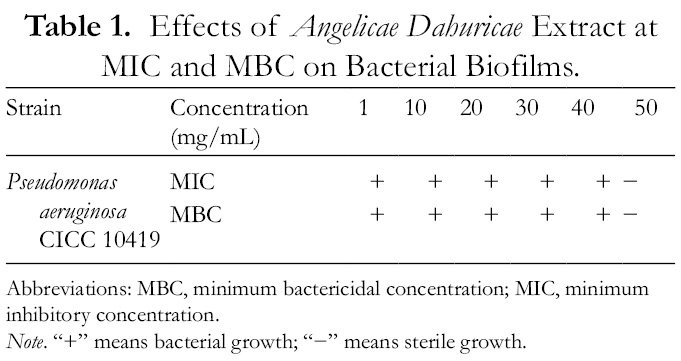
Abbreviations: MBC, minimum bactericidal concentration; MIC, minimum inhibitory concentration.
Note. “+” means bacterial growth; “−” means sterile growth.
The Effect of Extracts on Biofilm Formation
Figure 3 showed that the biofilm yield of the strain gradually decreased with increasing coumarin concentration. When the drug concentration was either greater than or equal to the MIC, the strain biofilm formation could be completely inhibited.
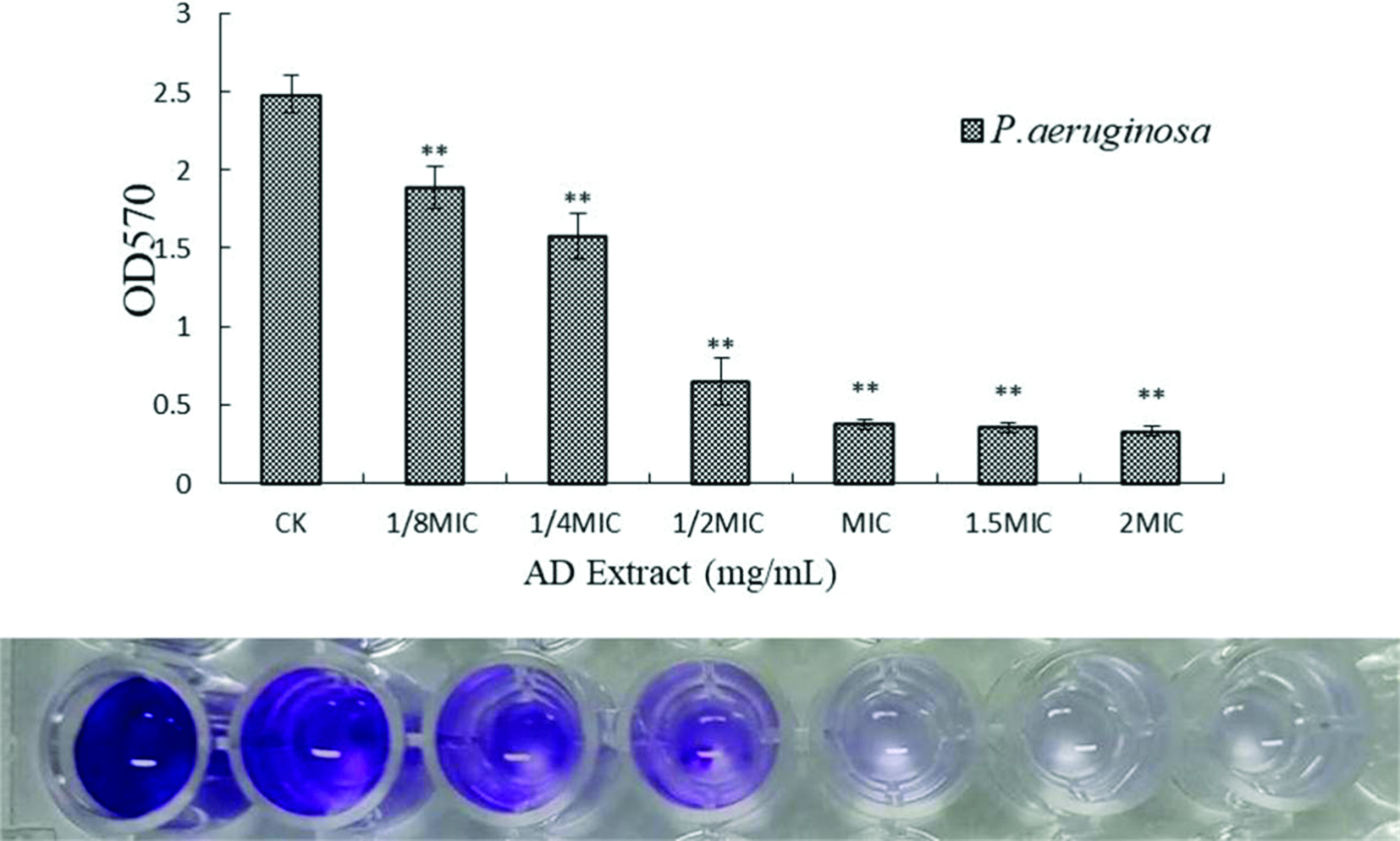
Effect of Angelicae Dahuricae extract on biofilm formation, as determined by crystal violet staining, **P < 0.01.
Determination of MIC and MBC of the Extracts on Bacterial Mature Biofilm
The results recorded in Table 2 show that the extract minimally affected mature biofilms due to its low coumarin concentration. When used alone, coumarin reacted positively on the mature biofilms but could not completely destroy them.
Effects of Coumarin at MIC and MBC on Mature Biofilms.

Abbreviations: MBC, minimum bactericidal concentration; MIC, minimum inhibitory concentration.
Note. “+” means bacterial growth; “−” means sterile growth.
C-A Combination Treatment of P. aeruginosa Mature Biofilm
Simple coumarin and antibiotics
Figure 4 showed that coumarin alone, in all groups, inhibited the formation of P. aeruginosa CICC 10419 biofilms. The simple coumarin-ceftazidime combination showed a more considerable impact than the simple coumarin-ampicillin group. The disintegration rate of the ceftazidime group dramatically decreased when the ceftazidime concentration was over 5 µg/mL. However, the disintegration rate of ampicillin was modest.

Effect of simple coumarin combined with ampicillin and ceftazidime on biofilms.
Imperatorin and antibiotics
Figure 5 showed that the inhibitory effect on P. aeruginosa CICC 10419 biofilms was enhanced when imperatorin was combined with antibiotics. The imperatorin-ampicillin combination seemed to be the best. For the imperatorin-ceftazidime combination, when the antibiotic concentration was 4 µg/mL, the disintegration rate of all groups was significantly reduced.

Effects of imperatorin combined with ampicillin and ceftazidime on biofilms.
Isoimperatorin and antibiotics
As showed in Figure 6, when isoimperatorin was combined with either amipicillin or ceftazidime, the inhibitory effect on P. aeruginosa CICC 10419 biofilm was obvious. When 3 µg/mL ceftazidime and 50 µg/mL isoimperatorin was applied, the inhibition effect was much more significant than that of 3 µg/mL ceftazidime alone. Moreover, when the concentration of antibiotics was more than 6 µg/mL, all groups showed a similar inhibitory effect on P. aeruginosa CICC 10419 biofilm growth.

Effects of isoimperatorin combined with ampicillin and ceftazidime on biofilms.
Discussion
Antibiotics resistance has become a threat to peoples’ health, and, therefore, some novel treatments should be explored to treat it, including some traditional medicines and herbs. 1,33 -35 AD has been used as a medical food for thousands of years in southwest Asia and shows valuable bioactivities. 35 -38 In this study, AD extracts showed promising anti-QS activity on aP. aeruginosa strain. Moreover, coumarin and its monomers have stronger antibiotic activity than certain abused antibiotic drugs. However, Figures 4 -6 show that once biofilms formed, even with high concentrations of antibiotics, the change in the bacteriostatic effect was extremely limited, but combined with coumarin, the biofilm started to collapse. Research has shown that coumarin can significantly negatively regulate genes which are responsible for QSI synthesis in P. aeruginosa. 39 Dense and thick biofilms of P. aeruginosa are one of the clinical challenges in terms of infection because QS gets involved in biofilm formation. 39 -41 However, biofilms dramatically decreased after the coumarin was added. Therefore, the C-A combination treatment was more likely to act directly on the bacterial biofilms, killing the colonies to a certain extent and to be a new QSI. 42,43 However, from the present outcomes, we could not figure out which combination is best to prevent the biofilm formation. It is true that the reliability of in vitro experiment is lower than that of in vivo experiment due to the influence of drug absorption, metabolism in vivo, strains, species, and so on. Nevertheless, according to this study, there is no doubt that C-A combination treatment could be a potential QSI to tackle P. aeruginosa drug resistance. Future exploration will go on to explore further the mechanism of C-A combination treatment of P. aeruginosa CICC 10419 biofilm formation, which could help us to decide whether this treatment could have the potential for use in the clinic.
Supplemental Material
Supplementary Material 1 - Supplemental material for An In Vitro Coumarin-Antibiotic Combination Treatment of Pseudomonas aeruginosa Biofilms
Supplemental material, Supplementary Material 1, for An In Vitro Coumarin-Antibiotic Combination Treatment of Pseudomonas aeruginosa Biofilms by Jinpeng Zou, Yang Liu, Ruiwei Guo, Yu Tang, Zhengrong Shi, Mengnan Zhang, Wei Wu, Yinyin Chen and Kai Hou in Natural Product Communications
Footnotes
Acknowledgments
The authors are grateful for financial support from the State Administration of Traditional Chinese Medicine of China, Science and Technology Department of Sichuan Province and China Scholarship Council.
Declaration of Conflicting Interests
The author(s) declared no potential conflicts of interest with respect to the research, authorship, and/or publication of this article.
Funding
The author(s) disclosed receipt of the following financial support for the research, authorship, and/or publication of this article: The Fourth National Census of Traditional Chinese Medicine Resources in China (No. 2018pc02), “13th Five-Year” Breeding Tackling Project of Sichuan Province (No. 2016NYZ0036), and China Scholarship Council (No. 201906910095 ).

Supplemental Material
Supplemental material for this article is available online.
References
Supplementary Material
Please find the following supplemental material available below.
For Open Access articles published under a Creative Commons License, all supplemental material carries the same license as the article it is associated with.
For non-Open Access articles published, all supplemental material carries a non-exclusive license, and permission requests for re-use of supplemental material or any part of supplemental material shall be sent directly to the copyright owner as specified in the copyright notice associated with the article.
