



Abstract
The aerial parts of the tarragon (Artemisia dracunculus) were collected around Kukteppa village, Ziddi, Varzob region of Tajikistan. The essential oil of tarragon was obtained by hydrodistillation and analyzed by gas chromatography-mass spectrometry. Forty-five compounds representing 99.8% of total oil were identified. Sabinene (29.1%), estragole (24.6%), limonene (7.8%), (Z)-artemidin (4.9%), myrcene (4.8%), and (E)-β-ocimene (4.0%) were components with a representation higher than 4% of the essential oils of aerial parts of tarragon. Hierarchical cluster analysis of А. dracunculus essential oils on the global phytogeographic origin based on 30 essential oil components and 105 samples (globally) of this species, indicated the existence of its 7 major chemotypes: ocimene, α-terpinene, capillene, methyl eugenol, mixed chemotype, (Z)-artemidin, and estragol chemotypes. The essential oils of А. dracunculus showed weak antioxidant and antibacterial activities. To our best knowledge, this is the first report concerning the chemical composition, chemotypic variation, antioxidant, and antimicrobial activities of the essential oils obtained from the aerial parts of А. dracunculus, growing wild in the Varzob region of Tajikistan.
Artemisia dracunculus L. (common names: tarragon, estragon, tarkhun) is a small perennial shrub, 60-120 cm tall, and belongs to the Asteraceae. The plant is native to south-eastern Russia, Central Asia, Turkey, Mongolia, and western North America. 1 In Tajikistan, tarragon forms dense thickets; it is distributed commonly in the vegetation belts of black and juniper forests, subalpine meadows, semi-savannas, mountain, and desertified steppes. Tarragon is an important species of the Artemisia genus.
Tarragon was a folk remedy a long time ago. 2 Gelenus, Avicenna, Al-Beruni, Ibn al-Baitar, and others have noted about medicinal properties of tarragon in their works. 3 Al-Beruni noted that “tarragon belongs to vegetables.” Avicenna had mentioned that “if tarragon chewed and kept in the mouth, it helps against foot-and-mouth disease; fresh tarragon grass useful for bleeding gums (gingiva) and bad breath.” 3 Ibn al-Baitar pointed that tarragon makes breath “sweet,” removes the bitterness of drugs, and promotes good sleep. 3
In Central Asian traditional medicine, tarragon is used to treat gastritis, dropsy, scurvy, and dyspepsia. The aerial parts of the tarragon are added as spices to dairy products and dishes; it improves appetite, promotes digestion, and clears the respiratory tract from the mucus (sputum). Its flowers have been noted to have antihelminthic action. 3,4 In Iranian folk medicine, aerial parts of tarragon were used to treat epilepsy, coagulopathy, and hyperlipidemia. 5
In modern medicine, the aqueous extract of tarragon is used for the treatment of patients with chronic gastritis with low acidity. The aerial parts of tarragon have antiscorbutic and antihelminthic properties. 3 Essential oil of tarragon is widely applied in food flavoring formulations and perfumery. 3,6
This herb possesses a wide range of biological activities, including antioxidant, 7,8 antifungal, 7,9,10 antibacterial, 11,12 antidiabetic, 13 hepatoprotective, 8 and anticonvulsant 14 activities.
The chemical compositions of essential oil of tarragon have been intensively investigated. Estragol (methyl chavicol), methyl eugenol, (E)-anethole, capillene, (E)-β-ocimene, (Z)-β-ocimene, (E)-α-ocimene, limonene, α-pinene, α-terpinolene, elemicin, isoelemicin, 5-phenyl-1,3-pentadiyne, β-phellandrene, α-phellandrene, pulegone, hinokitiol, (Z)-artemidin, and acenaphthene have been reported as major compounds (≥10%) of the essential oil of A. dracunculus L. 6,7,11,12,14 -39
In the present work, we investigated the chemical composition, chemotypic variation, antioxidant, and antimicrobial activities of the essential oils obtained from the aerial parts of А. dracunculus, growing wild in Tajikistan.
Results and Discussion
In Tajikistan, tarragon grows wild on pebbles, fine earth-gravelly slopes, along streams, rivers, irrigation ditches at an altitude of 1700-4000 m above the sea; it is widespread at the vegetation belts of Turkestan, Zeravshan, Gissar-Darvaz, West-Tajikistan, and West and East-Pamir floristic zones. 3
The aerial parts of the tarragon were collected around Kukteppa village, Ziddi, Varzob region of Tajikistan. The essential oil of tarragon was obtained by hydrodistillation and analyzed by gas chromatography-mass spectrometry (GC-MS). Forty-five compounds representing 99.8% of total oil were identified. The essential oil of aerial parts of tarragon was dominated by the monoterpene hydrocarbons and oxygenated aromatic compounds. Sabinene (29.1%), estragole (24.6%), limonene (7.8%), (Z)-artemidin (4.9%), myrcene (4.8%), and (E)-β-ocimene (4.0%) were the components (with a representation higher than 4%) of the essential oils of aerial parts of tarragon.
The chemical composition of the essential oil of tarragon growing wild in Tajikistan is presented in Table 1. Sabinene was also reported as a major component in the composition of essential oils of tarragon from different geographical origins (Romania, Lithuania, Kazakhstan, and China). 11,16,24,26 It has been found in high concentrations in the essential oil A. dracunculus growing in Tibet (China, 19.2%), Lithuania (14%-25%), Romania (42.4%), and Kazakhstan (20.2%). 11,16,24,26 Estragole or methyl chavicol was reported as one of the principal components in many tarragon essential oils with the range 70%-85% 12,17,20,22,24,29,34,35 and is a key component of French tarragon oil (>80%). 4
Essential Oil Composition of Tarragon From Tajikistan.

A hierarchical cluster analysis of А. dracunculus essential oils on the global phytogeographic origin, based on 30 essential oil components and 105 samples (globally) of this species, indicated the existence of its 7 major chemotypes: (
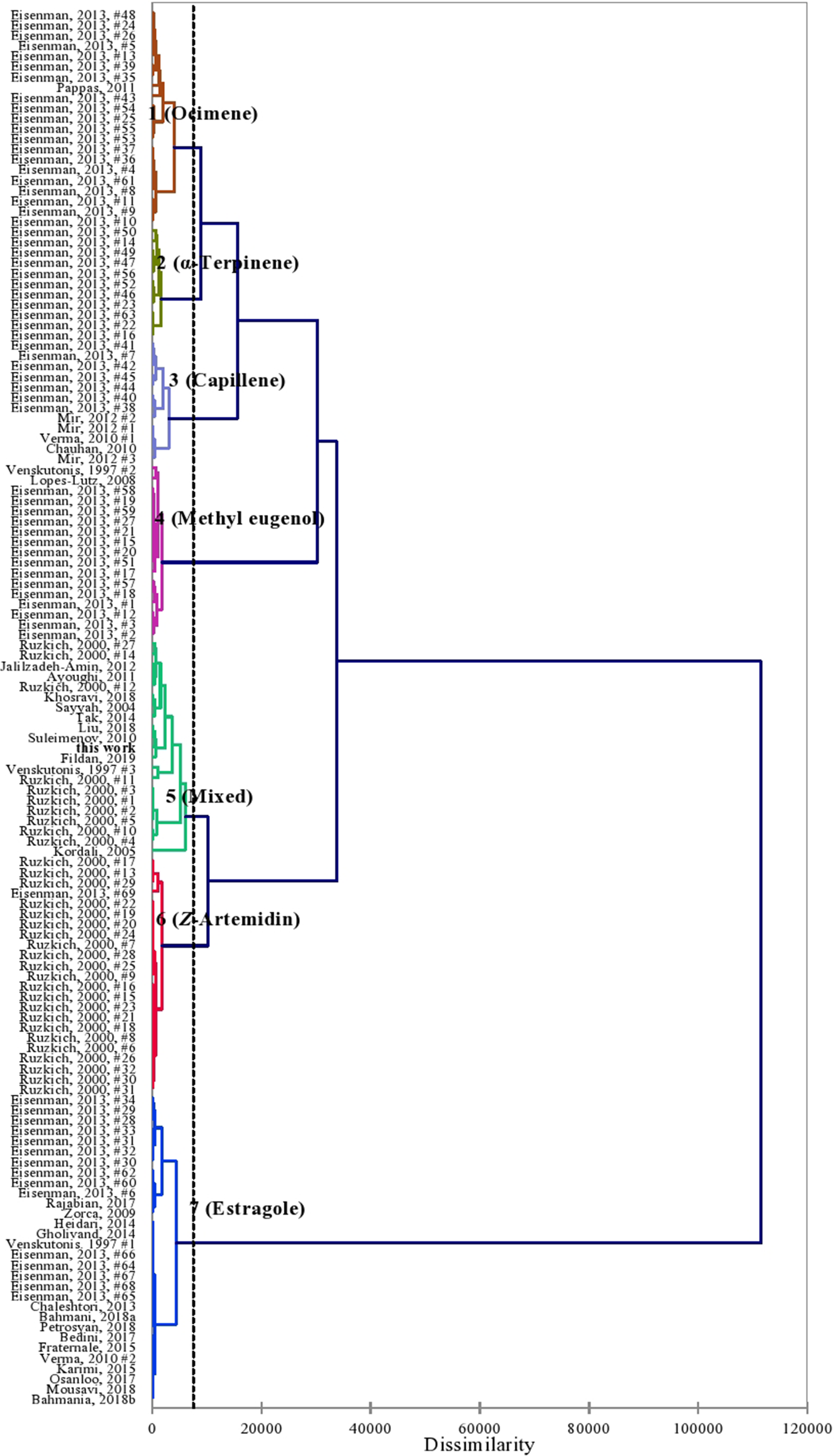
Hierarchical cluster analysis of Аrtemisia dracunculus essential oils.

Cluster (5), mixed chemotype, showing subclusters.
According to International Standard ISO 10115 (second edition 2013) the chromatographic profile of the essential oil of tarragon (French type) shall be the limits: α-pinene (0.5%-2%), limonene (2%-7%), (Z)-β-ocimene (5%-13%), (E)-β-ocimene (6%-12%), estragole (68%-84%), and methyl eugenol (up to 1%). 40 In 2019, Bakova and co-authors reported that 2 varieties of tarragon, Isumrud and Travnevy, were selected as prospective species for industrial production in Russia. The principal components were estragole chemotype (up to 91%) in Isumrud variety and sabinene (40.0%) and trans-iso-elemicin (26.1%) in Travnevy variety tarragon species. 41 Results of this present study revealed that essential oil Tajik tarragon does not fit with the essential oil profiles of tarragon for either the French or the Russian types. The essential oil of the Tajik tarragon is mainly characterized by sabinene (29.1%) and estragole (24.6%).
In the present work, the essential oil of tarragon has shown weak antioxidant activity compared with positive control which was evaluated by 2,2-diphenyl-1-picrylhydrazyl (DPPH) and 2,2′-azinobis-(3-ethylbenzthiazoline-6-sulfonic acid) methods. The half-maximal inhibitory concentration (IC50) values for the essential oil were 1.15 mg/mL for DPPH and 0.17 mg/mL for ABTS, respectively. The IC50 values of the positive control (ascorbic acid) were 0.002 mg/mL for DPPH and 0.005 mg/mL for ABTS, respectively. These results are in agreement with the antioxidant activity of tarragon reported previously. 7,8,32
Tarragon essential oil collected from Tajikistan demonstrated only very weak antibacterial activity against both Gram-positive (Staphylococcus aureus) and Gram-negative (Pseudomonas aeruginosa and Escherichia coli) bacteria.
Experimental Section
Plant Material
The aerial parts of А. dracunculus L. were collected from multiple individuals around Kukteppa village, Ziddi, Varzob region of Tajikistan (39°02′44 N, 68°54′12 E; 2670 m above the sea) on June 28, 2019. The plant collection site was a mountain meadow, and it has gray soil containing significant sand and gravel. The aerial parts of А. dracunculus were dried at 25 °C in the shade. The voucher specimen of the plant (CTICNPG 2018-10) was deposited at the Research Institution “Chinese-Tajik Innovation Center for Natural Products” of the Tajikistan Academy of Sciences.
Isolation of the Essential Oil
The dried plant material (pooled from multiple individuals; 300 g) of А. dracunculus L. was subjected to hydrodistillation, using a Clevenger-type apparatus for 3 hours. Yield of the essential oil was 0.5%.
GC-MS Analysis
GC-MS analysis was performed on the essential oil of А. dracunculus (3 analyses of the essential oil) using an Agilent 6890 GC with Agilent 5973 MSD and HP-5ms capillary column as described previously by us. 42,43 Identification of the essential oil components was based on retention indices (RI) and mass spectral fragmentation patterns with those reported in the literature, 44 and our own in-house database.
Antioxidant Activity
The antioxidant activity of the essential oils of A. dracunculus was evaluated by DPPH and ABTS assays. DPPH and ABTS assays were performed as described earlier by us. 45
Antimicrobial Activity
The antimicrobial activity of the essential oil was determined against S. aureus (ATCC 23235), P. aeruginosa (ATCC 27853), and E. coli (ATCC 25922). Bacterial strains were tested on agar. Sterilized paper disks were loaded with 10 µL of tarragon essential oil or positive control and applied on the surface of agar plates. Inhibition zones (mm) of bacterial strains were defined after the incubation period for 24 hours at 37 °C.
Hierarchical Cluster Analysis
Cluster analysis methodology was described previously by us. 46 The agglomerative hierarchical cluster analysis was performed by using the XLSTAT software, version 2018.1.1.62926 (Addinsoft, Paris, France). Euclidean distance was used to measure dissimilarity, and Ward’s method was used for cluster definition.
Supplemental Material
Supplementary Material 1 - Supplemental material for Phytochemical Study on the Essential Oils of Tarragon (Аrtemisia dracunculus L.) Growing in Tajikistan and Its Comparison With the Essential Oil of the Species in the Rest of the World
Supplemental material, Supplementary Material 1, for Phytochemical Study on the Essential Oils of Tarragon (Аrtemisia dracunculus L.) Growing in Tajikistan and Its Comparison With the Essential Oil of the Species in the Rest of the World by Farukh S. Sharopov, Aminjon Salimov, Sodik Numonov, Mahinur Bakri, Zafar Sangov, Maidina Habasi, Haji Akber Aisa and William N. Setzer in Natural Product Communications
Footnotes
Declaration of Conflicting Interests
The author(s) declared no potential conflicts of interest with respect to the research, authorship, and/or publication of this article.
Funding
The author(s) disclosed receipt of the following financial support for the research, authorship, and/or publication of this article: The authors are grateful for financial support to the Chinese Academy of Sciences President’s International Fellowship Initiative (Grant No. 2019PB0043), Central Asian Drug Discovery & Development Center of Chinese Academy of Sciences (Grant No. CAM 201808), National Natural Science Foundation of China (Grant No. U1703235), Foreign young scholar (Grant No. 2018FYB0004), and CAS “Light of West China” Program 2018-YDYLTD-001.

Supplemental Material
Supplemental material for this article is available online.
References
Supplementary Material
Please find the following supplemental material available below.
For Open Access articles published under a Creative Commons License, all supplemental material carries the same license as the article it is associated with.
For non-Open Access articles published, all supplemental material carries a non-exclusive license, and permission requests for re-use of supplemental material or any part of supplemental material shall be sent directly to the copyright owner as specified in the copyright notice associated with the article.
