



Abstract
Trehalose is a disaccharide consisting of 2 glucose units linked in an alpha 1,1-glycosidic bond. Pre-exercise trehalose ingestion enhances exercise performance within 30 minutes. Enhanced performance was hypothesized to be due to a mouth rinse effect. A 3-arm double-blind crossover trial was conducted to test this hypothesis. Ten healthy male collegiate distance runners rinsed their mouths with either trehalose (6% w/v) or maltose (6% w/v) or acesulfame potassium (0.04 mg/mL) for 5 seconds and then performed an exercise assessment composed of 6-second peak power and endurance tests. Trehalose induced the highest mean power output (P < .01) in peak power tests. In the endurance test, trehalose consistently showed higher mean power output than maltose. The 3 test drinks displayed indistinguishable sweetness and were expected to activate receptors for sweetness (T1R2-T1R3) with the same intensity. Trehalose activates taste receptors T1R1-T1R3, T1R3-T1R3 homodimer, and T1R2-T1R3, whereas sucrose activates only T1R2-T1R3. Therefore, a difference in mouth rinse effect might be due to a specific receptor in the oral cavity that recognizes differences between trehalose and maltose.
Trehalose is a disaccharide found in many organisms, except mammals. The sugar helps protect proteins and cellular membranes from denaturation caused by conditions, such as dehydration and freezing. 1 The Japanese company Hayashibara (Okayama, Japan) produces trehalose on an industrial scale, 2,3 supporting wide use as an ingredient in foods and cosmetics. Trehalose is absorbed slowly. Its glycemic index (38 4 ) is classified as low. 5 Trehalose is expected to be a carbohydrate source in sports nutrition.
However, limited studies have examined its properties for athletes. Pre-exercise ingestion of trehalose did not enhance time trial performance compared with that of glucose and galactose 6 over 41‐42 minutes. Trehalose ingestion suppresses the decrement in anaerobic exercise performance in an exercise protocol lasting approximately 120 minutes. 7 Further, we demonstrated that pre-exercise trehalose ingestion enhances exercise performance in a routine mimicking a 10 000 m running race. Trehalose appeared to enhance aerobic and anaerobic performance within 30 minutes from ingestion and was not correlated with blood glucose concentration. 8
The contribution of exogenous glucose to exercise performance is of interest. When trained men performed on an ergometer (77% peak O2 uptake) for 40 minutes, systemic glucose oxidation increased from 10 to 35 µmol/kg/min. Glucose was released from the liver, and hepatic glucose production increased from 10 to 40 µmol/kg/min in parallel with glucose oxidation. 9 Blood glucose level during exercise increased from 5 to over 6 mmol/L. 9 Intravenous glucose infusion to raise the blood glucose level to 7 mmol/L enhanced glucose oxidation and almost completely suppressed the increase in hepatic glucose production. 9 Elevated blood glucose levels (9, 12 mmol/L) maintained by intravenous glucose infusion did not, however, enhance 1-hour time trial performance. 10 Therefore, exogenous carbohydrate does not contribute to performance during exercise within 60 minutes, but can mitigate hepatic glucose secretion.
Trehalose enhances exercise performance compared with glucose. 8 However, the mechanism is not related to energy source because exogenous carbohydrate does not enhance exercise performance. A mouth rinse effect on performance is a research topic in sports nutrition. A 6.4% maltodextrin solution rinsed around the mouth for 5 seconds enhanced 1-hour time trial performance. 11 Further, a meta-analysis analyzing 16 trials shows that a carbohydrate mouth rinse improves mean power output. 12,13 Therefore, enhanced performance previously observed 8 could be due to the mouth rinse effect.
A randomized 3e-arm double-blind crossover trial was designed to examine this hypothesis. Ten healthy male collegiate distance runners participated in the trial. The exercise test included peak power and endurance tests (Figure 1). Immediately before each test, participants rinsed their mouths with 25 mL of a test drink for 5 seconds. Test drinks were trehalose (6% w/v), maltose (6% w/v), or the artificial sweetener, acesulfame potassium (0.04 mg/mL) (Figure 2). Acesulfame is a non-carbohydrate artificial sweetener that was used for control. These concentrations produced indistinguishable sweetness.

Schematic diagram of the experimental session. BW, body weight.
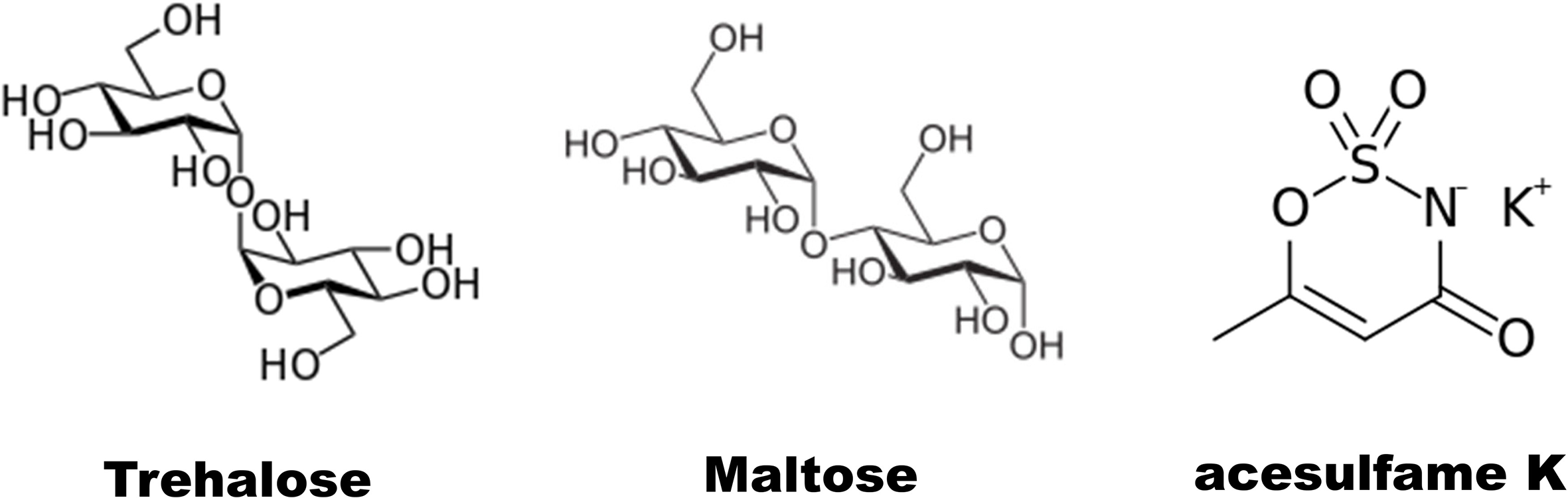
Structure of trehalose, maltose, and acesulfame potassium.
Results and Discussion
Trehalose induced the highest mean power output compared with acesulfame (P < .01) and maltose (P < .01) in the 6-second peak power test (Test 1); results were ranked as trehalose >acesulfame >maltose, although no significant difference was observed between the latter 2 treatments. Peak cadence was consistent with mean power output and was also ranked as trehalose >acesulfame >maltose (Table 1).
Summary of the Exercise Performance.
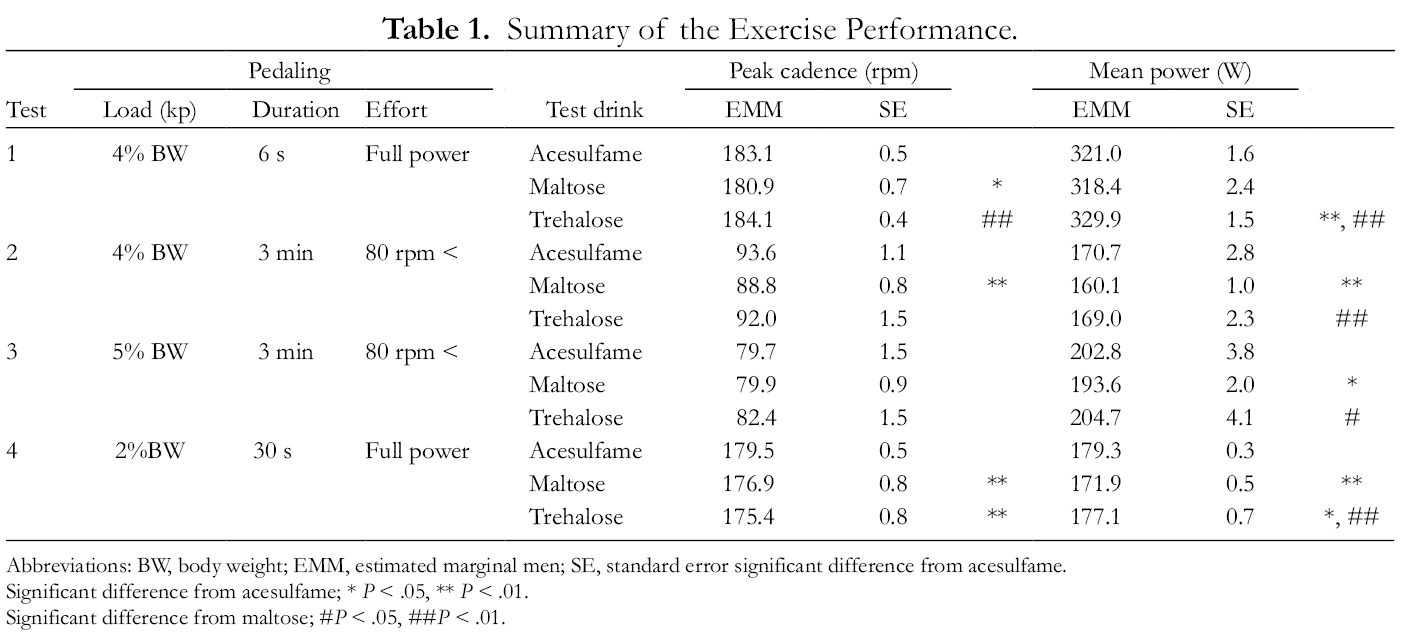
Abbreviations: BW, body weight; EMM, estimated marginal men; SE, standard error significant difference from acesulfame.
Significant difference from acesulfame; * P < .05, ** P < .01.
Significant difference from maltose; #P < .05, ##P < .01.
The 6-second test measures peak power and cadence. Energy is mostly dependent on the ATP-PCr system. Thereby, endogenous glycogen or circulating glucose contributes little to the outcome. Endogenous creatine phosphate was expected to be almost exhausted by repeated 6-second peak power tests but expected to recover to >90% of pre-exercise levels during a 5-minute rest. 14
Trehalose consistently showed higher mean power output in the endurance test than maltose (P < .05 in Test 3, P < .01 in Tests 2 and 4), but mean power was less than that observed after an acesulfame rinse during the last 30 seconds of full power pedaling (Test 4, P < .05). Likewise, acesulfame also showed significantly higher mean power output than maltose (P < .05 in Test 3, P < .01 in Tests 2 and 4) (Table 1). This endurance test is designed to mimic a 3000 m buildup run with the final push. The source of energy delivered during this test is estimated as 15% glycolytic and 85% oxidative. 15
In both 6-second peak power and endurance tests, trehalose consistently stimulated greater mean power output than maltose. Trehalose also induced significantly higher mean output than acesulfame, with lower mean power and peak cadence than those recorded in Test 4. Maltose was apparently inferior to acesulfame, especially in the endurance test. Therefore, performance enhancement overall following mouth rinse was trehalose > acesulfame > maltose. Because sweetness was the same for all treatments, the question arises concerning underlying mechanisms.
The central nervous system (CNS) is likely involved in the mouth rinse effect. Brain activity aroused by mouth rinse was explored using functional magnetic resonance imaging, which found glucose-activated, reward-related brain regions that were unresponsive to saccharin.
16
Specific receptors in the oral cavity involve the signal transduction. Sweetness is detected by a taste receptor, T1R, which includesT1R1, T1R2, and T1R3. The heterodimer, T1R1-T1R3, recognizes
Trehalose is a disaccharide consisting of 2 glucose units linked in an alpha 1,1-glycosidic bond. 1 Maltose is also a disaccharide consisting of 2 glucose units but linked in an alpha 1,4-glycosidic bond. The structure of acesulfame potassium is quite different from either disaccharide (Figure 2). The test drinks were indistinguishable in sweetness. Thus, the drinks were expected to activate T1R2-T1R3 with the same intensity. Trehalose is reported to activate taste receptors T1R1-T1R3, T1R2-T1R3, and T1R3-T1R3 homodimers, whereas sucrose activates only T1R2-T1R3. 20 Therefore, a specific receptor in the oral cavity could be present that distinguishes among the 3 compounds that signals the CNS regard to sweetness.
The study has some limitations. The results in this study assumed that trehalose mouth rinse induced enhanced performance in both anaerobic and aerobic exercises compared with maltose. However, the results could be understood as diminished exercise performance following maltose mouth rinse. We used acesulfame potassium as a control; however, it may act in similar fashion to trehalose. Trehalose and maltose exert different influence on exercise performance, and a further study using a more proper control is warranted.
This study suggests the presence of a specific receptor in the oral cavity that recognizes trehalose, maltose, and acesulfame potassium. The hypothesis should be confirmed by directly identifying the receptor or indirectly via exercise performance and CNS activation. The small sample size and bias in participants also weaken our conclusions. Male collegiate distance runners were chosen to limit participants to persons with similar exercise performance. Further study with a larger population and a wider range for participant backgrounds is needed to confirm and generalize the results.
Conclusions
Mouth rinse with trehalose induced greater mean power output in both anaerobic (6-second peak power test) and aerobic exercise compared with that with maltose. The presence of a specific receptor in the oral cavity that distinguishes trehalose and maltose is suggested.
Experimental
Participants
Ten healthy male collegiate distance runners were chosen. The inclusion criteria were (1) male collegiate distance runners and (2) aged 18‐25 years. The exclusion criteria were (1) receiving treatment or prescribed medicine; (2) suffering from serious cardiovascular, hepatic, renal, respiratory, endocrine, or metabolic disorder or a history of these disorders; (3) history of chest pain or fainting; (4) likely to be allergic to test supplements; (5) had 200 mL of blood collected within 1 month or 400 mL within 3 months before the initiation of the study; (6) history of smoking; and (7) judged as unsuitable by a practitioner. Participants received an explanation of the purpose, methods, expected results, and method of outcome review. Information included the protection of personal information, potential benefits, and disadvantages of participating in the trial. Participants understood that they could withdraw at any time. All participants provided written informed consent for participation. One participant did withdraw from the study before the third visit for personal reasons (not an adverse event). The remaining 9 participants completed the intervention: their age, height, body weight (BW), and body mass index are provided in Table 2. Because of an inappropriate load setting in the ergometer, 1 and 2 participants’ data were excluded from the analysis in Tests 2 and 3, and Test 4, respectively. In addition, a record was not obtained in Test 4 for 1 participant. The flow diagram of the study is shown in Figure 3.

Eligibility, randomization, allocation, and analysis.
Participants’ Characteristics.

The protocol was designed according to the Declaration of Helsinki and ICH E9 statistical principles for clinical trials (Iyaku-Shin-Dai 1047, Ministry of Health of Japan) and was approved by the Ethics Committee of Juntendo University Graduate School of Sports and Health Sciences (Approval #30‐68). The study protocol is registered on the University Hospital Medical Information Network – Clinical Trials Registry (UMIN-CTR ID: UMIN000034283).
Study Design
The study design was a randomized, double-blind crossover trial. Participants repeated the following experiment (Figure 1), changing the test drink for each repetition.
Participants visited the laboratory at 07:00 after an overnight fast from 21:00 the day before. Participants were allowed water during the fast. All exercise tests were carried out on a cycle ergometer PowerMax VII (Combi, Tokyo, Japan).
Participants warmed up for 20 minutes of pedaling at about 80 rpm with load (k p ) equal to 3% of BW (kg). After warmup, participants rested for 5 minutes. Ten seconds before the end of the rest, participants rinsed their mouths with a 25-mL bolus of a test drink for 5 seconds and spat out the fluid. The test drink was either trehalose (6% w/v) or maltose (6% w/v) or acesulfame potassium (0.04 mg/mL). The order of mouth rinses was randomized using Research Randomizer (https://www.randomizer.org/). Trehalose, maltose, and acesulfame drinks were confirmed to have the same level of sweetness by practitioners.
Participants then performed 6-second peak power tests with full power pedaling with a load of 4% BW k p 3 times at 1-minute intervals. Maximum power among the 3 trials was recorded.
The participants took another 5 minutes rest and repeated the mouth rinse as indicated earlier. The participants then performed an endurance test, composed of consecutive 3 minutes pedaling attempts (4% BW and 5% BW) followed by a 30-second full-power exercise (2% BW). In the test, the participants were instructed to pedal >80 rpm and to achieve their best power output throughout the test (Tests 2‐4).
Statistics
Descriptive data and results of generalized linear models are presented as mean and SD and estimated marginal mean with SE, respectively. The mean power and peak pedaling speed were compared using the generalized estimating equation of the generalized linear model. The model included participant identification as subject variable, test drink, and test day as within-subject variables, and test drink × test day as the interaction. Statistical significance was set at P < .05 (adjusted by Bonferroni’s method). SPSS ver. 19 (Japan IBM, Tokyo, Japan) was used for analyses.
Footnotes
Acknowledgments
Hayashibara Co., Ltd. (Okayama, Japan) provided their products trehalose “TREHA®” and maltose “SUNMALT®”. Acesulfame potassium “Sunett®” was a generous gift from Nabelin Co., Ltd. (Nagano, Japan).
Statement of Human and Animal Rights
All procedures followed were in accordance with Ethical Guidelines for Medical and Health Research Involving Human Subjects (Ministry of Health, Labour and Walfare of Japan) and with the Helsinki Declaration of 1964 and its later amendments.
Declaration of Conflicting Interests
The author(s) declared the following potential conflicts of interest with respect to the research, authorship, and/or publication of this article: Two authors, NA and SE, are employees of Hayashibara Co. Ltd. (Okayama, Japan). The other authors, YS and KS, declared no conflicts of interest for research, authorship, and publication of this article.
Funding
The author(s) disclosed receipt of the following financial support for the research, authorship, and/or publication of this article: This study was funded by Hayashibara Co., Ltd. (Okayama, Japan).
