



Abstract
A total of 10 male collegiate distance runners participated in a randomized crossover trial. After completing a warm-up, each participant ingested 300 mL of a test drink and performed 2 sets of pedaling for the duration of 10 minutes (tests 1 and 3) and a 30-second sprint test (tests 2 and 4) with 3-minute interval. During the exercise tests, participants were instructed to make a full power output in 30-second sprint tests and to keep the effort equivalent to their own pace in 10 000 m track race without a final push in the 10-minute pedaling phase. The test drinks allocated to the participants were either trehalose (6% w/v), glucose (6% w/v), or water. During the 4 tests, trehalose presented with the highest mean power outputs compared to that of glucose and water. It was statistically significant against water and glucose especially in the first 10 minutes of pedaling (test 1) and the last 30 seconds of sprint tests (test 4). Therefore, data indicate that trehalose may enhance exercise performance.
Trehalose is a nonreducing disaccharide consisting of 2 glucose units that are linked in an alpha 1,1-glycosidic bond. 1 Trehalose is found in various organisms such as bacteria, yeast, fungi, insects, invertebrates, and plants. It is considered to aid in the protection of proteins and cellular membranes from denaturation caused by stressful conditions like dehydration and freezing. 1 In 1995, Japanese company Hayashibara (Okayama, Japan) succeeded in producing this substance on an industrial scale. 2,3 Since then, trehalose has been widely used as an ingredient for various foods and cosmetic.
In mammals, ingested trehalose is digested by trehalase in the intestinal brush border membrane and it is then absorbed as glucose, despite the fact that mammals do not have endogenous torehalose. 1 Trehalose has also attracted attention as a source of carbohydrates in sports nutrition because it has slow absorptive kinetics which suppress and maintain postprandial glucose levels.
Pre-exercise ingestion of glucose, trehalose, and galactose do not show any significant difference in time during time trial performance using a cyclic ergometer, while glucose, on the other hand, shows a significantly higher postingested blood glucose levels compared to trehalose and galactose. 4 When a cycling test run was conducted for 150 minutes at 55% of maximal output with continuous ingestion of maltose or trehalose, both substances increased blood glucose levels during exercise in comparison to water. 5 During the exercise round, maltose had a higher oxidation level of exogenous carbohydrates, and thus had a higher “sparing effect” of endogenous glucose than trehalose did. 5 These results could, however, be accounted for by the glycemic index of trehalose. The glycemic index of trehalose is reported to be 38, 6 and therefore, it is considered as a low glycemic carbohydrate. 7
Recently, Wadazumi et al discussed the ergogenic effect of trehalose. 8 They assessed the effect of trehalose during high-intensity intermittent exercise comprising 3 sets of 30-minute pedaling (40% VO2 peak) and 30 seconds of full power cycling (Wingate test), and found that a single pre-exercise ingestion of trehalose suppressed a diminishment in power output of wingate tests that were conducted for more than 60 minutes. 8
However, the effect of trehalose on intensive exercise within a 30-minute period had not been previously determined. Therefore, a crossover trial was conducted as part of this study which aimed to assess the effect of a single trehalose ingestion on aerobic and anaerobic exercise performance.
A total of 10 male collegiate distance runners participated in the study. They visited the laboratory after an overnight fast. After completing a warm-up, the study participants ingested 300 mL of a test drink and performed 2 sets of 10 minutes of pedaling (tests 1 and 3) and a 30-second sprint test (tests 2 and 4) with 3-minute interval (Figure 1). During the exercise tests, participants were instructed to make a full power output in 30-second sprint tests and to keep their effort equivalent to that of their own pace in a 10 000 m track race without a final push in the 10-minute pedaling phase.

Schematic diagram of the experimental session.
The test drink allocated to the participants was either trehalose (6% w/v), glucose (6% w/v), or water; the order of the ingestion was randomized for each participant.
Results and Discussion
The power outputs of the exercise tests are summarized in Table 1. In the first round of 10-minute pedaling (test 1), trehalose recorded a significantly greater mean and peak power than water and glucose (P < .01 vs water and P < .05 vs glucose). The mean power in glucose was also greater than that of water (P < .01). In the following 30-second sprint (test 2), the estimated marginal means of mean power were ranked as trehalose > glucose > water, although no significant difference between them was seen. In contrast, the peak power in trehalose was significantly lower than that of the other 2 conditions, water and glucose (both P < .01). Similarly, trehalose recorded a greater mean power compared to the other 2 conditions which were not significant, but it also had the smallest peak power (P < .05 vs glucose) in the next round of 10-minute pedaling (Test 3). In the last 30-second sprint test (test 4), trehalose presented the greatest mean power (P < .05 vs glucose), although water showed a significantly greater peak power than the other 2 conditions (both P < .05).
Summary of the Exercise Performance.

BW, body weight; EMM, estimated marginal mean; SE, standard error.
Significant difference from water: *P < .05, **P < .01.
Significant difference from glucose: # P < .05, ## P < .01.
Overall, the exercise protocol mimicked that of an athletic 10 000 m track race lasting 30 minutes, comprising self-pace running and competitive push-ups. The 10-minute pedaling rounds were self-paced pedaling keeping their effort equivalent to that of their own pace in a 10 000 m track race without a final push. The expected energy deliverance levels were glycolytic (3%) and oxidative (97%). 9 The intensity of the 10-minute pedaling round was estimated to be 60% to 70% of the heart rate reserve, and thus, the contribution of plasma glucose was expected to be 10% of the total energy source used. 10 The 30-second sprint test was a reliable sprint test 11 and is often used in intermittent endurance training programs. 12 The 30-second sprint test evaluates anaerobic performance and is expected to use ATP-phosphocreatine (PCr) and glycolytic systems, 9 while plasma glucose is expected to contribute up to 10% of the total energy source used. 10
During the 4 tests, trehalose presented with the highest mean power outputs compared to that of glucose and water. It was statistically significant against water and glucose especially in the first 10 minutes of pedaling (test 1) and the last 30 seconds of sprint tests (test 4). Although the peak cadence did not match the mean power output, trehalose was shown to enhance overall exercise performance.
During the duration of the 4 tests, there was a significant difference in blood glucose concentration before the ingestion of the test drink, and a few significant differences were observed after the exercise tests as well (Table 2). The blood glucose levels of trehalose were at their lowest after the first 10-minute pedaling round (test 1) and highest after the last 30-second sprint test (test 4) (P < .01 vs glucose). Therefore, it cannot be posited that blood glucose concentrations correlate with exercise performance.
Blood Glucose Levels Throughout the Exercise Protocol.
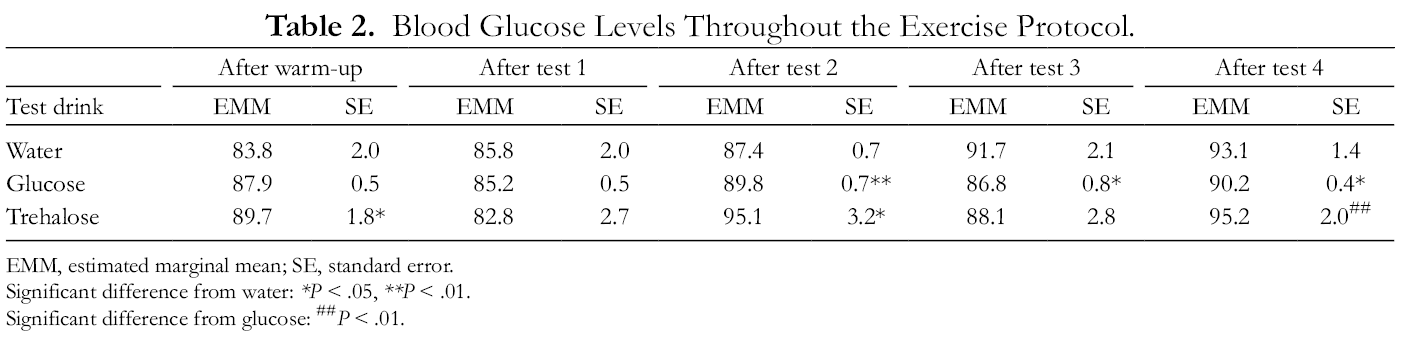
EMM, estimated marginal mean; SE, standard error.
Significant difference from water: *P < .05, **P < .01.
Significant difference from glucose: ## P < .01.
Actually, higher blood glucose levels do not enhance exercise performance lasting up to 60 minutes. Carter et al demonstrated that the results of a time trial (lasting c.a. 60 minutes) using a cyclic ergometer are not enhanced by a higher blood glucose level (9-12 mmol/L) attained by the continuous infusion of a glucose solution (20% glucose in saline). 13 Therefore, the power output enhanced by trehalose ingestion cannot be accounted for by blood glucose levels.
Carter et al also showed that a 6.4% maltodextrin solution rinsed around the mouth for 5 seconds enhanced 1-hour time trial performance and further discussed that the effect could be related to an individual’s central drive or motivation rather than to their metabolic state. 14 This mouth rinse effect has been investigated and a recent meta-analysis analyzing 16 trials summarized that a carbohydrate mouth rinse improves mean power output. 15,16 Therefore, the enhanced exercise performance observed in trehalose ingestion could be in relation to the mouth rinse effect.
It should be worth to note that glucose ingestion did not enhance exercise performance as much as trehalose. The mean power output in glucose ingestion was significantly greater than water in the first 10-minute pedaling round (test 1), however, it was even lower than water in tests 3 and 4. Additionally, the mean power outputs of glucose ingestion were consistently lower than those of the trehalose ingestion throughout the exercise tests (1-4). If trehalose enhanced exercise performance because of the mouth rinse effect, the discrepancy against glucose having stronger sweetness may propose another sensing mechanism in oral mouth than sweetness.
One of the limitations of this study was that the effect of mouth rinse has not been determined. Although the effect of mouth rinse was confirmed by a previous meta-analysis, most of the trials analyzed in the meta-analysis failed to show the significant results of this. 15,16 This study may well be one of the studies that cannot clarify the effects of this on its own. Further research is needed to clarify the mechanisms of trehalose. The timing of the test drink ingestion should be important, because trehalose showed the improvement at the beginning and the end of the session. However, the participants were only instructed to finish ingesting 300 mL of test drink during the 10 minutes rest, and the exact timing was not set. The timing of the ingestion should be controlled in the subsequent study.
Conclusions
The study concludes that pre-exercise trehalose ingestion enhances intermittent exercise performance. This enhanced exercise performance could also be in relation to the mouth rinse effect. Further research is needed to clarify this mechanism.
Experimental
Participants
A total of 10 healthy male collegiate distance runners participated in the study. They complied with the following inclusion criteria: collegiate distance runners, aged 18 to 25 years old; and did not meet any of the following exclusion criteria: (1) receiving treatment or prescribed medicine, (2) suffering from serious cardiovascular disorder, liver function disorder, renal dysfunction, respiratory disorder, endocrine disorder, metabolic disorder, or those having history of them, (3) having history of chest pain or fainting, (4) likely to have allergic reactions related to the test supplement, (5) collected 200 mL of blood within 1 month or 400 mL within 3 months prior to the study, (6) smokers, and (7) judged as unsuitable for this study by a physician. They received a full explanation about the study including its purpose, methods, expected results, and method of outcome review, as well as about the protection of personal information, potential benefits, and disadvantages of participating in the trial. Participation depended on the participants’ own free will and they were further informed that they could withdraw from the study at any time. The participants all provided written, informed consent to participate in the trial. The participants’ age, height, body weight (BW), and body mass index are shown in Table 3. All participants completed the intervention (Figure 2).
Participants’ Characteristics.

BMI, body mass index; SD, standard deviation.

Eligibility, randomization, allocation, and analysis.
The protocol was designed according to the Declaration of Helsinki and ICH E9 statistical principles for clinical trials (Iyaku-Shin-Dai 1047, Ministry of Health of Japan), and was approved by the Ethics Committee of Juntendo University Graduate School of Sports and Health Sciences (Approval #29-133). The study protocol was registered on the University Hospital Medical Information Network—Clinical Trials Registry (UMIN-CTR ID: UMIN000029584).
Study Design
The study was conducted as a randomized crossover trial. Participants repeated the following experiment (Figure 1) 3 times with a different test drink in each round.
Participants visited the laboratory at 07:00 after an overnight fast (excluding water), having finished their dinner by 21:00 the day before. All exercise tests were carried out on a cycle ergometer PowerMax VII (Combi, Tokyo, Japan).
For the study participants’ warm-up, each subject performed 15 minutes of pedaling with the work load (kp) set at 0.03 × BW (kg) (3%BW) followed by a 3-minute interval and 30 seconds of full power pedaling with the work load set at 7%BW (30-second sprint test).
After the warm-up, study participants ingested a test drink (300 mL) during the 10-minute resting period. Thereafter, they did 2 rounds of cycle pedaling for 10 minutes (4%BW) and the 30-second sprint test (7%BW, full power) with a 3-minute interval. Participants were instructed to make a full power output in the 30-second sprint test (tests 2 and 4) and to keep their effort equivalent to that of an athletic 10 000 m track race without the final push in 10 minutes pedaling (tests 1 and 3). Blood glucose concentration was determined before the test drink was ingested and also immediately after the tests (1-4) using Nipro Care Fast, a portable glucose sensor according to the manufacturer’s instructions (Nipro, Osaka, Japan).
The test drink was either trehalose (6% w/v), glucose (6% w/v), or water. Trehalose and glucose were obtained from Hayashibara (Okayama, Japan). The order of the test drink ingestion was randomized using Research Randomizer (https://www.randomizer.org/). The glucose drink was sweeter than the trehalose drink, while the water was tasteless. Therefore, it was assumed that participants could differentiate between different test drinks that they were provided with.
Statistical Analysis
Descriptive data and the results of generalized linear models from this study were presented as mean with standard deviation and estimated marginal mean with standard error, respectively. The mean power and peak pedaling speed were compared using the generalized estimating equation of generalized linear models. The model included subject identification (ID) as a subject variable, test drink and test day as within-subject variables, and the interaction (test food × test day). Statistical significance was set at P < .05 (adjusted by Bonferroni’s method). SPSS ver. 19 (Japan IBM, Tokyo, Japan) was used for the analyses.
Footnotes
Declaration of Conflicting Interests
The authors declared no potential conflicts of interest with respect to the research, authorship, and publication of this article.
Funding
The authors disclosed receipt of the following financial support for the research and publication of this article: A part of this study was supported by Hayashibara Co., Ltd (Okayama, Japan).
