



Abstract
Ten active principles (compounds
Diabetes is a major disease of the modern world; about 90% of people suffering from this have type 2 diabetes. According to the International Diabetes Federation, an estimated 463 million adults aged 20-79 years worldwide have diabetes, and this number is expected to rise to 574 million by 2030 and 700 million by 2045. 1 Glucose-transporter proteins, especially GLUT4, play an important role in glucose uptake into cells. This transport is biologically affected by the PTP1B enzyme, a member of the protein tyrosine phosphatases (PTPs) family. The PTP1B pathway plays a central role as a negative regulator in the insulin signaling pathway implicated in metabolic diseases such as obesity and type 2 diabetes. In insulin signaling, PTP1B dephosphorylates the insulin receptor (IR) and insulin receptor substrate (IRS), whereas, in the leptin pathway, it dephosphorylates the tyrosine kinase Janus kinase 2 (JAK2). 2 In the insulin signaling pathway, the recruitment and phosphorylation of the IRS are triggered as a result of the binding of insulin to the IR, which forms a docking site for phosphoinositide 3-kinase (PI3K) at the membrane. Docked PI3K then induces the phosphorylation of both Akt at Thr308 and the 70 kDa ribosomal protein S6 kinase 1 (p70s6k) by activation of phosphoinositide-dependent protein kinase 1 (PDK1). 3 -5 This facilitates glucose uptake in cells by allowing the translocation of GLUT4 from intracellular storage vesicles to the plasma membrane. In addition, a wealth of evidence from clinical and basic research indicates that the high expression of PTP1B can induce insulin resistance. Therefore, PTP1B is an effective target for the treatment of type 2 diabetes and possibly obesity. 6,7
In Vietnam, the traditional remedies for diabetes often involve the integrated effects of different medicinal plants—some as main ingredients and some as a supplemental factor. Polygonum cuspidatum Sieb. et Zucc., family Polygonaceae (known as knotweed in Japan and Huzhang in China), is a small perennial, straight-growing plant that usually grows to between 60 cm and 1 m high (though in some places, it can grow as high as 2.2 m).
8
Polygonum cuspidatum grows natively in many regions across China and Southeast Asia. It can be harvested year-round, but the best time is in the monsoon season when harvesting occurs continuously for 2-3 months. In Vietnam, P. cuspidatum has been used since ancient times for the treatment of liver diseases, rheumatism, arthritis, stomachache, and leg pain, and is used especially for the treatment of hepatitis.
8
Chemically, P. cuspidatum is a rich source of several bioactive secondary metabolites with pharmacological effects, including stilbenes, quinones, phenylpropanoid esters of sucrose, anthraquinones, and anthraquinone glucopyranosides.
9
-12
In traditional Chinese medicine (TCM), this plant is used for the treatment of cancer, angiogenesis, human immunodeficiency virus (HIV), hepatitis B, obesity, and oral cancer and is known for its antimicrobial, anti-inflammatory, and neuroprotective qualities.
13,14
Choi et al reported that P. cuspidatum extract showed free radical scavenging activity and prevented obesity-associated disorders in a diabetic rat model in vivo.
15
In addition, the effects of P. cuspidatum extract on advanced glycation end products (AGEs), Nε-(carboxymethyl)-
Results and Discussion
The methanol extract of the root of P. cuspidatum was partitioned into n-hexane, ethyl acetate (EtOAc), and water-soluble fractions. The EtOAc fraction had the greatest inhibitory activity on PTP1B (Supplemental Material). Chromatographic purification of this fraction led to the isolation of 10 compounds (compounds
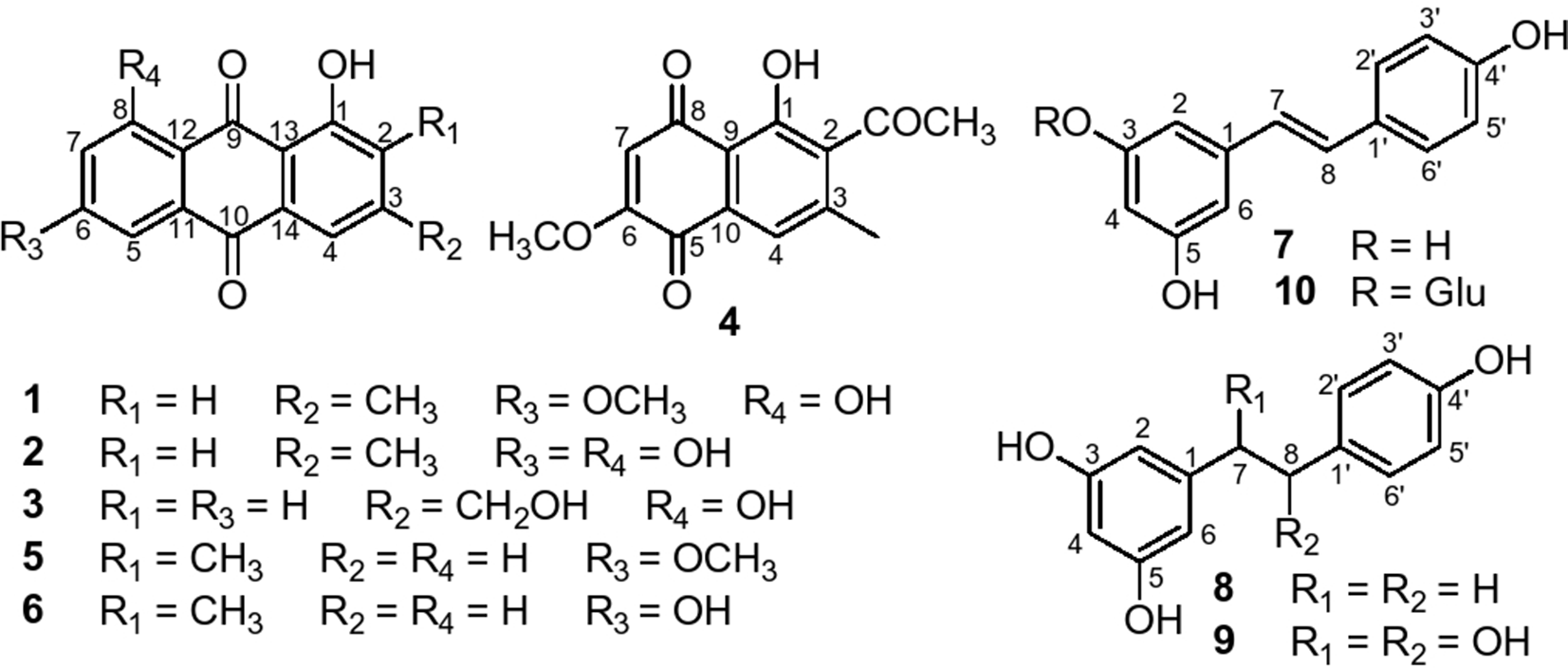
Chemical structure of compounds 1-10 isolated from Polygonum cuspidatum
Comparison of the 1H-nuclear magnetic resonance (NMR) and 13C-NMR data of the isolated compounds with those published in the literature led to their identification as physcion (
Isolates
PTP1B Inhibitory Activity of Compounds 1-10.

Abbreviation: Abbreviation: IC50, half-maximal inhibitory concentration.
aResults are expressed as IC50 values (µM), determined by regression analysis and expressed as the means ± SD of 3 replicates.
bData not determined.
cPositive control.
In our kinetic study, ursolic acid was previously determined as a mixed-competitive inhibitor.
29
Compounds with PTP1B inhibitory potency (compounds

Lineweaver-Burk plots for the inhibition of compounds (2, 3, 6, and 9) on the protein tyrosine phosphatase 1B-catalyzed hydrolysis of para-nitrophenylphosphate (p-NPP). Data are expressed as the mean reciprocal of initial velocity for n = 3 replicates at each substrate concentration.

Dixon plots for active compounds (2, 3, 6, and 9) used for determining the inhibition constant Ki. Ki values were determined from the negative x-axis value at the point of the intersection of 3 lines. Data are expressed as the mean reciprocal of initial velocity for n = 3 replicates at each substrate concentration.
Glucose transporters are a large group of membrane proteins that facilitate the transport of glucose across the plasma membrane. Among the 14 glucose transporters, GLUT4 is a well-characterized insulin-regulated glucose transporter expressed mainly in adipose tissues and striated muscle (ie, skeletal and cardiac muscle). The translocation of GLUT4 to the plasma membrane in muscle and adipocytes directly facilitates glucose uptake into the cells. This action is dependent mainly on the regulation of 2 physiological pathways: the AMP-activated protein kinase (AMPK) and the insulin signaling pathway.
3
PTP1B negatively regulates the insulin signaling pathway by dephosphorylating the insulin receptor (IR) and insulin receptor substrate (IRS), leading to the inactivation of PDK1 and Akt, the proteins that directly allow the translocation of GLUT4.
2,30
Therefore, the facilitation of the insulin signaling pathway by inhibition of PTP1B activity and/or reduction of its expression level can stimulate glucose uptake in adipocytes. To investigate this possibility, the stimulatory effects of compounds

Stimulatory effects of the potential protein tyrosine phosphatase 1B inhibitors (2, 3, 6, and 9) on 2-deoxy-2-[(7-nitro-2,1,3-benzoxadiazol-4-yl) amino]-
Conclusion
A study of the chemical constituents of the methanol extract of P. cuspidatum root—collected in 2018 from Thai Nguyen Province, Vietnam—has led to the purification and identification of 10 natural bioactive principles. The chemical structures were confirmed by NMR spectroscopic and mass spectrometric analyses and comparison with published data. This is the first time that 9,10-anthraquinones (compounds
Materials and Methods
General Experimental Procedures
1H-NMR (400 MHz) and 13C-NMR (100 MHz) were measured on a Varian Unity Inova 400 MHz spectrometer. Electrospray ionization-MS was obtained from a Varian FT-MS spectrometer and MicroQ-TOF III (Bruker Daltonics, Ettlingen Germany). Other spectroscopic measurements and chromatographic techniques are presented in Supplemental Material.
Plant Material
The roots of P. cuspidatum were collected in February 2018 from Thai Nguyen province, Vietnam. The sample was identified by Dr Nguyen Quoc Binh (Vietnam National Museum of Nature, Vietnam Academy of Science and Technology (VAST). A voucher specimen (CKC-TN01) was deposited at the Institute of Natural Products Chemistry (INPC), VAST.
Extraction and Isolation
The roots of P. cuspidatum (1.2 kg) were dried and cut into small pieces and then extracted with methanol (MeOH) with sonication for 2 hours, at 45 °C. The extract was then filtered before being evaporated under reduced pressure to give a crude MeOH extract (250 g). This was dissolved in water and further partitioned with n-hexane and EtOAc to give a hexane fraction (20 g) an EtOAc fraction (120.8 g), and a water residue. These fractions were then tested for their 2-NBDG uptake effects on 3T3-L1 adipocyte cells. The detailed isolation and purification of the isolated compounds are presented in the Supplemental Material.
Biological Assay
The PTP1B inhibitory assays, determination of the inhibition mode of active compounds, the 2-NBDG uptake stimulatory, and cell viability assay were performed according to the methods described in Supplemental Material.
Statistical Analysis
Data are represented as mean ± SD of at least 3 independent experiments performed in triplicate assays and determined by regression analysis. Sigma Plot program version 11.0 was used for the analysis of the kinetic data.
Supplemental Material
Supplementary Material 1 - Supplemental material for Natural PTP1B Inhibitors From Polygonum cuspidatum and Their 2-NBDG Uptake Stimulation
Supplemental material, Supplementary Material 1, for Natural PTP1B Inhibitors From Polygonum cuspidatum and Their 2-NBDG Uptake Stimulation by Hong-Luyen Le, Dao-Cuong To, Manh-Hung Tran, Thi-Thuy Do and Phi-Hung Nguyen in Natural Product Communications
Supplemental Material
Supplementary Material 2 - Supplemental material for Natural PTP1B Inhibitors From Polygonum cuspidatum and Their 2-NBDG Uptake Stimulation
Supplemental material, Supplementary Material 2, for Natural PTP1B Inhibitors From Polygonum cuspidatum and Their 2-NBDG Uptake Stimulation by Hong-Luyen Le, Dao-Cuong To, Manh-Hung Tran, Thi-Thuy Do and Phi-Hung Nguyen in Natural Product Communications
Footnotes
Declaration of Conflicting Interests
The author(s) declared no potential conflicts of interest with respect to the research, authorship, and/or publication of this article.
Funding
The author(s) disclosed receipt of the following financial support for the research, authorship, and/or publication of this article: this work was supported by the Post-Doctoral Program of the Vietnam Academy of Science and Technology (The project code number: GUST.STS.ĐT2017-HH14).

Supplemental Material
Supplemental material for this article is available online.
References
Supplementary Material
Please find the following supplemental material available below.
For Open Access articles published under a Creative Commons License, all supplemental material carries the same license as the article it is associated with.
For non-Open Access articles published, all supplemental material carries a non-exclusive license, and permission requests for re-use of supplemental material or any part of supplemental material shall be sent directly to the copyright owner as specified in the copyright notice associated with the article.
