



Abstract
Five Jasminum grandiflorum flower absolutes harvested as flower buds and processed in the “J. sambac-way” in different locations in the southern Indian state of Tamil Nadu were analyzed using gas chromatography (GC) and GC-mass spectrometry. These absolutes were compared with 5 commercial Indian J. grandiflorum flower absolutes manufactured in the traditional “J. grandiflorum-way” from open flowers. Focus was placed on 42 key ingredients to investigate the influence of such a flower processing on the absolute composition. Our study established olfactive and composition differences of such absolutes produced via the “J. sambac-way.” In addition, geographic variations in this species were analyzed by comparing 5 commercial Indian J. grandiflorum flower absolutes with absolutes from Egypt and Morocco, respectively. A composition range of the absolutes was established for the 3 main J. grandiflorum flower grower countries using a total of 14 commercial samples. The 12 main ingredients in the absolutes showed variations between 4.3% and 89.7%.
Keywords
The introduction of synthetic aroma molecules in the middle of the 19th century 1 -3 has changed the perfumer’s palette from 100% natural ingredients before to approximately 5% naturals today. However, absolutes and essential oils still play a significant role in modern perfumery, especially in fine fragrances. 4,5 While the key natural ingredients in perfumery have not changed much in the last decades, 4 the natural palette is still expanding. Today, the addition of really new naturals is more the exception than the norm due to increased regulatory and registration requirements and they are mainly used for the creation of prestigious fine fragrances. Instead, existing materials are processed using new extraction methods and solvents. 6,7 Currently, supercritical carbon dioxide (CO2) extracts experienced a revival as the technology is becoming more affordable. 8 Only very few debutants have gained at least some volume like Pink Pepper essential oil and the respective CO2 extracts from the berries of the 2 Schinus species molle L. 9,10 and terebinthifolius Raddi, 11,12 respectively. Another example is the absolute of Jasminum sambac (L.) Ait., 13 which still remains the little brother 5,14 -16 of J. officinale L. subsp. grandiflorum (L.) E. Laguna, 17 commonly known as J. grandiflorum L. 18 -20
It is worth to note that the flower processing of both jasmine species prior to concrete manufacturing is significantly different. The extraction processes leading to the concrete and consecutively to the respective absolute, however, are identical. These 2 different work streams for flower preparation have been established over the years due to different usage patterns of the 2 Jasminum species. This is mainly linked to the fact that the more robust and bigger flower buds of J. sambac are preferred in ornamental use over the much smaller and more delicate J. grandiflorum buds. The difference between the 2 species is very obvious from the kg/flower equivalent and also reflected in the price dependency of the flowers and subsequently the flower harvesting state. Only the remaining J. sambac buds, which are not sold on flower markets during the day for ornamental use, are purchased from raw material manufacturers, while J. grandiflorum flowers are picked from the farmers as fully blossomed out open flowers nearly exclusively for concrete production. Jasminum grandiflorum flowers are directly extracted (“J. grandiflorum-way”), while J. sambac buds awaiting their flourishing spread on a floor before they are extracted the same night (“J. sambac-way) as only fully blossomed out flowers are giving the maximum concrete yield. For a detailed comparison of the 2 Jasminum species: sambac and grandiflorum, see Table 1.
Indian Jasminum sambac and J. grandiflorum—Fact Sheet. a

aPersonal communication R. S. Palaniswamy (Jasmine C. E. Pvt. Ltd., India).
bGood picker.
While the influence of CO2 extraction on composition has been described in the literature, 21,22 to the best of our knowledge, no study has been carried out to establish the influence of a “J. sambac-way” flower treatment on J. grandiflorum absolute composition. To eliminate normal geographical variability, samples from different locations were used. Here, we report analyses of 5 J. grandiflorum flower absolutes all originating from different locations in the southern Indian state Tamil Nadu. These absolutes were processed in the traditional “J. sambac-way”, starting from flower buds, which were then spread out on the floor to blossom prior to extraction. These were compared with 5 commercially available J. grandiflorum absolutes from India, all processed in the traditional “J. grandiflorum-way.” In addition, geographic variations were investigated in J. grandiflorum by comparing the composition of commercial Indian flower absolutes with absolutes from Egypt and Morocco, respectively, to establish a country-specific composition range.
Results and Discussion
All J. grandiflorum absolutes were analyzed by gas chromatography (GC) and GC/mass spectrometry (MS). Constituents were identified by comparing their mass spectra with known compounds, published spectra, or the Symrise in-house library.
23
We focused our analyses on 42 constituents, covering major ingredients as well as compounds that help to distinguish between various Jasminum species including 2 epimeric methyl jasmonates.
24
Thirty-eight of these molecules were identified in a previous publication,
25
and 4 components were additionally added as they are monitored by other companies.
26
2-Phenylethyl alcohol (retention index 1090), phenylacetaldehyde oxime (1250), 1(10),5-germacradien-4-ol (1561), (2E,6E)-farnesol (1698), (2E,6E)-farnesyl acetate (1817), and 2-phenylethyl salicylate (1915) were not detected in any J. grandiflorum absolute
Comparison of 35 Constituents (Area %) of J. grandiflorum Flower Absolutes From India: Lab Trials A-E (“J. sambac-Way”), F-J (Commercial), Pilot Plant Trial K (“J. sambac-Way), and L (“J. grandiflorum-Way”). a

Abbreviations: RI, retention index; t, trace (≤0.01%).
aMeasured on ZB-1 column.
bCorrect isomer not determined; “-” indicates not detected.
Comparison of 35 Constituents (Area %) of Commercial J. grandiflorum Flower Absolutes From Egypt M-Q and Morocco R-T. a

Abbreviations: RI, retention index; tr, trace (≤0.01%).
aMeasured on ZB-1 column
bCorrect isomer not determined; “-” indicates not detected.
In India, J. grandiflorum shrubs (family: Oleaceae) can be found in varying degrees throughout peninsular India and the Indo-Gangetic plains. The state of Tamil Nadu, located geographically in the central part of the southern extremity of the Indian peninsula, however, has by far the largest acreage under commercial J. grandiflorum cultivation in India.
14,15
Other Indian states with a significant jasmine crop area are Karnataka, Andhra Pradesh, West Bengal, Uttar Pradesh, and Rajasthan. In India, J. grandiflorum season normally lasts from June to November reaching its peak from the end of July to September (Table 1). Our first focus was placed on the comparison of 5 Indian J. grandiflorum flower absolutes
Provenance (City/District/Geographic Coordinates), Harvest Time, and Processed Quantity (kg)] of J. grandiflorum Flowers A-E/K/L From Tamil Nadu, India.

Focusing only on major ingredients (>2.0%, marked bold in Tables 2 and 3), the 5 absolutes
Variability (%) a for 12 Main Ingredients (>2.0%) in J. grandiflorum Flower Absolutes From India A-E (“J. sambac-Way”), F-J (Commercial), Egypt M-Q, and Morocco R-T.

aCalculation of variability: (highest − lowest value)/highest value × 100 (%).
According to our supplier, there may be small but no significant agroclimatic differences between these 5 locations in the Indian state Tamil Nadu. Flowers for sample
Findings for the commercial samples
Interestingly, our perfumers pointed out that the odor profile of samples

aProduced via “J. sambac way”.
bOn smelling blotter as 10% ethanol solution.
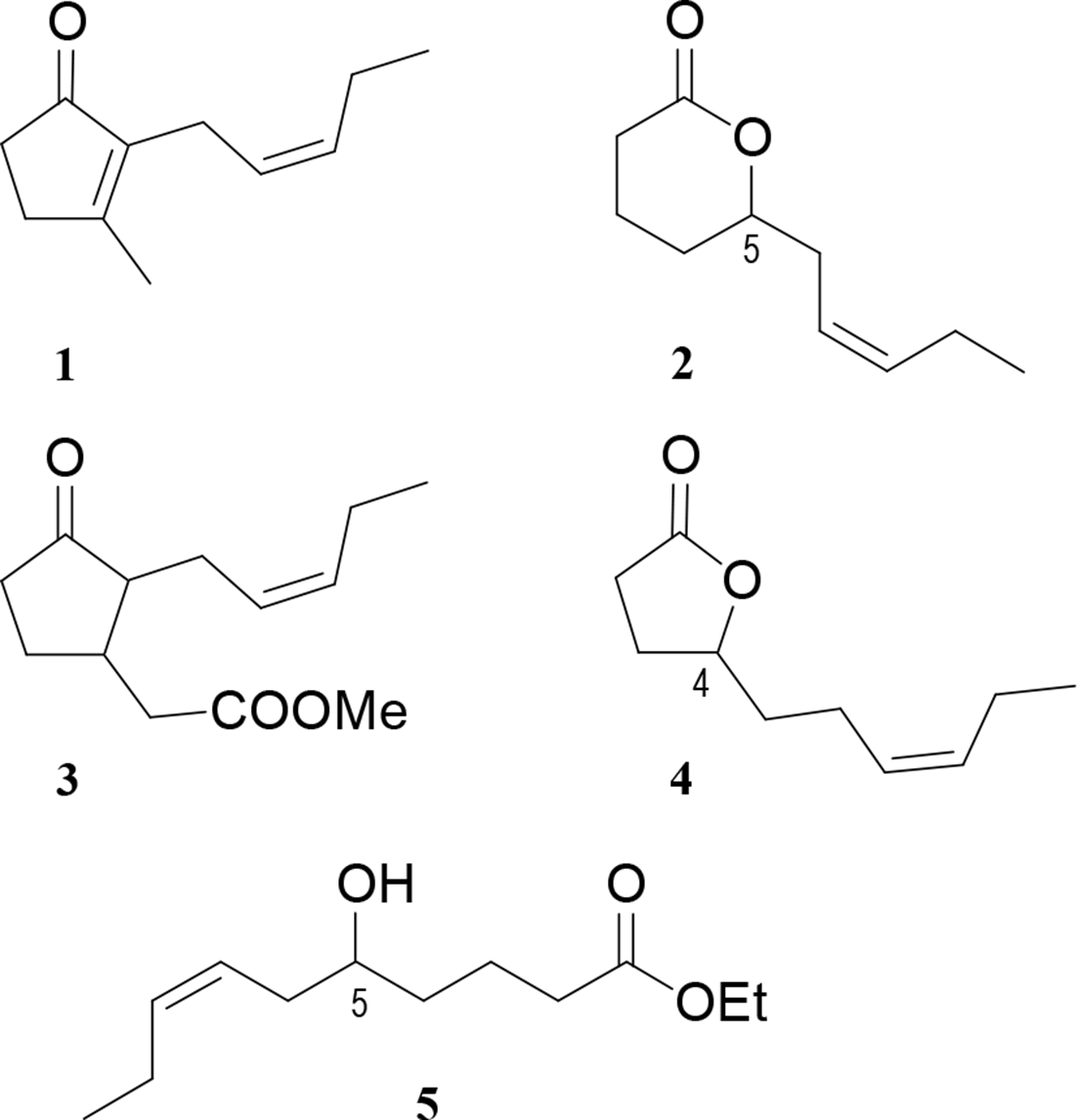
Lipoxygenase pathway derivative compounds: (Z)-jasmone (1), δ-jasmine lactone (2), (Z)-methyl jasmonate (3), γ-jasmine lactone (4), and ethyl 5-hydroxy-7-decanoate (5) derived from 2.
The above comparison was based on pilot plant samples using small amounts of plant materials, whereas commercial samples using large quantities. Oftentimes, for commercial samples, various jasmine lots are pooled into 1 batch to achieve a commercial standardization to fulfill customers’ quality control standards. To prove our hypothesis further and to draw a more reliable conclusion, we decided to repeat a trial 2 years later using similar amounts of plant materials from the same growing region and process both under pilot plant conditions (Tables 2 and 4 entry
Absolute
Both (Z)-jasmone (
We also found other δ-lactone
Besides India, J. grandiflorum is grown only in 2 Northern African countries today on a larger commercial scale. The second largest producer of J. grandiflorum flowers after India is Egypt. 5 Together, these 2 countries produce 95% of jasmine concrete. 14,15 Most plantations are located in the Nile delta in the governorate of Gharbia in the municipal of Kotoor around the village of Shoubra Beloula and smaller quantities come from the governorate Faiyum in the municipal of Faiyum. The season lasts normally from June till October but is sometimes extended to November. 15
Morocco is the third largest grower country of J. grandiflorum flowers but on a much smaller commercial scale compared with India and Egypt. 5,15 Harvest season is early June to the middle of December. Plots are scattered in various areas like Maazis, Tiddas, M’Nasra, Khémisset, the surrounding of Rabat and other places exist as well. 54
Significantly, smaller quantities of jasmine flowers are produced in France around Grasse. 5 Even so, France has today other than in the past 55 no real commercial relevance as a cultivation country of J. grandiflorum. The jasmine absolutes originating from France are used from very few precious fine fragrance houses. Nevertheless, till today French natural raw material manufacturers still play an important role as suppliers of various jasmine absolutes. They buy jasmine concretes from the respective producer countries and convert concretes into absolutes in France using their processing knowledge.
Besides these 4 countries, there are several more countries around the world where J. grandiflorum bushes are grown and which may still produce very minute quantities of jasmine flowers. South Africa has cultivated or is still cultivating a few hectares of jasmine bushes in the area of Rustenburg, 15,54 same applies for countries like Italy, Spain, Algeria, 54,55 Turkey, 56 and China 57 but all are not or no longer of any commercial relevance as concrete manufacturers. 5,15
To complete our work on J. grandiflorum, we further investigated geographic variations covering today’s main growing countries: India, Egypt, and Morocco, respectively. Various studies have been published before 1995 on geographic comparisons covering countries that have since then lost their importance 54,58 or covering only 2 countries. 26,59 Only Monique Remy 60 compared all 3 locations at her lecture in Digne les Bains in 1994. 61 Since then, French manufacturers share the commercial field with local producers, harvesting procedures have been refined, extraction techniques improved, and solvents like benzene, etc., banned due to regulatory reasons.
On top of the 5 commercial Indian absolutes
In all, J. grandiflorum absolutes from the 3 locations, benzyl acetate, benzyl benzoate, 2,3-epoxy squalene, phytol, isophytol, (E)-phytyl acetate, and squalene were identified as the main ingredients. These findings were in line with previously published J. grandiflorum compositions of this species from India,
25,26,60,62,63
Egypt,
26,59,60,64
and Morocco.
59,60
Variations range between 6.1% for squalene and 54.5% for indole in the absolutes from Egypt
Odor of the absolutes was comparable among the 3 locations but there are also obvious differences (Table 6), and the Indian absolutes were the most preferred. A detailed odor evaluation of 4 jasmine absolutes by our perfumers in a 10% solution in ethanol (EtOH) on smelling strips is given in Table 6. We used randomly J. grandiflorum from India as a reference.
Besides odor, the 3 locations can be distinguished via composition. As the number of samples was way too low to perform a proper statistic as outliers would have a big influence, therefore, we compared the locations manually. We split our analysis between 22 major compounds (>0.2% in average value) and 13 minor compounds. In Table 7, the composition range of the 3 commercial J. grandiflorum absolutes from India, Egypt, and Morocco is summarized with possible natural outliers in brackets. Thirteen out of 22 major compounds showed a similar composition range, including all fatty acid methyl esters (methyl palmitate, methyl linolenate, methyl oleate, and methyl stearate), and also benzyl alcohol, benzyl acetate, indole, eugenol, (3Z)-hexenyl benzoate, geranyllinalool, isophytol, (E)-phytol, and (E)-phytyl acetate. The commercial jasmine absolutes from India showed higher levels of linalool and benzyl benzoate and slightly higher levels of p-cresol compared with their North African counterparts. The Egyptian absolutes had a slightly higher content of δ-jasmine lactone and (3E,6E)-α-farnesene compared to the Indian absolutes. The commercial absolutes from Morocco featured the most deviations: δ-jasmine lactone, (3E,6E)-α-farnesene, (Z)-methyl jasmonate, and squalene levels were higher, and (Z)-jasmone was slightly higher, while 2,3-epoxy squalene levels were lower compared with the absolutes from Egypt and India. All 3 locations showed a very similar composition for the 12 minor compounds other than the slightly higher amount of (3Z,6E)-α-farnesene and tricosene in the jasmine absolute from Egypt. However, in 3 out of 5 samples, tricosene was found in low amounts similar to the absolutes from India and Morocco.

Abbreviations: nd, not detected; nr, not reported; RI, retention index; tr, trace (≤0.01%); ( ), values in parenthesis are outliers.
aInclusive J. grandiflorum values from literature. 25
bMeasured on ZB-1 column.
In addition, we created a literature range for an Indian, 26,60,62,63 Egyptian, 26,54,59,60,64 and Moroccan 59,60 absolute from published data taking single analysis as well as ranges into consideration. We have some doubts on values given in the publication from Verghese and Sunny 63 for Indian J. grandiflorum absolutes as some compounds like (Z)-jasmone, methyl jasmonate, and methyl anthranilate are significantly higher and isophytol levels are much lower compared with other literature data for the same species and our own values. Literature data points for Egyptian absolutes are well aligned and cover several analyses while only 2 references 59,60 were found for the absolutes from Morocco. In general, our analyses are well aligned with the literature references, but benzyl acetate, methyl benzoate, and δ-jasmine lactone ranges are higher in literature for all 3 countries compared with our findings. Linalool levels are higher in literature for the Egyptian and Moroccan absolutes compared with our findings. A detailed comparison is presented in Table 7.
In summary, composition variations in natural products are a given and necessary for the survival of the species. 66 Geographic origin plays a significant role in such variations as demonstrated here for J. grandiflorum and in a previous publication for J. sambac. 13 Harvest time and year also play a part in such composition differences. 54,63,67 All the above points are influenced by various abiotic and biotic factors like climate, soil, herbivores, parasites, etc.
In commercial products, manufacturing processes should not be neglected as a further key factor for variations. However, suppliers also use such processes to reduce variations and to achieve a standardization of natural products according to customers’ specifications. Variations can be observed, too, when plants are harvested at different stages of their development. Harvesting and processing of plant material for the flavor and fragrance industry are oftentimes based on heritage and traditional knowledge but most of the time has never been scientifically questioned or assessed. Agricultural practices have taken flowering times and other obvious factors into consideration and adapted of course to crop usage patterns like shown for the Jasminum species sambac and grandiflorum (Table 1) to finance the livelihood of the farmers. Better understanding such correlations and creatively changing the same has the potential to lead to new and olfactive exciting qualities of existing raw materials as demonstrated in this paper for J. grandiflorum.
Experimental
General
GC/MS: Agilent 6890 GC (ZB-1: 60m × 0.25 mm × 0.25µm film thickness, carrier gas He, 60 °C-280 °C at 4 °C/min) connected to Finnigan MAT SSQ 7000 quadrupole mass spectrometer, 70 eV (EI mode), mass range 25-450amu. GC: Hewlett Packard 6890 with FID and sniffing port (for column and temperature program, see GC/MS). All solvents and reagents are commercial products (Merck) and were used as received.
Plant Material
Jasminum grandiflorum flower buds for absolutes
Concrete/Absolute Manufacturing
Buds were allowed to blossom out before extraction while freshly picked flowers were directly extracted with n-hexane followed by filtration and solvent evaporation under reduced pressure to yield a waxy dark brown fragrant concrete. Concrete was dissolved in ethanol, chilled, and filtered. The filtrate was evaporated under reduced pressure to obtain a reddish-brown viscous liquid absolute with a delicate jasmine odor. The average absolute yield starting from fresh J. grandiflorum buds (“J. sambac-way”) was 0.17%.
Flower absolutes of J. grandiflorum (
Commercial Absolutes
All commercial samples from India
Spectral Data of Jasmine Lactones and Derivatives
(Z)-7-Ddecen-5-olide (=6-[(Z)-pent-2-enyl]oxan-2-one = δ-jasmine lactone) (2 )
RIDB-1 1443, RIDB-WAX 2262. C10H16O2 M = 168. GC /MS m/z (%): 39 (9), 41 (20), 42 (9), 43 (18), 55 (32), 67 (8), 68 (9), 71 (74), 79 (7), 81 (10), 99 (100), 108 (10), 121 (1), 122 (1), 139 (1), 150 (7), 168 (7).
(Z)-7-Decen-4-olide (=5-[(Z)-hex-3-enyl]oxolan-2-one = γ-jasmolactone = γ-jasmine lactone) (4 )
RIDB-1 1402, RIDB-WAX 2162. C10H16O2 M = 168. GC/MS m/z (%): 27 (10), 29 (26), 39 (8), 41 (23), 54 (6), 55 (14), 56 (6), 57 (5), 67 (14), 68 (100), 69 (10), 79 (8), 81 (7), 85 (26), 93 (5), 95 (6), 98 (3), 108 (7), 111 (6), 122 (1), 139 (1), 150 (1), 168 (1).
Ethyl (Z)-5-hydroxy-7-decenoate (5 )
RIDB-1 1533, RIDB-WAX 2265. C12H22O3 M = 214. GC/MS m/z (%): 39 (9), 41 (16), 42 (8), 43 (16), 45 (7), 55 (28), 67 (7), 68 (8), 71 (59), 79 (7), 81 (9), 99 (100), 108 (10), 115 (2), 122 (2), 133 (1), 139 (1) 145 (11), 150 (6), 168 (4), 196 (1).
Footnotes
Acknowledgments
We are especially grateful to Raja S. Palaniswamy, Jasmine C. E. Pvt. Ltd., Chennai, Tamil Nadu, India, for the generous gift of jasmine absolutes, many helpful discussions, the information in  and the summary of sampling locations in India. We owe a special thanks to Dr Daniel Joulain, Grasse, France, for the very cooperative exchanges and discussions about jasmine absolute and in particular on current growing regions and the ring-opening product
Declaration of Conflicting Interests
The author(s) declared no potential conflicts of interest with respect to the research, authorship, and/or publication of this article.
Funding
The author(s) received no financial support for the research, authorship, and/or publication of this article.