



Abstract
Previous studies have focused on the role of a cultured red macroalga Bangia fuscopurpurea as a functional food; however, except for antioxidant activity, there are no reports directly regarding the potential cosmetic properties of this alga. Our present study explored the moisturizing effect of its ethanol extract (BFH1) and used the tyrosinase activity inhibition assay to evaluate its in vitro whitening effect. The in vitro moisture-retention ability of BFH1 was similar to that of glycerol (positive control), but its moisture-absorption ability was significantly higher. The overall in vivo moisturizing effect of topical application of BFH1 in mice was similar to that of glycerol, but BFH1 did not cause significant changes in the oil content of the skin, and there were no obvious side effects regarding skin appearance and external behavior during treatment. BFH1 exerted in vitro tyrosinase inhibitory activity with a half-maximal inhibitory concentration (IC50) of 48.3 μg/mL (IC50 of positive control, vitamin C: 19.6 μg/mL). The total phenolic content of BFH1 was determined as 10.8 % ± 0.07 %. Thus, BFH1 has high potential to be turned into a cosmetic ingredient with moisturizing and whitening effects.
Keywords
Recently, applications of algae in cosmetic science have received more attention, such as moisturizing and skin-whitening agents. 1 However, the potential of some edible algae in cosmetics is still unclear. Since the 1990s, Bangia fuscopurpurea, an edible red macroalga, has been cultured in Putian (Fujian province, China), 2 which is the only known region for Bangia cultivation. 3 Bangia fuscopurpurea is traditionally believed to have antihypertensive effects and the ability to prevent vascular diseases. 4 In 2007, the phycoerythrin from this alga was demonstrated to have in vitro antioxidant activity 5 ; its polysaccharides also showed in vitro antioxidant properties. 6 In 2014 and 2015, 2 angiotensin-I converting enzyme (ACE) inhibitory peptides 7 and 3 antioxidant peptides 8 were derived from B. fuscopurpurea phycoerythrin. In 2016 and 2017, a polysaccharide fraction from B. fuscopurpurea was reported to have inhibitory effects on α-amylase, α-glucosidase, 9 and ACE. 10 In addition to the above, there have also been several pending patents about the bioactivity of this alga, including the polysaccharide for the regulation of blood fat 11 and inhibition of blood glucose increase (α-amylase and α-glucosidase inhibitors), 12 and the preparation of 2 antioxidant peptides from the water extract. 13,14 Further, there have been 2 granted patents about the bioactivity of B. fuscopurpurea, including R-phycocyanin with antiallergic effects 15 and an ACE inhibitory peptide from the phycoerythrin. 16 The previous studies mentioned above focused on the role of the alga as a functional food; however, except for antioxidant activity, there are no reports directly regarding its potential cosmetic properties.
Scientists in the field of natural products keep paying attention to the 2 bioactivities related to skin—moisturizing and whitening effects. 17 -19 The moisturizing effect is an important and common cosmetic property and is also a demand for other fields, such as dermatology. Glycerol has been commonly regarded as a cosmetic humectant, 20 but a few safety concerns in humans have been reported, such as adverse skin reactions. 21 Therefore, there is still a need to explore other new cosmetic materials with a moisturizing effect that may be safer and better. However, only a few studies have reported the moisturizing properties of macroalgal extracts. 22 The whitening effect is also another important demand for cosmetics, especially in Asia. 23 In addition to the continuous screening of materials with better effects, the cosmetic industry also attaches great importance to the continuous development of new and distinctive materials. Thus, the present study employed in vitro and in vivo tests to explore the moisturizing effect of the ethanol extract (BFH1) from B. fuscopurpurea. Additionally, we also examined whether the topical application of BFH1 induced other possible effects on the skin in normal mice. We also used the tyrosinase activity inhibition assay to evaluate the in vitro whitening properties of BFH1.
Results
Preparation of BFH1 Extract
The yield rate of ethanol extract (BFH1) of dried B. fuscopurpurea was about 5 %. The total phenolic content of BFH1 was determined as 10.8 % ± 0.07 % (n = 4).
In Vitro Moisturizing Assays of BFH1
Glycerol was used as a positive control. 20 In the in vitro moisture-retention test, based on the time course of the change of water-retention rate (%), both the glycerol and BFH1 groups had higher trends of water-retention rate compared with the vehicle (deionized water) group (Figure 1(A)). To simplify data analysis, the duration of the moisture-retention effects of BFH1 and glycerol has been transformed into the area under the curve (AUC) using the trapezoidal method. 24 AUC analysis showed that the moisture-retention ability of BFH1 was similar to that of glycerol in the silica gel desiccator (Figure 1(B)). Besides, we still used the AUC method to present the overall trend of the effect-time curve for subsequent experiments. AUC analysis revealed that the moisture-absorption ability of BFH1 was significantly higher than that of glycerol for 80 % relative humidity (Figure 2(B)). In Figure 3(A), the data for the change of moisture-absorption rate (%) of the BFH1 group at 80 % relative humidity within 72 hours were extracted from Figure 2(A). The moisture-absorption ability of BFH1 at 80 % relative humidity was significantly higher than that at 44 % relative humidity (Figure 3(B)). With the decrease in relative humidity, the moisture-absorption ability of BFH1 also decreased.

In vitro moisture-retention ability of BFH1. (A) Time course of the change of water-retention rate (%) of BFH1. (B) Area under the moisture-retention effect-time curve. Image B was transformed from image A. The duration of the moisture-retention effects of BFH1 and glycerol (positive control) are shown as the area under the curve (AUC). The moisture-retention ability of BFH1 was similar to that of glycerol. Each point or bar represents the mean ± SEM of each group (n = 6). *P < 0.05 compared with the vehicle (deionized water) group.
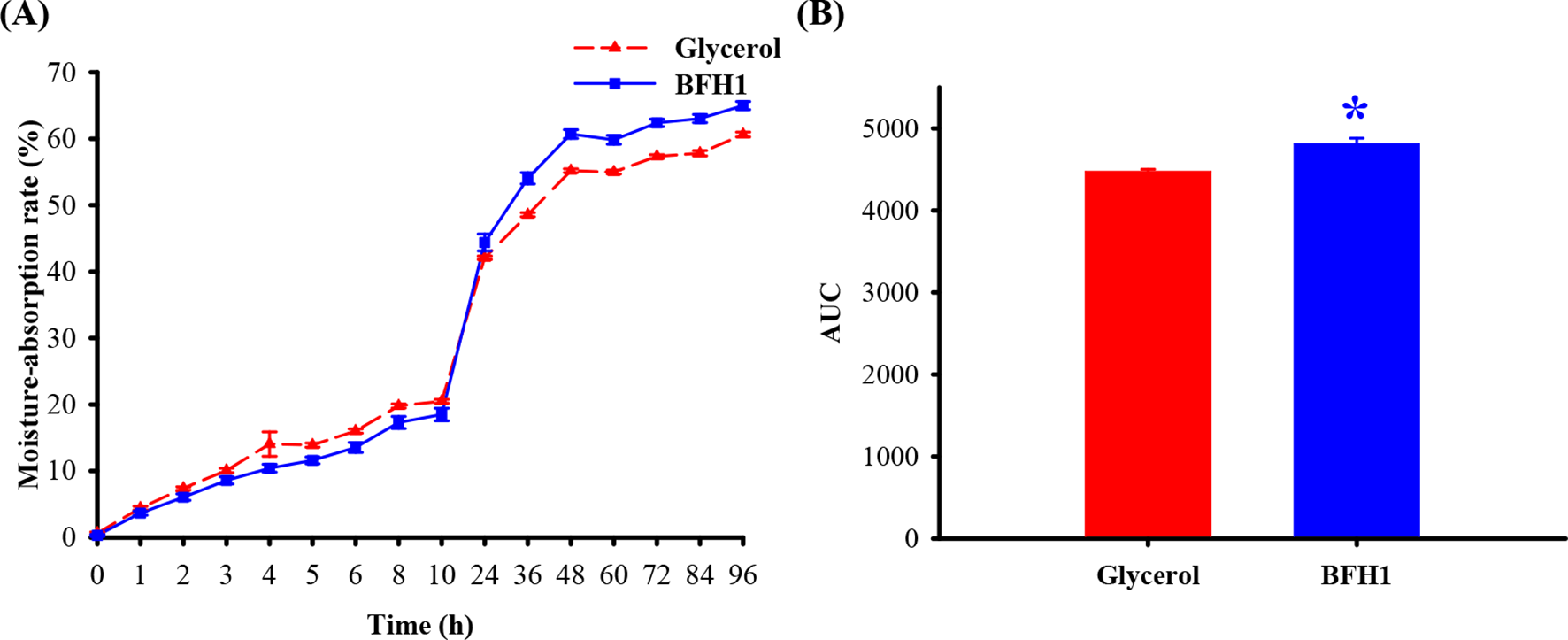
In vitro moisture-absorption ability of BFH1 at 80 % relative humidity. (A) Time course of the change in moisture-absorption rate (%) of BFH1. (B) Area under the moisture-absorption effect-time curve. Image B was transformed from image A. The duration of the moisture-absorption effects of glycerol (positive control) and BFH1 are shown as the area under the curve (AUC). The moisture-absorption ability of BFH1 was significantly higher than that of glycerol at 80 % relative humidity. Each point or bar represents the mean ± SEM of each group (n = 6).
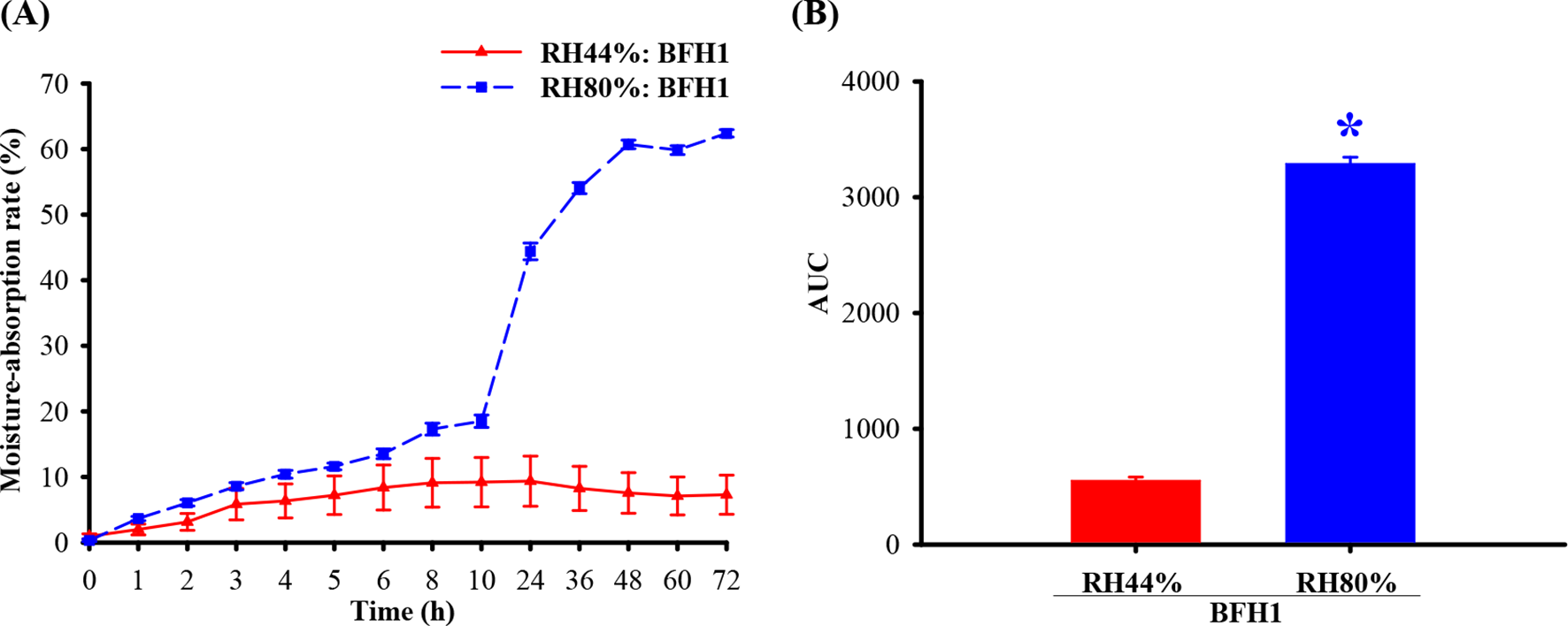
In vitro moisture-absorption ability of BFH1 at 44 % relative humidity. (A) Time course of the change of moisture-absorption rate (%) of BFH1. The data of the change of moisture-absorption rate (%) of the BFH1 group at 80 % relative humidity within 72 hours were extracted from Figure 2A. (B) Area under the moisture-absorption effect-time curve. Image B was transformed from image A. The duration of the moisture-absorption effects of BFH1 at 44 % and 80 % relative humidity are shown as the area under the curve (AUC). The moisture-absorption ability of BFH1 at 80 % relative humidity was significantly higher than that of BFH1 at 44 % relative humidity. RH44 %: 44 % relative humidity; RH80 %: 80 % relative humidity. Each point or bar represents the mean ± SEM of each group (n = 6). *P < 0.05 compared with the BFH1 group at 44 % relative humidity.
The In Vivo Moisturizing Ability of BFH1
The average baseline for the water content of the skin in normal mice was 23.7 % ± 1.6 % (n = 24). Because BFH1 at a dilution of 0.45 % did not exceed the solubility of BFH1 in deionized water, we selected this for the present study. Compared with the vehicle (deionized water) group, BFH1 (at a dilution of 0.45 % in a volume of 50 µL) could obviously increase the water content of the skin in normal mice from 0.5 to 3 hours after topical application of BFH1 on the skin (Figure 4(A)). The overall in vivo moisturizing effect of BFH1 in normal mice was similar to that of the positive control, glycerol (Figure 4(B)). BFH1-treated mice did not exhibit any obvious side effects regarding skin appearance and external behavior during treatment (n = 8). In addition, the average baseline for the oil content of the skin in normal mice was 35.5 % ± 0.95 % (n = 18). Compared with the vehicle (deionized water) group, glycerol could significantly increase the oil content of the skin, but BFH1 (at a dilution of 0.45 % in a volume of 50 µL) did not cause significant changes in the oil content of the skin within at least 3 hours (Figure 5(B)).

In vivo moisturizing ability of BFH1 in normal mice. (A) Time course of the increase in water content of skin after topical application of BFH1 (at a dilution of 0.45 % in a volume of 50 µL) on skin. (B) Area under the moisturizing effect-time curve. Image B was transformed from image A. The duration of the moisturizing effects of BFH1 and glycerol (positive control) are shown as the area under the curve (AUC). Both BFH1 and glycerol could obviously increase the water content of skin compared with the vehicle (deionized water) group. The moisturizing effect of BFH1 in normal mice was similar to that of glycerol. Each point or bar represents the mean ± SEM of each group (n = 8). *P < 0.05 compared with the vehicle group.

Effect of BFH1 on oil content of the skin in normal mice. (A) Time course of the increase in the oil content of skin after topical application of BFH1 (at a dilution of 0.45 % in a volume of 50 µL) on skin. (B) Area under the oil content change-time curve. Image B was transformed from image A. The duration of the moisturizing effects of BFH1 and glycerol are shown as the area under the curve (AUC). Compared with the vehicle (deionized water) group, glycerol significantly increased the oil content of the skin, but BFH1 did not cause any significant change. Each point or bar represents the mean ± SEM of each group (n = 6). *P < 0.05 compared with the vehicle group.
In Vitro Whitening Effect of BFH1
For measuring tyrosinase inhibitory activity, we used vitamin C (VC) as a positive control. 25 The in vitro tyrosinase inhibitory effects of BFH1 and VC over the dose ranges used (0.01-1.5 mg/mL and 0.005-0.05 mg/mL, respectively) were dose dependent (Figure 6). BFH1 exerted in vitro tyrosinase inhibitory activity with a half-maximal inhibitory concentration (IC50) value of 0.0483 mg/mL (48.3 µg/mL), which indicated that BFH1 had a whitening effect (IC50 of VC: 0.0196 mg/mL [19.6 µg/mL]).

In vitro whitening effect of BFH1. (A) Tyrosinase activity inhibitory effect of BFH1. (B) Tyrosinase inhibitory effect of VC (positive control). BFH1 exerted in vitro tyrosinase inhibitory activity with an IC50 value of 0.0483 mg/mL (48.3 µg/mL), which indicated that BFH1 had a whitening effect (IC50 of VC: 0.0196 mg/mL [19.6 µg/mL]). Each bar represents the mean ± SEM of each group (n = 3). IC50, half-maximal inhibitory concentration; VC, vitamin C
Discussion
Bioactivity of Ethanol Extract (BFH1) of B. fuscopurpurea
Previous studies of the bioactivity of B. fuscopurpurea focused on 2 research directions: proteins and polysaccharides from the water extract. Crude phycoerythrin was obtained from the water extract of the alga using a freeze-thaw and ammonium sulfate precipitation method, 5 and bioactive peptides could be derived from the phycoerythrin. 7,8,16 R-phycocyanin was isolated and purified from the water extract of B. fuscopurpurea. 15 The pending patents about 2 antioxidant peptides were also prepared from the water extract. 13,14 The crude polysaccharides were obtained from the alga by hot water extraction and ethanol precipitation. 6,9 -12 Our last literature search was carried out in the PubMed database on December 22, 2019, with the following search term: Bangia fuscopurpurea; this search yielded only 10 items. Most of the studies focused on the fields of algal physiology and algal molecular biology. In order to find additional studies about the bioactivity of this species, we also manually searched the relevant articles and patents in Chinese, which are also collated in the Introduction section and the References section. To the best of our knowledge, our present study is the first to explore the bioactivity of the ethanol extract of the red macroalga B. fuscopurpurea.
Moisturizing and Whitening Effects of BFH1
The in vitro moisture-retention test results showed that the BFH1 group had a higher trend for water-retention rate compared with the vehicle group (Figure 1(A)). We used glycerol as a positive control. 20 The in vitro moisture-retention ability of BFH1 was similar to that of glycerol (Figure 1(B)), but the in vitro moisture-absorption ability of BFH1 was significantly higher than that of glycerol for 80 % relative humidity (Figure 2(B)). The in vitro moisture-absorption of BFH1 also decreased with a decrease in relative humidity (Figure 3(B)). The relevance between in vitro humectancy (the moisture-retention ability and the moisture-absorption ability) and in vivo moisturization for skin is not a simple correlation. 26 Therefore, we needed to perform the in vivo moisturizing test for BFH1. BFH1 (at a dilution of 0.45 % in a volume of 50 µL) could obviously increase the water content of the skin in normal mice for at least 3 hours after topical application (Figure 4(A)). The overall in vivo moisturizing effect of BFH1 in normal mice was similar to that of glycerol (Figure 4(B)). In addition, BFH1 did not cause significant changes in the oil content of the skin (Figure 5(B)). BFH1-treated mice did not exhibit any obvious side effects regarding skin appearance and external behavior during treatment. Mushroom tyrosinase has been used as a commercially available system for screening hypopigmentation agents. 27 We used VC as a positive control. 25 BFH1 exerted in vitro tyrosinase inhibitory activity with an IC50 value of 48.3 µg/mL (Figure 6(A)), which indicated that BFH1 had a whitening effect (IC50 of VC: 19.6 µg/mL). The IC50 value of VC in the present study was close to the 16.1 µg/mL value from a previous study. 28
Advantages and Future Studies of BFH1
Supplying a marine natural product continuously and stably is often one of the key determining factors for further successful development in preclinical and clinical trials. 29,30 Because B. fuscopurpurea can be farmed, BFH1 can be supplied steadily. The yield rate of BFH1 from the dried alga was about 5 %. Another advantage of B. fuscopurpurea is its low cytotoxicity since it is a general food product, and this hypothesis is supported by the fact that BFH1-treated mice did not exhibit any obvious side effects on skin appearance and external behavior (n = 8). In the present study, we report the 2 cosmetic properties of BFH1: the moisturizing and whitening effects. The topical application of BFH1 (at a dilution of 0.45 % in a volume of 50 µL) could obviously increase the water content of the skin in normal mice for at least 3 hours (Figure 4), which provides basic information about an effective dosage for in vivo application. These features indicated that B. fuscopurpurea has high potential to be turned into either a cosmetic ingredient or for use in the development of other biomedical applications for the skin. The development of BFH1 has 3 future directions. First is the identification of the major active ingredients of BFH1. A commonly used method for polysaccharide extraction from algae 31,32 is briefly described as follows: (1) to soak the algal powder in 0.15 N hydrochloric acid (HCl) solution for 72 hours; (2) add ethanol to the clarified liquid from the centrifuge for polysaccharide precipitation; and (3) obtain polysaccharide through vacuum cooling and drying. By using the ethanol extraction method in the present study, which is different from most other polysaccharide extraction methods, we ensured that BFH1 did not contain any polysaccharides. Ethanol has been considered as safe for human consumption and a good solvent for polyphenol extraction. 33 The total phenolic content of BFH1 was 10.8 % ± 0.07 %. Some polyphenols were previously reported to absorb and preserve moisture and have tyrosinase inhibitory effects. 34 Therefore, the beneficial effects of BFH1 may partially result from its total phenolic content. The second direction would be the cellular mechanisms of the in vivo moisturizing effect of BFH1. The final direction would be to explore other biomedical applications or other potential biological activities of BFH1. The results and literature review from this study are expected to help the continued development of B. fuscopurpurea for biomedical applications.
Materials and Methods
Preparation of Extract
The farmed B. fuscopurpurea (Dillwyn) Lyngbye used in this study came from Putian (Fujian province, China). The dry alga was crushed into powder, which was soaked in 70 % ethanol at room temperature for 24 hours for extraction. The extract was centrifuged at 5000 rpm for 20 minutes, and the supernatant was concentrated under reduced pressure and then freeze-dried to obtain the above-mentioned ethanol extract (BFH1).
Determination of Total Phenolic Content of BFH1
Using a modified Folin-Ciocalteu’s method from previous studies, 35,36 100 µL of each sample and 100 µL of 1 mM Folin-Ciocalteu’s phenol reagent (catalog no. A500467; Sangon Biotech, Shanghai, China) were mixed in each well of a 96-well plate. Ten minutes after incubation at room temperature, 200 µL of 20 % sodium carbonate solution (catalog no. A500840; Sangon Biotech) was added to the mixed solution. At 10 minutes after incubation at room temperature, the absorbance of the mixed solution in each well was measured at 750 nm using a microplate reader (SpectraMax i3x; Molecular Devices, Downington, PA, USA). Pyrogallic acid (catalog no. PB0798; BBI Life Sciences, Shanghai, China) was used as a standard. The total phenolic content was then expressed as a percent of BFH1.
In Vitro Moisturizing Assays: Moisture-Retention Test and Moisture-Absorption Test
Moisture-retention and moisture-absorption tests were performed using methods modified from previous studies. 37 In the moisture-retention test, BFH1 was oven-dried at 105 °C for 12 hours. The test samples were prepared by adding 0.15 g water (deionized water) to each 0.05 g sample. The moisture-retention ability of the test sample was evaluated by the percentage of residual added-water of the test sample:

W 0 is the weight of added-water in the test sample before being put in the desiccator and W t is the weight of added-water in the test sample at the designated time after being put in the silica gel desiccator at 20 °C.
Prior to the moisture-absorption test, BFH1 was oven-dried at 105 °C for 12 hours. The moisture-absorption ability of the test sample was evaluated by the percentage of weight increase of the test sample:

For 80 % relative humidity, W 0 is the weight of the test sample before being put in the desiccator and W t is the weight of the test sample at the designated time after being put in the saturated ammonium sulfate desiccator at 20 °C.
For 44 % relative humidity, W 0 is the weight of the test sample before being put in the desiccator and W t is the weight of the test sample at the designated time after being put in the saturated potassium acetate desiccator at 20 °C.
In Vivo Moisturizing Test
Male Kunming mice (25-30 g) received free access to food and water. According to the Guiding Principles in the Care and Use of Animals of the American Physiology Society, experiments involving mice were approved. In order to minimize the number of mice used and their suffering, we performed every effort for experimental design and execution. After the back of each mouse had been shaved under anesthesia (isoflurane inhalation), a circular area of 2 cm in diameter was marked on the back of each mouse for topical application (in a volume of 50 µL). A skin analyzer (KRD1042; Belulu, Kanagawa, Japan) was used to analyze the effects of topical application of the substance on either the water content or the oil content of the skin in mice. The substance could be a vehicle (deionized water), a positive control (glycerol), or BFH1. Five recordings from a circular area on the back were taken for each mouse to determine the average of measurements (the water content or the oil content of skin) at each time point. The data were expressed as:

W 0 is the baseline (before topical application) and W t is the water content (or oil content) of skin at each time point.
In Vitro Test by Measuring Tyrosinase Inhibitory Activity for Whitening Effect
VC (

OD1 is the absorbance of the BFH1 or VC group, and OD2 is the absorbance of the vehicle group.
Data and Statistical Analysis
We represented all data as the mean ± SEM of each group and calculated the differences between groups using a one-way analysis of variance for statistical analysis, followed by the Student-Newman-Keuls post hoc test. The statistical significance was then defined as P < 0.05.
Conclusions
In the present study, we report the 2 cosmetic properties of the ethanol extract (BFH1) of B. fuscopurpurea, including the moisturizing and whitening effects. These results indicated that BFH1 has a high potential to be turned into a cosmetic ingredient.
Footnotes
Author note
Male Kunming mice (25–30 g) received free access to food and water. According to the Guiding Principles in the Care and Use of Animals of the American Physiology Society, experiments involving mice were approved by Quanzhou Normal University (201801). In order to minimize the number of mice used and their suffering, we performed every effort for experimental design and execution.
Declaration of Conflicting Interests
The author(s) declared no potential conflicts of interest with respect to the research, authorship, and/or publication of this article.
Funding
The author(s) disclosed receipt of the following financial support for the research, authorship, and/or publication of this article: the study was supported by research grants from the Fujian Province Key Laboratory for the Development of Bioactive Material from Marine Algae (2017FZSK09), National Training Program of Innovation and Entrepreneurship for Undergraduates of Fujian Province of China (201710399007), Natural Science Foundation of Fujian Province of China (2018J01585), Engineering Research Center of Natural Cosmeceuticals College of Fujian Province, Xiamen Medical College (No. XMMC-NC201902), and Science and Technology Program of Quanzhou Normal University (3001-G16037).
