



Abstract
A new neo-lignan named (7ʹS,8ʹR)-4ʹ,5ʹ,9ʹ-trihydroxy-5-methoxy-4,8ʹ-oxyneolign-7-en-9-al (
Acanthopanax senticosus (Rupr. & Maxim.) Harms (Araliaceae), is a shrub found widely distributed in the northeast of Asia such as China, Korea, Japan, and Russia. The stems and roots of A. senticosus were named as “Ci-Wu-Jia” in China, and it was traditionally used for treating acute rheumatism,
1
hydroncus,
2
hypopiesia,
2
and chloasma.
3
Pharmacological experiments showed that A. senticosus possesses anti-inflammatory,
4
antidiabetes,
5
anticancer,
6
hepatoprotective,
6
antioxidant,
7
hypocholesterolemic,
7
and other biological activities. And previous chemical studies of A. senticosus revealed the presence of flavonoids,
8
lignans,
8
triterpene saponins,
9
and aromatic glycosides.
10
During our course of identifying more interesting and bioactive compounds from A. senticosus, a new neo-lignan named (7’S,8’R)−4’,5’,9’-trihydroxy-5-methoxy-4,8’-oxyneolign-7-en-9-al (
Results and Discussion
Compound
Nuclear Magnetic Resonance Data of Compound 1 in Deuterated Methanol (1H: 500 MHz, 13C: 125 MHz).


Two-dimensional nuclear magnetic resonance correlations of compound 1 . HMBC, heteronuclear multiple bond correlation; NOESY, nuclear Overhauser effect spectroscopy.
Moreover, 5 known compounds (

The structure of compounds 1
All compounds were evaluated for their cytotoxicity against 4 cell lines including HepG2, A549, Hela, and MCF-7, and the doxorubicin was used as the positive control. Compounds
Cytotoxicities of Compounds 1-
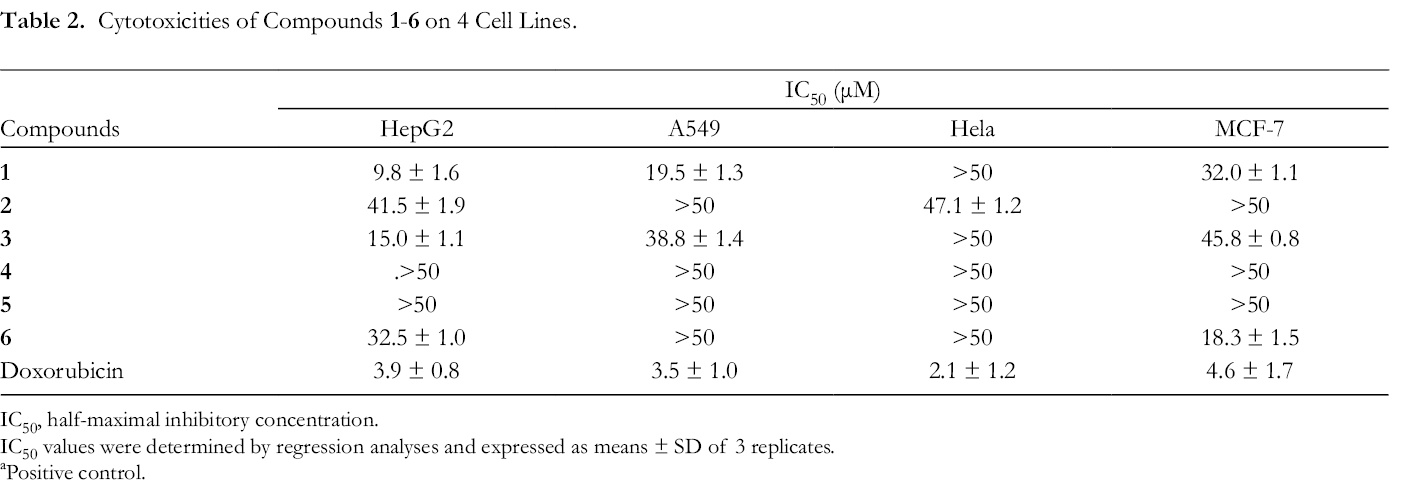
IC50, half-maximal inhibitory concentration.
IC50 values were determined by regression analyses and expressed as means ± SD of 3 replicates.
aPositive control.
Experimental
General
Optical rotations were determined by a JASCO P-2000 polarimeter (JASCO, Tokyo, Japan). Ultraviolet (UV) spectra were recorded on the diode-array detector Agilent SL1100 series (Agilent, Santa Clara, CA, USA). Infrared (IR) spectra were recorded with a JASCO FT-IR 620 spectrophotometer (JASCO, Tokyo, Japan). NMR spectra were recorded on a Bruker Avance III 500 MHz spectrometer with tetramethylsilane (TMS) as an internal standard (Bruker, Karlsruhe, Germany). Mass spectra were obtained from an API QSTAR Pulsar mass spectrometer (Thermo, Wythenshawe, UK). Column chromatography was conducted using silica gel 60 (200 μm particle size, Yantai Xinde Chemical Co., Ltd, Yantai, China). Thin-layer chromatography was performed with precoated silica gel GF254 glass plates (Qingdao Marine Chemical Co., Ltd). High-performance liquid chromatography (HPLC) was carried out using a Shimadzu LC-6AD instrument with an SPD-20A detector (Shimadzu, Kyoto, Japan) and a C-18 column (YMC-Pack ODS-A, 10 × 250 mm, 5 µm particle size, Shiseido Fine Chemicals, Tokyo, Japan).
Plant Material
The stems of A. senticosus were collected in Jilin, Jilin province, China, and authenticated by Professor Xiaohui Chen (College of Pharmacy, Zhengzhou University). A voucher specimen of the plant (No. 20180828) was deposited at the College of Pharmacy, Zhengzhou University, Henan, China.
Extraction and Isolation
Dried stems of A. senticosus (5.0 kg) was extracted with ethanol aqueous and then concentrated under vacuum at 45°C to obtain a residue (713.3 g). This extract was suspended in water (H2O), partitioned successively with petroleum ether (PE), ethyl acetate (EtOAc) and n-butanol. The EtOAc fraction (123.4 g) was chromatographed over a silica gel column using a gradient of dichloromethance–methanol (MeOH) (from 100:1 to 1:1) and was separated into 15 fractions (Fr.1-Fr.15). Fr.7 (8.9 g) was fractionated by column chromatography on silica gel using a gradient of PE-EtOAc (from 100:1 to 0:1) and was separated into 12 fractions (Fr.7.1-Fr.7.12). Furthermore, Fr.7.4 (1.2 g) was subjected to the RP-18 column and using the elution of MeOH–H2O (from 3:7 to 1:0) to afford 9 fractions (Fr.7.41- Fr.7.4.9). Fr.7.4.4 (100.3 mg) was applied to the C18 reversed-phase HPLC column and eluted with a gradient of 55%-65% MeOH in H2O at a flow rate of 3.0 mL/min over 80 minutes. This resulted in the isolation of compound
(7′S,8′R)-4′,5′,9′-trihydroxy-5-methoxy-4,8′-oxyneolign-7-en-9-al (
Cytotoxicity Assay
All cancer cell lines were obtained from the Beyotime Biotechnology Company. The 3-(4,5-dimethylthiazol-2-yl)-2,5-diphenyltetrazolium bromide assay was used to determine the proliferation inhibition of compounds
Supplemental Material
Figure S1 - Supplemental material for New Neo-Lignan From Acanthopanax senticosus and the Cytotoxic Effects on Human Cancer Cell Lines
Supplemental material, Figure S1, for New Neo-Lignan From Acanthopanax senticosus and the Cytotoxic Effects on Human Cancer Cell Lines by Zhi-Chao Feng, Sheng Wang, Jun Li and Jun-Sheng Wang in Natural Product Communications
Footnotes
Acknowledgments
We are grateful to the Department of Instrumental Analysis of Zhengzhou University for the measurement of the UV, IR, HREIMS, and NMR.
Declaration of Conflicting Interests
The author(s) declared no potential conflicts of interest with respect to the research, authorship, and/or publication of this article.
Funding
The author(s) received no financial support for the research, authorship, and/or publication of this article.

References
Supplementary Material
Please find the following supplemental material available below.
For Open Access articles published under a Creative Commons License, all supplemental material carries the same license as the article it is associated with.
For non-Open Access articles published, all supplemental material carries a non-exclusive license, and permission requests for re-use of supplemental material or any part of supplemental material shall be sent directly to the copyright owner as specified in the copyright notice associated with the article.
