



Abstract
Coriander and cilantro, the fruit and herb of Coriandrum sativum, are popular additives in various cuisines worldwide. The essential oils derived from coriander and cilantro are also popular and have shown some remarkable biological properties and health benefits. In this report, we have analyzed the essential oil compositions of 19 commercial coriander and 28 commercial cilantro essential oil samples by gas chromatography–mass spectrometry (GC–MS) techniques. In addition, 5 coriander and 4 cilantro commercial essential oil samples were analyzed by chiral GC–MS. Commercial coriander essential oil is dominated by linalool (62.2%-76.7%) with lesser quantities of α-pinene (0.3%-11.4%), γ-terpinene (0.6%-11.6%), and camphor (0.0%-5.5%). Commercial cilantro essential oil is composed largely of (2E)-decenal (16.0%-46.6%), linalool (11.8%-29.8%), (2E)-decen-1-ol (0.0%-24.7%), decanal (5.2%-18.7%), (2E)-dodecenal (4.1%-8.7%), and 1-decanol (0.0%-9.5%). The enantiomeric distribution of linalool was 87% (+)-linalool:13% (−)-linalool in both coriander and cilantro essential oils, while α-pinene was 93% (+):7% (−) in coriander, 90% (+):10% (−) in cilantro; and (+)-camphor:(−)-camphor was 13%:87% in both essential oils. Chiral GC–MS analysis was able to detect an adulterated coriander essential oil sample. The data provided in this study serves to establish a baseline for future evaluations of these essential oils as well as a screen for authenticity or adulteration.
Introduction
Coriander Essential Oil
The original geographical range of wild Coriandrum sativum is not clear but has been suggested to occur from southeastern Europe to southern Russia, including North Africa, Central Asia, the Near East, India, and Abyssinia. 1 The phytochemistry and medicinal properties of C. sativum have been extensively reviewed, see, for example, 1 -6 but are summarized here.
The dry fruits of C. sativum are known as coriander seeds, and the word “coriander” often refers to the fruits (as a spice), rather than to the plant. The top producers of C. sativum fruits in the world today are India, Russia, Morocco, Canada, Romania, and Ukraine, with smaller producers including Iran, Turkey, Israel, Egypt, China, the United States, Argentina, and Mexico. 6,7 In 2008, global trade in coriander was around 100 million kg (around US$ 134 million). 8 The odor of the fruits of C. sativum has been described as sweet, candy-like, and aromatically spicy. 9 The dried fruits are used in curries, curry powder, pickles, sausages, soups, stews, and ratatouille. 8 The fruit essential oils of C. sativum are typically dominated by linalool (60%-80%), with lesser concentrations of α-pinene (up to 9.5%), γ-terpinene (1%-10%), camphor (up to 4.9%), and geranyl acetate (up to 4.7%). 10 -12 The International Organization of Standards (ISO) standard for coriander essential oil is α-pinene (3.0%-7.0%), myrcene (0.5%-1.5%), limonene (2.0%-5.0%), γ-terpinene (2.0%-7.0%), linalool (65.0%-78.0%), camphor (4.0%-6.0%), α-terpineol (0.5%-1.5%), geraniol (0.5%-3.0%), and geranyl acetate (1.0%-3.5%). 13
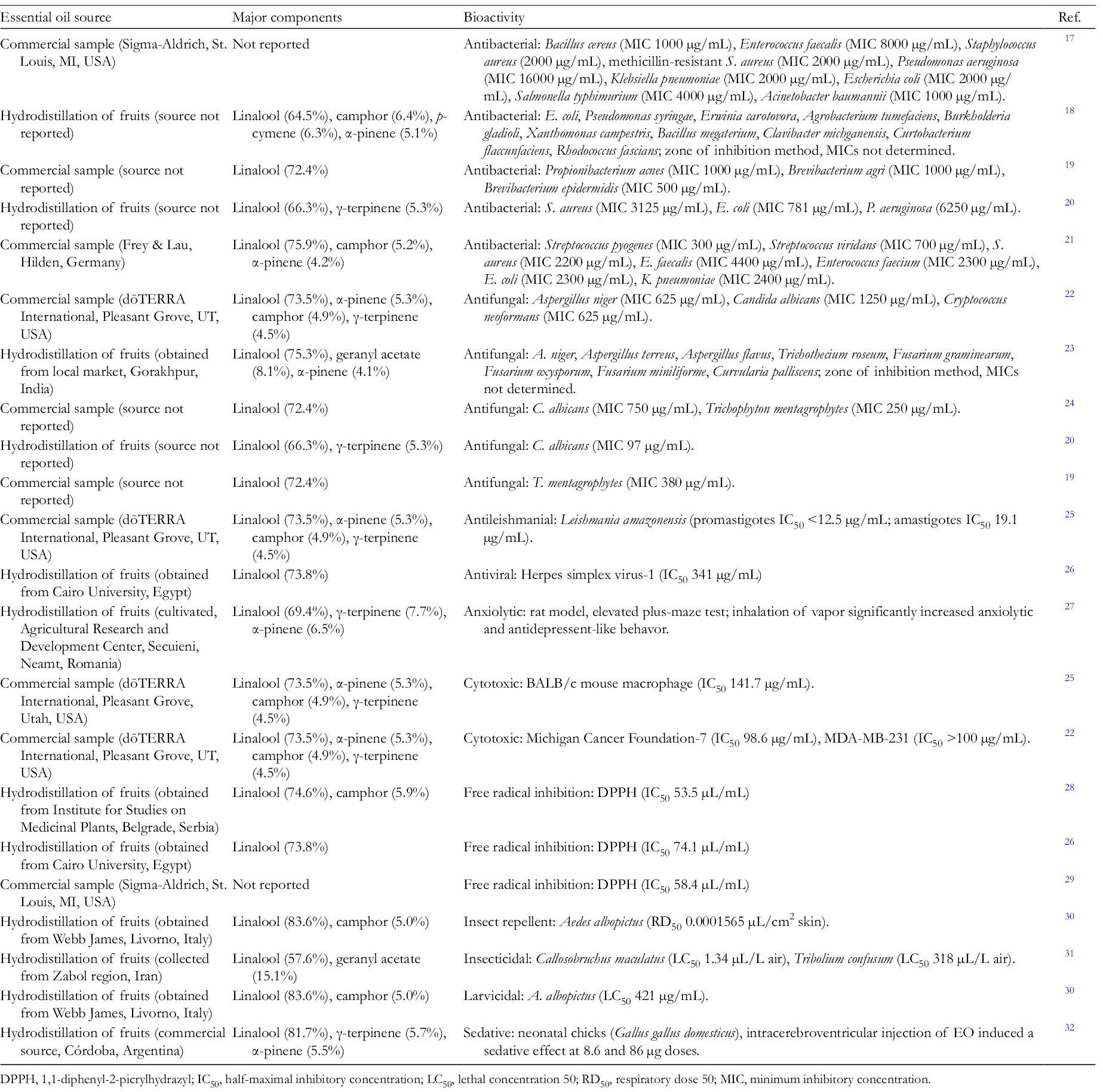
A perusal of the literature (Google Scholar, PubMed) for biological activities of coriander fruit essential oil has been carried out and are summarized in Table 1. Much of the observed biological activities can be attributed to the major component, linalool. Linalool has exhibited a wide variety of biological activities and health benefits. 14 -16
Biological Activities of Coriandrum sativum Fruit (Coriander) Essential Oils.
DPPH, 1,1-diphenyl-2-picrylhydrazyl; IC50, half-maximal inhibitory concentration; LC50, lethal concentration 50; RD50, respiratory dose 50; MIC, minimum inhibitory concentration.
Based on the criteria of Sartoratto and co-workers, 33 coriander essential oil shows relatively modest antibacterial or antifungal activities (Table 1), which is consistent with the reported antimicrobial activities of linalool. Linalool has shown only weak antimicrobial activities (minimum inhibitory concentration [MIC] ≥625 µg/mL) against Bacillus cereus, Escherichia coli, Pseudomonas aeruginosa, Candida albicans, or Aspergillus niger. 34
Coriandrum sativum fruit essential oil is not especially cytotoxic to either breast tumor cells or mouse macrophages. Consistent with this, linalool has been shown to be non-cytotoxic (median inhibitory concentration [IC50] >650 µg/mL) to several tumor cell lines (MDA-MB-231, Michigan Cancer Foundation-7 [MCF-7], Hs 578T, PC-3, Hep-G2) 34 and weakly cytotoxic to human endothelial (HMEC-1) and fibroblast (HNDF, 153BR) cells with IC50 ≥600 µg/mL. 35 Linalool, however, has been shown to potentiate the activity of the antitumor agent doxorubicin in MCF-7 breast tumor cells 36 and in P388 leukemia cells. 37 Likewise, linalool enhanced the cytotoxic effect of citral on MCF-7 cells. 38
Coriander essential oil showed notable antiparasitic activity against Leishmania amazonensis promastigotes (IC50 <12.5 µg/mL) and amastigotes (IC50 19.1 µg/mL). 25 Linalool has shown excellent antileishmanial activity against L. amazonensis with IC50 of 4.3 ng/mL and 15.5 ng/mL on promastigotes and amastigotes, respectively. 39 Linalool showed lower antiparasitic activity against Trypanosoma cruzi epimastigotes, however, with IC50 >100 µg/mL. 40
The free-radical scavenging activity of coriander seed essential oil is modest, with IC50 values for inhibition of the 1,1-diphenyl-2-picrylhydrazyl (DPPH) radical ranging from 54 to 74 µL/mL (Table 2). Linalool is only a weak scavenger of DPPH radicals, however (IC50 227 µL/mL). 29
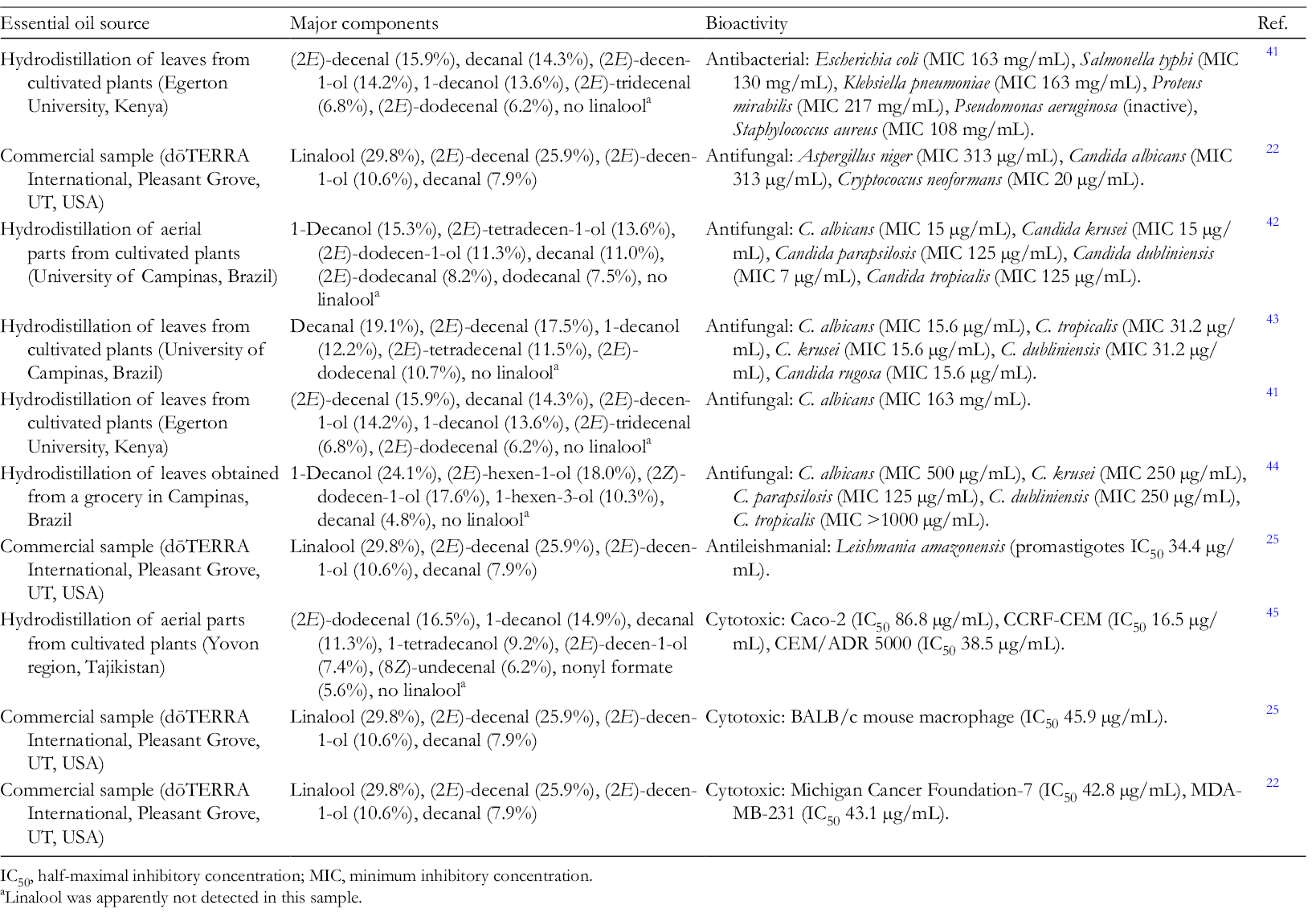
Biological Activities of Coriandrum sativum Herb (Cilantro) Essential Oil.
IC50, half-maximal inhibitory concentration; MIC, minimum inhibitory concentration.
aLinalool was apparently not detected in this sample.
The anxiolytic and sedative effects of coriander essential oil are corroborated by the similar effects of linalool. Based on mouse models, linalool has shown antidepressant (forced swimming test) and sedative (exploratory cylinder test) effects. 46 Similarly, inhaled linalool increased pentobarbital-induced sleeping time in mice indicating sedative activity. 47 Linalool exhibited anxiolytic effects in mice using the light/dark box test and the elevated plus maze test. 48,49 In humans, inhalation of (−)-linalool increases relaxation and sedation and reduces aggressiveness and hostility. 50,51 The sedative properties of (−)-linalool were similar for racemic (±)-linalool, but the reverse was observed for (+)-linalool. 50 In contrast, Cheng and co-workers have found that both (+)-linalool and (−)-linalool demonstrate anxiolytic effects in a rat model (elevated plus maze test). 52
Cilantro Essential Oil
The fresh herb of C. sativum is commonly referred to as Chinese parsley, coriander leaves, fresh coriander, or cilantro. 1 Fresh cilantro is an important spice in many Asian cultures (eg, China, India, Thailand, Vietnam, and Bangladesh) as well as Latin American cuisine. 53
The essential oil from C. sativum herb (cilantro) typically has as its major components linalool (0%-26%), decanal (3%-20%), (2E)-decenal (1%-30%), (2E)-decen-1-ol (0%-19%), 1-decanol (2%-36%), (2E)-undecenal (0%-5%), (2E)-dodecen-1-ol (0%-18%), (2E)-tetradecenal (0%-13%), and (2E)-pentadecenal (4.8%). 43,54 -61 The high concentrations of unsaturated aldehydes in cilantro are the source of the aroma of the herb as well as the source of the well-documented preference or disdain for cilantro. 62 (2E)-Decenal has been described as having a fatty, pungent odor; (2E)-dodecenal has a floral, pungent odor; (2E)-tetradecenal has a pungent, spicy, floral odor; while the unsaturated alcohol, (2E)-decen-1-ol, has been described as having a wet dog odor. 63 There is apparently a genetic variation in olfactory receptors responsible for the preference for or the aversion to the odor of cilantro. 64,65
The chemical compositions (major components) and biological activities of cilantro essential oils gleaned from the literature are summarized in Table 2.
Several researchers have found cilantro essential oil to demonstrate antifungal activity, particularly against Cryptococcus neoformans (MIC 20 µg/mL) 22 and Candida spp. (MIC 15.6-31.2 μg/mL). 43 Likewise, cilantro essential oil has shown cytotoxic activity against a number of tumor cell lines (Table 2) as well as antileishmanial activity against L. amazonensis. 25
The bioactivities of cilantro essential oil are likely due to the aliphatic aldehydes present, especially the α,β-unsaturated aldehydes. α,β-Unsaturated aldehydes are electrophilic agents and can react with biological nucleophiles such as glutathione, amino groups of deoxyribonucleic acid and proteins. 66 -68 Citral (a mixture of neral and geranial), for example, has shown cytotoxic activity against several tumor cell lines 38,69,70 and antifungal activity against several strains of fungi. 71 -73 Note, also, that the essential oil of Galangania fragrantissima, rich in (2E)-dodecenal (83.6%), showed cytotoxic activity against MCF-7, Caco-2, and HeLa cells. 74
The purpose of this work is to analyze several commercial essential oils of coriander and cilantro in order to evaluate the consistency of chemical composition of commercial sources and to establish a baseline for future evaluations of these essential oils as well as a screen for authenticity or adulteration.
Results and Discussion
Coriander Essential Oil
An agglomerative hierarchical cluster (AHC) analysis of 19 commercial coriander essential oil samples from the Aromatic Plant Research Center (APRC) collection was carried out using percentages of the chemical components (123 compounds). The cluster analysis revealed very little dissimilarity between the essential oils. Nevertheless, there were 3 well-defined clusters and 2 outliers (Figure 1).

Dendrogram obtained from agglomerative hierarchical clustering of Coriandrum sativum fruit (coriander) essential oil compositions.
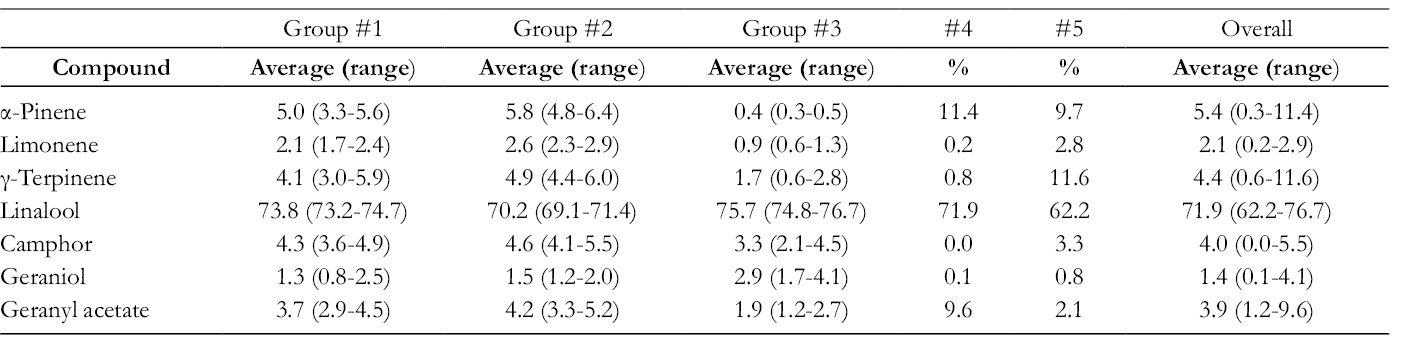
Groups #1 and #2 are very similar, differing only in the concentrations of linalool; group #1 has a slightly higher concentration of linalool than group #2 (Table 3). Group #3 has an even higher concentration of linalool, at the expense of concentrations of α-pinene, limonene, γ-terpinene, and geranyl acetate. Outlier #4 has relatively high concentrations of α-pinene and geranyl acetate, while outlier #5 has relatively high concentrations of α-pinene and γ-terpinene. Groups #1 and #2 correspond more closely to the ISO standard 13 than the atypical samples #3, #4, or #5.
Percent Compositions of the Major Components in Coriandrum sativum Fruit (Coriander) Essential Oils.
A chiral gas chromatography–mass spectrometry (GC–MS) analysis has been carried out on several commercial coriander essential oil samples; the enantiomeric distributions are summarized in Table 4. The major enantiomer of linalool in coriander essential oil is S-(+)-linalool (around 87%). This distribution has been previously observed in coriander essential oil (87% in coriander from Germany, 75 84% in coriander from Pakistan, 76 and 88% in coriander from France). 77 The particular enantiomer of linalool can have an effect on biological activity. 51,78 Coriander essential oils are often adulterated with either synthetic linalool or with natural linalool from other sources. Synthetic linalool can be determined by chiral GC–MS and/or by the presence of some synthetic markers such as α-linalool, dehydrolinalool, dihydrolinalool, and plinols. 79 The enantiomeric distribution of linalool in commercial sample 180907F suggests that this sample is inauthentic and/or adulterated. In addition, the enantiomeric distributions of α-pinene, β-pinene, limonene, camphor, terpinen-4-ol, and α-terpineol corroborate this conclusion. In this work, (+)-limonene ranged from 51% to 63%, which is comparable to that reported for coriander essential oil from Germany. 75 Likewise, (−)-camphor in coriander essential oil in this work was 87%, in agreement with that observed in coriander essential oil from Italy. 80
Enantiomeric Distribution of Monoterpenoids in Coriandrum sativum Fruit (Coriander) Essential Oils.

aCoriander essential oil sample 180907F is apparently not authentic.
The major enantiomer of α-pinene in coriander essential oil was the (+)-enantiomer, which was also the dominant enantiomer in other members of the Apiaceae, Trachyspermum ammi and Anethum graveolens, both 100% (+)-α-pinene. 81 In contrast, (−)-α-pinene (95%) was the dominant enantiomer in Ferula akitschkensis essential oil. 82 Similarly (+)-β-pinene was the major enantiomer in C. sativum fruit essential oil (76%-90%), also found in T. ammi, 100% (+)-β-pinene, 81 and Niphogeton dissecta, 87% (+)-β-pinene, 83 again in contrast to that observed for F. akitschkensis with only 6% (+)-β-pinene. 82 (+)-Sabinene was the exclusive enantiomer found in coriander essential oil in this study and was the major enantiomer in both F. akitschkensis (97%) 82 and N. dissecta (81%). 83
Cilantro Essential Oil
The cilantro herb essential oil compositions of 28 commercial essential oil samples from the Aromatic Plant Research Center (APRC) collection were subjected to an AHC using the chemical compositions (56 components). There are 3 well-defined clusters from the AHC analysis: #1 ((2E)-decenal > linalool > (2E)-decen-1-ol), #2 ((2E)-decenal > (2E)-decen-1-ol > linalool), and #3 ((2E)-decenal >> decanal > linalool) (Figure 2). The compositions of the major components for each of the clusters are summarized in Table 5.

Dendrogram obtained from agglomerative hierarchical clustering of Coriandrum sativum herb (cilantro) essential oil compositions.
Percent Compositions of the Major Components in Coriandrum Sativum Herb (Cilantro) Essential Oils.
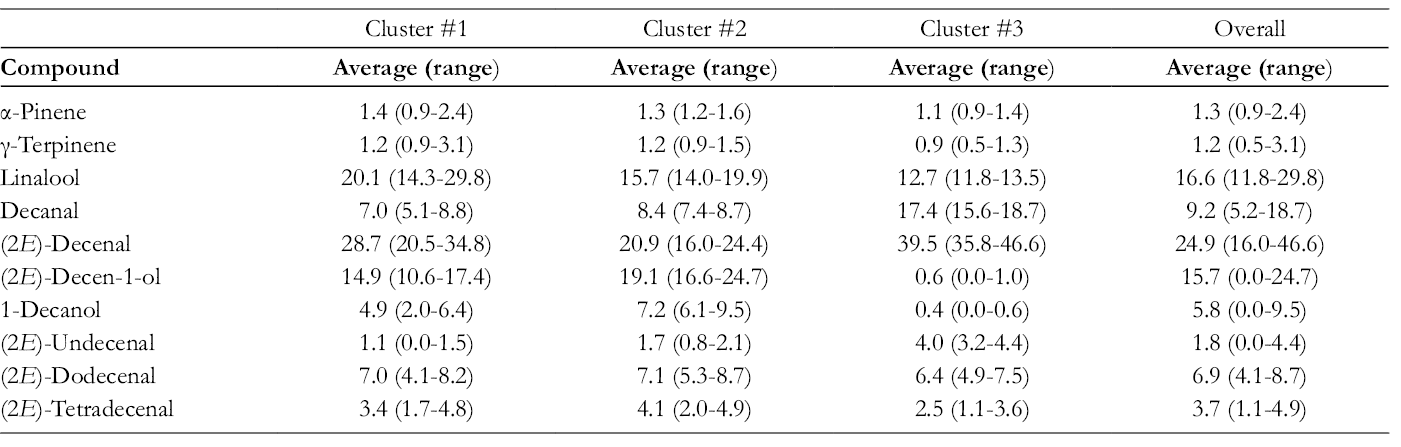
The cluster analysis reveals that the essential oil compositions are not very different. Groups #1 and #2 are very similar and group #3 differs mainly in the concentration of linalool (lower in #3) and decanal and (2E)-decenal (both higher in #3). Linalool is reported to have a refreshing, floral, woody odor, 84 while (2E)-decenal has a pungent, fatty odor. 85 Interestingly, several of the herb essential oils reported in the literature (Table 2) were devoid of linalool, in contrast to commercially available essential oils in this work. It is apparent that there are other chemotypes of cilantro that are not reflected in the commercial samples from the present study.
The enantiomeric distributions of monoterpenoids in cilantro essential oils were determined by chiral GC–MS and are summarized in Table 6. Not surprisingly, the enantiomeric distributions are similar to those seen in the coriander essential oils (Table 4).
Enantiomeric Distribution of Monoterpenoids in Coriandrum Sativum Herb (Cilantro) Essential Oils.

Conclusions
The commercially available C. sativum essential oils from this study, either the fruit (coriander) essential oil or the herb (cilantro) essential oil, have similar chemical compositions. Thus, unless adulteration is a problem, the chemical qualities of the essential oils are very consistent. Commercial coriander essential oil is dominated by linalool (62.2%-76.7%) with lesser quantities of α-pinene (0.3%-11.4%), γ-terpinene (0.6%-11.6%), and camphor (0.0%-5.5%). Commercial cilantro essential oil is composed largely of (2E)-decenal (16.0%-46.6%), linalool (11.8%-29.8%), (2E)-decen-1-ol (0.0%-24.7%), decanal (5.2%-18.7%), (2E)-dodecenal (4.1%-8.7%), and 1-decanol (0.0%-9.5%). Nevertheless, there are likely other chemotypes of C. sativum essential oils that may be considered for cultivation and commercialization. The enantiomeric distribution of linalool was 87% (+)-linalool:13% (−)-linalool in both coriander and cilantro essential oils, while α-pinene was 93% (+):7% (−) in coriander, 90% (+):10% (−) in cilantro; and (+)-camphor:(−)-camphor was 13%:87% in both essential oils. Chiral GC–MS analysis was able to detect an adulterated coriander essential oil sample. Coriander essential oil has apparently shown no human toxicity. 11 . There are no published reports on any adverse effects of cilantro essential oil. Both coriander and cilantro essential oils can be considered safe for use in human foods. The data provided in this study serves to establish a baseline for future evaluations of these essential oils as well as a screen for authenticity or adulteration.
Materials and Methods
Essential Oil Samples
Essential oils of C. sativum fruit (coriander) and herb (cilantro) were obtained from a collection of commercial essential oils housed with the Aromatic Plant Research Center (APRC, Lehi, UT, USA). Coriander fruits were dried and the essential oil obtained by steam distillation (distillation time 3 hours, temperature 97-105°C, pressure 1 atm, yield 1.5%). Freshly cut cilantro herb was steam distilled within 3 hours after harvest (distillation time 2 hours, temperature 97-105°C, pressure 1 atm, yield 0.3%). The essential oils were labeled, stored under refrigeration (4°C), and analyzed within days of receipt, generally within 1 month after production. The first 2 numbers of the label codes indicate the year that the sample was processed. All of the coriander samples were from suppliers from Russia. Nineteen commercial coriander and 28 commercial cilantro essential oil samples were obtained.
Gas Chromatography–Mass Spectrometry
The essential oils of C. sativum (19 commercial coriander (Supplemental Table S1) and 28 commercial cilantro (Supplemental Table S2) essential oil samples) were analyzed by GC–MS using a Shimadzu GCMS-QP2010 Ultra (Shimadzu Scientific Instruments, Columbia, MD, USA) with a ZB-5 column (Phenomenex, Torrance, CA, USA) as previously described. 86 Identification of the essential oil components was based on their retention indices determined by reference to a homologous series of n-alkanes and by comparison of their mass spectral fragmentation patterns with those reported in the databases. 87 -89
Chiral GC–MS
Chiral analysis of the C. sativum essential oils (5 commercial coriander and 4 commercial cilantro samples) was carried out on a Shimadzu GCMS-QP2010S (Shimadzu Scientific Instruments, Columbia, MD, USA) with a Restek B-Dex 325 capillary column (Restek Corporation, Bellefonte, PA, USA) as described previously. 86
Hierarchical Cluster Analyses
The C. sativum fruit (19 coriander samples) and herb (28 cilantro samples) essential oil compositions from the collections of the Aromatic Plant Research Center (Lehi, UT, USA) were treated as operational taxonomic units. The percentage composition of the essential oil components (123 compounds for coriander, 56 compounds for cilantro) was used to determine the chemical relationship between the various C. sativum essential oil samples by AHC analysis using the XLSTAT software, version 2018.1.1.6097 (Addinsoft, Paris, France). Euclidean distance was used to measure dissimilarity, and Ward’s method was used for cluster definition.
Supplemental Material
Table S1 - Supplemental material for Chemical Compositions of Commercial Essential Oils From Coriandrum sativum Fruits and Aerial Parts
Supplemental material, Table S1, for Chemical Compositions of Commercial Essential Oils From Coriandrum sativum Fruits and Aerial Parts by Prabodh Satyal and William N. Setzer in Natural Product Communications
Supplemental Material
Table S2 - Supplemental material for Chemical Compositions of Commercial Essential Oils From Coriandrum sativum Fruits and Aerial Parts
Supplemental material, Table S2, for Chemical Compositions of Commercial Essential Oils From Coriandrum sativum Fruits and Aerial Parts by Prabodh Satyal and William N. Setzer in Natural Product Communications
Footnotes
Acknowledgements
This work was carried out as part of the activities of the Aromatic Plant Research Center (APRC, https://aromaticplant.org/).
Declaration of Conflicting Interests
The author(s) declared no potential conflicts of interest with respect to the research, authorship, and/or publication of this article.
Funding
The author(s) received no financial support for the research, authorship, and/or publication of this article.

References
Supplementary Material
Please find the following supplemental material available below.
For Open Access articles published under a Creative Commons License, all supplemental material carries the same license as the article it is associated with.
For non-Open Access articles published, all supplemental material carries a non-exclusive license, and permission requests for re-use of supplemental material or any part of supplemental material shall be sent directly to the copyright owner as specified in the copyright notice associated with the article.
