



Abstract
Elettaria cardamomum is cultivated in the Southern part of India showed great extinct of differences in their morphotypes and chemical compositions. In the present study, we have selected three varieties of Elettaria cardamomum “Valley Green, Palakuzhi, and ICRI”, to analyze the morphological perturbations, chemical compositions, and antimicrobial activities. The differences in the morphological character of cardamom varieties (Valley Green, Palakuzhi, and ICRI) were carried out on the basis of panicles, capsules shape, plant height, tiller, and seeds per capsule. The GC-MS analysis of the essential oils resulted in the identification of 27, 29, 30 compounds representing over 97.4%, 95.2%, and 98.8% of the Valley Green (VG), Palakuzhi (PAL), and ICRI fruit oils respectively. Monoterpene, α-terpinyl acetate varied from 35.4 to 47.5%, a major constituent while 1,8-cineole (22.8% to 27.4%) observed the second major compounds revealed in oils of these cultivars. Further, the antimicrobial activities of each essential oils were performed against Staphylococcus aureus, Bacillus subtilis, Escherichia coli, Klebsiella pneumoniae, Candida albicans, and Aspergillus niger. The maximum inhibition percentage against the microbes was observed in Valley Green essential oil as compared to oils of other varieties.
E. cardamomum (L.) Maton is a perennial plant (family: Zingiberaceae) cultivated worldwide with high latitude with humid area. The center of origin of several varieties of this plant is also found in evergreen rain forest of Southern part of India (Kerala, Karnataka and Tamil Nadu) and Sri Lanka. 1 In India, lesser cardamom is mainly cultivated in Kerala and covered its 70% production. 2 Several high yielding varieties of E. cardamomum (Najalani, Panikulangara, Valley Green, IISR, ICRI, CCS, PV, Palakuzhi, Mudigere, Elarani) are also cultivated in the different parts of India. These high yielding varieties belong to the three natural cultivars, Mysore, Malabar and Vazhukka of E. cardamomum. 3
The identification of cardamom varieties is based on their morphological features, such as the number of the panicle, fruit’s shape and size and also preliminary information collected from local growers. 4 Due to climatic conditions, the varieties of E. cardamomum are varied in biomass, yield and aroma of fruits resulted in the variation of percent metabolites oil contents. 5 In the recent past, several studies have been reported that active metabolites ie monoterpenes (α-terpinyl acetate and 1,8-cineole) were reported, the active constituents packed with limonene, linalool, α-pinene and β-pinene in the essential oil of E. cardamomum. 6 -8
In the traditional or Indian system of medicine fruits, seeds, and oil are mainly used for a pharmaceutical cause against teeth and gum infections, carminative, constipation, epilepsy, colic pain, pulmonary tuberculosis, eye inflammation, anorexia, coughs and cold, bronchitis and asthma treatments, snake and scorpion poisoning. 9 -14 Clinical studies showed the effectiveness and safety of lesser cardamom supplementation on lipid profile, glycemic control, and oxidative stress in a patient with type 2 diabetes mellitus. 15
Recently, it has also been reported that the essential oil of E. cardamomum is effective against bacteria (Gram-positive, Gram-negative) and fungi. 16 Essential oils exhibited resistance against a wide range of microbes, including B. cereus, S. aureus, S. typhimurium, and E. coli. 17 As per the latest research survey number of studies revealed that essential oils of E. cardamomum has shown great potential of antimicrobial property. Keeping in view of previous information the antimicrobial activities of these essential oils extracted from fruits of cardamom has not been well studied. However, we emphasized that the high yield varieties of E. cardamomum packed with high content of essential oils led to show the high rate of mortality against the microbes and also helpful for other pharmacological activities.
Material and Methods
Materials
Three varieties of E. cardamomum (Valley Green, Palakuzhi, and ICRI) surveyed and dried fruits were collected from Indian Cardamom Research Institute (ICRI), Myladumpara (Kerala, India, an altitude of 1068 m above MSL at 9 0 53'N latitude) with the accession number ICRI RES-500-27414 obtained from purchase department.
Study of Morphological Variations
The morphological traits were observed by plant features and stored information at ICRI Myladumpara based on previous record. 3 The qualitative parameters, orientation of panicles, shape and color of fruits, plant heights, tiller per clump, panicles per clump, capsules per panicle, and seeds per capsule were analyzed for this study. Five years old three clumps of each variety and variables were calculated on the basis of morphological features.
Extraction of Essential Oils
Fifty grams of fresh fruits of E. cardamomum varieties (Valley Green, Palakuzhi, and ICRI) were ground as powdered form and transferred to the Clevenger apparatus for 4 hours for hydro-distillation. Each sample of each variety was hydro-distilled in thrice for the extraction of essential oils. Further, water content present in the essential oil was removed by adding the sodium sulfate (anhydrous). Extracted pure essential oils of each variety (Valley Green, Palakuzhi, and ICRI) were stored in a dark place for further analyses to carried-out the GC-MS and antimicrobial activities.
GC-MS Analyses
The GC-MS study of the essential oils of E. cardamomum varieties was conceded out using a GCQP 2010 PLUS; Quadrupole mass spectrometer Shimadzu, Japan (RTx-5 MS capillary-column: 60 m × 0.25 mm i.d.; 0.25 µm film thickness) having a flame ionization detector with the flow rate of 1 mL/min helium, respectively. The temperature 250°C and 280°C were adjusted for the injector and detector, respectively. The temperature of the column was adjusted as initial temperature 40°C (5 minutes) and final 250°C with the rate of 2°C/min (run 5 minutes) with the rate of 5°C/min until the temperature reached up to 275°C. Prepared 20% v/v solution of n-pentane and 1 µl of essential oil dissolved in n-pentane. The sample solution was injected in split mode (10:1, split ratio) to the GC-system. The compositions of essential oil were identified on the basis of spectra and retention indices (RI) and also their hits on inbuilt computer library (NIST and Wiley), and published literature. 18,19
Comparative Antimicrobial Activities of the Selected Varieties of Essential Oils
The antimicrobial activity was assessed by evaluating the zone of inhibition, minimum inhibitory concentration (MIC) and fungicidal concentration (MBC) using the agar well diffusion and broth dilution method respectively. 20 The essential oils from each variety (Valley Green, Palakuzhi, and ICRI) were tested against four bacterial strains B. subtilis (MTCC-736), S. aureus (MTCC-902), E. coli (MTCC-443) and K. pneumoniae (MTCC-432) and two fungal strains, C. albicans (MTCC-183) and A. niger (MTCC-1344). The bacterial and fungal strains were maintained on MHA (Mueller-Hinton agar) and PDA (potato dextrose agar) agar plate, respectively. 21 In brief, 25mL of MHA and PDA were solidify in petri-plates; 24 hours and 48 hours old cultures of bacterial and fungal suspension, respectively, were streaked on the petri plates. Four wells (6 mm diameter and 5mm height) in each plate were made using sterilized borer; 15 µL of the dilute essential oil (40 mg/mL in 10% dimethyl sulfoxide) of each variety of E. cardamomum was prepared and filled in the wells. The plates were incubated for 24 and 48 hours at 37°C, respectively, for the bacteria and fungi. These experiments were repeated thrice. The zones of inhibition were calculated in millimeters (mm) and the average of triplets was reported. MIC and MBC were determined using the agar dilution method. 22 These were performed at seven different concentrations (0.125, 0.25, 0.5, 1, 2, 4, 8 mg/mL) of essential oils. All plates were incubated for 24 hours, at 37°C for bacteria and 25°C for fungi, respectively.
Results
Study of Morphological Traits
Three varieties (Valley Green, Palakuzhi, and ICRI) of E. cardamomum were selected for macro-morphological study grown under the control area of ICRI (Myladumpara, Idukki, Kerala), and identified by ICRI staffs. The comparative qualitative and quantitative morphological traits, panicle arrangement, shape and color of the capsule, height of plants, tiller/clump, panicles/clump, capsules/panicle, and seeds/capsule of selected varieties were observed and shown in Table 1.
Qualitative Morphological Traits of Selected Varieties of E. cardamomum.

Compositions of Essential Oils
Total, 27, 29, and 30 compositions were identified in the essential oil of cardamom varieties (Valley Green, Palakuzhi and ICRI) respectively, using GC-MS analysis (Table 2). In Valley Green, the major components, α-terpinyl acetate (47.5%), and; 1, 8-cineol (27.4%) were estimated followed by the other metabolites; linalool (5.3%), α-terpineol (3.3%) and linalyl acetate (2.0%). Similar trends were also observed in Palakuzhi essential oil; α-terpinyl acetate (40.3%) and 1, 8-cineol (22.8%) with linalool (6.8%), α-terpineol (2.8%) and linalyl acetate (2.8%) and ICRI essential oil; α-terpinyl acetate (36.4%), 1, 8-cineol (25.4%) with linalool (5.2%), linalyl acetate (3.8%), neryl acetate (3.2%), and α-terpineol (2.4%) rather than these metabolites, other compounds were also detected in GC-MS analyses listed in Table 2.
Chemical Composition of the Essential Oil Identified in E. cardamomum Varieties.
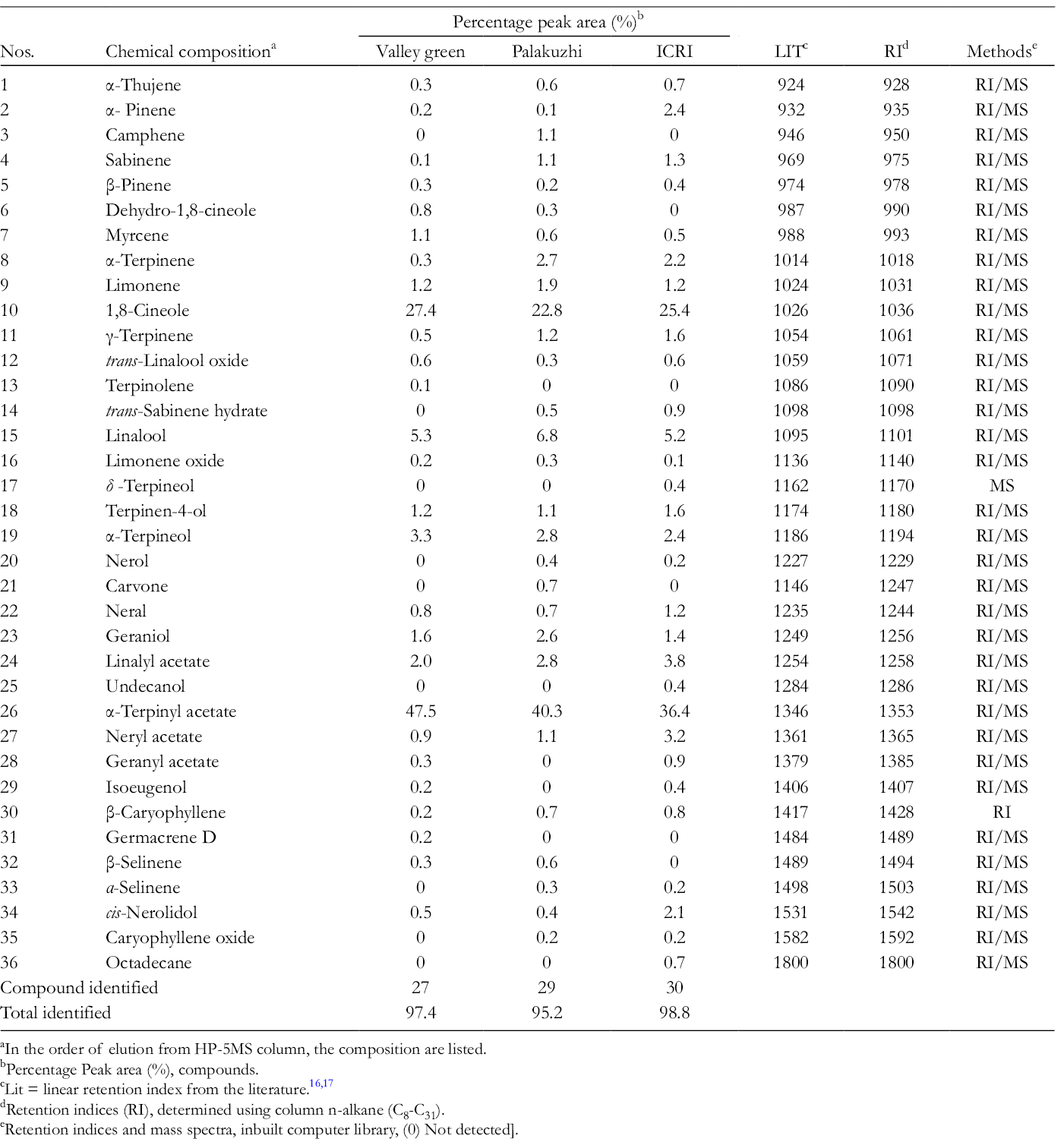
aIn the order of elution from HP-5MS column, the composition are listed.
bPercentage Peak area (%), compounds.
dRetention indices (RI), determined using column n-alkane (C8-C31).
eRetention indices and mass spectra, inbuilt computer library, (0) Not detected].
Antimicrobial Activities of Essential Oils
The antimicrobial activity of Valley Green, Palakuzhi and ICRI essential oils have shown great potential against bacterial (B. subtilis, E. coli, K. pneumonia, and S. aureus) and fungal strains (C. albicans and A. niger). The essential oil of the Valley Green showed maximum zone of inhibition against, Gram-positive bacteria (B. subtilis (15.4 mm), S. aureus (14.5 mm)) and fungi C. albicans (13.6 mm) and A. niger (12.7 mm), while less inhibition against Gram-negative bacteria, E. coli (10.3 mm), K. pneumonia (10.5 mm), followed by Palakuzhi and ICRI essential oils [B. subtilis (12.2 and 12.1 mm), S. aureus (12.8 and 11.3 mm), C. albicans (11.4 and 10.8 mm) and A. niger (9.5 and 8.7 mm) E. coli (8.1 and 7.2 mm), K. pneumonia (9.6 and 8.3 mm)], respectively (shown in Table 3). The MIC and MBC values of these essential oils extracted from cardamom varieties against bacterial and fungal strains have shown in Table 4.
Antimicrobial Activity (Zone of Inhibition, Diameter (mm)) of the Essential Oils Extracted From E. cardamomum Varieties.

“NA (Not applicable)”
Minimum Inhibitory and Bactericidal Concentrations (MIC and MBC (mg/mL)) of the Essential Oils Extracted From E. cardamomum Varieties.

Discussion
Three natural cultivars, Malabar, Mysore and Vazhukka of Cardamom (E. cardamomum) cultivars are widely cultivated in Indian subcontinent. Three varieties of E. cardamomum ie Valley Green, Palakuzhi, and ICRI are known to be high yielding varieties and have a high market value due to its capsule size, aroma, and color. 23,24 Ankegowda et al reported the same diversification of these three natural cultivars, panicle grows vertically upward (Mysore), horizontally (Malabar) while Vazhukka panicle grows in between vertical and horizontal reported by us. After the domestication of these cultivars; ICRI originated from Mysore, Palakuzhi from Malabar, and Valley Green from the Vazhukka. 3 These varieties are now cultivated in the southern part of India due to its great diversity and favorable edaphic factors. In the domestication or cultivation of these varieties, the growers have been reported that Malabar is originated in Kerala, but now have been wildly distributed in Mysore and Tamil Nadu, while Mysore is originated in Karnataka but distributed in Kerala. 25 In present finding, we have observed that the qualitative traits are similar to the previous report but the variations in quantitative traits are quite different at the phenotypic levels among these varieties. 26,27
Further, GC analyses revealed that the Valley Green essential oils contain a high proportion of α-terpinyl acetate (47%), and 1,8-cineole (27%) as compared to other varieties. Kumar et al reported that the major components of the E. cardamomum seeds and fruits, essential oils contain α-terpinyl acetate (56.87% and 51.25%), 1,8-cineole (15.13% and 23.74%), α-terpineol (4.67% and 5.25%) and limonene (4.05% and 3.82%), respectively. 28 Mejd et al reported that the fragrance of E. cardamomum is mainly due to the combine effects of 1,8-cineole and α-terpinyl acetate. 29 Leela et al studied the composition of the essential at different maturity levels and the results revealed that α-terpinyl acetate and 1,8-cineole were continually the foremost components. 30 Morsy, stated that, α‐terpinyl acetate is used as an indicator for the superior quality of cardamom essential oils, where, α‐terpinyl acetate is always more than 1,8‐cineole. 31 More recently, it is very interesting that the major constituents of E. cardamomum essential oil was reported less α-terpinyl acetate (28.6%) as compared to 1,8-cineole (55.4%) while the other studied showed the antagonistic pattern. 32 It may be because of some mutation or environmental factors.
E. cardamomum varieties were exhibited moderate-to-high activity against the selected bacteria and fungi by antimicrobial bioassay. Valley Green essential oil was recorded highly range of zone of inhibition (10.3-15.4 mm), MIC (0.125-1 mg/mL) and MBC (0.25-2 mg/mL) against all pathogenic strains. It is noted that Valley Green is most susceptible as compared to Palakuzhi (MIC, 0.25-2 mg/mL) and ICRI (MIC, 0.25-4 mg/mL). Due to these active ingredients (α-terpinyl acetate and 1,8-cineole) in the essential oils; Jaramillo-Colorado et al proved that the E. cardamomum had active potential against Gram-positive bacteria, cariogenic bacteria, and fungi, ranged 0.023 to 0.046 mg/mL MICs against the microbes. 33 A similar study has also been carried by Teneva et al, the essential oil E. cardamomum showed effectiveness against E. coli, S. aureus, Salmonella sp., and P. vulgaris with a variable susceptibility. 34 More recently our study is also supported by Mutlu-Ingok et al, who observed that the E. cardamomum varieties with high content of α-terpinyl acetate and 1,8‐cineole were more active against Campylobacter coli and Campylobacter jejuni . 35 In the present study, we were now reporting that, the role of α-terpinyl acetate and 1,8-cineole showed potentially more effective against microbes as compared to less content originating varieties of α-terpinyl acetate and 1,8‐cineole. 36,37
Conclusion
The morphological study of cardamom clearly indicated that the variations in panicle arrangement, height of plants, tiller per clump, panicles per clump, capsules per panicle, and seeds per capsule in the selected varieties are quite different. The chemical compositions of essential oils of these varieties (Valley Green, Palakuzhi and ICRI) of E. cardamomum were mainly packed with high content of α-terpinyl acetate and 1,8-cineole. It has marked that the tested essential oils (α-terpinyl acetate and 1,8-cineole) contain high concentration and oxygenated monoterpenes showed great potential against Gram-positive bacteria and fungi, as compared to Gram-negative bacteria. These low effects against Gram-negative may be due to the low susceptible of essential oil (low concentration of monoterpene) against Gram-positive and fungi. Therefore, we concluded that Valley Green essential oil packed with highly susceptible antimicrobial agent of α-terpinyl acetate and 1,8-cineole acetate, may also be used for other pharmacological activities.
Footnotes
Acknowledgments
We are greatly thankful to ICRI Myladumpara for providing capsule and site visit of the cardamom cultivation area. Logistic facility from Department of Biotechnology, Sharda University is also highly acknowledged. We are also thankful to Dr. Raish, and Dr. Rizwan Ahmed, College of Pharmacy, King Saud University, Riyadh (KSA), for helping in antimicrobial and GC-MS study.
Declaration of Conflicting Interests
The author(s) declared the following potential conflicts of interest with respect to the research, authorship, and/or publication of this article: We declare that this work was done by the authors Aftab Alam (AA), Rita Singh Majumdar (RM) and Pravej Alam (PA) all liabilities pertaining to claims related to the contents of this article will be borne by the authors. RM provided the conception and design of the study. AA wrote all the manuscript according to the journal, acquisition of data, analysis and explanation of data, drafting the article, revised it critically for important knowledgeable content, and final approval of the version to be submitted. PA is the part of morphological traits study and revise the manuscript. We have future plan to explore these varieties for other scientific evaluation.
Funding
The author(s) received no financial support for the research, authorship, and/or publication of this article.
