



Abstract
Dried flower of Campsis grandiflora (Bignoniaceae), known as ryoushouka in Japanese, is a traditional Chinese medicine used to treat stagnant blood, contusion, pruritus, and gynecopathy such as menstrual and menopausal disorders. In the present study, we evaluated the stagnant blood flow (BF) improvement effect of the methanol extract (CG) of dried flowers of C. grandiflora using an in vivo assay, in a continuing effort to improve peripheral circulatory disturbance using natural sources. We used the assay system to monitor a decrease in BF in the tail vein microcirculation of mice subjected to sensitization with hen-egg white lysozyme. Bioassay-guided fractionation of the CG led to the isolation of apigenin (
Dried flower of Campsis grandiflora (Bignoniaceae), known as ryoushouka in Japanese, is a traditional Chinese medicine used to treat stagnant blood, contusion, pruritus, and gynecopathy such as menstrual and menopausal disorders. It has been reported to exhibit bioactivities, such as increase blood flow (BF) from the heart, anti-inflammatory effect, and improvement of abnormal lipid metabolism. Several chemical constituents including flavonoids, iridoids, triterpenoids, and phenolic acid derivatives have been identified in the flower of C. grandiflora. 1 -6
Stagnant blood (oketsu in Japanese), considered as a severe important pathological condition in traditional Chinese and Japanese medicine, is one of the leading causes of gynecopathy, poor circulation, and shoulder discomfort. Development of novel drugs to treat oketsu can improve the quality of life of many people suffering from these symptoms. Previously, we reported the application of an in vivo bioassay method to search for novel anti-oketsu drugs. 7 The assay system monitors a decrease in BF in the tail vein microcirculation of mice subjected to sensitization with hen-egg white lysozyme (HEL). The decrease in BF is considered to be due to the contraction of peripheral blood vessels and an increase in the viscosity of blood, changing the blood pressure and shortening the blood clotting time. 8 The decrease in BF is regulated by various factors, which may be related to stagnant blood, such as nitric oxide, thromboxane (TX) A2, prostaglandin I2, and endothelin-1 together with cyclooxygenase (COX)-1 and -2, inducible nitric oxide synthase (iNOS), and constitutive nitric oxide synthase. 8,9 This assay method had been developed to search for novel preventive allergy substance that monitors BF decrease in the allergy induction phase. Further study of this phenomenon led us to realize a similarity between the BF decrease in the model and the stagnant BF in the oketsu. In addition, not only allergy preventive drug but also Kampo formula (a traditional medicine system practiced in Japan, based on ancient Chinese medicine) and crude drugs clinically used to treat oketsu can recover HEL-induced BF decrease which is used for other purpose showing little effect. Although our primary screening identified drugs to treat stagnant blood syndrome that significantly attenuated HEL-induced BF decrease, we cannot prove a causal connection. 10 In the present study, we evaluated the stagnant BF improvement effect of the methanol (MeOH) extract (CG) of dried flowers of C. grandiflora and the isolated compounds in the peripheral circulatory system.
As shown in Figure 1(a), the BF in HEL-sensitized mice of the control group gradually and significantly decreased to approximately 80% of that in normal mice on day 9. The oral administration of CG significantly (P < 0.05) attenuated the decrease in BF. However, CG did not affect the decrease in BF in normal mice without HEL sensitization. The blood clotting time in HEL-sensitized mice was significantly reduced to approximately 40% compared with that in the normal control group mice on day 9. 8 The administration of CG significantly extended the blood clotting time (Figure 1(b)). Thus, CG can be used to prevent complicated stagnant blood syndrome.
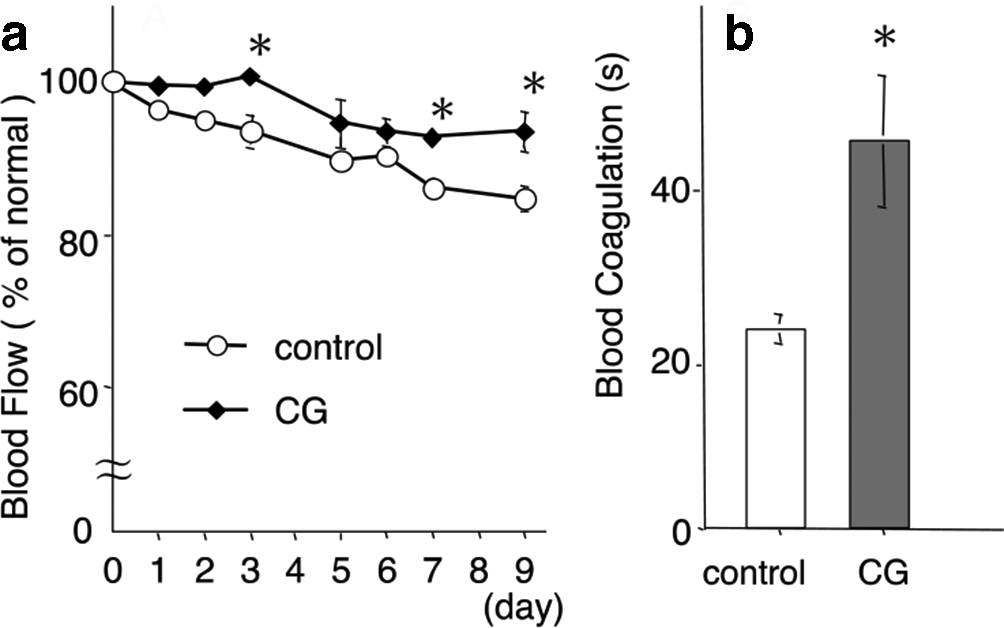
Effect of the MeOH extract (CG) of ryoushouka. (a) Effect on hen-egg white lysozyme induced blood flow decrease. Pretreatment with CG at 0, 3, 6, and 9 days after sensitization. Each value presents the mean ± standard error of 5 mice. *P < 0.05 compared with the control group (Dunnett’s test with Bonferroni). (b) Effect on blood coaggregation. Data present the mean ± standard error of 5 mice. *P < 0.05 compared with the control group (Student’s t-test).
Ethyl acetate (AcOEt) extract of CG significantly attenuated the HEL-induced decrease in BF (Figure 2(a)) and shortened the blood clotting time (Figure 2(b)). Contrarily, the n-butanol (n-BuOH) extract significantly extended the blood clotting time (Figure 2(b)), but it did not increase the BF (Figure 2(a)).


Effect of the fraction extract from CG. (a) Effect on hen-egg white lysozyme induced blood flow decrease. Pretreatment with the extract at 0, 3, 6, and 9 days after sensitization. Each value presents the mean ± standard error of 5 mice. *P < 0.05 compared with the control group (Dunnett’s test with Bonferroni post hoc test). (b) Effect on blood coaggregation. Data present the mean ± standard error of 5 mice. *P < 0.05 compared with the control group (Dunnett’s test).
By bioassay-directed fractionation of CG, compounds
Among these compounds, compound

Effect of compounds 2 to
Overall, CG improved peripheral circulatory disturbance and increased the blood clotting reaction. Thus, it might be a potential novel drug for stagnant blood. Our findings verify the stagnant blood improvement effect of dried flowers of C. grandiflora using an in vivo assay method in HEL-induced stagnant blood model mice.
Experimental
General Experimental Procedure
The melting point was determined using a Yanagimoto micro melting point apparatus. The IR spectra were recorded on a Shimadzu IR-435 spectrometer and UV absorption spectra on a Shimadzu UV-160A spectrometer. 1H-NMR (500MHz) and 13C-NMR (125MHz) spectra were recorded on a JEOL JNM-ECP 500 spectrometer (TMS as the internal reference). MS was performed on a JMS-700 double-focusing spectrometer with xenon atom of kinetic energy equivalent to 6 kV at ion-accelerating voltage.
Plant Material
The dried petals of C. grandiflora flower were purchased from Matsuura Yakugyo Co., Ltd. (Nagoya, Japan). A voucher specimen is maintained in our laboratory.
Materials
Hen egg-white lysozyme and complete Freund’s adjuvant (CFA) were purchased from Sigma Co., Ltd. (St Louis, MO, United States) and DIFCO (Michigan, United States), respectively.
Animals
Male ddY mice (SPF grade), 5 weeks old, were obtained from Japan SLC, Inc. (Shizuoka, Japan) and housed at 24°C ± 2°C. Food and water were provided ad libitum. All experiments were performed in accordance with the Guidelines for Animal Experiments of Mukogawa Women’s University.
Hen Egg-White lysozyme Sensitization
Immunization with HEL was performed as previously described 7 with slight modifications. Male ddY mice (5 weeks old) were sensitized subcutaneously with 50 µg of HEL in 50% CFA on day 0.
Blood Flow Measurement
Subcutaneous BF in the mouse tail was monitored using a contact type Laser Doppler Blood Flow Meter (FLO-C1; Neuroscience, Tokyo, Japan) as previously reported. 7 Each mouse was prewarmed for 10 minutes at 36°C before the experiment and was placed on a holder in a measuring chamber maintained at 36°C throughout the experiment. The BF was measured for 10 minutes without anesthetizing the mice. The results were expressed as mean ± standard error (S.E.) of the percent of normal BF in each mouse, measured 1 day before the experiment.
Blood Clotting Time
The whole blood from sensitized mice was sampled within 15 seconds after anesthetizing them with ether on day 9. The natural whole blood clotting time was measured immediately using an Automatic Blood Analyzer (Amelung KC 4A micro, Lemgo, Germany).
Improvement Effect on Stagnant BF
CG, each fraction (100 mg/kg), and each compound (10 mg/kg) were resuspended in water and administered orally to the mice on days 0 (1 hour before sensitization), 3, 6, and 9. The statistical significance was determined in comparison with the HEL-sensitized mice (control group).
Statistical Analysis
All data are expressed as mean ± S.E. All the statistical analyses were conducted using the software GraphPad Prism 7. The results with a P-value of <0.05 were considered statistically significant. In the case of BF, a two-way analysis of variance was used to test statistical differences. When significant differences were identified, the data were further analyzed by Dunnett’s multiple range test coupled with a Bonferroni post hoc test for significant differences between each test group and the control group. In the case of clotting time, the data were analyzed by Student’s t-test or Dunnett’s multiple range test.
Extraction and Isolation
Two kilograms of dried flowers of C. grandiflora were extracted with MeOH at room temperature, and then filtered and evaporated in vacuo to obtain the MeOH extract (CG; yield, 514 g). Further, 285 g of CG was suspended in water and then extracted with AcOEt and n-BuOH to obtain the AcOEt extract (14 g), n-BuOH extract (32 g), and H2O extract (215 g). The AcOEt extract was subjected to chromatography on a silica gel column using a CHCl3-MeOH gradient step to obtain 9 fractions (Fr. A I-IX). Fr. A IV (1.79 g), which was eluted with CHCl3-MeOH (15:1), was subjected to repeated flash chromatography on a silica gel column with a CHCl3-MeOH gradient step and purified by gel filtration on Sephadex LH-20 using MeOH, to yield compound 1 (1.1 mg). Fr. A IX (836 mg), which was eluted with CHCl3-MeOH (2:1), was subjected to repeated column chromatography on Sephadex LH-20 using MeOH or ODS column with a H2O-MeOH gradient step to yield compound
Footnotes
Authors’ note
This article is dedicated to the late Professor Hideaki Matsuda for his outstanding contributions to phytopharmaceuticals and raw materials for functional foods.
Declaration of Conflicting Interests
The author(s) declared no potential conflicts of interest with respect to the research, authorship, and/or publication of this article.
Funding
The author(s) disclosed receipt of the following financial support for the research, authorship, and/or publication of this article: The study was partially supported by a Grant-in-Aid for Scientific Research C from the Ministry of Education, Culture, Sports, Science and Technology of Japan.