



Abstract
A complete determination of the carotenoid composition of the edible aril and mesocarp of Cionosicyos macranthus fruit is reported for the first time. The carotenoids present in the fruit were identified and quantified using high-purity carotenoid standards. The fruit contained several rare carotenoids like zeaxanthin, β-cryptoxanthin, and cryptocapsin epoxides. Various keto-κ end-ring carotenoids, derivatives of their corresponding epoxides, ie cryptocapsin, capsanthin, capsanthin 5,6-epoxide, and capsoneoxanthin, were also identified. The total carotenoid contents for the aril and mesocarp were 226.0 μg/g and 83.4 µg/g, respectively. β-Cryptoxanthin was the most abundant carotenoid in both edible parts (58.3 μg/g in the aril and 29.5 μg/g in the mesocarp). Cryptocapsin was the primary keto-κ end-ring carotenoid both in the aril (41.6 μg/g) and in the mesocarp (13.2 μg/g). The fruit provitamin A activity was also determined. Considering the high β-cryptoxanthin and cryptocapsin contents, C. macranthus can be considered a good source of provitamin A carotenoids.
Cionosicyos macranthus (Pittier) C. Jeffrey (Cucurbitacae) tree is a native plant from the tropical areas of Central America, Panama, and Mexico. Figure 1 shows a picture of the C. macranthus fruits, in which the mesocarp and the seeds surrounded by their aril are clearly visible. The aril has an intense red color, sweet flavor, and a creamy texture, while the mesocarp is orange, slightly sweet, and has a fibrous texture. Preliminary studies have indicated that the red-orange color of the edible portions is due to the high carotenoid content of the fruit. 1 Carotenoids well-known bioactivity is the provitamin A activity, which is characteristic of carotenoids containing a β-ionone ring in their structure. 2 However, an ample evidence has been accumulated in recent years linking carotenoids to the prevention of chronic and degenerative diseases such as cancer, atherosclerosis, cataracts, and macular degeneration. 3 -5 On the other hand, there is abundant information in the literature that attributes specific bioactivities to specific carotenoids. For example, lutein and zeaxanthin have been shown to be involved in the prevention of macular degeneration 6 ; and lycopene has been shown to prevent prostate cancer. 7 Therefore, it is important to expand both the qualitative and quantitative information available on the carotenoid profiles of foods, such as tropical fruits. The present work represents the first study in which an in-depth investigation of the carotenoids present in the edible portions (mesocarp and aril) of C. macranthus is performed, and the provitamin A activity of this fruit is determined.
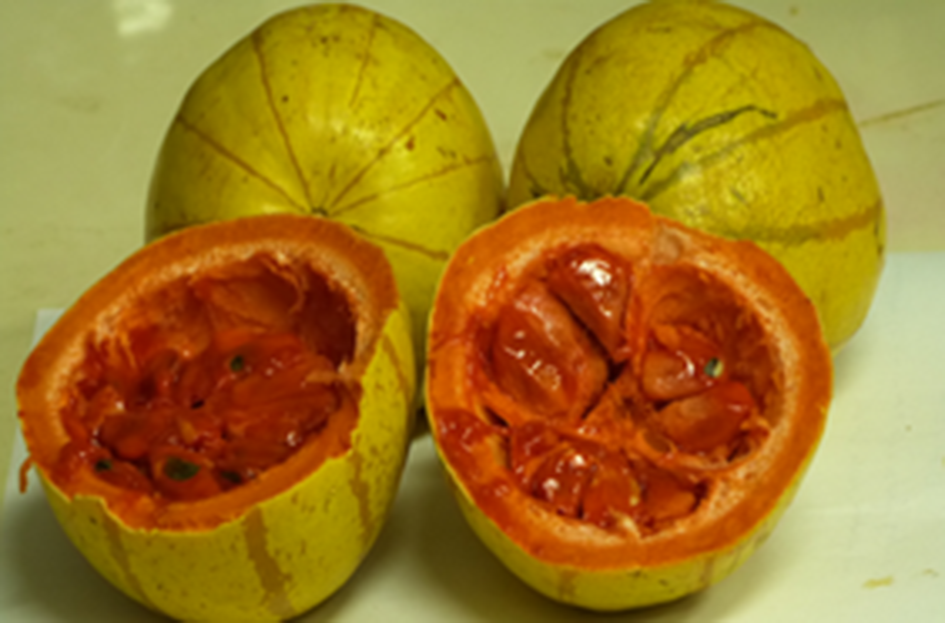
Cionosicyos macranthus fruits. The edible mesocarp and aril parts of the fruit are clearly visible.
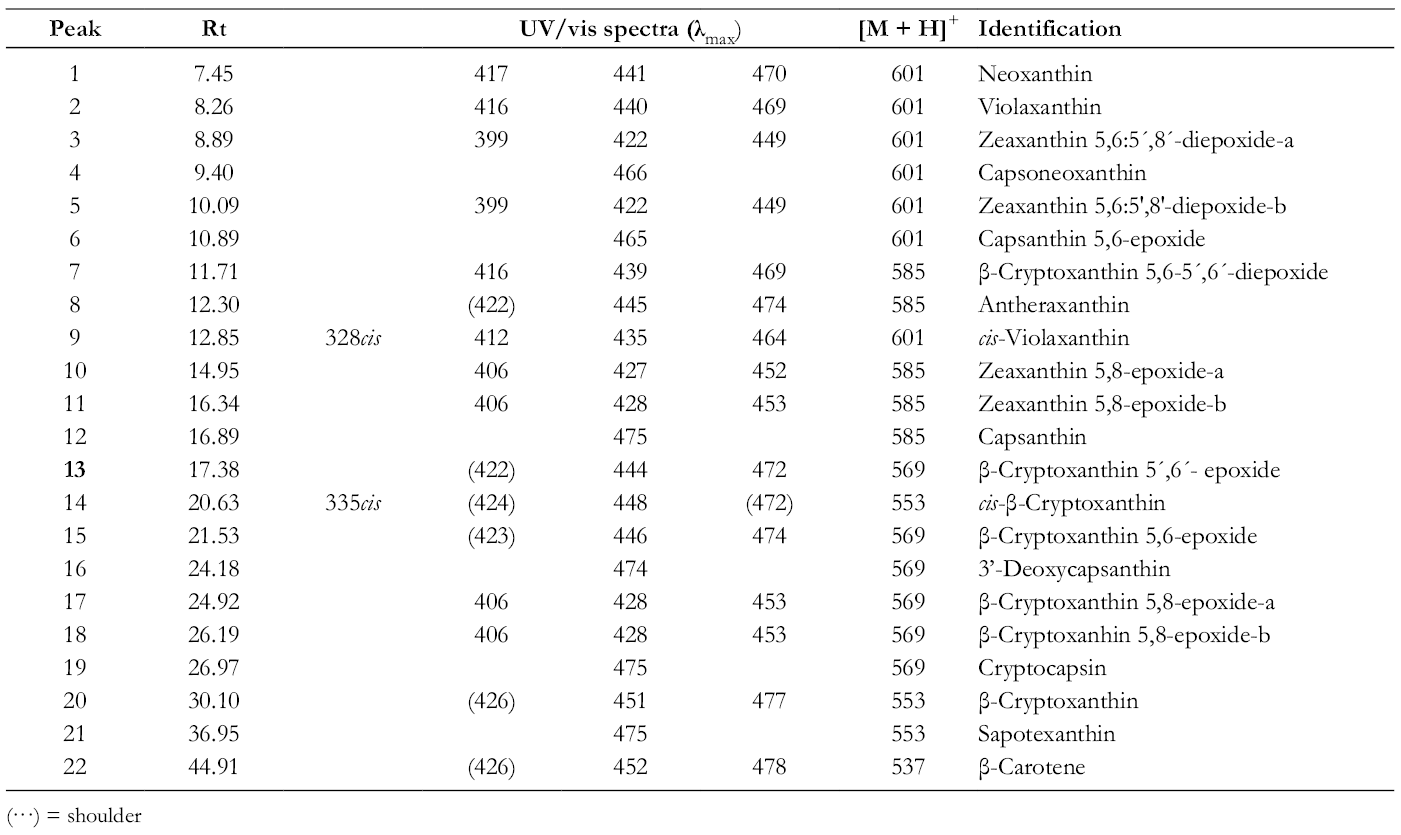
The carotenoids in C. macranthus were identified by their UV-vis spectra, high-performance liquid chromatography (HPLC) retention times (Rt values), m/z values ([M + H]+), by the use of available standards prepared in our laboratory, and by comparing the experimental results with those reported in the literature. 8 Table 1 shows the retention times, UV/Vis and atmospheric pressure chemical ionization (APCI) (+)/mass spectrometry (MS) data for the carotenoids identified in C. macranthus. Figure 2 shows the HPLC/diode array detector (DAD) chromatogram of the saponified carotenoids extracted from the aril edible part of C. macranthus, and the numbers correspond to the identified carotenoids as reported in Table 1. The mesocarp edible part showed the same profile, but the carotenoids were present in different ratios. It can be noted that most of the carotenoids are xanthophylls and a small amount are carotenes. The major carotenoids were those corresponding to peaks 2, 9, 12, 17, 19, and 20. Peak numbers 1, 2, and 8 were identified as neoxanthin, violaxanthin, and antheraxanthin, respectively. Peak numbers 3 and 5 correspond to zeaxanthin-5,6:5′,8′-diepoxide-a and zeaxanthin-5,6:5′,8′-diepoxide-b (diastereoisomers); the UV/vis spectra of these carotenoids were perfectly superimposable and their λmax values were shifted by 18 nm (440-422) related to that of the corresponding 5,6–5′,6′-diepoxide (violaxanthin). These compounds are generated via a furanoid rearrangement of one of the 5,6-epoxy groups, and they showed the same [M + H]+ pseudomolecular ion at m/z 601. Peak 9 was identified as cis-violaxanthin by its pseudomolecular ion at m/z 601, UV/vis spectra and the position of the “cis peak” at 328 nm. Peaks 10 and 11 were identified as zeaxanthin-5,8-epoxide-a and zeaxanthin-5,8-epoxide-b (diastereoisomers); their UV/vis spectra were perfectly superimposable, and their λmax values were shifted by approximately 18 nm (445-427) relative to that of the corresponding 5,6-epoxide (antheraxanthin). Peak 7 was identified as cryptoxanthin 5,6:5′,6′-diepoxide. Peaks 13 and 15 were identified as β-cryptoxanthin-5′,6′-epoxide-a and β-cryptoxanthin-5,6-epoxide-b, respectively. These carotenoids were also identified by comparison with the corresponding standards obtained by the partial synthesis from β-cryptoxanthin. As shown in Figure 3, the difference between these compounds is the position of the 5,6-epoxy group. Peak 14 was identified as cis-β-cryptoxanthin based on its HPLC chromatogram (running along with monohydroxy species), molar mass and UV/vis spectrum, which exhibits a maximum at 335 nm corresponding to the “cis peak” of β-cryptoxanthin. Peaks 17 and 18 were identified as β-cryptoxanthin-5,8-epoxide-a and β-cryptoxanthin-5,8-epoxide-b (diastereoisomers); they showed the same molar mass, and their UV/vis spectra were perfectly superimposable. Their λmax values were shifted by approximately 17 nm (445-428) relative to that of the corresponding β-cryptoxanthin-5,6-epoxides. Peak 20 was identified as β-cryptoxanthin based on its elution order, molar mass, and UV/vis spectrum and by comparison with a β-cryptoxanthin standard. The UV/vis spectra of keto-κ end-ring carotenoids are characterized by having a single absorption maximum (they do not possess a spectral fine structure) due to conjugation with the carbonyl group of the polyene chain. Peaks 4, 6, 12, 19, and 21 were identified as capsoneoxanthin, capsanthin-5,6-epoxide, capsanthin, cryptocapsin, and sapotexanthin, respectively, by their Rt values, mass spectra and UV/vis spectra and by comparison with the corresponding standards. Cryptocapsin (peak 19) and 3′-deoxycapsanthin (peak 16) showed the same UV/vis spectra and molar mass and eluted with the monohydroxy fraction by HPLC.
Chromatographic Retention Time, UV/Vis and APCI (+)/MS Spectroscopic Data for the Identified Carotenoids in C. macranthus.
(···) = shoulder

HPLC/DAD chromatogram of the saponified carotenoid extracted from the aril of Cionosicyos macranthus recorded at 450 nm.

Chemical structures of β-cryptoxanthin-5,6-epoxide and β-cryptoxanthin-5′,6′-epoxide.
The structural difference between these 2 carotenoids is the position of the hydroxy group, as shown in Figure 4. Keto-κ end-ring carotenoids are biosynthesized by the pinacol rearrangement of precursors containing the 5,6-epoxy group in a reaction catalyzed by the enzyme capsanthin-capsorubin synthase. 9 The biosynthetic precursor of cryptocapsin is β-cryptoxanthin-5,6-epoxide, whereas, on the other hand, the precursor of 3′-deoxycapsanthin is β-cryptoxanthin-5′,6′-epoxide, which has been identified in C. macranthus in this work. Furthermore, in this study, we also identified the precursors of capsanthin, neocapsanthin, and capsanthin 5,6-epoxide, which are antheraxanthin, neoxanthin, and violaxanthin, respectively. Recently, it has been reported that the red mamey (Pouteria sapota), another fruit native to Mexico and Central America, has a high content of keto-κ end-ring carotenoids some of which are novel. 10,11 Interestingly, when comparing the carotenoids of C. macranthus and P. sapota, we found that they have the same carotenoids but in different proportions. Cionosicyos macranthus contains significant amounts of both 5,6-monoepoxides of β-cryptoxanthin and their respective 5,8-monoepoxides, which can be considered unusual, but this elucidates the origin of cryptocapsin and 3′-deoxycapsanthin in this fruit. Capsicum annuum red varieties are well known for their high contents of keto-κ carotenoids, with capsanthin, capsorubin, and capsanthin 5,6-epoxide as the main carotenoids. 12 Maoka t al 13 reported trace amounts of 3′-deoxycapsanthin in a variety of Capsicum annuum. Finally, peak 22 was identified as β-carotene by comparison of its Rt, molar mass, and UV/vis spectra with those of the corresponding standard. Table 2 shows that the aril and mesocarp of C. macranthus have the same carotenoid profile, but the identified compounds are present in different quantities (µg/g) and proportions (%). The intense red color of the aril can be explained by its high carotenoid content (225.3 µg/g) and, in particular, by the high amounts of the “red carotenoids” capsanthin, 3′-deoxycap-santhin, and cryptocapsin. Table 2 also shows that β-cryptoxanthin and cryptocapsin were the major carotenoids in both the mesocarp and aril. β-Cryptoxanthin is usually present in various fruits and vegetables, but it is notable that cryptocapsin had so far only been reported in high amounts in red mamey (P. sapota). 1

Chemical structures of cryptocapsin and 3′-deoxycapsanthin.
Carotenoid Content in the Mesocarp and Aril of C. macranthus Fruit.

NQ = not quantifiable
Only 6 of the 22 carotenoids identified in this study, ie neoxanthin, β-cryptoxanthin-5,6-epoxide, β-cryptoxanthin-5,8-epoxide, β-cryptoxanthin-5,6:5´,6´-diepoxide, cryptocapsin, and β-cryptoxanthin, were reported previously in C. macranthus fruit, most of the compounds in their esterified forms. 14 Moreover, zeaxanthin, which was reported to be present in the fruit, 15 was found as its epoxides.
Carotenoids with a terminal β-ring are known to have provitamin A activity. 2 In this sense, the provitamin A activity of β-cryptoxanthin is well established. 2 Cryptocapsin, which contain a terminal β-ring (Figure 4), possesses provitamin A activity; therefore, the values of provitamin A activity shown in Table 2 were calculated considering the contents of cryptocapsin, β-cryptoxanthin, and β-carotene. The high content of β-cryptoxanthin in the mesocarp (29.5 µg/g) and in the aril (58.3 µg/g) allowed us to classify C. macranthus as a source with a “very high content” of this carotenoid according to the classifications suggested by Britton, 16 which considers a concentration greater than 20 µg/g as a “very high content.” Although β-cryptoxanthin has traditionally been considered important for its provitamin A activity, it has recently attracted interest for it potential in preventing osteoporosis. 17
Sixteen carotenoids unreported for C. macranthus fruit were identified in this study. The qualitative and quantitative profiles of carotenoids in the edible portions of C. macranthus, the aril and mesocarp, were characterized for the first time. The carotenoid profile of C. macranthus was found to include a variety of epoxides and keto-κ end-ring carotenoids, which are indeed epoxide derivatives. The red color of the aril and the orange color of the mesocarp were due to the presence of keto-κ end-ring carotenoids and β-ring carotenoids in different proportions. Moreover, the fruit contained several zeaxanthin, β-cryptoxanthin, and cryptocapsin epoxides, some of which are considered rare carotenoids. Because of the high total carotenoid contents in the edible parts (aril 225.3 µg/g and mesocarp 83.4 µg/g), C. macranthus can be considered an excellent source of carotenoids. β-Cryptoxanthin was the main carotenoid identified both in the aril and the mesocarp of this fruit (58.3 µg/g and 29.5 µg/g, respectively). Cryptocapsin was the main keto-κ end-ring carotenoid (41.6 µg/g in the aril and 13.2 µg/g in the mesocarp). This fruit can be classified as “high” in β-cryptoxanthin and cryptocapsin and is therefore as a good source of provitamin A carotenoids.
Experimental
Samples
Fresh, ripe C. macranthus were collected from trees in El Valle, Cocle Province, Panama, and identified by a taxonomist of the University of Panama. The aril surrounding the seeds represents approximately 15% of the edible portion of the fruit, while the mesocarp represents approximately 85%. The aril and the mesocarp of the fruits were separated and analyzed for their carotenoid contents.
Carotenoid Extraction and Saponification
The extraction and saponification of the carotenoids present in the fruit were performed following the procedure described by Britton 18 with slight modifications. One hundred grams of each sample were mixed with sodium bicarbonate (10%) in a porcelain mortar and extracted repeatedly with acetone until sample discoloration was achieved. Then, the extract was partitioned into ether:n-hexane (1:1), washed with water, dried under vacuum, and dissolved in diethyl ether. Saponification with methanolic KOH (5%) was conducted over 2 hours at room temperature in the dark.
Carotenoid Standards
Most of the carotenoids found in C. macranthus fruit are uncommon and hence commercially unavailable. The carotenoids present in the fruit were identified and quantified using high-purity all-trans carotenoid standards (>95%) obtained from known sources of these carotenoids. Various carotenoids were isolated from red P. sapota fruit following the procedures described by Amaya et al. 19 Cryptocapsin, β-cryptoxanthin 5,6-epoxide, β-cryptoxanthin 5´,6´-epoxide, 3’-deoxycapsanthin, neoxanthin, capsoneoxanthin, β-cryptoxanthin 5,8-epoxide, and β-cryptoxanthin 5,6,5´,6´-diepoxide were characterized by nuclear magnetic resonance spectroscopy, MS, and UV/vis spectroscopy as described in the literature. 10,11,20-22 Violaxanthin was isolated from Mangifera indica fruit; β-cryptoxanthin from Carica papaya fruit; capsanthin and capsanthin 5,6-epoxide from C. annuum fruit; and β-carotene from carrot (Daucus carota). The identities of these carotenoids were confirmed by HPLC-DAD-MS by comparison with their reported UV/vis spectra. 8 Antheraxanthin was obtained from CaroteNature GmbH (Lupsingen, Switzerland).
HPLC/DAD and HPLC (APCI)/MS Analyses
HPLC/DAD analyses were performed using a Hewlett Packard model 1050 instrument equipped with a DAD and operated using HP ChemStation 2003 software. The spectra were acquired between 200 and 600 nm. The molecular weights of the separated components were obtained by HPLC (APCI)/MS using an Agilent 1100 HPLC coupled to an LCmate JEOL mass spectrometer. Positive ion mode with TIC was used in conjunction with the following parameters: scanning range, m /z 300-700; corona voltage, 4 kV; acquisition voltage, 20 V; flow rate of dry nitrogen (nebulizer gas), 600 L/h; and vaporizer temperature, 300°C. A YMC C30 column (250 × 4.6 mm i.d. and 3 µm in particle size) was used for all HPLC separations. The solvent system was the one recommended by Sander et al. 23 A mixture of 81% methanol, 15% MTBE, and 4% water (Solvent A) and a mixture of 6% methanol, 90% MTBE, and 4% water (Solvent B) were used in a linear gradient starting with 100% of Solvent A and shifting to 50% of Solvent B over 45 minutes, followed by a 13 minutes postrun. Throughout the run, the flow was maintained at 1.0 mL/min, and the eluate was monitored at 450 nm.
Quantitative Analysis
For the quantitative analyses of the carotenoids in the fruit (mesocarp and aril), the external standard calibration method was used. Dose-response curves for each standard were prepared according to the recommended procedures. 19 To evaluate the cis-violaxanthin and cis-β-cryptoxanthin contents, the dose-response curves of the respective all-trans compounds were used. The dose-response curve of all-trans-β-carotene was used for the evaluation of all carotenoids for which a standard was not available. The provitamin A activity (retinol equivalents) was calculated using the following formula:
Footnotes
Acknowledgments
Enrique Murillo and Armando Durant-Archibold gratefully acknowledge the National Secretariat for Science, Technology, and Innovation of Panama (SENACYT) for the financial support through its National System of Research Awards (SNI). The authors also sincerely appreciate Prof Mahabir P. Gupta for revision of the manuscript.
Declaration of Conflicting Interests
The author(s) declared no potential conflicts of interest with respect to the research, authorship, and/or publication of this article.
Funding
The author(s) received no financial supportfor the research, authorship, and/or publication of this article.