



Abstract
A triterpene glycoside identified as holothurin A2 (= echinoside A) was isolated from the extract of the tropical starfish Choriaster granulatus and identified by extensive nuclear magnetic resonance (NMR) spectroscopy and electrospray ionization (ESI) mass spectrometry techniques. The fact of obtaining this typical for tropical sea cucumbers metabolite in starfish may be explained by feeding of C. granulatus on sea cucumbers of the family Holothuriidae that allows to use triterpene glycosides as food source markers in predators of sea cucumbers.
Keywords
Starfish (phylum Echinodermata, class Asteroidea) are a rich source of polar steroids, structurally subdivided into polyhydroxylated steroids and steroidal glycosides, such as mono-, bi-, and triosides of polyhydroxylated steroids, steroidal oligoglycosides (asterosaponins), cyclic glycosides, and some other rare group of steroidal glycosides. 1,2 All of these compounds have oxygenated steroidal nucleus and differ from each other in the number of hydroxyl groups, the presence or absence of sulfate groups and monosaccharide residues, etc. Recently, Chinese scientists report about isolation of 2 new triterpene glycosides, rollentosides A and B, from the starfish Asterias rollestoni Bell (in the title of the article, the name of starfish was erroneous Asterias rollentoni) collected in the Yellow Sea near the shore of Jiangsu Province. 3 The structures of isolated triterpene glycosides were very similar to those of glycosides of sea cucumbers Eupentacta spp., but not to steroidal glycosides of starfishes. Moreover, rollentoside B from the starfish is structurally identical to cucumarioside A15 from the sea cucumber Eupentacta fraudatrix. 4 The fact of obtaining triterpene glycosides, characteristic of sea cucumbers, from starfish was doubtful, but the authors did not explain it. We have suggested that the presence of triterpene glycosides in A. rollestoni 3 may be explained by the feeding of the starfish on sea cucumbers of the genus Eupentacta. 2 The model experiment for finding sea cucumber triterpene glycosides in the starfish Patiria pectinifera fed by E. fraudatrix was conducted in our laboratory. As a result, the liquid chromatography -electrospray ionization mass spectrometry identification of a series of triterpene glycosides of E. fraudatrix in P. pectinifera confirmed our suggestion. 5
In a continuation of our studies of low molecular weight metabolites of the tropical starfish Choriaster granulatus Lütken, 1869 collected at Van Phong Bay in the South China Sea, we have isolated minor triterpene glycoside holothurin A2 (= echinoside A) and identified its structure. Earlier, 3 biosides of polyhydroxysteroids, 5-deoxyisonodososide and granulatosides A and B, were described from C. granulatus by Italian research group 6 and 3 new steroidal glycosides, granulatosides C-E, and 13 previously known glycosides of polyhydroxysteroids, and 1 steroidal heptaol were obtained from this starfish by our group. 7,8 All these compounds have steroidal nucleus, most of them are typical starfish glycosides of polyhydroxysteroids.
The water-soluble fraction from the EtOH extract of C. granulatus was sequentially subjected to chromatographic separation on columns with Polychrom 1, Si gel, and Florisil followed by High Performance Liquid Chromatography (HPLC) on semipreparative Diasfer-110-C18 and Discovery C18 columns to yield a glycoside (
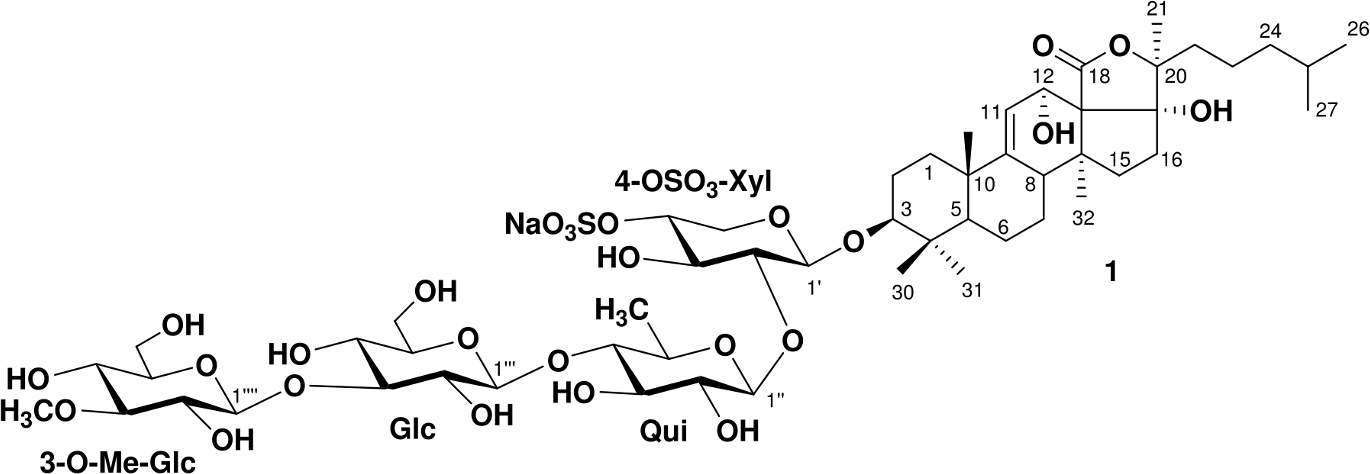
Structure of holothurin A2 (1) identified in the starfish Choriaster granulatus.
The compound
Experimental
General
Optical rotation was determined on a Perkin-Elmer 141 polarimeter. The 1H and 13C NMR spectra were recorded on a Bruker Avance III 700 spectrometer at 700.13/176.04 MHz with tetramethylsilane as an internal standard. The high resolution electrospray ionization mass spectra were recorded on an Agilent 6510 Q-TOF LC/MS. HPLC separations were carried out on an Agilent 1100 Series chromatograph equipped with a differential refractometer; Diasfer-110-C18 (10 µm, 250 × 15 mm) and Discovery C18 (5 µm, 250 × 10 mm) columns were used.
Animal Material
Specimens of C. granulatus (order Valvatida, family Oreasteridae) were collected in May 2007 at a depth of 5 to 10 m at Van Phong Bay in the South China Sea near Vietnam coast (the research vessel Akademik Oparin, 34th scientific cruise). Species identification was carried out by Dr V.B. Krasohin (PIBOC FEB RAS). A voucher specimen (no. 034-128) is on deposit at the marine specimen collection of the G.B. Elyakov Pacific Institute of Bioorganic Chemistry, Vladivostok, Russia.
Extraction and Isolation
The fresh animals of C. granulatus (10 kg) were chopped and extracted twice with EtOH. The EtOH extract was evaporated, the residue was dissolved in H2O (2 L), and was passed through a Polychrom 1 column (8 × 60 cm), eluted with distilled H2O until a negative chloride ion reaction was obtained, and then eluted with EtOH. The EtOH eluate was evaporated, dissolved in 70% EtOH (0.5 L), treated 3 times with n-hexane, and the water-ethanol layer was evaporated to give a brownish residue (35.9 g). The resulting total fraction was chromatographed on a Si gel column (6 × 20 cm) using CHCl3-EtOH (stepwise gradient, 6:1 → 1:5, v/v), and then the obtained fractions were purified on a Florisil column (4 × 4.5 cm) using CHCl3-EtOH (stepwise gradient, 4:1 → 1:3, v/v). HPLC separation of subfractions was carried out on a Diasfer-110-C18 (2.5 mL/min) and on a Discovery C18 (1.5 mL/min) column with EtOH-H2O (70:30, v/v) and EtOH-H2O (60:40, v/v), respectively, as the eluent systems to yield pure
Holothurin A2 (= Echinoside A) (1)
Colorless powder; MP: 240°C-242°C.
R f: 0.2 toluene/EtOH (9:5, v/v).
[α]D: −3.8 (с 0.3, MeOH).
1H and 13C NMR (700.13 and 176.04 MHz, С5D5N): Identical with those reported for echinoside A. 12
(+)-HR ESI-MS: m/z [M+Na]+ calcd for C54H87O26SNa2: 1229.4996; found: 1229.5002.
(−)-HR ESI-MS: m/z [M−Na]– calcd for C54H87O26S: 1183.5212; found: 1183.5217.
Footnotes
Declaration of Conflicting Interests
The author(s) declared no potential conflicts of interest with respect to the research, authorship, and/or publication of this article.
Funding
The author(s) disclosed receipt of the following financial support for the research, authorship, and/or publication of this article: The study was supported by the Grant no. 17-04-00034 from the Russian Foundation for Basic Research.