



Abstract
Some species of Artemisia have traditionally been used as anthelmintics. The presence of toxic components in the extracts of these plants, such as α- and β-thujones, and their poor aqueous solubility constitutes important limitations for their clinical applications. Recently, some thujones-free populations of A. absinthium have been cultivated in Zaragoza (Spain). The main aim of the present study was to design novel microemulsion (ME) formulations of thujones-free A. absinthium steam distilled extract (AAE) to improve its solubility and, subsequently, to enhance its oral bioavailability and nematocidal activity. A D-optimal mixture design was developed to optimize the ME system, based on droplet size distribution. The optimized formulation was analyzed for its conductivity and behavior in a gastric media and its nematocidal efficacy was evaluated in an ex vivo murine model for Trichinella spiralis larvae L1. The optimized ME was composed of Tween 80: propylene glycol (1.5:1) (66.45% w/w), AAE (29.35% w/w), and distilled water (4.25% w/w). It was seen that although the optimized ME has a W/O structure, it is capable of dispersing in the gastric environment in less than 15 minutes, forming 10 nm-sized droplets. A dilution of this ME, containing 0.05% w/w AAE, was prepared and its efficacy was compared with a 0.05% w/w AAE solution. The optimized ME decreased the intestinal parasites by up to 95.7%, while the solution of the extract showed a reduction of 86.5% (P = 0.0033). The results evidenced that the designed ME system provides a significant improvement of AAE in terms of aqueous solubility and nematocidal effect. It can also act as a promising formulation to improve the oral bioavailability of this hydrophobic extract, in order to design a future alternative to the classical treatments with benzimidazole drugs.
In the last decades, intestinal nematode infections have been treated with benzimidazole drugs, especially albendazole. However, recent research reports evince an increase of the resistance to the commonly used anthelmintic drugs, leading to lower levels of efficacy. 1 Consequently, alternative treatments based on natural products are being developed to control these infections. 2,3
Some species of Artemisia have traditionally been used as anthelmintics. 4,5 However, the presence of toxic components in the extracts of these plants, such as α- and β-thujones, implies important limitations for their clinical applications. 6,7 In recent years, some thujones-free populations of A. absinthium have been developed by the Research Institute of Agricultural Sciences (ICA) in Zaragoza (Spain). Artemisia absinthium steam distillation extracts (AAEs) were characterized using gas chromatography-mass spectrophotometry analysis. The extracts were mainly composed of (Z)-epoxyocymene (38.8%), chrysanthenol (22.5%), (E)-caryophyllene (5.4%), and linalool (3.5%). 11 AAEs have also shown promising nematocidal activity against Trichinella spiralis. 12 Nevertheless, the oily characteristics of these extracts require the development of galenic formulations to improve their solubility and oral bioavailability. 13
Microemulsions (MEs) are colloidal dispersions, with a homogeneous appearance, used in the formulation of oily products. MEs are constituted by an aqueous phase, an oily phase, and a mixture of emulsifiers. A co-emulsifier is usually added in order to improve the ME stability. 14,15 Since the ME systems are composed of specific amounts of those components—water, oil, and surfactant—, it is useful to represent them in ternary diagrams; in case a co-surfactant is included in the mixture, pseudoternary diagrams are used (Figure 1a). MEs may form 3 different microstructures: oil-in-water (O/W), water-in-oil (W/O), and bicontinuous, depending on the molecular arrangement. In O/W and W/O structures MEs have a small droplet size—between 20 and 200 nm—; however, droplets may not be clearly found in bicontinuous structures. 14,16 All these structures can be characterized by their conductivity. 17,18

(
D-optimal mixture designs are commonly used in the formulation of MEs. These methodologies estimate the effect of the components on the formulation properties, such as droplet size. 19,20 D-optimal mixture designs allow optimization of the composition of an ME formulation in order to enhance the oral bioavailability of the AAE. The main aim of the present study was to design a novel ME formulation of a thujones-free AAE to improve its solubility and subsequently, to enhance its oral bioavailability and nematocidal activity.
In previous studies, it was shown that a surfactant mixture (SM) composed of Tween® 80: propylene glycol (1.5:1) was able to dissolve a high amount of AAE and water, so this combination of surfactants was selected for further research. The components of the mixture design were the SM, set to a range of 48% to 82% w/w, and distilled water (W), and AAE, which were set to within ranges of 4% to 80% w/w each (Figure 1a). According to these ranges, the software Design-Expert® assessed randomly 16 experiments or combinations of the 3 components (W, AAE, and SM) adding up to 100% w/w, to fit a quadratic model (Table 1).
Composition and Results of Experiments in the D-Optimal Mixture Design.

Each experiment was prepared by stirring the components until the mixture had a homogeneous appearance, and then analyzed for droplet size (D32) and conductivity. The software was used to develop and evaluate the experimental designs, and to assess further the equation of the model and its quality parameters. The optimization of the final formulation was based on droplet size.
Conductivity
The conductivity results of the 16 ME formulations ranged from 10.68 to 69.82 mS/cm (Table 1). Linear, quadratic, special cubic, and cubic models were fitted to the responses. The quadratic model was found to be the most suitable mathematical model, as it has the lowest PRESS, and a reasonable agreement between predicted R2 (0.9532) and adjusted R2 (0.9831) (Table 2). The F-value is 163.74 and P-value is <0.0001, which implies that the model is significant. The adequate precision is 37.54, and, as it is greater than 4, it indicates an adequate signal. These results support the validation of the model to be used for point-prediction or optimization.
Summary of the Statistical Analysis of the Conductivity and the D32 Responses.

PRESS: predicted residual error sum of squares.
The model equation was assessed and the coefficients are shown in Table 3. The magnitude of coefficients indicates the positive or negative contribution of the components to the system conductivity. 23 The resulting equation evidenced that the presence of W has a high influence on conductivity, because of the nonionic nature of the other components. SM and AAE do not improve the ionic movement in the system; therefore, they have a low or even negative influence on conductivity. As can be seen in Figure 1b, conductivity increased with increasing water-content.
Coefficients in Conductivity and Lg(D32) Models.

Droplet Size
The mean droplet size, expressed as Sauter mean diameter (D 32), was calculated using the following equation D 32=Σn i d i 3/Σn i d i 2, where n i is the number of droplets of diameter d i . 24 D 32 values of the ME formulations were between 0.87 to 105.90 nm (Table 1). Linear, quadratic, special cubic, and cubic models were fitted to the D 32 responses. Most of the formulations had a low D 32 value; however, with certain amounts of water, a steep increase in droplet size was observed (Figure 1c). A Box Cox analysis showed that the response variable should be transformed to a logarithmic base, in order to get a better fit. 23,25 The quadratic model was selected after transformation (Table 2). The F-value is 63.13 and P-value is <0.0001, which implies that the model is significant, and the adequate precision is 21.73; as a consequence, the model can be used to optimize the ME formulation.
Droplet size was highly influenced by the proportions of AAE and specially water content. It could be explained because of the high surfactant content in the experiments; surfactant molecules are organized in layers surrounding the droplets. Hence, when the content of the other components (W and AAE) increases, the droplets may break down, being surrounded by a thin layer of surfactant molecules. 26
According to the droplet size responses, the components of the ME were optimized using the desirability function. 27,28 SM and AAE content were set to be maximized and the content of W was minimized. The optimized solution with a desirability value of 0.7670, was 66.40% w/w of the SM, 29.35% w/w of AAE and 4.25% w/w of W, which was similar to the composition of experiments 2 and 3, already included in the design. The predicted response value was 1.1836 nm (95% CI 0.71-1.99), comparable with the D32 values measured in experiments 2 and 3, 0.87 nm and 1.04 nm, respectively.
In Vitro Dissolution Test
The behavior of the optimized ME was analyzed in a gastric medium. The optimized ME (4.1 g) was dispersed in artificial gastric fluid (250 mL) prepared according to USP 32, simulating fasting conditions. 29 A rotating paddle apparatus was set at 100 rpm, samples (5 mL) were taken at predetermined times (15 and 30 minutes) and their droplet sizes were analyzed. The droplet size distribution of the samples was similar at 15 and 30 minutes and the average droplet size was 11.69 nm. D 32 values were 49.78 nm ±5.34 nm and 49.80 nm ±27.26 nm at 15 and 30 minutes, respectively.
Ex Vivo Nematocidal Efficacy Against T. spiralis
AAE was dissolved in up to 0.1% w/w dimethyl sulfoxide (DMSO):Tween® 80 (98:2). A dilution of the previously optimized ME formulation in Hank’s balanced salt solution (HBSS) was also prepared in order to obtain a similar concentration of oil (0.1% w/w). Dispersions of the solvents (placebo solution) and ME surfactants (placebo ME) in HBSS were also prepared.
One mL of each formulation was poured into each well of a 24-well plate and mixed with 1 mL of a dispersion of T. spiralis larvae L1 in HBSS containing 300 larvae/mL. Larvae were exposed for 24 hours to the formulations at 37°C in a 5% CO2 atmosphere. Afterwards, 0.3 mL of the resultant larvae dispersion was administered to Swiss-CD-1 mice using an oral gavage device and divided into 6 groups of 6 mice per group. Mice were housed in a light/dark and temperature-controlled environment with water and food ad libitum. The number of parasite adults in the intestine tissue per mouse was measured using a binocular loupe. 30
The results showed no difference between the results from control and placebo groups, and between placebo solution and placebo ME groups (P > 0.05). Hence, these results evidenced that the excipients used in these formulations do not affect the viability of T. spiralis L1 in the conditions of the study. However, the amount of adult viable parasites decreased dramatically in those formulations containing the extract (P < 0.05). The number of remaining adult parasites was 86.5% in the group treated with the solution of AAE, while this decrease was 95.7% in the group that received the ME formulation (Figure 2). As can be seen, the ME formulation had a higher nematocidal efficacy than the solution at the same concentration of AAE (P = 0.0033).
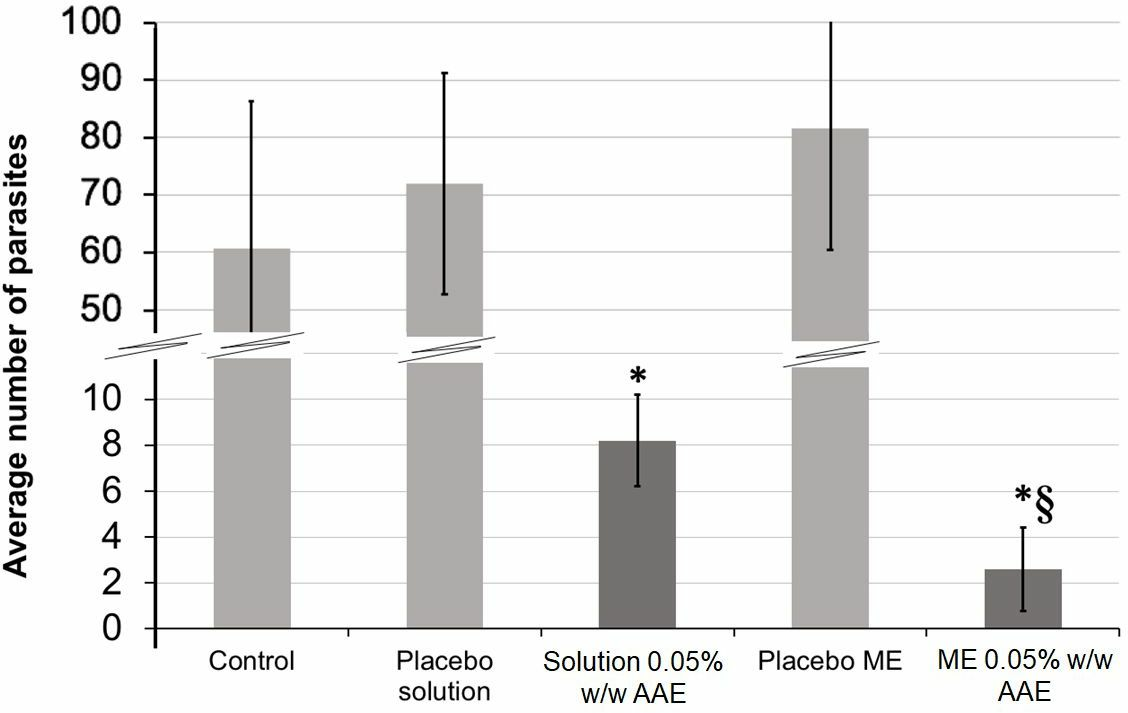
Average number of adult parasites per group ±95% confidence interval (n = 6). *P < 0.05 compared with control group; §P < 0.05 compared with solution group; **Dilution of the optimized ME up to 0.05% w/w of AAE.
The AAE solution showed a similar efficacy as that in previous studies. 12 However, the optimized ME is constituted of less-toxic surfactants (Tween® 80 and propylene glycol) than other solvents like DMSO. 31 In addition, a higher amount of AAE is able to dissolve because of those surfactants, as the optimized formulation includes 29.35% w/w of AAE.
This study shows a methodology to formulate a natural extract in a ME system. The optimized ME system is composed of 66.40% w/w of the SM, 29.35% w/w of AAE, and 4.25% w/w of W. It is a W/O system, with the lowest particle size and a low conductivity (around 10 mS/cm). However, its behavior in an aqueous medium showed that the ME is able to disperse in less than 15 minutes, forming 10 nm size droplets. The optimized ME is able to dissolve a higher amount of oil than the AAE solution, resulting in an improved efficacy of the extract against T. spiralis L1 larvae. These results constitute a promising strategy to formulate oily natural products using low-toxic surfactants with a high dissolution capacity. The formulations may constitute a future alternative to the classical treatments with benzimidazole drugs.
Experimental
Materials
The AAE was kindly provided by ICA (Madrid, Spain). Polysorbate 80 (Tween® 80), DMSO, and propylene glycol were purchased from Acofarma Distributions, S.A. (Madrid, Spain), and were of pharmaceutical quality. Hydrochloric acid 37% was obtained from Panreac Quimica S.A.U. (Barcelona, Spain). HBSS was prepared by dissolving 8 g/L NaCl, 0.04 g/L KCl, 0.2 g/L MgSO4 7 H2O, 0.06 g/L KH2(PO4)3, 0.5 g/L Na2H(PO4)3, 9 g/L glucose, 0.05 g/L penicillin G, and 0.05 g/L streptomycin in double-distilled water. The solution was vacuum-filtered (pore size 0.22 µm). All the components of HBSS medium and porcine pepsin (P-7000; specific activity of 800-2500 U/mg) were purchased from Sigma Aldrich Quimica, S.A. (Madrid, Spain).
Trichinella spiralis MFEL/ES/S2 GM-1-ISS48 isolate (Trichinellosis Reference Center, Istituto Superiore di Sanitá, Roma, Italy) was used for ex vivo assays. The parasites were maintained in the laboratory by periodical passage in outbred Swiss-CD-1 mice (Charles River, Barcelona, Spain). This study was carried out in accordance with the recommendations of Directive 2010/63/EU of the European Parliament and the Council of the European Union and transposed in Spain by Royal Decree 53/2013, on the care and use of laboratory animals (VISAVET-ES280790000154).
Methods
Droplet size and conductivity were analyzed using Zetasizer NanoZS equipment (Malvern Instruments, Malvern, UK). Dissolution tests were performed using a rotating paddle apparatus described in the European Pharmacopeia (Erweka DT80, Erweka-Gomensoro, Madrid, Spain). Design-Expert® version 7 (Stat-Ease Inc, Minneapolis, MN, USA) was used to develop the mixture design and to analyze the results.
Footnotes
Acknowledgments
The authors wish to thank Dr A González-Coloma (ICA) for providing the AAE and Prof Dr AI Olives (Department of Chemistry in Pharmaceutical Sciences, Faculty of Pharmacy, Complutense University of Madrid) for providing the equipment necessary to perform the conductivity measurements.
Declaration of Conflicting Interests
The author(s) declared no potential conflicts of interest with respect to the research, authorship, and/or publication of this article.
Funding
The author(s) disclosed no financial support for the research, authorship, and/or publication of this article.