



Abstract
Introduction
Infectious diseases are one amid the most central healthcare problems in the current century. The production, prescription, and consumption of chemical drugs, especially antibiotics, for the treatment of infectious diseases have increased over time. Today, due to the high occurrence of chronic and infectious ailments followed by the widespread prescription and indiscriminate use of antibiotics, many microorganisms have become resistant to chemical drugs and antibiotics, and the treatment of infectious diseases has become difficult.1,2 Therefore, the need for an inexpensive alternative treatment method that has more efficiency and fewer side effects is felt. Furthermore, it seems necessary to exploit the antibacterial efficiency of plant-based products, especially essential oils (EOs), for treating infectious diseases. 3
Plants contain several types of phytochemicals with diverse structures, a large part of which are polyphenols. Phenolic composites and fatty acids are two classes of natural harvests that are found in all parts of plants. Unsaturated fatty acids, particularly omega-3, indicated anti-inflammatory, anti-swelling, anti-arrhythmic, and antimicrobial properties. The two main groups of natural products are flavonoids and terpenoids, which possess antioxidants activities owing to the absorption and neutralization of free radicals. Flavonoids and terpenoids can exert preventive and therapeutic properties against cardiovascular diseases and cancer. 4 Several studies have indicated that the high amount of phenolics and terpenoids including thymol, carvacrol and eugenol, in a plant or essential oil can lead to antibacterial effects against pathogens. 5 Essential oils have antimicrobial properties that are mainly determined by their chemical elements and the amount of their chief single composites. Each compound has its own unique properties. In the bacterial cell, a sequence of biochemical answers is responsible for the mechanism of antibacterial action, that the kind of chemical ingredients existing in the essential oil affects its characteristics. Moreover, different bacterial architectures, like Gram-positive and Gram-negative bacteria, and the cell membrane compositions of these are different causing essential oils to have different antibacterial properties. Essential oils are principally responsible for weakening the cellular architecture, resulting in the interruption of membrane integrity and improved permeability that various cellular happenings, such as energy generation, membrane transference, and additional metabolic regulatory roles, are disrupted by this phenomenon. Essential oils’ distraction of the cell membrane may aid in several vital procedures, such as energy alteration procedures, nutrient dispensation, the secretion of growth regulators and the synthesis of structural macromolecules. 6
Sclerorhachis leptoclada is a participant of the Asteraceae family that is primarily distributed in dry areas of Iran, Afghanistan, and Turkmenistan. S. leptoclada is a very aromatic plant and aerial parts are introduced as a traditional herb tea to treat digestive disorders and also to flavor many food products. This species, known by the local name of Mastar, is a perennial plant 15-30 cm tall shielded with coarse hairs and nearly leafless in the higher half. Its leaves are in the form of two bases of the fluorescence of a semi-spherical cavity. 7 The flowers are tube-shaped and brown in color. The flowering period of this plant is from April to May, growing in open areas, particularly on the highest of Rocky Mountains.8,9 The main components of the EOs of this plant include E-nerolidol (14.5%), terpinene (13.3%), camphor (6.1%), 1-8-cineole (4.8%), and para-cymene (4.5%). Reports suggest that the EOs inhibit the growth of Escherichia coli, Enterococcus faecalis, Staphylococcus aureus, and Klebsiella pneumoniae with minimum inhibitory concentration (MIC) = 3.75-15 mg/mL.9,10
Considering that the growth of S. leptoclada was in South Khorasan region and limited studies have been done on this species, the impartial of this training was to estimate the antimicrobial and antioxidant properties of S. leptoclada EOs collected from Birjand.
Result and Discussion
Chemical Conformation of the EOs
The 42 components in the EOs from S. leptoclada were identified. The most important parts of oil were α-terpineol (14.6%), (E)-nerolidol (13.2%), 1,8-Cineole (8.4%), Camphor (5.6%), and Borneol (4.9%). Monoterpenes were the most common type of compound in EOs from S. leptoclada. The reason for the high number of monoterpenes was primarily because they were present of α-terpineol (14.6%) as the most common part of the oil. The findings of the GC-MS test on the essential oils from S. leptoclada are revealed in this analysis exhibited in Table 1. The chief apparatuses recognized in the S. leptoclada EOs were α-terpineol and (E)-nerolidol. Overall, oxygenated monoterpenes, oxygenated sesquiterpenes, monoterpene hydrocarbons, and sesquiterpenes hydrocarbons represented 38.2%, 21.2%, 16.4%, and 11.5% of the total oil, respectively. In an education directed by Sonboli et al, oxygenated monoterpenes and oxygenated sesquiterpenes represented 39% and 26.8% of S. leptoclada essential oil, respectively. Moreover, terpinene-4-ol and (E)-nerolidol had the highest percentage of identified compounds, whereas in our study α-terpineol and (E)-nerolidol were the main components. 9 In another study, pinene and terpinene compounds were the dominant compounds in S. platyrachis EOs. 11 In several studies, the major component of S. leptoclada and S. platyrachis EOs were described as bornyl acetate (18.8%), camphor (17.7%), and cadinene (6.9%), which are not consistent to the findings of our study. The reasons for this inconsistency could be differences in the geographical location of the collection of plants, climate conditions, tested parts of the plant, collection time, as well as the technical method used to characterize the compounds of the plants in various studies.12,13
Chemical Composition of EOs from S. leptoclada.

The amount of compound in bold denotes the chief apparatuses recognized in the S. leptoclada EOs were α-terpineol and (E)-nerolidol.
RT, retention time.
KIExp, Experimental Kovats retention index.
KILit, Kovats retention indices on CP-Sil 8CB capillary column.
Antioxidant Activity
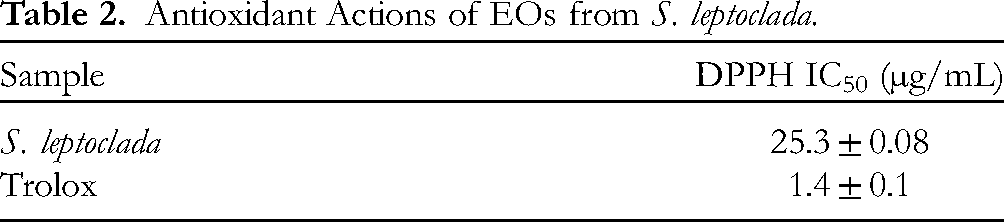
The estimation of the antioxidant effect of EOs from S. leptoclada was carried out with 2,2-diphenyl-1-picrylhydrazyl (DPPH). The IC50 value for the EOs of S. leptoclada was 25.3 µg/mL. The value below IC50 indicates that the EOs have great ability to serve as DPPH scavengers and apply antioxidant action. The antioxidant action of EOs from S. leptoclada was punier than Trolox that used as a reference ingredient. The presence of terpenoids in the assay medium with low solubility compared to trolox has had a negative outcome on the antioxidant action of EOs. The weak antioxidant action of EOs was due to the presence of terpenoid components that have little solubility in the reaction medium of the examiner compared to Trolox. Antioxidant activities of the EOs from S. leptoclada are exposed in Table 2. The lower IC50 values display a stronger ability of the EOs to assist as DPPH scavengers and exertion of antioxidant actions. The methanolic extract of S. platyrachis showed antioxidant effects with an IC50 of 124.07 µg/mL. 13 In an education directed by Bicas et al, antioxidant properties of the carvone, α-terpineol, and perillyl alcohol have revealed that carvone (IC50 = 32.1 g/L) was the foremost compelling compared than α-terpineol (IC50 = 332.8 g/L) and perillyl alcohol (IC50 = 738.3 g/L). 14 In another study, the antioxidant activity of (E)-nerolidol was reported 1104 µg/mL in DPPH assay. 15 The major component of S. leptoclada has a low DPPH free radical scavenging activity in this study, but essential oils are very complex combinations composed of several apparatuses. From the general point of view, S. leptoclada inhibits free radicals and exert antioxidant activity owing to the existence of phenolic composites (thymol, carvacrol, and eugenol) in this plant. In the following order, thymol, carvacrol, and eugenol derivatives indicated antioxidant action in a dose-dependent manner, and the DPPH radical inhibition was reduced: eugenol (9 µg/mL) > BHT (20 µg/mL) > carvacrol (267 µg/mL)> thymol (269 µg/mL). Thymol has higher antioxidant action as initiate from lipids, which is due to a greater steric limitation of the phenolic collection associated with carvacrol. For complexes with a hydroxyl collection sterically suppressed, such as BHT, it is acknowledged that there are high stages of antioxidative activity. Despite the fact that only one hydrogen is available in a hydroxyl group, eugenol, and BHT have been shown to reduce two or more DPPH radicals; three hypotheses are proposed for explaining the anti-radical efficiency of different monophenolic compounds.16,17 Furthermore, other compounds such as flavonoids, phenolic acid derivatives, triterpenoids, sesquiterpenoids, and dihydro isocoumarin found in this plant possess antioxidant activities.18,19
Antioxidant Actions of EOs from S. leptoclada.
Antibacterial Activity
The antibacterial action of EOs from S. leptoclada was examined using the MIC technique and against two Gram-negative and Gram-positive bacteria (Table 3). In MIC from 12.5 mg to 50 mg/mL, EOs have a substantial inhibitory outcome on the growth of bacteria. The results displayed that EOs inhibited Gram-positive bacteria extra than Gram-negative bacteria. EOs display the weakest inhibitory activity (range 12.5-50 mg/mL) against all bacteria. Essential oils which are correlated to the main components have antibacterial activity. Referring to the works the major components of S. leptoclada was α-terpineol and E-nerolidol showed low antibacterial activity. S. aureus and Klebsiella pneumonia were the greatest sensitive microorganisms to the plant oil with MIC values of 12.5 mg/mL. On the other hand, Pseudomonas aeruginosa and E. coli were inadequately inhibited by the EOs. The antimicrobial activity of trans-nerolidol were investigated. Result showed trans-nerolidol exert antibacterial action against S. aureus (MIC = 0.2 mg/mL), E. coli (MIC = 0.2 mg/mL) and P. aeruginosa (MIC = 0.4 mg/mL). 20 The α-terpineol showed antibacterial effects against P. nigrescens, K. pneumonia, and A. actinomycetemcomitans with MIC range 0.4-1.6 mg/mL. Based on the in vitro studies, a-terpineol not only displayed strong antimicrobial activity. 21 In a study achieved by Joharchi et al, the EOs of two species of Sclerorhachis had antibacterial effects on E. faecalis, P. aeruginosa, E. coli, S. aureus, and K. pneumoniae, in the range of 20-50 mg/mL which is dependable with the current findings. 19 Sonboli et al described that the MIC value of the EOs of S. leptoclada on E. faecalis was 15 mg/mL, on S. aureus and E. coli was 3.75 mg/mL, and on K. pneumoniae was >15 mg/mL, which was not similar to our findings. Among the reasons for this dissimilarity, different geographical locations of the collection of plants, climate conditions, and different tested strains of bacteria were mentioned. 9 The results exhibited Gram-positive bacteria significantly inhibited by EOs nevertheless Gram-negative strains owing to the existence of hydrophilic lipopolysaccharides in their outside film were more resistant that stops the dispersion of hydrophobic antibacterial composites current in the EOs.22,23 The synergistic impacts of the differing qualities of major and minor constituents display in essential oil responsible for antibacterial action. For example, the presence of phenolic compound (Thymol, carvacrol, and eugenol) and terpinen-4-ol in the essential oils exert antibacterial activities.
Antibacterial Actions of EOs from S. leptoclada Introduced as MIC (mg/mL).

In our study limitations may include no detection of some compounds due to low signal limitation of the mass spectral database, the usage of limited bacteria to identify antibacterial properties and not examine the mechanism(s) basic the antimicrobial outcome of the EOs and using a reagent to investigate antioxidant properties.
Conclusion
In this study, chemical elements as well as antioxidant and antimicrobial actions of the EOs of S. leptoclada from Birjand were reported. In the EOs of S. leptoclada, α-terpineol and (E)-nerolidol were found to be the principal constituents. Furthermore, monoterpenes and phenolic compounds such as thymol, carvacrol, and eugenol in S. leptoclada are likely responsible for the DPPH radical-scavenging and antimicrobial activity. Given the existing conclusions, S. leptoclada EOs might be presented as a bioactive natural invention, and additional examinations are necessary to explore its beneficial therapeutic outcome in trial models. Future considerations are invigorated to look at the mechanism(s) fundamental to the antimicrobial impact of the EOs and recognize the chief unstable apparatuses ascribed to the identified natural exercises.
Material and Methods
Plant Material
In April 2022, 250 g of S. leptoclada obtained from South Khorasan, Birjand (35° 24´N, 61° 31´ E at an altitude of 1018 m) in the flowering stage. The number 42610 was put in the Herbarium at the School of Pharmacy in Mashhad University of Medical Sciences. The plant was recognized by Mr M.R. Joharchi.
Essential Oil Extraction
The essential oils of the aerial parts (200 g) of S. leptoclada were taken out using a hydro distillation technique that done for 3 h at 50 °C using a Clevenger-type device. The essential oils were taken out, desiccated using anhydrous sodium sulfate, and kept in dark at 4 °C until it was time for the next step.
GC/MS Analysis of the Essential Oil
The GC examinations were accomplished on a Varian CP-3800 framework prepared with a melded silica column (CP-Sil 8CB, 50 m × 0.25 mm, film thickness 0.12 μm) and fire ionization. The stream degree of the carrier gas (N2) was 3 °C/min. The broiler temperature was at first set at 50 °C for 5 min, at that point expanded to 250 °C at a rate of 3 °C min−1, and at last reserved at 250 °C for 10 min. The temperatures of the injector and finder were 260 and 280 °C, separately. 1 μL of each EO was infused in part mode (1:5). For GC/MS examination, the stove temperature was modified utilizing an HP-5 MS column (30 m × 0.25 mm i.d., 0.25 μm film thicknesses) interfaces with a quadrupole mass finder with the taking after program: reach 50 °C (5 min), raised to 3 °C/min to 140 °C, hold 10 min at 240 °C, the infusion was done by 0.1 μL at 1:50. The carrier gas with stream rate 1 mL/min, ionization current:150 μA, particle source: 70 eV and filter extend: 35-465. Assurance of the natural components of the fundamental oil was affirmed by AMDIS processer program (www.amdis.net) and recognized by its maintenance files with reference to n-alkanes arrangement (C6-C20), assessment of their maintenance time, mass spectra, and processer coordinating with the Wiley 7n.L and NSIT collection catalog. Evaluation was completed by an outside standard strategy utilizing calibration bends created by running GC examination of agent composites.24,25
Antioxidant Action of EOs
The DPPH strategy was utilized to test the antioxidant action of EOs. Distinctive meditations of each EOs (2.8-50 µg/mL) fundamental oil unraveled in ethanol were utilized, and 10 μL of them with 250 μL of DPPH were included to all plate wells. The plates were hatched at room temperature for 20 min, and color alter was decided at 517 nm. The taking after equation calculated the values of DPPH radical restraint:
Microbial Strains and Culture Media
Antibacterial effects of the S. leptoclada species were measured against two Gram-positive (K. pneumoniae (9997) and S. aureus (25923)) and two Gram-negative (E. coli (25922) and P. aeruginosa (27853)) bacteria. All bacterial strains were developed overnight in Mueller-Hinton agar at 37 °C.
MIC Assay
The broth microdilution procedure was applied to evaluation the MIC of essential of S. leptoclada. 100 μL of Mueller–Hinton broth containing different concentrations of EOs tests (1.8-50 μg/mL) were included to each well of the sterile 96-well microplate and 100 μL of bacterial suspension with a last concentration of 105 CFU/mL was included to it. At that point the plates were hatched for 18-24 h at 37 °C. The medium containing microscopic organisms without EOs was presented as a positive control, the culture medium lacking of microbes was utilized as a negative control, and the anti-microbial tetracycline was utilized as a control. The minimum concentration of the compound that inhibited the bacterial agent was reported as MIC (µg/mL). 26
Statistical Analysis
Statistical examination of the data was directed by Microsoft Excel 2016. Hierarchical cluster investigation by average connection with shaped Euclidean remoteness, and principal component analysis was achieved utilizing SPSS 17.0 computer program. The result of antioxidant action is detailed as the mean ± SD of triplicate tests.
Footnotes
Declaration of Conflicting Interests
The authors declared no potential conflicts of interest with respect to the research, authorship, and/or publication of this article.
Ethical Approval
Ethical approval to report this study was obtained from Birjand University of Medical Sciences (APPROVAL NUMBER/IR.BUMS.REC.1400.228).
Funding
The authors disclosed receipt of the following financial support for the research, authorship, and/or publication of this article: This work was supported by the Birjand University of Medical Sciences through Grant No. 456536.

Statement of Human and Animal Rights
This article does not comprise any considers with human or creature subjects.