A new phenolic (caricapapayol, 1) and 8 known compounds (2-9) were isolated from the flowers of Carica papaya. Their structures were determined by analysis of HR-ESI-MS, NMR spectral data, and comparison with the literature. Among known compounds, compound 2 has not been reported from natural source. Compounds 1, 2, and 4 exhibited tyrosinase inhibitory activity with IC50 values of 14.3 ± 2.7, 25.5 ± 1.9, and 19.8 ± 3.0 µM, respectively, in comparison with positive control kojic acid IC50 11.3 ± 1.6 µM.
Carica papaya is a well-known tropical plant producing edible fruit called papaya, papaw, or pawpaw. Papaya and its products are listed as a significant nutritional source for provitamin A (carotenoids), folate, potassium, and ascorbic acid.1 The content of carotenoids and ascorbic acid depend on the ripeness of the fruit, growing location, and cultivar.2 Different parts of C. papaya such as barks, flowers, fruits, latex, leaves, roots, and seeds have been used in traditional medicinal remedies.3,4 Literature surveys indicate that C. papaya contains broad diversity of phytochemicals such as carotenoids, phenolics, alkaloids, glucosinolates, ascorbic acid, amino acids, and enzymes (papain and caricain).1 In this report, the flowers of C. papaya were subjected for chemical study and lead to the isolation of 9 metabolites comprising a new phenolic compound (1, Figure 1).
Compound 1 was isolated as a yellowish amorphous powder. Its molecular formula was determined to be C29H34O4 by a quasi-molecular ion peak at m/z 447.2526 [M + H]+ (calcd for C29H35O4, 447.2535) in the HR-ESI-MS and in conjunction with 13C-NMR data. The 1H-NMR spectrum of 1 contained signals characteristic for a symmetric 1,3,4,5-tetrasubstituted phenyl group [δH 6.59 (2H, br s)], an asymmetric 1,3,4,5-tetrasubstituted phenyl group [δH 6.88, 6.69 (each 1 H, d, J = 2.0 Hz)], a cis-vinylene group [δH 6.35, 5.69 (each 1 H, d, J = 10.0 Hz)], a trans-vinylene group [δH 6.84, 6.76 (each 1 H, d, J = 16.0 Hz)], 2 olefinic protons [δH 5.27, 5.09 (each 1 H t, J = 7.0 Hz)], and 5 methyl groups [δH 1.78, 1.64, 1.58, 1.44, 1.44 (each 3 H, s)]. The 13C-NMR and DEPT spectral data of 1 showed 29 carbons comprising 4 sp2 oxygenated tertiary (δC 157.2, 157.2, 146.4, 141.2), 6 sp2 quaternary, 1 sp3 oxygenated tertiary (δC 77.8), 10 sp2 methine, 3 sp3 methylene, and 5 methyl carbons. The HMBC correlations between H-1′ (δH 6.84) and C-3 (δC 114.3)/ C-5 (δC 117.1)/ C-3′ (δC 137.4), H-2′ (δH 6.76) and C-4′ (δC 105.8)/ C-8′ (δC 105.8)/ C-4 (δC 132.0) indicated that 1,3,4,5-tetrasubstituted phenyl groups connected each other via a trans-vinylene group (Figure 1). The presence of a geranyl group was deduced by HMBC correlations between H3-9″ (δH 1.64)/H3-10″ (δH 1.58) and C-7″ (δC 125.5)/ C-8″ (δC 131.9), H2-6″ (δH 2.07) and C-7″/ C-8″/ C-5″ (δC 40.9)/ C-3″ (δC 134.9), H3-4″ (δH1.78) and C-5″/ C-3″/ C-2″ (δC 124.5), H2-1″ (δH 3.33) and C-3″/ C-2″. Additionally, HMBC correlations between H2-1″ and C-5′ (δC 157.2)/ C-7′ (δC 157.2)/ C-6′ (δC 116.1) in conjunction with the downfield shifted values of δC-5′,C-7′ 157.2 indicated the presence of hydroxy groups at C-5′, C-7′ and geranyl group at C-6′ to form a symmetric 1,3,4,5-tetrasubstituted phenyl moiety. The HMBC correlations between H-3 (δH 6.88) and C-1 (δC 141.2)/ C-2 (δC 146.4) suggested the assignment of2 oxygenated sp2 carbons C-1 and C-2. The presence of a 3-methylbut-1-enyl side chain and its binding location at C-6 were confirmed by HMBC correlations between H3-10 (δH 1.44)/ H3-11 and C-9 (δC 77.8)/ C-8 (δC 132.3), H-7 (δH 6.35) and C-1 (δC 141.2)/ C-6 (δC 123.2)/ C-5 (δC 117.1). An ether bridge between C-1 and C-7 was deduced by a signal of sp3 oxygenated tertiary carbon at δC 77.8 (C-9). Consequently, the structure of compound 1 was established to be a new phenolic compound and named as caricapapayol.
Chemical structure and important HMBC correlations of 1.
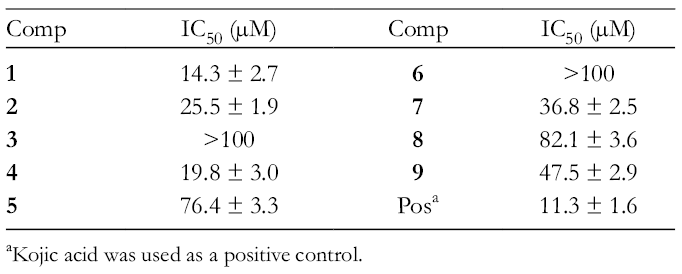
Other compounds were determined to be 1-benzyl-5-(hydroxymethyl)-1H-pyrrole-2-carbaldehyde (2),5 benzyl O-β-d-glucopyranoside (3),6 lariciresinol (4),7 dehydrodiconiferyl alcohol (5),8 vitexsoid (6),9 6-hydroxy-2,6-dimethyl-2,7-octadienoic acid (7),10 2,6-dimethylocta-2,7-diene-1,6-diol (8),11 6-hydroxy-2,6-dimethyloct-7-enoic acid (9)12 by comparison their NMR spectral data with those reported in the literature (Supplemental Material). To the best of our knowledge, this is the first report on the isolation of compound 2 from natural source. Because of tyrosinase inhibitory effect of the methanol extract (62.7% at 200 µg/mL), compounds 1 to 9 were then evaluated their effects on the activity of mushroom tyrosinase using l-tyrosine as a substrate. Tyrosinase inhibitors can be prevented the formation of o-quinone from phenolic substrates, suppressing the browning processes.13 Compounds 1, 2, and 4 showed potent inhibitory effect with their IC50 values of 14.3 ± 2.7, 25.5 ± 1.9, and 19.8 ± 3.0 µM, respectively. Compounds 3, 5 to 9 displayed weak inhibitory effect in comparison with kojic acid as a positive control (Table 1).
Tyrosinase Inhibitory Activity of Compounds 1 to 9.
NMR spectra, Bruker AM500 FT-NMR spectrometer; HR-ESI-MS, Agilent 6530 Accurate Mass Q-TOF LC/MS system.
Plant Material
The flowers of Carica papaya Linn. were collected at Da Nang, Vietnam in December 2016. Its scientific name was identified by botanist Dr Ngo Van Trai, Vietnam National Institute of Medicinal Materials. A voucher specimen No. DD001 was deposited at the Herbarium of the Institute of Chemistry, Vietnam Academy of Science and Technology.
Extraction and Isolation
The dried powdered C. papaya flowers (5 kg) were ultrasonically extracted with MeOH for 3 times (each 8 L, 50°C in 30 minutes). After filtration, the filtrate was evaporated in vacuo to give methanolic extract (300 g). This extract was suspended in water and successively partitioned with n-hexane, methylene chloride (MC), ethyl acetate, and n-butanol to obtain corresponding n-hexane (54 g), MC (52 g), ethyl acetate (20 g), and n-butanol (70 g) residues. The MC residue was roughly separated on a silica gel column, eluting with MC/methanol (0-100% volume of methanol) to give5 fractions CPD1-CPD5. Fraction CPD2 was further chromatographed on a silica gel column, eluting with MC/methanol (20/1, v/v) to give 4 smaller fractions CPD2A-CPD2D. Compounds 2 (5 mg, yield 1.0 × 10⁻⁴% w/w dried material) and 6 (7 mg, yield 1.4 × 10⁻⁴% w/w) were isolated from fraction CPD2A (1.2 g) using reverse phase C-18 (RP-18) column and acetone/water (2/1, v/v) as an eluent. Fraction CPD2B (0.8 g) was loaded on a silica gel column and eluted with MC/ethyl acetate (2/1, v/v) to give compounds 4 (5 mg, yield 1.0 × 10⁻⁴% w/w) and 5 (2.5 mg, yield 5.0 × 10⁻⁵% w/w). Fraction CPD2C was purified on a RP-18 column, eluting with methanol/water (2/1, v/v) to give compound 1 (9 mg, yield 1.8 × 10⁻⁴% w/w). Fraction CPD2D (0.5 g) was first chromatographed on a RP-18 column eluting with methanol/water (2/1, v/v) and further purified on a silica gel column eluting with MC/acetone (5/1, v/v) to give compound 3 (3 mg, yield 6.0 × 10⁻⁵% w/w). Fraction CPD4 (3.5 g) was separated on a silica gel column, eluting with MC/methanol (20/1, v/v) to give 3 fractions CPD4A-CPD4C. Fraction CPD4A was repeatedly chromatographed on a silica gel column, eluting with MC/ethyl acetate (4/1, v/v) to give 4 fractions CPD4A1-CPD4A4. Compounds 7 (10 mg, yield 2.0 × 10⁻⁴% w/w) and 9 (8 mg, yield 1.6 × 10⁻⁴% w/w) were isolated from fraction CPD4A4 using silica gel column and MC/methanol (10/1, v/v) as eluent. Fraction CPD4C was separated on RP-18 column eluting with methanol/water (2/1, v/v) and then purified on a silica gel column eluting with MC/acetone (3/1, v/v) to give compound 8 (7 mg, yield 1.4 × 10⁻⁴% w/w).
1H (500 MHz) and 13C (125 MHz) NMR Data for Compound 1 in CD3OD.
No.
δC
δH (mult., J in Hz)
No.
δC
δH (mult., J in Hz)
1
141.2
-
5′
157.2
-
2
146.4
-
6′
116.1
-
3
114.3
6.88 (d, 2.0)
7′
157.2
-
4
132.0
-
8′
105.8
6.49 (s)
5
117.1
6.69 (d, 2.0)
1″
23.2
3.33 (d, 7.0)
6
123.2
-
2″
124.5
5.27 (t, 7.0)
7
123.4
6.35 (d, 10.0)
3″
134.9
-
8
132.3
5.69 (d, 10.0)
4″
16.3
1.78 (s)
9
77.8
-
5″
40.9
1.97 (t, 7.0)
10
28.0
1.44 (s)
6″
27.8
2.07 (m)
11
28.0
1.44 (s)
7″
125.5
5.09 (t, 7.0)
1′
128.2
6.84 (d, 16.0)
8″
131.9
-
2′
128.0
6.76 (d, 16.0)
9″
25.8
1.64 (s)
3′
137.4
-
10″
17.7
1.58 (s)
4′
105.8
6.49 (s)
Assignment were done by HSQC and HMBC experiments.
HR-ESI-MS: m/z 447.2526 [M + H]+ calcd for C29H35O4, 447.2535.
Supplemental Material
Supplementary Material - Supplemental material for A New Phenolic Constituent From Carica papaya Flowers and Its Tyrosinase Inhibitory Activity
Supplemental material, Supplementary Material, for A New Phenolic Constituent From Carica papaya Flowers and Its Tyrosinase Inhibitory Activity by Giang Thi Kim Lien, Do Thi Thuy Van, Dao Hung Cuong, Pham Hai Yen, Bui Huu Tai, and Phan Van Kiem in Natural Product Communications
Footnotes
Declaration of Conflicting Interests
The author(s) declared no potential conflicts of interest with respect to the research, authorship, and/or publication of this article.
Funding
The author(s) disclosed receipt of the following financial support for the research, authorship, and/or publication of this article: This research was funded by Funds for Science and Technology Development of Vietnam Ministry of Education and Training under grant number KYTH-56 and by Funds for Science and Technology Development of the University of Danang under grant number B2018-ĐN03-30.
References
1.
IkramEHK.StanleyR.NetzelM.FanningK. Phytochemicals of papaya and its traditional health and culinary uses – a review. J Food Composit Anal. 2015;41:201-211.doi:10.1016/j.jfca.2015.02.010
2.
WallMM. Ascorbic acid, vitamin A, and mineral composition of banana (Musa sp.) and papaya (Carica papaya) cultivars grown in Hawaii. J Food Composit Anal. 2006;19(5):434-445.doi:10.1016/j.jfca.2006.01.002
3.
NguyenTTT.ShawPN.ParatM-O.HewavitharanaAK. Anticancer activity of Carica papaya : A review. Mol Nutr Food Res. 2013;57(1):153-164.doi:10.1002/mnfr.201200388
4.
VijT.PrasharY. A review on medicinal properties of Carica papaya Linn. Asian Pac J Trop Dis. 2015;5(1):1-6.doi:10.1016/S2222-1808(14)60617-4
5.
AdhikaryND.KwonS.ChungW-J.KooS. One-pot conversion of carbohydrates into pyrrole-2-carbaldehydes as sustainable platform chemicals. J Org Chem. 2015;80(15):7693-7701.doi:10.1021/acs.joc.5b01349
6.
CoenM.EngelR.NahrstedtA. Chavicol β-D-glucoside, a phenylpropanoid heteroside, benzyl-β-d-glucoside and glycosidically bound volatiles from subspecies of Cedronella canariensis. Phytochemistry. 1995;40(1):149-155.doi:10.1016/0031-9422(95)00241-X
7.
MasudaT.AkiyamaJ.FujimotoA.YamauchiS.MaekawaT.SoneY. Antioxidation reaction mechanism studies of phenolic lignans, identification of antioxidation products of secoisolariciresinol from lipid oxidation. Food Chem. 2010;123(2):442-450.doi:10.1016/j.foodchem.2010.04.065
8.
YuenMSM.XueF.MakTCW.WongHNC. On the absolute structure of optically active neolignans containing a dihydrobenzo[b]furan skeleton. Tetrahedron. 1998;54(41):12429-12444.doi:10.1016/S0040-4020(98)00725-X
9.
WuJ.ZhouT.ZhangSW.ZhangXH.XuanLJ. Cytotoxic terpenoids from the fruits of Vitex trifolia L. Planta Med. 2009;75(4):367-370.doi:10.1055/s-0028-1112211
10.
ArslanianRL.AndersonT.StermitzFR. Iridoid glucosides of Penstemon ambiguus. J Nat Prod. 1990;53(6):1485-1489.doi:10.1021/np50072a013
11.
SköldM.BörjeA.HarambasicE.KarlbergA-T. Contact allergens formed on air exposure of linalool. Identification and quantification of primary and secondary oxidation products and the effect on skin sensitization. Chem Res Toxicol. 2004;17(12):1697-1705.doi:10.1021/tx049831z
12.
PopeSA.BurtinGE.ClaytonPT.MadgeDJ.MullerDP. New synthesis of (±)-alpha-CMBHC and its confirmation as a metabolite of alpha-tocopherol (vitamin E). Bioorg Med Chem. 2001;9(5):1337-1343.doi:10.1016/S0968-0896(01)00010-4
13.
LoizzoMR.TundisR.MenichiniF. Natural and synthetic tyrosinase inhibitors as antibrowning agents: an update. Compr Rev Food Sci Food Saf. 2012;11(4):378-398.doi:10.1111/j.1541-4337.2012.00191.x
Supplementary Material
Please find the following supplemental material available below.
For Open Access articles published under a Creative Commons License, all supplemental material carries the same license as the article it is associated with.
For non-Open Access articles published, all supplemental material carries a non-exclusive license, and permission requests for re-use of supplemental material or any part of supplemental material shall be sent directly to the copyright owner as specified in the copyright notice associated with the article.